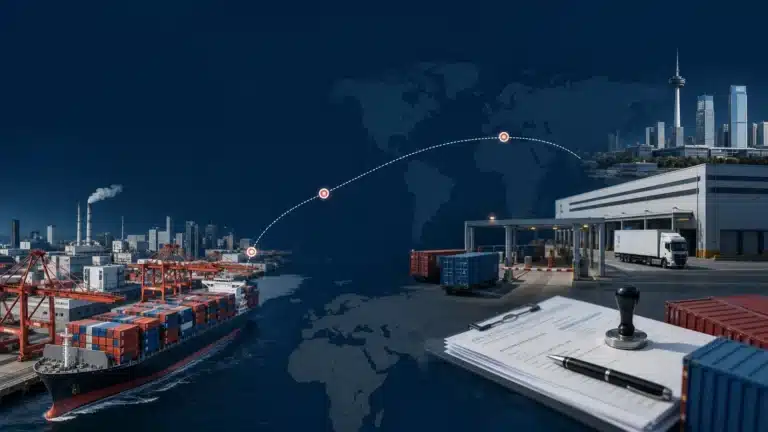

Low-cost country sourcing (LCCS) is procuring goods, components, or services from countries where labour and production costs are substantially lower – typically 10-40% cheaper than sourcing in high-cost markets. For manufacturing businesses and procurement managers, it remains one of the most powerful levers for margin improvement. But the savings on paper frequently don’t survive contact with reality: freight, tariffs, quality failures, and coordination costs erode the advantage unless the strategy is executed rigorously.
This guide covers what works, what doesn’t, and what the true landed cost of LCCS actually looks like in practice.
What is Low-Cost Country Sourcing (LCCS)?
Definition and background
Low-cost country sourcing (LCCS) is a procurement strategy in which a company sources materials, components or finished goods from countries with lower labour and production costs in order to reduce operating expenses.
The basic idea is to exploit cost differentials between geographies labour, overhead, raw materials, utilities while leveraging global supply chains.
How it fits in the broader sourcing strategy
LCCS is a subset of global sourcing. While global sourcing covers procuring from anywhere in the world, LCCS specifically targets “low-cost” geographies (typically emerging economies) to extract cost advantage.
It’s related to but distinct from strategies such as near-shoring and best-cost country sourcing (which balances cost and capability).
Why it matters now
With labour costs rising in many traditional manufacturing hubs, trade dynamics shifting, supply-chain disruption becoming more frequent, and competitive pressures high, sourcing from lower-cost countries remains one of the few levers companies can pull to maintain margins or invest in growth.
Read more China Sourcing vs. Worldwide Sourcing: Choosing the Best Approach for Your Business
Why companies adopt low-cost country sourcing
Primary benefits
- Cost savings – Reduced labour, lower overhead, often cheaper raw materials. For example, production labour in certain countries may be a fraction of that in high-cost markets
- Competitive pricing & margin improvement – By sourcing at lower cost you can either reduce your sale price or maintain price and increase margin.
- Access to a larger supplier base & scalability – Many emerging-economy countries are actively building manufacturing capacity, offering more supplier options and larger volumes.
- Market expansion opportunities – Sourcing in a country may also open access to that local market or neighbouring regions.
- Risk diversification – Spreading sourcing across geographies can reduce dependence on a single country or region. See how the China +1 strategy applies this in practice.
Strategic value beyond cost
While cost is often the initial driver, mature organisations use LCCS to improve agility, innovation (via alternative suppliers), and supply-chain resilience. For example, sourcing from multiple low-cost regions allows companies to hedge geopolitical or logistical risk.

Best-cost vs low-cost country sourcing: what’s the difference?
Best-cost country sourcing” (BCCS) is often confused with LCCS but they serve different strategies:
- Low-cost country sourcing prioritises lowest unit price – typically used for commoditised, high-volume, labour-intensive goods.
- Best-cost country sourcing optimises for the best balance of cost, quality, reliability, and logistics.
For most manufacturers and brand owners, best-cost country sourcing delivers better real-world outcomes than pure LCCS – because quality and lead-time failures in the cheapest country often cost more than the savings achieved.
How to Choose the right country and supplier for LCCS
Key criteria for selecting a low–cost country
When evaluating potential countries for sourcing, consider:
- Labour cost vs skill level
- Infrastructure quality (transport, ports, power, communication)
- Supplier base capability and readiness (quality, lead time, capacity)
- Trade agreements, tariffs, logistics costs
- Political, regulatory and economic stability
- Proximity to market (for lead-time and freight cost considerations)
- Ethical, environmental, and compliance standards
These criteria help ensure that you are truly gaining cost advantage and not inadvertently increasing risk or hidden cost. Read more: Which Country Is the Best Alternative to China for Your Product: Indonesia or Vietnam?
Typical countries used
Popular sourcing destinations have included countries such as China, India, Vietnam, Indonesia, Thailand, Mexico, Bangladesh. However, as labour costs rise and trade dynamics shift, companies are increasingly looking beyond the traditional hubs.
Supplier selection & qualification
Selecting and qualifying a supplier in a low-cost country requires more than simply comparing quote prices. Key aspects:
- Visit the factory (if possible) or use third-party audit/inspection agencies.
- Check quality control, ISO or relevant certifications, supplier track record.
- Establish clear contracts including KPIs on quality, delivery, compliance, penalties.
- Ensure intellectual-property (IP) protection where relevant.
- Build relationship and communication protocols (language, time zones, escalation).
- Consider dual sourcing or alternative suppliers as backup.
Cost-modelling: thinking beyond unit price
It’s critical to look at landed cost, not just the quotation. That includes:
- Freight/shipping costs
- Tariffs, customs, duties
- In-country logistics (from factory to port)
- Lead-time impact (longer lead times may require higher inventory)
- Quality-fail cost (rework, returns, defects)
- Hidden costs of coordination, audits, governance
- Currency/foreign-exchange exposure
For example: “While labour cost may be low, if shipping, import tariffs and quality rework are high, the savings may diminish.” Get to know more about Total Landed Cost: Definition, Formula, and How to Calculate
What Zignify Experts Know
After sourcing cosmetics for brands across 40+ countries, here’s what the guides leave out.
💡 The savings erode faster than most models predict and here’s why.
When we model LCCS for clients, the first-pass quote from a low-cost country factory typically shows savings of 25–40% vs their current supplier. By the time we add domestic freight to port, international shipping, import duties, quality inspection, and the cost of one failed production run requiring rework – the real saving on a first order is often closer to 8–15%. The strategy still makes sense at scale, but the business case needs to be built on landed cost, not factory price. We build that model before any client commits to a new sourcing country.
💡 The consultants selling LCCS strategy and the agents executing it see completely different realities.
The strategic frameworks (TCO, dual sourcing, country scorecards) are sound in theory. In practice, the biggest LCCS failures we see come from one gap: the procurement team chose the country based on a framework, but nobody visited the factory, audited the supplier, or modelled the logistics until after the purchase order was placed. We reverse this sequence every time — factory audit and landed cost model before country decision, not after.
📋 We’ve helped a German cosmetics company reduce procurement costs by €1.4 million in 8 months through better supplier sourcing across low-cost countries. Read the case study →
Implementation: Step by step guide
Step 1: Internal readiness & strategy alignment
- Understand which products/categories are good candidates (often high-volume, labour-intensive, relatively standardised).
- Set clear objectives (cost savings target, lead-time tolerance, quality standard, risk tolerance).
- Ensure your procurement, supply-chain, quality, legal and compliance teams are aligned.
Step 2: Country & supplier market scan
- Short-list candidate countries using the criteria above.
- Map supplier ecosystem in each country.
- Assess trade and logistics connectivity to your market.
- Conduct initial supplier outreach and request capability statements.
Step 3: Supplier qualification & contract setup
- Visit suppliers or engage sourcing agents/inspection firms.
- Audit factory, check certifications, capacity, quality systems, governance.
- Negotiate pricing, terms, QC standards, lead-time, penalties, escalation.
- Make sure the contract covers ethical and environmental standards.
Step 4: Sample and pilot production
- Order prototypes or small production runs to validate quality, delivery, and communication.
- Conduct quality inspections (pre-shipment and upon receipt).
- Capture lessons on communication gaps, logistic delays, customs issues.
Step 5: Full production ramp & monitoring
- Once a pilot is successful, ramp production.
- Establish clear KPIs (on-time delivery, defect rate, cost variance, supplier responsiveness).
- Set up regular reviews and audits.
- Maintain open communication, build trust with suppliers.
Step 6: Risk management & continuous improvement
- Develop contingency plans (alternate suppliers, buffer inventory) to mitigate disruptions.
- Monitor for rising labour costs, changes in trade policy, currency swings, infrastructure bottlenecks.
- Periodically review whether the sourcing country still offers competitive advantage or if it’s time to re-source.
Key risks and how to mitigate them
Major risks in LCCS
- Quality control issues – Lower cost may come with lower quality if not managed.
- Hidden/landed cost escalation – Shipping, tariffs, customs, logistics may erode savings.
- Supplier reliability and lead-time delays – Long distance, infrastructure issues can impact responsiveness.
- Ethical, environmental and regulatory compliance risk – Sourcing from low-cost countries may expose you to labour or environmental compliance issues.
- Currency, trade policy and geopolitical risk – Fluctuating exchange rates or changes in tariffs/trade rules can erode advantage.
- Over-dependence on a single supplier or region – Creates vulnerability if disruption occurs.
Mitigation strategies
- Conduct thorough supplier audits and enforce strong contractual terms.
- Model the full landed cost (not just unit cost) and stress-test for shifts (currency, tariffs).
- Diversify suppliers and countries where possible.
- Monitor socio-political environment and keep communication channels open.
- Require suppliers to meet ethical/ESG metrics and include compliance checks.
- Build in buffer lead-time, inventory safety stock for critical parts.
Best practices and trends
- Total cost of ownership (TCO) mindset – Not just what you pay the factory, but what you pay in freight, quality, delay, tariffs.
- Supplier relationship management – Being more than transactional; build shared goals, transparency, continuous improvement.
- Ethical sourcing and sustainability – Today customers and regulators expect labour & environmental compliance, even when sourcing from low‐cost countries.
- Use of technology – Remote factory monitoring, digital supply-chain visibility, analytics for supplier risk.
- Agility and flexibility – Given rising volatility, sourcing strategy must be able to shift quickly if a country’s cost advantage erodes.
Emerging trends
- Some traditional low-cost countries are seeing rising labour costs (e.g., China) and companies are shifting to newer hubs (e.g., Vietnam, Bangladesh).
- Increased regulation and consumer scrutiny around labour and environment in supply chains; ethical sourcing is no longer optional.
- Trade and geo-political shifts mean companies are balancing “cost” with resilience; some combining LCCS with near-shoring.
- Supplier ecosystems in low-cost countries are maturing, meaning quality and capability are improving, which opens up higher tech/higher value sourcing.
When LCCS makes sense and when it doesn’t
Good fit:
- Products that are labour-intensive, high-volume, standardised, not extremely heavy/bulky for shipping.
- Markets where cost pressure is severe and differentiation is limited.
- Organisations that have robust supply-chain management capabilities and are comfortable managing overseas suppliers.
Poor fit:
- Very low-volume, highly customised or extremely heavy items (shipping may negate cost benefit)
- Products with very high strategic importance and where IP risk is unacceptable
- Organisations without the resources to monitor distant suppliers or manage complexity
- When supplier country’s infrastructure, logistics or regulatory environment is weak
Case Examples & Illustrations
IKEA – global furniture & home goods retailer
IKEA is often cited as a textbook example of how a large brand uses sourcing in low-cost countries to deliver value. According to Veridion, IKEA’s sourcing strategy “combines the cost benefits of its scale with a strong focus on local sourcing and environmental sustainability.” In more detail:
- The company takes advantage of its global scale to source components and finished goods from regions where labour and production costs are lower, while still maintaining control over quality, design and supply-chain management.
- By doing this, IKEA can offer competitive price points on furniture and home-goods items without necessarily compromising too heavily on design, brand strength or sustainability.
- It’s a good demonstration of how LCCS isn’t solely about “cheapest possible labour” but rather leveraging global cost differentials plus strong supplier networks, volume advantage and strategic sourcing.
How Zignify helps as your sourcing partner
At Zignify, we specialise in global sourcing strategy and low-cost country sourcing for businesses seeking to optimise procurement without compromising on quality or compliance. Here’s how working with us can help you:
- Expert market access: We maintain a vetted network of suppliers across multiple low-cost geographies with capabilities matched to your product category.
- End-to-end process: From supplier identification and qualification, cost modelling, contract negotiation, quality oversight, to logistics and landed cost analysis.
- Risk mitigation: Our methodology includes full supplier audits, ethical/ESG compliance checks, dual sourcing planning and real-time visibility into production metrics.
- Cost transparency: We help you model the true landed cost (factory price + freight + tariffs + risk buffer) so you can make data-driven decisions.
- Strategic guidance: Whether you’re at the early stage of assessing LCCS, or re-evaluating your existing sourcing footprint, we help you align sourcing strategy with business goals.
Conclusion
Low-cost country sourcing remains a compelling lever for companies seeking cost reduction, margin improvement and global competitiveness. But its success depends on far more than just choosing the cheapest country. It demands rigorous supplier qualification, full cost modelling, risk management, ethical governance and ongoing supplier relationship management.
When executed well, LCCS can deliver substantial benefits. When done poorly, hidden costs and risks can undermine the very savings you sought. That’s where partnering with an experienced sourcing specialist like Zignify makes a real difference: we bring the expertise, network, processes and governance to help you turn low-cost country sourcing into a strategic advantage, not just a cost gamble.
Frequently Asked Questions About Low-Cost Country Sourcing
What does low-cost country sourcing mean?
Low-cost country sourcing (LCCS) is a procurement strategy where a company sources materials, components, or finished goods from countries with substantially lower labour and production costs than its home market - typically 10-40% cheaper. Common LCCS destinations include China, India, Vietnam, Indonesia, Bangladesh, and Mexico. The goal is to reduce procurement costs and improve margins, though the true saving depends on total landed cost, not just the factory price.
How can I ensure quality when sourcing from low-cost countries?
Set clear specifications and quality standards, perform supplier audits, use third-party inspection agencies, pilot production runs, maintain frequent communication with the supplier, and build a relationship of transparency and trust.
What are the hidden costs of low-cost country sourcing?
Hidden costs may include longer lead times, higher freight/shipping costs, tariffs/customs duties, import duties, higher inventory carrying costs due to longer transit, quality rework, currency fluctuations, logistics infrastructure issues and governance/monitoring costs.
How do I select which products/categories are suitable for LCCS?
Look for products that are labour-intensive, high-volume, standardised, and not extremely heavy or bulky for shipping. Evaluate transportation cost, supplier capability in target country and whether the cost saving justifies the additional complexity.
Which risks should I monitor in low-cost country sourcing?
Key risks include supplier reliability, quality variability, legal/regulatory and ethical compliance, political or economic instability in the sourcing country, currency/FX risk, infrastructure and logistics failure, and over-dependence on a single supplier or region.
When might LCCS not be the right strategy?
If your product is very low-volume or highly customised, or its shipping cost/weight makes overseas sourcing uneconomic. Also if you lack internal capability to manage offshore suppliers, or if the supplier country lacks stable infrastructure or strong supplier base.
How do trade policies and tariffs affect LCCS?
Tariffs, import duties, customs delays, and trade-policy changes can significantly affect landed cost and risk. Because you’re importing from abroad, changes in trade regime or currency can erode your cost advantage. Always model these sensitivities.
What role does ethical/sustainable sourcing play in LCCS?
Increasingly important. While cost is a driver of LCCS, companies today must ensure their overseas suppliers meet labour standards, environmental regulations and ethical sourcing requirements. Failure to do so can lead to reputational damage or legal liability.
Which country is an example of low-cost sourcing?
- China is the most established low-cost sourcing destination globally, offering the largest supplier base and highest production capacity across almost every product category.
- Vietnam has become the leading alternative for textiles, electronics, and consumer goods, particularly as companies diversify away from China after tariff changes. India is the primary low-cost hub for pharmaceuticals, textiles, and IT components.
- Bangladesh dominates for garment manufacturing, with some of the lowest labour costs in the world.
- Mexico serves as the nearshoring option for North American buyers seeking lower costs without long shipping lead times.