Building a brand from scratch is exciting until you realize how critical it is to find a manufacturer you can trust. Every year, entrepreneurs lose money to unreliable suppliers, poor product quality, and hidden costs that were never clearly communicated. Whether you’re launching a skincare line, supplements, or eco-friendly products, your success depends on choosing the right private label manufacturer before placing your first order. Many first-time founders underestimate just how expensive early supplier mistakes can be.
This guide covers everything you need to know about private label manufacturing: what it is, how it works, where to find verified suppliers, how to screen them properly, and what to do once you have found the right partner.
Read more about Main Types of Manufacturers You Should Know When Sourcing Products
What Is a Private Label Product?
A private label product is any product manufactured by a third-party company and sold under your own brand name. You control the brand identity, the packaging, and the product positioning, while the manufacturer handles production. This model allows entrepreneurs and businesses of all sizes to launch products without building a factory or investing in production equipment. This is exactly why private labels are attractive low capex, faster go-to-market.
Think of the store-brand pasta at your local supermarket or the unbranded wellness supplements sold by dozens of companies with slightly different logos. These are classic private label examples. In many cases, the same manufacturer produces identical or very similar products for multiple brands, each sold under a different label.
In the early stages, differentiation rarely comes from the product itself. Instead, brands stand out through branding, packaging, and positioning—while the underlying product often remains largely the same across competitors.
Private label is different from white label in one important way: with white label, the exact same product is sold to multiple retailers with minimal or no customization. Private labels, on the other hand, usually allows for some degree of product customization, including formula changes, ingredient adjustments, scent variations, and fully custom packaging.
Read more about Product Sourcing Trends in 2026: Global Strategies & Best Practices

Benefits and Drawbacks of Private Label Products
Private label manufacturing offers compelling advantages, but it is not the right model for every business. Understanding the trade-offs helps you make a smarter decision before committing time and capital.
Benefits
- Brand Ownership: You own the brand, the packaging, and the customer relationship, unlike reselling someone else’s product.
- Lower Barrier to Entry: You do not need to develop a product from scratch, which significantly reduces the time and cost to market.
- Higher Margins: Compared to buying branded wholesale products for resale, private labels typically deliver higher profit margins.
- Product Customization: Many manufacturers allow formula tweaks, scent variations, or ingredient swaps to help you stand out in your category.
- Scalability: Once your manufacturing relationship is established, scaling up production is relatively straightforward. Scalability is especially important once you hit product-market fit
Drawbacks
- Quality Control Challenges: You are dependent on the manufacturer’s quality standards, and without proper vetting, inconsistent batches can damage your brand.
- Minimum Order Requirements: Most manufacturers have minimum order quantities (MOQs) that require upfront investment, which can be a barrier for early-stage brands.
- Limited Differentiation: If competitors are using the same manufacturer with similar products, it can be difficult to stand apart on product alone.
- Intellectual Property Risks: Without proper contracts and protections, a manufacturer could produce your formula for another client.
- Supply Chain Dependency: Your business is vulnerable if your single manufacturer faces production delays, quality issues, or shutdowns.
Read more about What is an NNN Agreement and When Do You Need It?
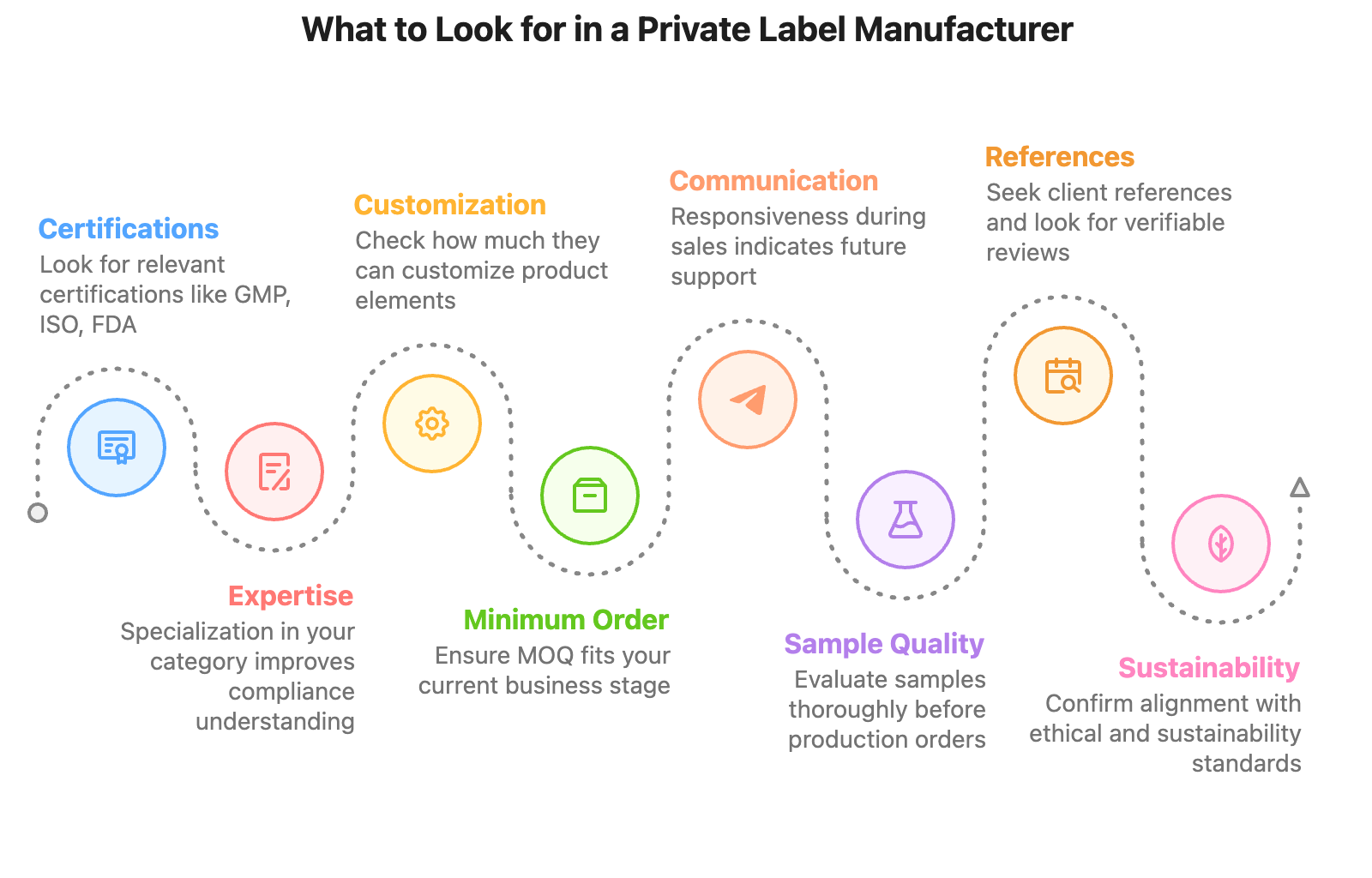
What to Look for in a Private Label Manufacturer
Not every supplier who claims to offer private label services is worth your time or money. Before you commit to a manufacturer, there are several qualities you should evaluate to protect your investment and your brand reputation.
- Certifications and Compliance: Look for manufacturers with relevant certifications such as GMP (Good Manufacturing Practice), ISO, FDA registration, or organic certifications depending on your industry.
- Product Category Expertise: A manufacturer who specializes in your category, whether skincare, supplements, or pet care, will understand regulatory requirements and best practices far better than a generalist.
- Customization Capabilities: Confirm exactly how much they can customize: formula, ingredients, packaging, labeling, and fragrance options.
- Minimum Order Quantities: Make sure the MOQ aligns with your current stage. Some manufacturers work with small brands and offer low MOQs; others require large volume commitments.
- Communication and Responsiveness: A manufacturer who is slow to respond during the sales process is likely to be slow when issues arise in production.
- Sample Quality: Always evaluate samples rigorously before placing a production order. The sample sets the standard.
- References and Track Record: Ask for client references or look for verifiable reviews. A manufacturer who has worked with established brands is a safer bet.
- Ethical and Sustainability Standards: If your brand values align with sustainability or ethical sourcing, confirm the manufacturer shares or can meet those standards.
A useful rule of thumb: if a manufacturer resists sharing certifications, avoids questions about their processes, or pressures you to place an order before samples are approved, treat that as a serious red flag. Just as importantly, pay close attention to communication, slow responses, unclear answers, or lack of transparency often lead to the majority of operational issues down the line.
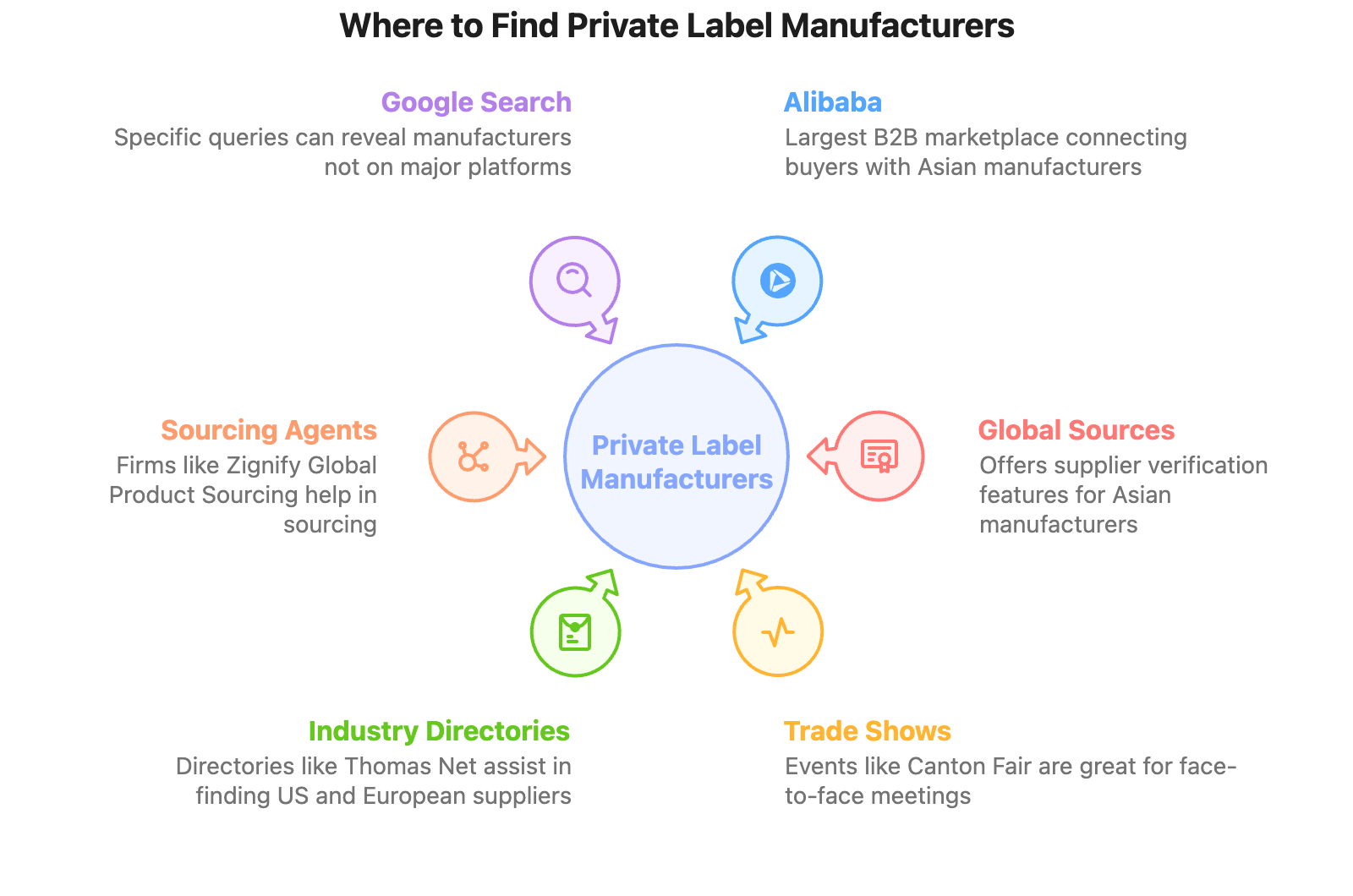
Where to Find Private Label Manufacturers
Finding private label manufacturers has never been easier, thanks to the growth of global sourcing platforms and directories. The challenge today is not finding suppliers at all, but finding the right ones. Here are the most reliable channels:
- Alibaba and Global Sources: Two of the largest B2B marketplaces connecting buyers with manufacturers primarily in Asia. Both offer supplier verification features, though independent vetting is still essential.
- Trade Shows: Events such as Canton Fair in China, Cosmoprof (beauty), and Natural Products Expo (food and supplements) are excellent for meeting verified manufacturers face-to-face.
- Industry Directories: Thomas Net for US-based manufacturers, Kompass for European suppliers, and specific directories like Mintel for the beauty industry.
- Sourcing Agents and Companies: Professional sourcing firms like Zignify Global Product Sourcing
- LinkedIn and Industry Networks: Many manufacturers maintain a professional presence and can be approached directly through business networks.
- Google Search with Specific Queries: Searches like “private label skincare manufacturer USA” or “supplement contract manufacturer GMP certified” can surface manufacturers not listed on major platforms.
For sourcing from China specifically, platforms like Made-in-China and 1688 (the domestic Chinese version of Alibaba) list tens of thousands of manufacturers, though these require more careful navigation due to language and verification barriers.
If you’re looking for the right private label manufacturer, working with a sourcing partner can help you move faster and reduce risk, especially if you’re a first-time buyer. Zignify offers access to pre-vetted factories and verified suppliers, guiding you through the sourcing process with confidence while supporting you every step of the way.
Read more about Top Reasons to Choose Zignify for Global Product Sourcing
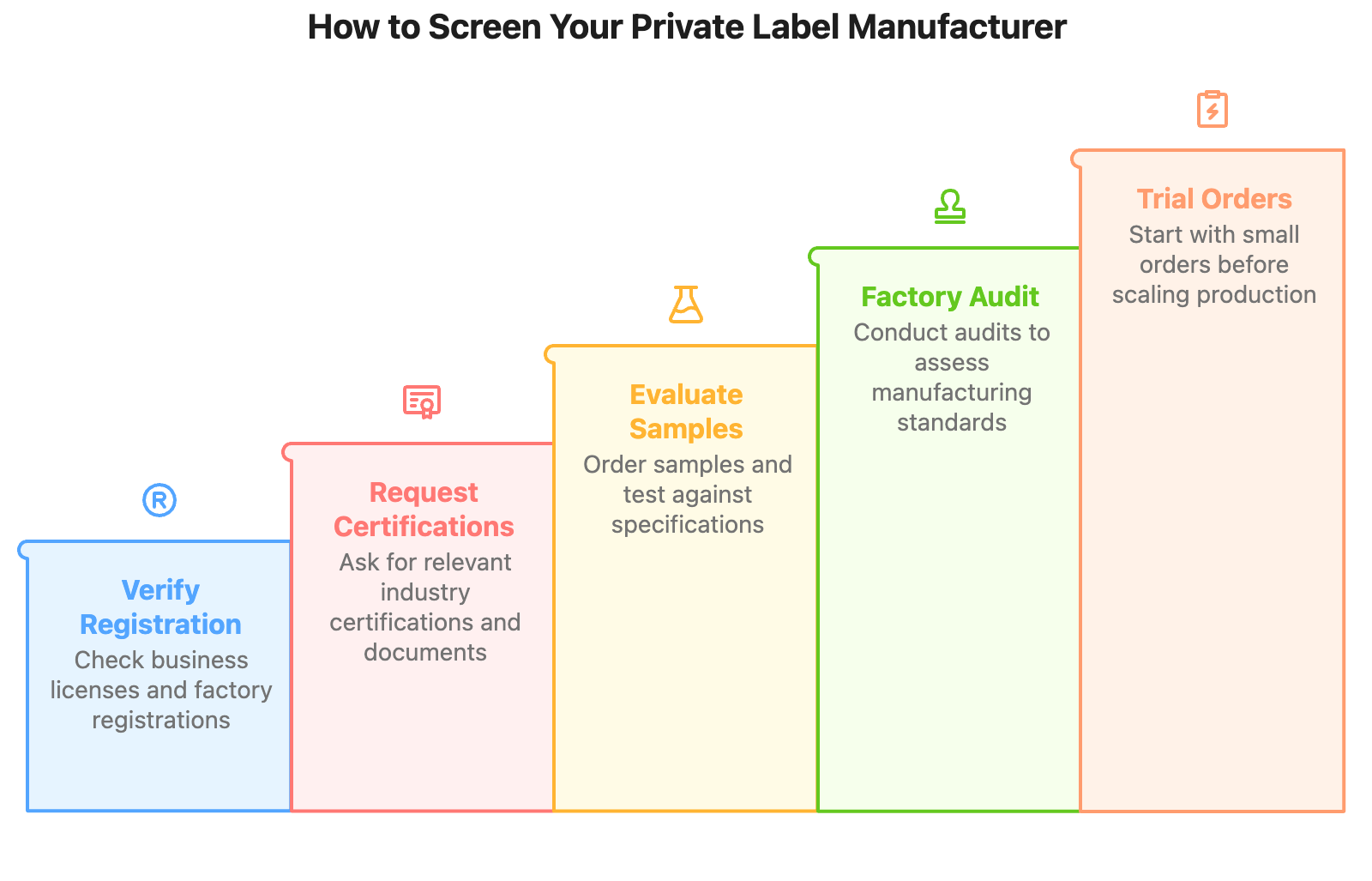
How to Screen Your Private Label Manufacturer
Finding a manufacturer is only half the job. Screening them properly before placing an order is what separates brands that scale from those that get burned. Here is a systematic approach to verifying and qualifying a potential manufacturer:
Step 1: Verify Their Business Registration
Ask for their business license, factory registration, and any relevant export licenses. In China, you can use the National Enterprise Credit Information Publicity System to verify company registration details.
Step 2: Request Certifications
Depending on your industry, ask for GMP certificates, ISO 9001 certification, FDA facility registration, USDA organic certificates, or other relevant documentation. Cross-check certificate numbers with the issuing authority where possible.
Step 3: Order and Evaluate Samples
Order samples and evaluate them against your specification document. Check consistency across multiple units, not just one sample. Test for packaging quality, product texture or formula performance, labeling accuracy, and shelf stability if relevant.
Step 4: Conduct a Factory Audit
For significant orders, arrange a factory audit either in person or through a third-party inspection company such as Bureau Veritas, SGS, or QIMA. A factory audit assesses production capacity, quality management systems, worker conditions, and compliance with your standards.
Step 5: Start Small Before Scaling
Place an initial trial order at or near the MOQ before committing to large volumes. This gives you a real production sample rather than a specially prepared prototype, and it reveals how the manufacturer performs under normal conditions.
Private Label Manufacturers by Industry
Different industries operate under entirely different certification requirements, regulatory frameworks, and quality benchmarks. Knowing which manufacturers are active and credible in your specific category is one of the most time-saving steps you can take before reaching out. Below is a curated breakdown of real manufacturers worth exploring, organized by product category.
Private Label Manufacturers for Skincare Products
The skincare market is highly competitive, driven by demand for clean ingredients and sustainable products. Always choose manufacturers with proper certifications and testing.
- Skinlys (France): premium skincare manufacturer focused on R&D and sustainability
- Dynamic Blending (USA): low MOQ manufacturer ideal for startups
- HSA Cosmetics (Italy): full-service provider for hair, skin, and body care
- Lady Burd (USA): 50+ years experience with GMP-certified products
- Trilogy Laboratories (USA): science-based skincare for clinics and spas
Choose suppliers with GMP, ISO 22716, and strong testing standards to ensure product safety and compliance.
Private Label Manufacturers for Supplements Products
The supplement industry is highly regulated, so certifications and testing are essential. Always verify certifications like cGMP, NSF, and request batch testing reports.
- Makers Nutrition (USA): full-service manufacturer with fast lead times
- NutraScience Labs (USA): strong support for custom formulations
- Vitalabs (USA): wide range of stock formulas with low MOQ
- ENZ Pharmtech (China): global manufacturer with multiple certifications
Private Label Manufacturers for Organic Products
Organic products require strict certification and full ingredient traceability. Use trusted databases like to verify supplier certification before working with them.
- Nature’s Brands (USA): USDA-certified organic products with clean ingredients
Private Label Manufacturers for Eco-Friendly Packaging
Sustainability is a growing demand, but claims must be verified. Always check certifications like FSC or BPI to confirm sustainability claims.
- CarasaLab (Spain): natural cosmetics with eco packaging focus
- Artcosmetics (Italy): high sustainability standards with waste reduction
Private Label Manufacturers for Candle Manufacturing
Candle production is easier to enter but still requires safety testing. Focus on burn testing, fragrance performance, and safety validation.
- Armatage Candle Company (USA): custom candles with consistent quality
Private Label Manufacturers for Fast-Turnaround Cosmetics Products
Speed matters in trend-driven markets like beauty. Fast production is usually based on pre-made formulas rather than custom development.
- Cosmetic Solutions (USA): quick white-label production for fast launches
- Columbia Cosmetics (USA): full-service manufacturer with efficient timelines
Private Label Manufacturers for Pet Care Products
Pet care is growing fast and requires regulatory compliance. Check compliance with FDA or AAFCO standards depending on product type.
- Cassco Bio Labs (USA): natural pet products and global distribution
- PURUS.PET (Europe): organic grooming products
- NutraPak USA (USA): pet supplements with GMP certification
Private Label Manufacturers for Apparel Products
Apparel manufacturing ranges from simple labeling to full customization. Look for strong sampling capability and ethical production standards.
- Zega Apparel (Global): low MOQ and full customization
- Apparel Production Inc. (USA): long-standing full-service manufacturer
- Alanic Clothing (Global): wide range including sportswear and fashion
Private Label Manufacturers for Hair Care Products
Hair care products require strong formulation testing and compliance. Always verify pH testing, ingredient claims, and safety documentation.
- HSA Cosmetics (Italy): professional salon-grade products
- Cosmewax (Spain): experienced European manufacturer
- Bo International (India): ISO-certified cost-effective option
These manufacturers are a strong starting point, but always verify certifications, MOQs, and production timelines before making a decision. The private label market changes quickly, so due diligence is essential.
What to Do After Finding Your Private Label Manufacturer
Finding the right manufacturer is a milestone, not the finish line. What you do next will determine whether your private label brand succeeds or stalls. Here is a step-by-step approach to starting your brand after locking in your manufacturing partner.
- Formalize the Relationship with a Contract: A well-drafted manufacturing agreement should cover pricing, payment terms, lead times, quality standards, intellectual property ownership, non-disclosure obligations, and grounds for termination. Never rely on verbal agreements.
- Develop Your Brand Identity: Your brand name, logo, packaging design, and brand story are the emotional connection between your product and your customer. Invest in professional design and ensure your packaging complies with labeling regulations for your market.
- Build Your Sales Channels: Decide whether you will sell on Amazon, through your own Shopify store, via wholesale to retailers, or a combination. Each channel has different requirements in terms of product photography, listings, pricing strategy, and logistics.
- Arrange Quality Control Before Shipment: Hire a third-party inspection service to check your products before they leave the factory. This is the single most effective way to catch quality problems before they reach your customers.
- Register Your Brand: Apply for trademark protection for your brand name and logo in the markets where you plan to sell. If you are selling on Amazon, enrolling in Amazon Brand Registry provides additional protection.
- Plan Your Launch and Marketing Strategy: Develop a pre-launch strategy that builds anticipation, collects email subscribers, and generates early reviews. Influencer partnerships, content marketing, and paid social advertising are effective for private label brand launches.
The brands that succeed in private label are those that treat manufacturing as the beginning of a larger business-building process rather than an end in itself. Product quality wins customers once; brand experience keeps them coming back.
This is where many founders shift focus too early, execution matters more than sourcing at this stage.
Read more about Product Manufacturing Guide: Best Countries to Source & Manufacture
How Zignify Helps You Find Private Label Manufacturers in China and Beyond
Sourcing private label manufacturers on your own is possible, but it comes with real risks, unreliable suppliers, language barriers, difficulty verifying certifications, and a high risk of costly mistakes. On top of that, it takes time to vet dozens of suppliers before finding one you can trust. This is where a professional product sourcing company like Zignify can add real value.
Zignify specializes in finding and verifying manufacturers for private label brands across a wide range of product categories. Whether you are looking for a supplement manufacturer in China, a cosmetics contract manufacturer in Europe, or an apparel supplier in Southeast Asia, Zignify manages the research, outreach, qualification, and communication process on your behalf.
Here is what working with a sourcing partner like Zignify typically includes:
- Supplier Identification: Access to an established network of vetted manufacturers across multiple countries, far beyond what any individual buyer could build independently.
- Manufacturer Verification: Document verification, factory assessments, and background checks to confirm that a supplier is legitimate, compliant, and capable.
- Negotiation Support: Experienced sourcing professionals who understand local pricing norms and can negotiate better terms than most first-time buyers.
- Quality Control Coordination: Arranging pre-shipment inspections and managing quality issues directly with the factory.
- Ongoing Supplier Management: Monitoring your manufacturer’s performance over time, managing reorders, and identifying alternative suppliers when needed.
For brands that want to move fast, reduce risk, and focus on building their brand rather than managing supplier logistics, working with a sourcing expert is one of the smartest investments they can make at the early stages of their business.
Wrapping Up on Private Label Manufacturing
Private label manufacturing remains one of the most accessible and profitable ways to build a product brand. The model is proven, the infrastructure exists, and the global network of manufacturers is vast. But success is not guaranteed simply by finding a manufacturer. It depends on finding the right one, screening them rigorously, structuring the relationship properly, and building a brand that resonates with your target audience.
If you are unsure where to start or want to fast-track the process with expert guidance, exploring a partnership with a professional sourcing company like Zignify Global Product Sourcing is a logical first step. The right manufacturer is out there. The goal is finding them before your competitors do
Frequently Asked Questions About Private Label Manufacturers
What is the difference between white label and private label manufacturing?
White label refers to a generic product that multiple businesses buy and rebrand with minimal or no customization. The exact same product may be sold by dozens of companies under different names. Private labels, by contrast, usually involve some degree of customization, whether in formula, packaging, ingredients, or branding, giving the buyer more control over how the product stands out in the market. In short, white label is faster and cheaper to set up, while private label allows for more differentiation and brand identity.
What are the typical minimum order quantities for private label goods?
Minimum order quantities vary widely by product category and manufacturer. For cosmetics and skincare, MOQs can range from 100 to 500 units for brands working with flexible suppliers, while larger factories may require 1,000 units or more. Supplements often start at 500 to 1,000 units. Apparel and custom packaging typically require higher MOQs due to setup costs. As a general rule, smaller manufacturers and sourcing platforms designed for small brands offer lower MOQs, while larger factories optimized for volume require bigger commitments.
How do you protect your intellectual property when working with a private label manufacturer?
The most important step is to have a well-drafted Non-Disclosure Agreement (NDA) and a manufacturing agreement that explicitly assigns ownership of your formulas, designs, packaging, and branding to you. In countries like China, it is also advisable to register your trademark locally rather than relying solely on home-country registration. Some brands also use split manufacturing strategies, sourcing key proprietary ingredients or components from separate suppliers, so no single manufacturer has access to the full product formula.
How do you negotiate pricing with private label manufacturers?
Effective negotiation starts with doing your research. Know the market rate for your product category by requesting quotes from multiple manufacturers before entering serious discussions with any one of them. Leverage volume commitments when you can, as higher order quantities almost always unlock lower per-unit pricing. Be specific about payment terms, lead times, and packaging specifications in writing, because vague terms tend to favor the manufacturer. Finally, building a long-term relationship rather than treating each order as a one-time transaction often yields better pricing over time, as manufacturers prioritize reliable repeat buyers.