In today’s global manufacturing landscape, understanding the differences between OEM (Original Equipment Manufacturer), ODM (Original Design Manufacturer), and OBM (Original Brand Manufacturer) is essential for businesses looking to build, scale, or optimize their product sourcing strategy. Each model represents a different level of control, cost, speed, and ownership across the product lifecycle.
Whether you are launching a new product, expanding your brand, or optimizing your supply chain, choosing the right model can directly impact your success, profitability, and long-term competitiveness, some companies have delayed launches by 6–12 months simply due to selecting the wrong model.
What is an OEM (Original Equipment Manufacturer)?
OEM (Original Equipment Manufacturer) refers to a company that produces products based on the specifications and design provided by another company, which then sells the product under its own brand.
- Definition: OEM is a manufacturer that produces goods based on a client’s design and specifications.
- Brand Ownership: The buyer owns the brand and intellectual property.
- Production Role: The manufacturer focuses purely on manufacturing execution.
- Customization Level: High customization based on client requirements.
- Example: Apple designs products while manufacturers like Foxconn produce them.
- Control Level: The client has full control over product design and features.
- Use Case: Ideal for companies with strong R&D capabilities but no factories.
- The upside is differentiation; the downside is you’re responsible for getting every detail right from tolerances to user experience
What is ODM (Original Design Manufacturer)?
ODM (Original Design Manufacturer) refers to a company that both designs and manufactures products, which are then rebranded and sold by another company.
- Definition: ODM is a manufacturer that handles both product design and production.
- Design Ownership: The manufacturer typically owns the design and IP.
- Speed to Market: Faster because designs are already available or partially developed.
- Customization Level: Limited to moderate customization.
- Branding: The buyer sells the product under their own brand.
- Cost Efficiency: Lower upfront cost due to reduced R&D investment.
- Use Case: Ideal for startups or brands without design expertise. If speed is your priority, ODM wins
What is OBM (Original Brand Manufacturer)?
OBM (Original Brand Manufacturer) refers to companies that design, manufacture, and sell products under their own brand name, controlling the entire value chain.
- Definition: OBM companies create, manufacture, and market their own products.
- Brand Ownership: Full ownership of brand, product, and IP.
- Control Level: Complete control over design, pricing, and distribution.
- Market Position: Strong focus on brand building and differentiation.
- Investment Level: High due to R&D, manufacturing, and marketing costs.
- Example: Companies like Samsung operate under the OBM model.
- Use Case: Ideal if you’re building long-term brand equity, because this is where the most value sits, but only if you can manage the complexity that comes with it.
| Aspect | OEM (Original Equipment Manufacturer) | ODM (Original Design Manufacturer) | OBM (Original Brand Manufacturer) |
| Definition | Produces products based on client specifications and design | Designs and manufactures products for other brands | Designs, manufactures, and sells products under its own brand |
| Design Ownership | Owned by the client | Owned by the manufacturer | Owned by the brand/manufacturer |
| Brand Ownership | Owned by the buyer | Owned by the buyer | Owned by the manufacturer |
| Production Role | Focuses only on manufacturing execution | Handles both design and production | Manages full value chain from production to branding |
| Customization Level | High customization | Limited to moderate customization | Full customization |
| Speed to Market | Slower due to product development | Faster due to ready-made or semi-ready designs | Depends on internal capability |
| Cost Structure | High due to R&D investment | Lower due to reduced development cost | Highest due to full investment (R&D + marketing) |
| Control Level | High control by client | Moderate control | Full control by brand owner |
| Example | Apple designs, Foxconn manufactures | White-label electronics manufacturers | Samsung producing and selling its own products |
| Use Case | Companies with strong R&D but no factories | Startups or brands without design capability | Companies building long-term brand equity |
OEM vs ODM vs OBM: Advantages and Disadvantages
Each manufacturing model comes with its own trade-offs depending on business strategy and stage.
OEM Advantages and Disadvantages
OEM is best for companies that want full control over their product design but outsource manufacturing.
- Full Control: Businesses own product design and IP.
- Customization: Products can be fully customized.
- Brand Differentiation: Easier to stand out in the market.
- Higher Cost: Requires significant R&D investment.
- Longer Timeline: Product development takes time.
ODM Advantages and Disadvantages
ODM is ideal for companies that want to launch products quickly with minimal development effort.
- Faster Launch: Ready-made designs reduce time to market.
- Lower Cost: No need for full product development.
- Limited Differentiation: Products may be similar to competitors.
- IP Limitation: Manufacturer often owns the design. OEM rewards clarity if your specs are vague, your results will be too
OBM Advantages and Disadvantages
OBM is suitable for companies focused on building long-term brand value.
- Full Ownership: Control over brand, product, and pricing.
- Higher Margins: Greater profit potential.
- Brand Equity: Strong market positioning.
- High Investment: Requires capital for R&D and marketing.
- Operational Complexity: Managing a full supply chain is challenging. At this level, your biggest risk isn’t manufacturing it’s execution across multiple fronts at once.
How to Choose Between OEM, ODM, and OBM (Where to Start)
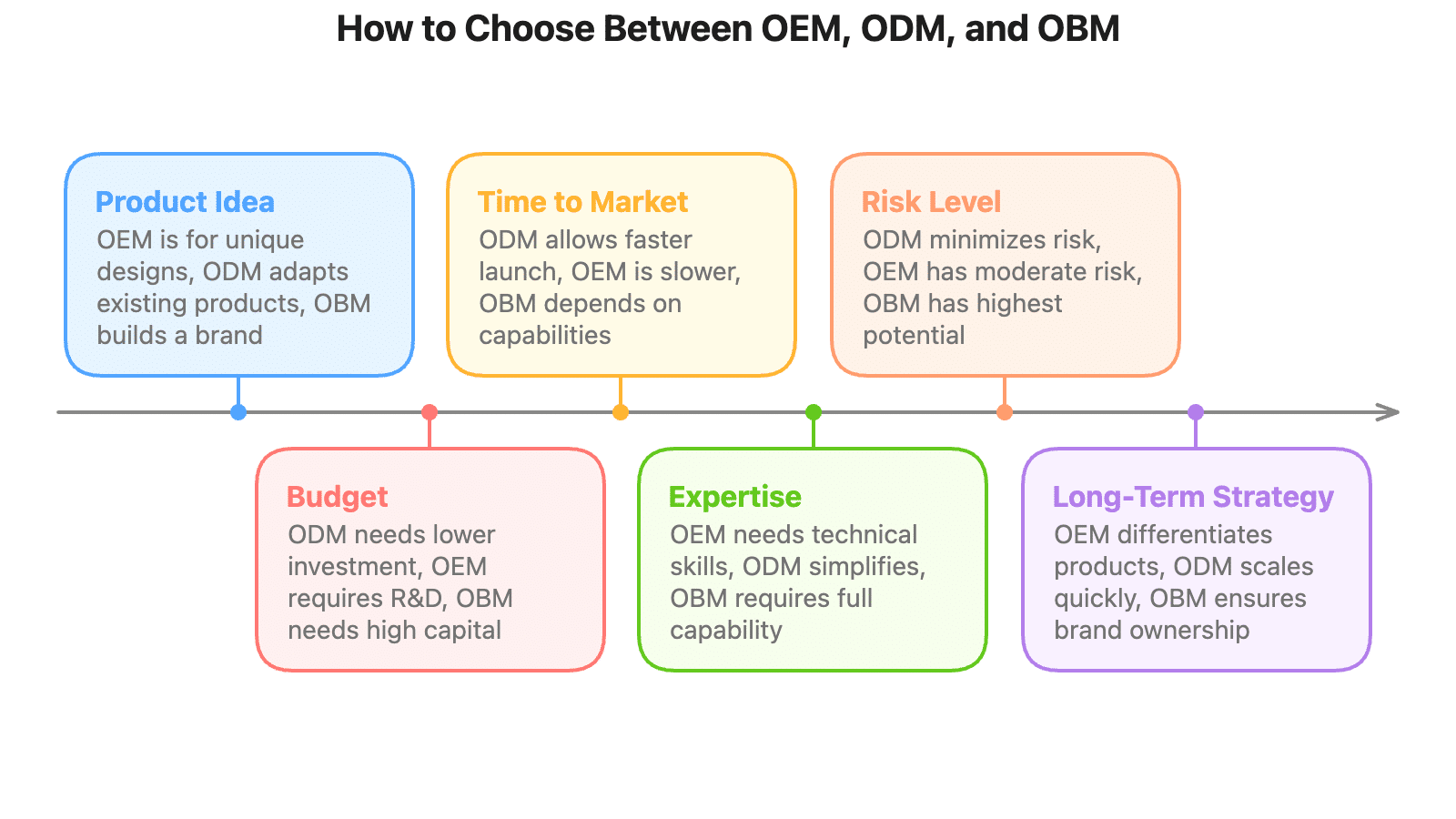
Choosing between OEM, ODM, and OBM can feel overwhelming, especially if you are just starting your product journey. The right decision depends on your budget, timeline, product idea, and long-term business goals. Instead of guessing, it’s often better to validate your direction early with expert guidance.
- Start with Your Product Idea: OEM is ideal if you already have a unique design, ODM fits if you want to adapt existing products, OBM works if you want to build a full brand.
- Define Your Budget: ODM requires lower upfront investment, OEM needs R&D cost, OBM demands the highest capital for branding and operations.
- Consider Time to Market: ODM allows faster launch, OEM takes longer due to development, OBM depends on internal capabilities.
- Evaluate Your Expertise: OEM requires technical knowledge, ODM reduces complexity, OBM requires full business and branding capability.
- Understand Your Risk Level: ODM minimizes risk, OEM has moderate risk, OBM carries the highest but with higher potential returns.
- Think Long-Term Strategy: OEM supports product differentiation, ODM supports quick scaling, OBM supports brand ownership and long-term equity.
Not Sure Which One Fits for Your Business?
If you are still unsure whether OEM, ODM, or OBM is the right path, this is where working with a product sourcing partner becomes valuable. A sourcing partner like Zignify can help you break down your idea, validate feasibility, and guide you toward the most suitable manufacturing model based on your goals. Good sourcing partners don’t just find factories, they challenge assumptions before they become expensive mistakes
Frequently Asked Questions about OEM vs ODM vs OBM
How can I find reliable ODM services for consumer gadgets?
You can find reliable ODM partners through sourcing platforms, trade shows, and professional sourcing agents. Always verify certifications, request samples, and conduct factory audits before committing. Samples tell you what they can do once, audits tell you what they can do consistently.
Distinction between ODM and OEM models?
OEM focuses on manufacturing based on your design, while ODM provides both design and manufacturing. ODM is faster and cheaper, while OEM offers more control and customization.
Benefits of using an ODM for new product development?
ODM reduces development time and cost since the manufacturer already has design capabilities. It is ideal for businesses looking to launch products quickly without heavy R&D investment.
Key challenges in partnering with an ODM?
The main challenges include limited product differentiation and potential intellectual property concerns. Since designs are often shared, competitors may sell similar products.
Can ODM firms handle product design and development from scratch?
Yes, many ODM firms offer full product development services, including concept design, prototyping, and mass production. However, ownership of the design may remain with the manufacturer.
How do ODMs handle intellectual property rights?
In most cases, ODM manufacturers retain ownership of the original design unless otherwise agreed. Businesses should clearly define IP terms in contracts to avoid conflicts. IP isn’t what you assume it’s what’s written and enforceable.
What is OBM (Original Brand Manufacturer)?
OBM refers to companies that design, manufacture, and sell products under their own brand. They control the entire value chain, from production to marketing.
ODM vs OEM vs OBM?
OEM focuses on production, ODM combines design and production, and OBM handles everything including branding and sales. The main difference lies in control, cost, and ownership. At the end of the day, this is a control spectrum where you sit and define how much of the value you actually keep.