Most buyers do not start out hating sourcing agents. They start out hopeful. They sign up with a sourcing agency, expect a smoother supply chain, and quickly run into the same set of problems. Hidden margins. Suppliers they cannot speak to directly. Quality issues blamed on the factory. Pricing that mysteriously stops improving after the first few orders. By the time a buyer realises the agent and the factory may share more interests than the agent and the buyer, real money has already been lost.
This page exists to answer a fair question. If you have already worked with a sourcing agent, a product sourcing company, or a supply chain partner before, why should Zignify be different? The short version is that Zignify is built around the buyer, not the factory.
Need help with your product sourcing?
Get practical advice tailored to your product, suppliers, and market form Zignify experts
Why This Topic Matters: The Real Cost of a Bad Sourcing Partner
Sourcing is never one big mistake. It’s a hundred small ones. A misread lead time here. A supplier you trusted too quickly there. A quality check skipped because things seemed fine. Each decision feels minor in the moment, and that’s exactly what makes it dangerous. Bad sourcing doesn’t arrive as a single dramatic failure. It shows up quietly, decision by decision, slowly eroding your margin, your timeline, and your trust.
Consider what often happens when a sourcing agent is misaligned with the buyer:
Hidden commissions on factory side: the unit price already includes the agent’s cut, so every quotation is structurally inflated.
Limited supplier search: the agent only shows three to five “trusted” factories, often ones who pay them, instead of the best factories for the product.
Weak negotiation: Weak negotiation isn’t incompetence, it’s math. When an agent earns a percentage of the order value, negotiating your price down means negotiating their commission down too. If they push too hard, they reduce their own upside. So they don’t push hard.
Opaque relationships: the buyer never gets direct access to the supplier, so they cannot verify capacity, audits, or quality on their own.
Vendor lock-in: after the first orders, switching becomes painful because the agent owns the supplier relationship and the documents.
The cost of doing nothing is not theoretical. On a $2 million annual purchasing volume, even a quiet 10 to 20 percent cost gap is $200,000 to $400,000 of margin walking out the door every year. That is before anyone counts shipping inefficiency, packaging waste, tariff exposure, or quality returns.
This is why “choosing a sourcing agent” is not a small operational choice. It is a structural decision about whose side you want sitting at the table when prices are set, contracts are written, and quality is judged.
Reliable product sourcing starts here
Work with experts who help you evaluate suppliers and reduce risk.
Most people use the words sourcing agent, product sourcing company, sourcing agency, and supply chain company as if they all mean the same thing. In practice, they describe very different operating models. Understanding the difference is the first step in choosing the right partner. This confusion is actually the root cause of most bad supplier decisions.
The Traditional Sourcing Agent Model
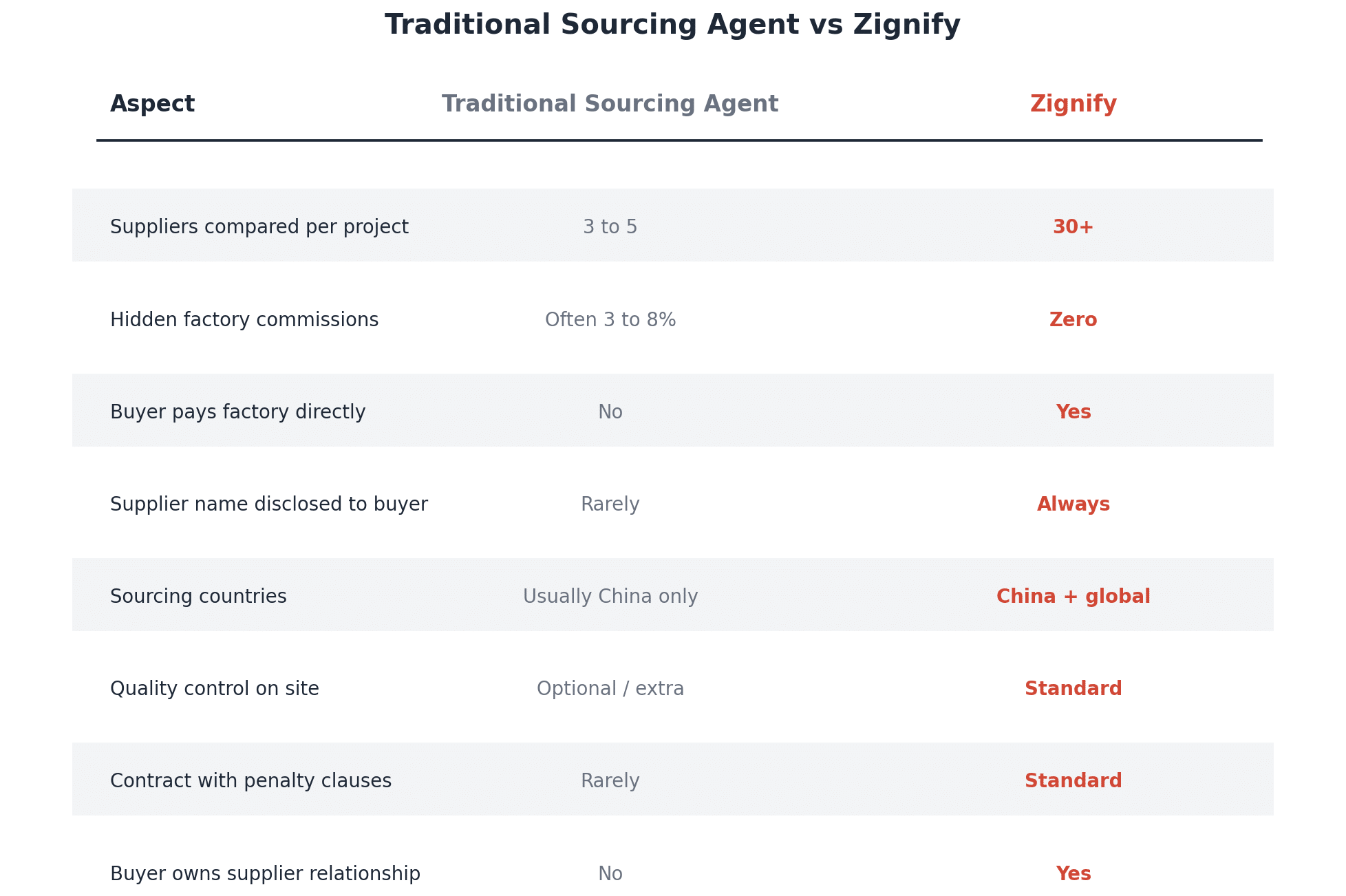
Traditional sourcing agents are often small teams located near major factory hubs, especially in China. While buyers may pay a visible service fee, many agents also receive hidden commissions or rebates from factories. This creates a conflict of interest, where suppliers may be recommended based on payouts rather than overall value, quality, or long-term fit for the buyer.
The Trading Company Model
Trading companies act as intermediaries between factories and buyers. They purchase products from manufacturers and resell them with a markup, while keeping the actual factory hidden. Buyers get a simplified process, but usually pay significantly higher prices and lose direct visibility into supplier relationships, production costs, and negotiation opportunities. This model survives because buyers value simplicity more than transparency until something goes wrong..
The Strategic Sourcing Partner Model
A strategic sourcing partner works entirely on the buyer’s side. Suppliers are sourced, vetted, and negotiated with full transparency. Buyers communicate with factories directly and pay them directly. There are no hidden margins, just a focus on reducing costs, improving quality, and building sourcing stability that holds up over time.
The first two models are common because they are easy to set up and easy to profit from. The third is rarer because it requires discipline, real procurement methodology, real supplier networks, real accountability. And that’s the kind of discipline most agencies don’t want to maintain.
How traditional sourcing agents and Zignify differ across the variables that actually affect margin and risk
Reliable product sourcing starts here
Work with experts who help you evaluate suppliers and reduce risk.
Global Sourcing Strategy: China, Yes, But Not Only China
A common mistake among ecommerce sellers and procurement teams is treating “sourcing” and “sourcing from China” as the same thing. For many product categories that has been the right answer for two decades. In 2026, with shifting tariffs and rebalancing global trade, it is no longer automatic.
Why country selection is now a strategic decision
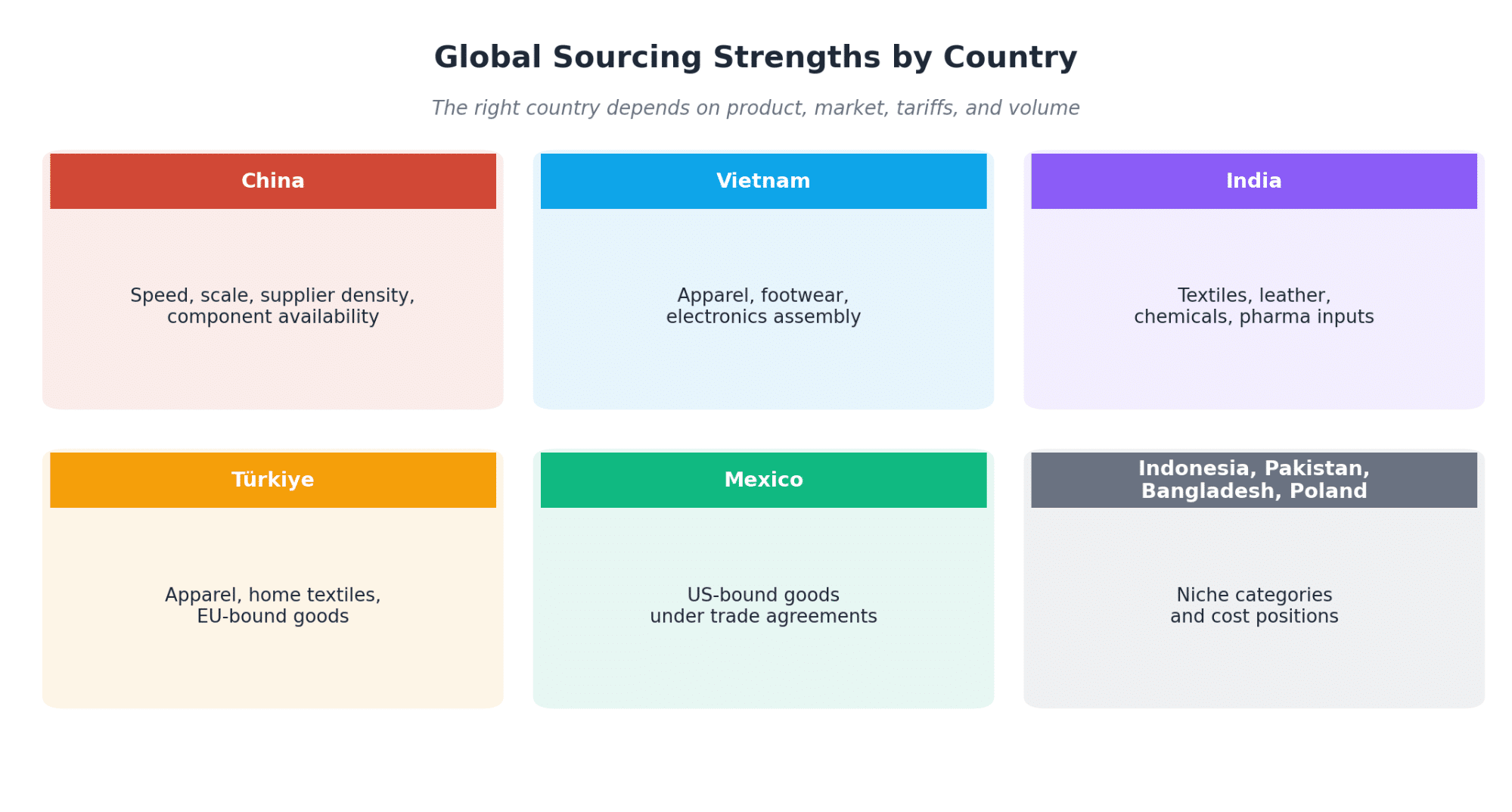
Different countries specialize in different industries. China leads in scale and supplier density, while Vietnam, India, Türkiye, Mexico, and other regions each offer advantages in categories like apparel, electronics, textiles, or industrial goods. The mistake is assuming “China alternative” means “cheaper China.”
The best sourcing country depends on the product, costs, tariffs, lead times, and destination market. Strong sourcing strategies compare multiple regions instead of relying on a single-country approach.
Country-by-country sourcing strengths. The right answer is product specific and shifts with policy
How tariff exposure changes the equation
This is where many sourcing strategies collapse, they only look at unit price, not landed cost. A 5 percent unit price advantage can disappear entirely once tariffs are factored in. For US-bound goods, duties alone can turn that 5 percent difference into a 30 percent landed cost swing. A factory in Vietnam at a slightly higher unit price will often beat a Chinese supplier once the full cost is calculated. For European-bound goods, the math can flip the other way. The right answer is product-specific, and it changes every time policy changes.
For ecommerce sellers facing post tariff margin pressure, this is exactly the kind of decision that benefits from a partner who has actually moved supply chains across countries, not one who only knows one factory cluster.
Reliable product sourcing starts here
Work with experts who help you evaluate suppliers and reduce risk.
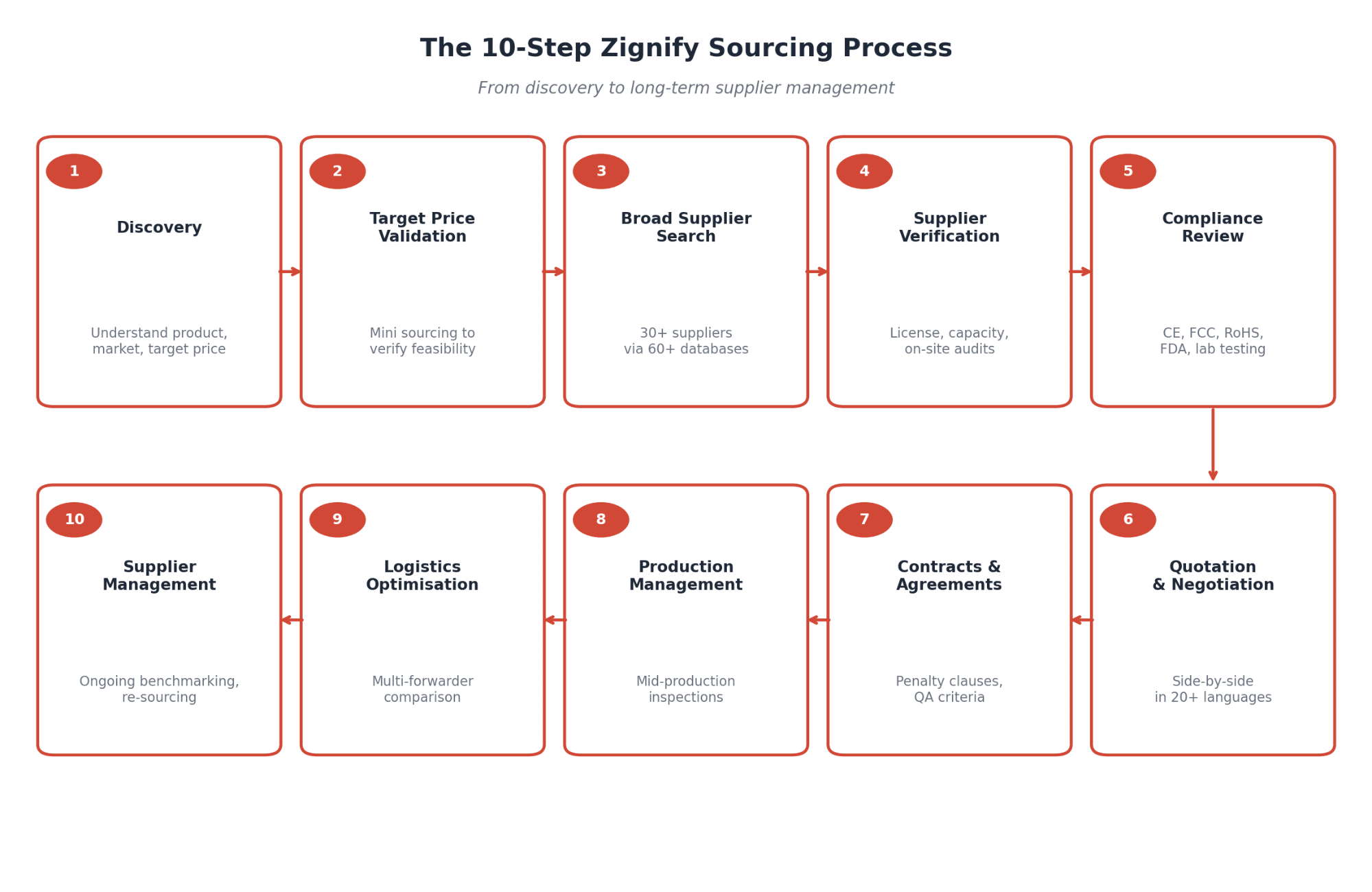
The differences between sourcing companies are not in the headlines. They are in the workflow. Here is how a Zignify sourcing project is structured, step by step, and why each step matters.
The 10-step Zignify sourcing process, from discovery to long-term supplier management
Step 1: Understanding the buyer’s situation
Every project starts with a discovery call. The goal is to understand the product, the target landed cost, the destination market, the volume, the tolerance for tariff exposure, the certification requirements, and the timeline. Most sourcing agents skip this and jump straight into supplier names. Without a clear understanding of the business context, supplier matching is just guesswork. This is where most low quality sourcing already fails; they skip context.
Step 2: Target price validation
Before a full sourcing project starts, Zignify often runs a target price validation, sometimes called a mini sourcing. This checks whether the price the buyer needs to make their margin work is realistic. Many ecommerce sellers discover at this stage that the product they want to launch cannot be produced profitably at the price they assumed. Better to find out in week one than after three months of negotiation. This step prevents unrealistic expectations from contaminating the whole project
Step 3: Broad supplier search and identification
This is where most sourcing agencies stop short. The standard practice in the industry is to compare three to five factories. Zignify’s standard practice is to target around 30 potential producers per project, and significantly more on cost reduction projects. The search runs across more than 60 sourcing databases, a verified internal database of over 50,000 suppliers, and direct outbound research using Google, Baidu, Yandex, and direct calls when factories are not online.
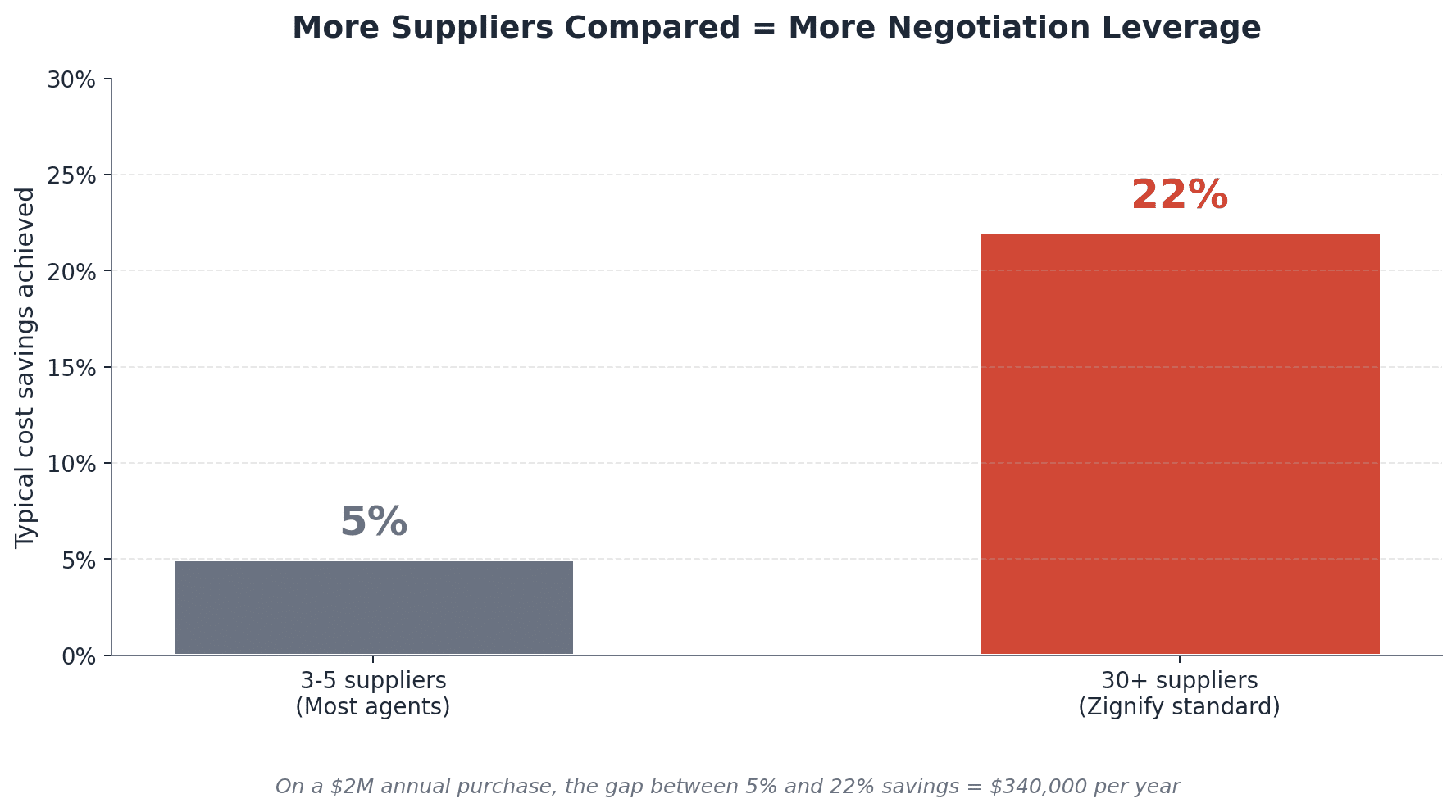
Why so many? Because the more competitive quotations you compare, the more leverage you have to negotiate. A buyer who has 20 quotations on the table is in a different conversation than a buyer who has 3. Supplier volume directly determines negotiation leverage
The number of suppliers compared is the single strongest predictor of final price
Step 4: Supplier verification and audit
Once shortlisted, suppliers are verified, not assumed. Verification covers business licenses, factory ownership, real production capacity, machinery, quality systems, export experience, and references. For higher risk projects, on site audits and social compliance audits are added. This step exists because too many factories online are actually trading companies, brokers, or showrooms, not real producers. Verification is where 50% of “online factories” usually fall apart
Step 5: Compliance and documentation review
Different products require different certifications depending on the destination market. CE, FCC, RoHS, REACH, FDA, CPSIA, lab testing, anti dumping considerations, and import tariff codes all need to be checked before the order is placed, not after the goods are stuck in customs. Zignify reviews compliance requirements with the buyer and either confirms the supplier already has them or arranges lab testing through independent labs.
Step 6: Quotation comparison and negotiation
Quotations are compared side by side using consistent specifications. This is harder than it sounds, because two factories will quote slightly different specs unless someone forces them to quote the same product. Zignify’s project managers run quote normalisation so the buyer is comparing apples to apples. Negotiation is then conducted in the supplier’s local language whenever possible. Zignify’s internal team works across roughly 20 languages, including Chinese, Spanish, Polish, and others, which closes the gap that most Western buyers face when negotiating directly. Quote normalization is one of the most underrated procurement skills
Step 7: Contracts and purchase agreements
Most self sourced orders skip this step entirely. The buyer pays a deposit, the factory ships, and if anything goes wrong there is no contractual recourse. Zignify drafts purchase agreements that include penalties for delays, defined quality acceptance criteria, payment terms, and protections in case of supplier failure. This is one of the cheapest forms of insurance in the entire process. If it’s not in the contract, it doesn’t exist
Step 8: Mass production management and on site quality control
Once production starts, quality control becomes critical. Samples, mid-production checks, and pre-shipment inspections help ensure the final shipment matches approved standards. A good sample does not guarantee good mass production, which is why inspections are essential before final payment.
Step 9: Logistics optimisation
Most factories will offer to arrange shipping. Most of those offers are not competitive. Zignify treats logistics the way it treats sourcing, by comparing multiple forwarders, evaluating cost versus transit time, and negotiating rates. Even small per container savings, multiplied across multiple shipments, can add tens of thousands of dollars in margin per year. Logistics is one of the most underestimated profit levers people obsess over unit price and ignore freight efficiency
Step 10: Documentation and ongoing supplier management
Once the first order is delivered, the work continues. Suppliers do not stay competitive on their own. Without periodic benchmarking, prices drift up and quality drifts down. Zignify supports ongoing supplier management, periodic re-sourcing, and the addition of secondary suppliers when concentration risk becomes too high. Read more about how proactive supplier management protects long term margin on the Zignify blog.
Reliable product sourcing starts here
Work with experts who help you evaluate suppliers and reduce risk.
The Transparent Sourcing Model: Why It Matters in Practice
Transparency in sourcing is not an abstract value. It has specific operational consequences.
The buyer pays the factory directly. There is no markup baked into the unit price. The cost of goods is the actual cost of goods.
The buyer knows the factory’s name, address, and contact. Audits, factory visits, and direct quality conversations are possible because the buyer is not blocked from the supplier.
Zignify does not take factory side commissions. There is no incentive to keep an order with a particular factory just because that factory pays a kickback. The recommendation is always the best option for the buyer.
Pricing for Zignify’s services is open. Buyers pay for hours, fixed scope work, or savings linked fees. There are no hidden percentage cuts on order volume that the buyer never sees.
Quotations are shared openly with the buyer. The buyer can see how many suppliers were contacted, who responded, what their offers looked like, and how the negotiation moved each one. This is what “procurement visibility” should actually look like in practice
The result is that the buyer ends every project with two assets, not one. The first is a delivered product. The second is a real, owned supplier relationship that can be used in future orders without paying anyone in the middle. Most sourcing agents are structurally unable to provide the second.
Zignify Real Case Studies: What Buyer Side Sourcing Actually Delivers
The numbers below are real client outcomes. They are included not as marketing claims, but as concrete examples of what a serious procurement methodology can produce when run end to end.
Case study 1: Clothing brand, $924,000 saved at the same supplier
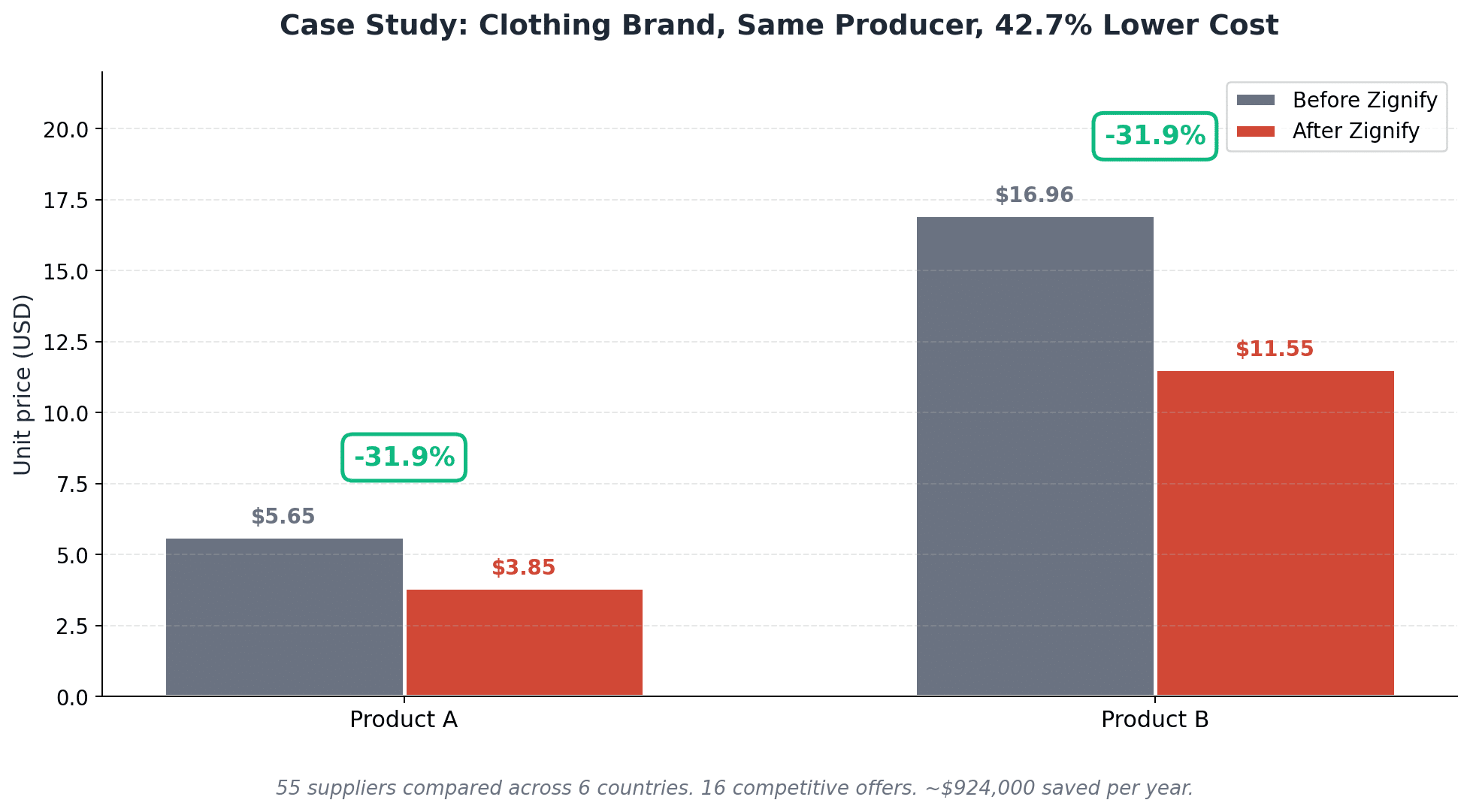
A clothing brand was already running production in China. They believed their pricing was competitive, but had a quiet feeling that costs were probably too high. The Zignify team ran a full sourcing comparison across 55 suppliers in China, India, Vietnam, Türkiye, Pakistan, and Bangladesh. Sixteen factories returned competitive quotations. The data was used as negotiation leverage. The end result was a 42.7 percent cost reduction while keeping the same producer. Pre-project pricing of $5.51 to $5.80 per unit and $16.53 to $17.40 per unit fell to $3.85 and $11.55 respectively. Annualised savings reached approximately $0.5 million in extra profit, on a base of around $924,000 in additional yearly margin. Even cheaper offers were available, but the client chose to maintain the relationship with the existing factory at the negotiated rate. This is a textbook example of why benchmarking beats switching suppliers most of the time.
Clothing brand case study. Same producer, 42.7% lower unit cost after 55-supplier benchmarking
Reliable product sourcing starts here
Work with experts who help you evaluate suppliers and reduce risk.
Common Pitfalls Buyers Fall Into When Choosing a Sourcing Company
Choosing a sourcing partner is one of the highest leverage decisions a product business makes. Here are the mistakes that show up most often, and how to avoid them.
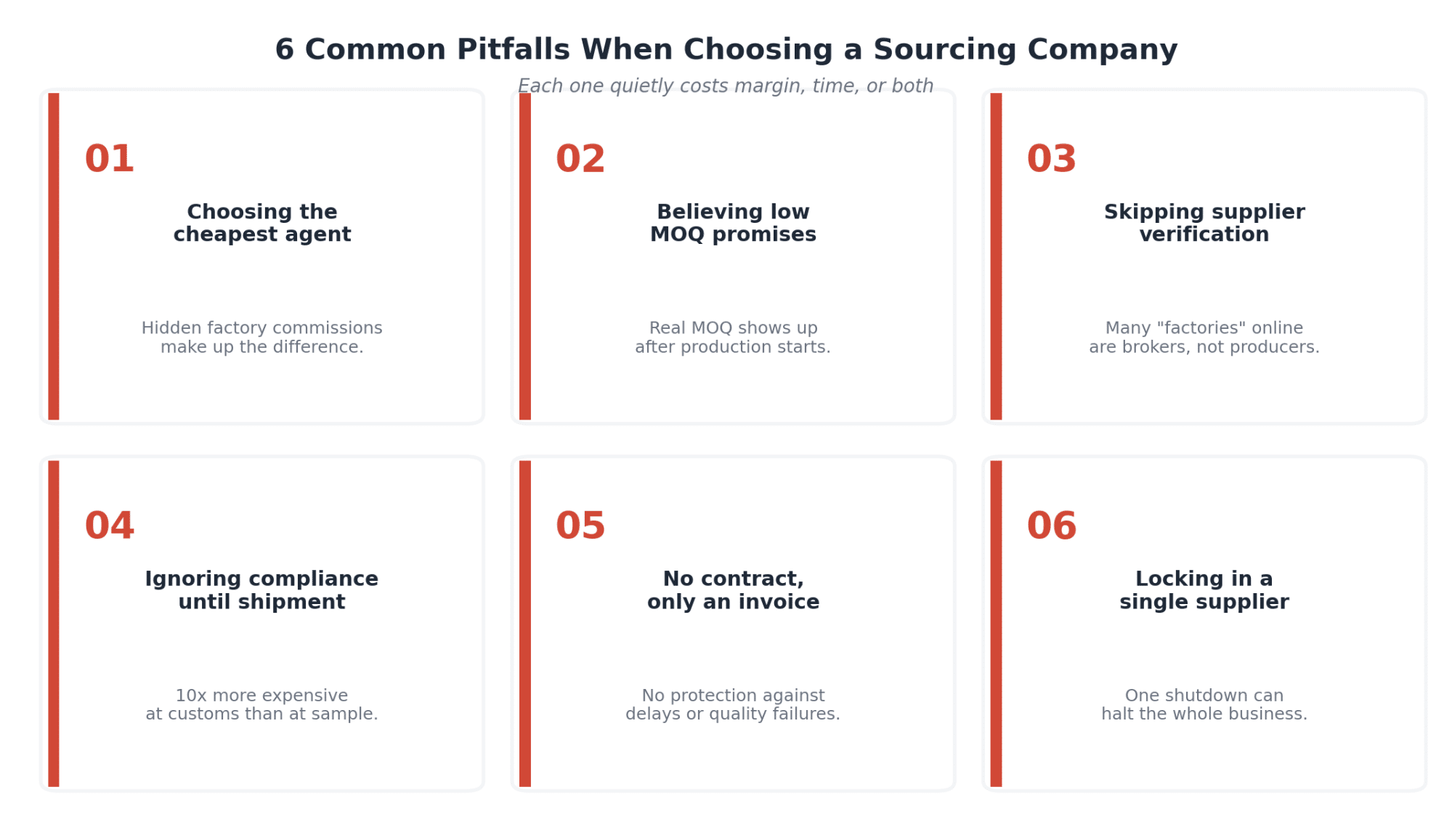
Six common pitfalls when choosing a sourcing company. Each is detailed below
Pitfall 1: Choosing the cheapest agent
Sourcing fees are not a cost. They are an investment that should pay back many times over in supplier savings, avoided quality failures, and reduced risk. An agent who charges very little usually has to make up the difference with factory side commissions. The buyer pays anyway, just without seeing it. “Cheap sourcing” often becomes expensive sourcing just delayed.
Pitfall 2: Believing low MOQ promises
Some agents promise unrealistically low minimum order quantities to win the project. Once production starts, the real MOQ appears, surcharges are added, or quality drops because the factory was never set up for that scale. A serious sourcing partner is honest about what is achievable at a given volume. MOQ manipulation is one of the most common sales tactics in sourcing
Pitfall 3: Skipping supplier verification
Many factories online are not factories. They are brokers, trading companies, or showrooms. Without verification, a buyer can spend months negotiating with a middleman who does not even own the production line. Always verify.
Pitfall 4: Ignoring compliance until shipment
Compliance issues found at customs are 10 times more expensive than compliance issues found at sample stage. Certifications, lab testing, and labelling requirements need to be defined before the order is placed.
Pitfall 5: No contract, only an invoice
Most self sourced orders rely on a Performa invoice. This is not a contract. It does not protect against delays, quality failures, or non delivery. A proper purchase agreement with penalty clauses is one of the cheapest risk reduction tools in the entire process.
Pitfall 6: Locking in a single supplier
Concentration risk is invisible until something breaks. A single factory shutdown, a tariff change, or a quality dispute can stop the entire business. Even when one supplier is preferred, having a verified secondary supplier dramatically reduces risk. Dual sourcing is not inefficiency, it’s operational insurance.
Reliable product sourcing starts here
Work with experts who help you evaluate suppliers and reduce risk.
Not every business needs the same kind of sourcing support. The Zignify approach is shaped to four primary client types.
Amazon, eBay, and Etsy Sellers: Many ecommerce sellers start with a small number of products and limited supplier comparisons. Zignify helps improve margins through supplier benchmarking, country diversification, packaging optimization, and sourcing support for new product launches.
Manufacturing Business Owners: Manufacturers often need alternative component suppliers, backup factories, or support shifting production between countries. Zignify helps reduce supplier dependency and improve procurement flexibility.
Procurement Managers and Corporate Buyers: Internal procurement teams often lack time for deep supplier benchmarking projects. Zignify acts as an extension of the procurement team, handling large-scale supplier comparisons and sourcing analysis.
New Ecommerce Entrepreneurs: First-time sellers face the highest sourcing risk. Zignify helps validate pricing, source suppliers properly, and avoid common quality, logistics, and supplier mistakes early on. These categories all share one thing asymmetric sourcing knowledge risk
The single biggest test of a sourcing partner is what happens after the first project. A traditional sourcing agent is dependent on the buyer not building competence. The buyer cannot leave because they do not know who the factory is. The relationship works because the buyer is locked in. If you control supplier data, you control the relationship
The Zignify model works the opposite way. Buyers walk away from each project owning the supplier relationship, the contracts, and the quality protocols. They are technically free to leave at any time. Most do not, for a few practical reasons:
Ongoing supplier benchmarking. Suppliers stop sharpening their pencils once they feel safe. Periodic re-sourcing keeps prices honest. If you don’t re-benchmark, your “good price” slowly becomes average or even expensive without anyone noticing
New product launches. Most ecommerce brands launch new SKUs regularly, and each new product is a new sourcing project.
Country diversification as policy shifts. Tariff changes, trade tensions, and currency moves create rolling reasons to qualify new suppliers in new countries.
Quality control and ongoing inspections. Once a quality protocol is established, maintaining it across orders is easier with the same partner. Most issues don’t come from bad factories, but from inconsistent enforcement of specs over time
Operational scale. As the buyer’s business grows, sourcing complexity grows with it. Logistics, contracts, compliance, and supplier management benefit from continuity.
In other words, clients stay because the work keeps producing returns, not because they are locked in.
What Most Guides Get Wrong, Here’s What Our Expert Knows ✅
Most articles comparing sourcing agents focus on the wrong variables. They compare fees, response times, or how many factories the agent claims to have on file. The variables that actually predict whether a buyer ends up with strong margin and clean supply are different, and they tend to be invisible until you have run a few projects.
💡 The number of suppliers compared matters more than the agent’s price list.
Most sourcing agencies quietly cap supplier searches at three to five factories per project. The reason is simple. A wider search costs the agent more time and creates the risk that a non preferred factory wins. From a buyer’s perspective, however, the number of suppliers compared is the single strongest predictor of final price. A 20 to 30 supplier comparison routinely produces 15 to 30 percent lower prices than a 3 to 5 supplier comparison. Always ask, in writing, how many suppliers will be contacted. The answer tells you almost everything about the partner’s incentives.
🚩 Hidden factory side commissions look like a small detail and behave like a structural tax.
Many sourcing agents take a 3 to 8 percent commission from the factory in addition to the fee they charge the buyer. This commission is built into the unit price the buyer pays. On a $1 million order, this is $30,000 to $80,000 per year, every year, often invisible. The clue is simple. If the agent will not let the buyer pay the factory directly, or will not disclose factory pricing, the structure almost certainly contains a hidden margin. Direct factory payment is not a preference, it is a structural requirement for clean sourcing.
⚠️ Country diversification is now a margin question, not a political one.
For US bound products in particular, tariff exposure has turned country selection into a core procurement decision. A factory in Vietnam at slightly higher unit cost frequently beats a Chinese supplier on landed cost once duties are calculated. Sellers who source only in China and assume the world has not changed are quietly losing 10 to 25 percent of margin to tariffs that did not exist three years ago. The right answer is product specific and shifts with policy, which is why a sourcing partner who only knows one country is increasingly a liability rather than an asset.
If any of the above looks uncomfortably familiar in your current sourcing setup, a 30 minute conversation is the fastest way to know whether it is fixable. Book a free sourcing call →
Frequently Asked Questions
1. How is Zignify different from a normal sourcing agent?
Zignify is a strategic sourcing partner, not a traditional sourcing agent. Buyers pay the factory directly, see the supplier’s name and contacts, and own the relationship after the project ends. There are no hidden factory side commissions, and supplier searches typically cover 30 or more producers per project, not 3 to 5.
2. Does Zignify only source from China?
No. Zignify sources globally, including China, Vietnam, India, Türkiye, Pakistan, Bangladesh, Mexico, Indonesia, Poland, and others. Country selection is a strategic decision based on the product, the destination market, tariff exposure, and required volume. Many recent projects involve moving production out of China for tariff reasons.
3. How much can I realistically save by switching to Zignify?
Typical savings on cost reduction projects range from 10 to 30 percent on unit pricing, with some projects exceeding 40 percent. The exact number depends on the product, the current pricing, the volume, and how many suppliers have already been compared. A free initial call is enough to estimate the realistic range for your specific case.
4. Will I have direct contact with the supplier?
Yes. Direct supplier access is part of the model. Buyers know the factory name, location, and primary contact. They can visit, audit, and communicate directly. The relationship is owned by the buyer, not held hostage by the sourcing partner.
5. How does Zignify charge?
Zignify offers hourly rates, fixed price scopes, and savings linked fees depending on the project. There are no hidden percentages on order volume and no factory side commissions. Pricing is open, scope is defined upfront, and clients are not locked into long term retainers.
6. What if I already have a sourcing team or my own agent?
Many Zignify clients already have internal procurement or a local agent. The most common engagement in this case is a benchmarking project. Zignify runs a parallel supplier search on a specific product or category to validate whether the current setup is competitive. If it is, no further action is needed. If it is not, the savings tend to justify the engagement many times over.
7. How long does a typical sourcing project take?
A China based sourcing project typically takes 25 to 30 working hours spread over a few weeks, depending on supplier response times. Projects outside China usually take 40 to 50 hours because supplier response times are slower and supplier density is lower. Cost reduction projects on existing products can be faster because the specifications are already defined.
8. Is sourcing through Zignify suitable for first time ecommerce sellers?
Yes, especially for first time sellers, because the first supplier decision is the highest leverage decision in the business. A wrong supplier early on can lead to product failures, quality returns, or scams that the seller may not recover from. A structured first sourcing project significantly reduces those risks.