

International Freight & Shipping Guides
Practical guides for sellers and manufacturers who source internationally – covering freight forwarding from China and beyond, air vs sea freight decisions, shipping to Amazon FBA, import duties, and how to choose the right logistics partner for your supply chain.
Getting the product right is half the job. Getting it to your warehouse, fulfilment centre, or customer without losing your margin to avoidable freight costs, customs delays, or the wrong shipping method is the other half. These guides are written for buyers who source internationally – not for logistics professionals. They cover the decisions a sourcing buyer actually faces: which freight method to use, how to find a forwarder you can trust, what import duties will cost you before you place the order, and how to coordinate shipping when your supply chain spans multiple countries.
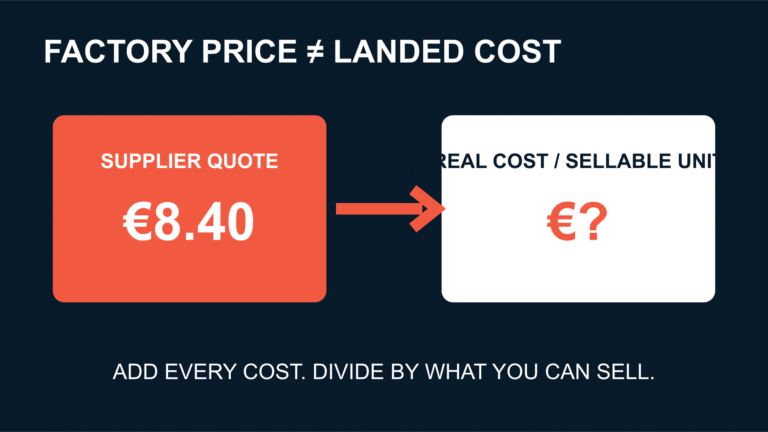
Compare suppliers on cost per sellable unit, not the factory price. A complete landed cost model ...
- Oct 06, 2026

Learn how to ship products from China with this step-by-step guide, from shipping methods and costs ...
- Mar 01, 2026
Discover how 3PL logistics (third-party logistics) supports sourcing companies, ecommerce fulfilment and supply-chain efficiency. Learn key ...
- Nov 08, 2025
Explore 25 top international freight shipping companies, what to evaluate when choosing one, and how to ...
- Nov 06, 2025
Discover the top 15 3PL providers to scale your e-commerce or small business logistics, expert insights, ...
- Nov 01, 2025

What is port congestion? Port congestion occurs when ships arrive at a port and are unable ...
- Mar 23, 2025

Selecting the right freight forwarder is a crucial decision that can significantly impact your business’s success. ...
- Oct 18, 2023
Freight Forwarding From China and Alternative Sourcing Markets
A freight forwarder coordinates the movement of goods from your supplier’s factory to your destination — booking cargo space, managing documentation, handling customs clearance, and tracking the shipment at every stage. For most sourcing buyers, the freight forwarder is the least-understood part of the supply chain and the most likely to cause expensive problems when chosen poorly. These guides explain how freight forwarding works, how to find a reliable forwarder in China and other sourcing markets, what to check before you appoint one, and how freight costs and lead times vary by origin country. As part of Zignify’s end-to-end sourcing service, logistics coordination is managed by our team — so clients don’t need to navigate forwarder selection alone.
Shipping From China to Amazon FBA – Step by Step
Shipping from a Chinese manufacturer to an Amazon fulfilment centre involves more steps than most new sellers anticipate. The shipment must be prepared to Amazon’s packaging and labelling standards, booked with a freight forwarder or courier, cleared through US or EU customs, and received into the FBA warehouse within the booking window. A missed step anywhere in this sequence can result in rejected shipments, storage fees, or delayed inventory that misses a sales window. These guides walk through the complete process — from confirming your order is ready at the factory through to stock appearing as available in Seller Central — with specific guidance on sea freight vs air freight for FBA replenishment and how to manage lead times across multiple sourcing countries.
Air Freight vs Sea Freight – Choosing the Right Method
The choice between air freight and sea freight is one of the most consequential logistics decisions a sourcing buyer makes on every order. Sea freight is significantly cheaper per unit but adds three to six weeks to your lead time depending on the origin country. Air freight costs three to five times more but delivers in five to ten days — critical for urgent restocks, seasonal launches, or high-value low-weight products where speed protects margin more than freight cost does. The right answer depends on your product, your order value, your inventory position, and your sales velocity. These guides provide the decision framework Zignify’s logistics team uses on every sourcing project — covering cost thresholds, lead time calculations, and how the freight decision connects to your sourcing strategy.
Import Duties, Customs, and Landed Cost
The price your supplier quotes is not the price you pay. Landed cost — the total cost of goods delivered to your door — includes the unit price, international freight, import duties, customs clearance fees, insurance, and any warehousing costs between the port and your final destination. Buyers who model only unit price consistently underestimate their true sourcing cost and discover the gap when the goods arrive at customs. These guides explain how import duties work for goods sourced from China, Vietnam, India, and other major manufacturing markets, how to calculate landed cost before placing an order, and how Zignify’s sourcing team incorporates full landed cost modelling into every project to ensure the numbers work before production begins.
Choosing a Logistics Partner for Your Supply Chain
Most factories will offer to arrange shipping. Most of those offers are not competitive. A factory’s freight arrangement is rarely optimised for the buyer — it is optimised for the factory’s relationship with its preferred forwarder. Sourcing buyers who manage freight independently — by appointing their own forwarder, comparing rates across multiple providers, and specifying delivery terms clearly in the purchase agreement — consistently achieve better freight rates and fewer logistics surprises than buyers who let the factory control shipping. These guides cover how to evaluate freight forwarders, what to look for in a logistics partner for international sourcing, and how Zignify approaches freight coordination as part of a full sourcing engagement — including how to structure Incoterms in your purchase agreement to control who is responsible for what at each stage of the journey.
FAQ on International Freight, Logistics and Shipping at Sourcing
What is a freight forwarder and do I need one when sourcing internationally?
A freight forwarder is a company that organises the transportation of goods from the supplier’s location to the buyer’s destination — booking cargo space with carriers, preparing shipping documentation, managing customs clearance, and coordinating delivery. For most international sourcing buyers, working with a freight forwarder is not optional – it is the standard method for moving goods across borders. Direct carrier relationships are typically only available to buyers with very high shipping volumes. Zignify coordinates freight forwarding as part of every end-to-end sourcing engagement, selecting forwarders based on route, cost, lead time, and reliability rather than factory preference.
Should I use air freight or sea freight when sourcing from China?
Sea freight is the standard choice for most sourcing orders – it costs significantly less per unit and works well when lead times allow three to six weeks for transit. Air freight makes sense when the product is high-value and low-weight, when an urgent restock is needed, or when the cost of being out of stock exceeds the freight premium. As a rough guide, orders above 200kg or one cubic metre typically favour sea freight on cost. Below that threshold, or when speed is the priority, air freight often wins on total economics. Zignify’s logistics team calculates the optimal freight method for every order as part of the sourcing process.
How do I calculate the landed cost of my order?
Landed cost is calculated by adding the unit cost, international freight, import duty rate applied to the customs value, customs clearance fees, insurance, and any local delivery or warehousing costs. Import duty rates vary by product category and destination country – the applicable rate is determined by the product’s HS tariff code. For US buyers sourcing from China, additional Section 301 tariffs apply on many product categories. Zignify models full landed cost on every sourcing project before recommending a supplier, ensuring the commercial case holds at the delivered price rather than the ex-works price.
How long does shipping from China to the USA take?
Sea freight from China to the US West Coast typically takes 14 to 21 days transit time. East Coast ports add another 7 to 10 days. Air freight from China takes 5 to 10 days depending on the courier or carrier. Total lead time from order confirmation to stock available for sale is longer than transit time alone — it includes production completion, factory handover, customs clearance at destination, and FBA receiving time for Amazon sellers. Zignify builds realistic total lead times into every sourcing project timeline, accounting for all stages from factory release to delivered stock.
What import duties apply to goods sourced from China in 2026?
Import duties on goods sourced from China for the US market consist of standard MFN tariff rates plus additional Section 301 tariffs, which apply to most product categories and range from 7.5% to 145% depending on the product and the tariff list it falls under. The applicable duty rate is determined by the product’s HS code. For EU buyers, standard customs duties apply without the Section 301 surcharge, making China sourcing more cost-competitive for European importers than for US buyers in 2026. Zignify advises clients on duty exposure as part of the supplier and country selection process – factoring tariff costs into the total landed cost model before any purchase order is placed.
How does shipping work when I source from multiple countries?
Multi-country sourcing requires coordinating separate freight arrangements for each origin – each with its own freight forwarder relationship, documentation requirements, transit time, and customs clearance process. For buyers who are consolidating shipments from multiple origins into one destination, a freight forwarder with consolidation capability can combine multiple smaller shipments into one container, reducing per-unit freight cost. Zignify manages multi-country logistics coordination for clients who are actively diversifying their supply chains – including buyers who have moved part of their sourcing from China to Vietnam, India, or Mexico and need to manage the logistics of multiple concurrent shipments.
Let's talk
Stop Losing Margin to Logistics You Haven't Optimised
Most sourcing buyers focus on unit cost and overlook freight. Zignify’s team models full landed cost on every project – freight, duties, customs, and delivery – so you know the real numbers before you commit to a supplier.
No commitment required | 5,000+ companies helped
