
The U.S.–Israel vs Iran war is not just a regional conflict—it’s a global economic shock that reshapes how goods move, how costs are managed, and how businesses operate worldwide. In today’s interconnected supply chains, disruptions like energy volatility, shipping delays, and rising logistics costs spread almost instantly, turning a local conflict into a global problem overnight.
In today’s tightly connected supply chains, disruptions in the Middle East carry outsized impact because the region sits at the center of critical energy supplies and key trade routes. Modern supply chains span multiple countries for sourcing, production, and distribution, making them highly efficient, but also highly vulnerable to geopolitical shocks. We’ve optimized for cost and speed, not resilience, and this is exactly where the cracks start to show.
When tensions rise, the impact hits fast from fuel prices increasing, shipments get delayed, and markets become unpredictable.
This is a wake-up call for businesses: supply chains are no longer just about operations, but a key part of strategy shaped by global politics and conflict. If you’re not actively thinking about your supply chain, you’re already exposing your business to risk.
In this article, we will explore how the US–Israel vs Iran war on the global supply chain is disrupting global trade, logistics, and key industries. We will break down the immediate and long-term impacts, analyze how different regions and sectors are affected, and share practical insights from a product sourcing perspective on how businesses can adapt and stay resilient in an increasingly uncertain global environment.
Read more Supply Chain Optimization 101: Definition, Strategies, and Trends
How the Conflict is Disrupting Global Supply Chains
The US–Israel vs Iran war on the global supply chain is not just a regional conflict, but a direct threat to global trade, especially due to its impact on the Strait of Hormuz, a critical route for oil and gas shipments. Any disruption in this chokepoint can quickly drive up fuel prices, delay shipping, and affect production worldwide. In today’s interconnected economy, instability in this region spreads fast, making supply chains highly vulnerable to geopolitical risk. The speed of disruption today is measured in days, not months
According to Supply Chain Digital analysis, the conflict has already disrupted major trade routes and global logistics networks. Below are the main impacts of the conflict on global supply chains:
- Energy Disruption: military strikes on oil and gas infrastructure create immediate supply uncertainty and price volatility. Nearly 20% of global oil flow is at risk
- Trade Route Risk: escalation increases the threat to key shipping lanes like the Strait of Hormuz
- Shipping Disruption: vessels face delays, rerouting, or cancellations due to safety concerns
- Air Cargo Disruption: flight delays and airspace restrictions reduce capacity and increase transit time for global shipments
- Increased Logistics Cost: higher fuel prices and risk premiums drive up freight and insurance costs
- Market Reaction: global markets respond quickly with rising commodity prices and volatility
- Supply Chain Shock: companies experience sudden disruptions in sourcing, production, and delivery timelines

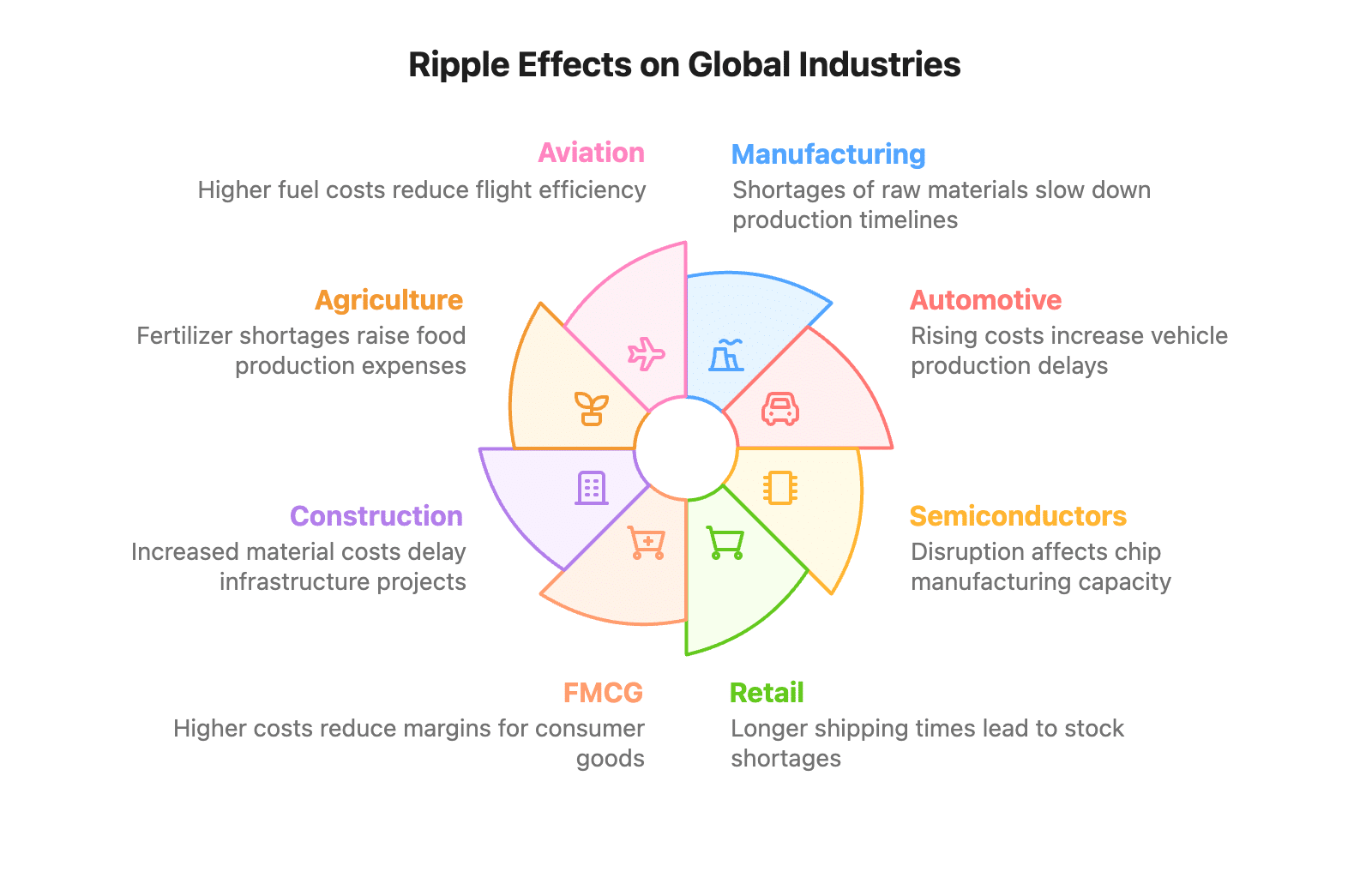
Ripple Effects on Global Industries
The US–Israel vs Iran to global supply chain disruption does not stop at logistics and energy. It creates a cascading effect across multiple industries, as higher costs, delayed shipments, and unstable supply make it harder for businesses to operate efficiently. From manufacturing to retail, many sectors are experiencing both short-term shocks and long-term structural changes. Supply chains don’t break in isolation; they fail in layers.
- Manufacturing Disruption: shortages of raw materials and components slow down production timelines
- Automotive Impact: rising metal and semiconductor costs increase vehicle production costs and delays
- Semiconductor Risk: disruption in energy and helium supply affects chip manufacturing capacity
- Retail & E-commerce Delays: longer shipping times lead to stock shortages and delayed deliveries
- FMCG Pressure: higher logistics and production costs reduce margins for fast-moving consumer goods
- Construction Slowdown: increased material costs (steel, aluminum) delay infrastructure projects
- Agriculture Impact: fertilizer shortages and higher fuel costs raise food production expenses
- Aviation Industry Pressure: higher fuel costs and airspace restrictions reduce flight efficiency
- Tech Industry Disruption: delayed components affect product launches and supply availability
- Logistics Industry Strain: freight companies face capacity constraints and operational challenges
According to Reuters coverage on global business disruption, the conflict is already affecting industries from food to automotive manufacturing.
Commodity-Level Impact Across Industries
As the conflict escalates, its effects are quickly reflected in global commodity markets, where supply disruptions and uncertainty drive price volatility. Since these commodities are essential inputs for multiple industries, even small disruptions can create widespread ripple effects across production, logistics, and end markets.
- Oil & Gas: supply uncertainty drives price spikes, increasing costs across transportation and manufacturing
- Aluminum: Middle East production disruption affects global supply and raises prices for automotive and construction sectors
- Steel & Iron: higher energy costs increase production expenses and impact infrastructure projects
- Fertilizers: supply constraints raise agricultural costs and contribute to food price inflation
- Agricultural Commodities: increased logistics and input costs affect global food supply chains
- Chemicals & Petrochemicals: rising oil prices impact plastics, packaging, and industrial materials
- Helium: supply disruption affects semiconductor manufacturing and medical applications
- Sulfur: shortages impact fertilizer production and mining processes
- Rare Materials: geopolitical instability affects access to critical materials used in electronics and clean energy
Which Regions Are Most Impacted by the US–Israel vs Iran Conflict?
The US–Israel vs Iran to global supply chain disruption does not affect all regions equally. The level of impact depends on each region’s reliance on Middle East energy, trade routes, and global supply networks. While some regions face direct cost pressure, others experience indirect effects through inflation, delays, and reduced trade efficiency. Geography still matters a lot more than people thought during globalization’s peak
Asia (Most Exposed to Energy Dependency)
Asia is one of the most impacted regions due to its heavy reliance on Middle Eastern oil and export-driven economies.
- Energy Dependency: countries rely heavily on imported oil and gas from the Middle East
- Manufacturing Vulnerability: production depends on stable raw material and energy supply
- Export Risk: delays and cost increases affect global competitiveness
- Supply Chain Sensitivity: disruptions quickly impact large-scale production hubs
Europe (Facing Energy and Cost Pressure)
Europe is impacted through rising energy costs and the need to shift sourcing strategies.
- Energy Diversification Challenge: reduced access to stable Middle East energy supply
- Industrial Cost Increase: higher fuel prices affect manufacturing and production
- Logistics Adjustment: companies shift to alternative suppliers and routes
- Inflation Pressure: increased costs passed down to consumers
United States (Indirect but Significant Impact)
The U.S. is less dependent on Middle East energy but still affected through global market shifts.
- Inflation Risk: rising global oil prices impact domestic costs
- Strategic Reserve Usage: government intervention to stabilize supply
- Industrial Impact: increased cost of imported materials and components
- Market Volatility: uncertainty affects investment and business planning
Middle East (Direct Operational Disruption)
The region at the center of the conflict faces the most direct physical and logistical impact.
- Infrastructure Damage: attacks affect energy and logistics facilities
- Export Disruption: oil and gas shipments face delays or restrictions
- Trade Instability: regional trade flows become unpredictable
- Security Risk: ongoing conflict affects operational continuity
Read more Supply Chain Optimization 101: Definition, Strategies, and Trends
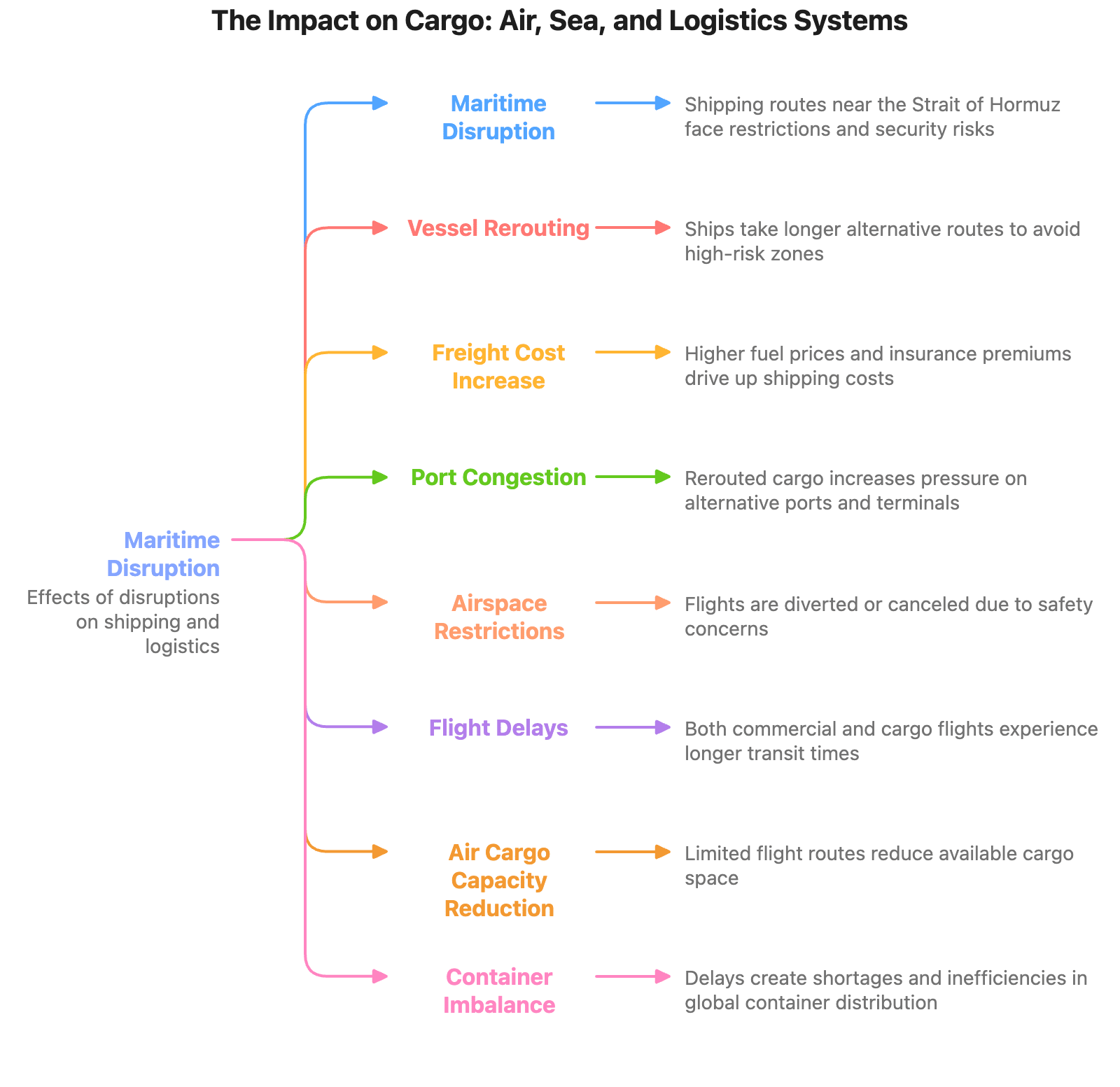
The Impact on Cargo: Air, Sea, and Logistics Systems
Logistics doesn’t stop, but it becomes slower, more expensive, and far less predictable. Across air and sea freight, delays increase, routes shift, and costs rise as disruptions ripple through the system, making it harder for businesses to plan and deliver with confidence.
- Maritime Disruption: shipping routes near the Strait of Hormuz face restrictions and security risks
- Vessel Rerouting: ships take longer alternative routes to avoid high-risk zones
- Freight Cost Increase: higher fuel prices and insurance premiums drive up shipping costs
- Port Congestion: rerouted cargo increases pressure on alternative ports and terminals
- Airspace Restrictions: flights are diverted or canceled due to safety concerns
- Flight Delays: both commercial and cargo flights experience longer transit times
- Air Cargo Capacity Reduction: limited flight routes reduce available cargo space
- Container Imbalance: delays create shortages and inefficiencies in global container distribution
According to S&P Global analysis on shipping disruption, logistics networks are experiencing major reconfiguration due to the conflict.
Scenario Analysis: What Happens Next?
The future impact of the US–Israel vs Iran will depend on how the conflict evolves. In a best-case scenario, tensions de-escalate and key routes like the Strait of Hormuz remain stable, allowing oil prices and logistics to gradually normalize. In a more likely scenario, prolonged instability keeps shipping risks high, costs elevated, and forces companies to adapt through supplier diversification, alternative routes, and higher inventory levels. The real risk isn’t the worst-case, it’s being unprepared for the “likely” one.
In a worst-case scenario, a broader regional escalation or disruption in the Strait of Hormuz could severely impact global trade. This would lead to sharp increases in fuel prices, major shipping delays, and widespread supply shortages, potentially triggering global inflation and economic slowdown. For businesses, this highlights the growing need to build more resilient and flexible supply chains in response to geopolitical risks.
Read more about the potential trigger for global inflation and economic slowdown from US-Israel vs Iran War
Practical Strategies to Navigate Supply Chain Disruptions
As the conflict disruption continues, companies are shifting from reactive decisions to more structured strategies focused on resilience and risk management. Instead of relying on a single sourcing model or region, businesses are actively redesigning their supply chains to be more flexible, diversified, and prepared for ongoing geopolitical uncertainty.
- Supplier Diversification: companies expand sourcing beyond high-risk regions to reduce dependency on a single country or supplier
- Nearshoring Strategy: production is moved closer to key markets to reduce transit time and geopolitical exposure
- Multi-Sourcing Approach: businesses work with multiple suppliers for the same product to ensure continuity
- Inventory Buffering: companies increase safety stock to protect against delays and supply disruption
- Alternative Logistics Routes: shipments are rerouted through safer but sometimes longer trade corridors
- Digital Supply Chain Visibility: companies adopt tracking and AI tools to monitor risks and disruptions in real time
- Strategic Partnerships: businesses collaborate with sourcing agents and logistics providers to navigate complex markets
- Contract Flexibility: companies renegotiate supplier contracts to include contingency terms and pricing adjustments
- Scenario Planning: organizations prepare for multiple disruption scenarios to improve decision-making speed
- Cost Optimization Strategy: businesses balance between cost efficiency and supply chain resilience. Most of these sound obvious but they only work if implemented before disruption, not during the disruption.
If you are unsure how to navigate these changes or adapt your sourcing strategy, it may help to get expert guidance. Working with an experienced sourcing partner can give you clearer direction, reduce risk, and help you build a more resilient supply chain. You can start with a free consultation to better understand your current situation and identify the right strategy moving forward.
Conclusion: A Turning Point for Global Supply Chains
The US–Israel vs Iran impact represents a major shift in how global trade operates. What was once optimized for efficiency is now being redesigned for resilience. Businesses that adapt quickly by diversifying suppliers, improving visibility, and working with experienced sourcing partners will be better positioned to navigate this new era of uncertainty. The winners won’t be the cheapest they’ll be the most adaptable
Frequently Asked Questions About Global Supply Chains
How do geopolitical conflicts disrupt global supply chains so quickly?
Geopolitical conflicts disrupt supply chains by affecting critical trade routes, energy supply, and logistics infrastructure almost immediately. Since modern supply chains are highly interconnected, even small disruptions can cascade globally within days.
Which industries are most vulnerable to disruptions caused by geopolitical conflicts?
Industries such as energy, manufacturing, automotive, semiconductors, and agriculture are the most vulnerable because they rely heavily on global sourcing and stable logistics networks.
How can companies prepare their supply chains for geopolitical disruptions?
Companies can prepare by diversifying suppliers, increasing inventory buffers, investing in supply chain visibility tools, and working with sourcing experts to reduce dependency on high-risk regions.
How does the US-Israel conflict with Iran impact global semiconductor supply chains?
The conflict affects semiconductor production by disrupting energy supplies and critical materials like helium, which are essential for chip manufacturing processes.
How will Middle East tensions affect global oil prices and consumer costs?
Tensions in the Middle East typically lead to higher oil prices, which increase transportation and production costs, ultimately raising prices for consumers worldwide.
What are the risks to oil and gas shipments due to US-Israel vs Iran geopolitical tensions?
The main risks include blocked shipping routes, damaged infrastructure, and increased security threats, particularly around the Strait of Hormuz.
Are there alternative shipping routes to avoid delays caused by US-Israel vs Iran tensions?
Yes, companies may reroute shipments through alternative ports or longer trade routes, but this often increases transit time and costs significantly.
Where can I find real-time updates on global supply chain disruptions connected to US-Israel vs Iran conflicts?
You can monitor updates through sources like Reuters, Supply Chain Digital, and logistics intelligence platforms that track global trade and geopolitical developments.
What services offer supply chain risk assessment related to geopolitical tensions in the Middle East?
Consulting firms, logistics providers, and sourcing agents like Zignify Global Product Sourcing offer risk assessment services that help businesses evaluate and mitigate geopolitical risks in their supply chains.
Where can I find a service specializing in geopolitical risk investment strategies?
You can work with sourcing and consulting firms like Zignify Global Product Sourcing that provide strategic sourcing insights and risk mitigation solutions for long-term supply chain stability.
Which logistics providers specialize in navigating supply chain challenges linked to Middle East conflicts?
Major global logistics companies such as DHL, Maersk, and Kuehne+Nagel specialize in handling disruptions and rerouting shipments during geopolitical crises.