You have spent weeks finding the right supplier, comparing quotations, ordering samples, and finally settling on a factory you trust. Then the supplier asks for a 30 percent down payment to start production. You wire the money. Eight weeks later, the goods arrive late, the packaging is wrong, and one out of every twenty units fails a basic functionality test. You ask the supplier to fix it. They reply that everything was produced “as discussed”, and there is nothing in writing that says otherwise. This is the moment most buyers learn what a purchase agreement is actually for, and by then it is too late. Most buyers confuse trust with control. In sourcing, if it is not written down, it does not exist.
A purchase agreement is the document that turns your verbal understanding with a supplier into something enforceable. It defines what you are buying, how it should be made, when it should be delivered, what happens if quality fails, and how money flows.
In this guide, you will learn what a purchase agreement with a supplier really is, what it should include, how to write one step by step, what a working sample looks like, and the mistakes that quietly cost buyers tens of thousands of dollars per order. By the end, you will know exactly what to put in writing before you place your next purchase order. In reality, most people still copy-paste templates without adapting them to their specific supplier’s behavior. That is where problems start.
Need help with your product sourcing?
Get practical advice tailored to your product, suppliers, and market form Zignify experts
A purchase agreement with a supplier is a written contract between a buyer and a manufacturer or vendor that defines the full terms of a transaction before goods are produced and shipped. It goes well beyond a price and a delivery date. It documents specifications, quality standards, payment milestones, lead times, penalties for delays, inspection rights, intellectual property protection, and what happens if either party fails to perform.
A few terms often get confused, so it helps to clarify them up front:
Purchase agreement: a binding contract that governs the entire commercial relationship for a specific order or ongoing supply, including obligations beyond price and quantity.
Purchase order (PO): a transactional document that confirms a specific order under terms already agreed elsewhere. A PO alone usually does not replace a proper agreement.
Master supply agreement (MSA): an umbrella contract for ongoing supply over time, with individual purchase orders issued under it.
Blanket purchase agreement: a long-term arrangement for repeated purchases at agreed pricing, typically used by larger buyers.
Sales contract: another common name for a purchase agreement, often used interchangeably in international trade.
When you are sourcing from a factory in China, Vietnam, India, Turkey, or Indonesia and committing to a production run of any meaningful size, the document you actually need is a purchase agreement, not just a purchase order. PO-only setups are where 90% of first-time importer disputes come from.
Why a Properly Drafted Purchase Agreement Matters
Most sourcing problems do not start in production. They start in the gap between what was discussed and what was written down. A well-drafted agreement closes that gap.
Here is what a real purchase agreement protects you from in business terms:
Financial exposure: you are committing significant capital before you see a single finished unit. Without payment milestones tied to inspection, your money is gone before quality is verified.
Quality drift: factories often interpret “good quality” differently than buyers. Without a written standard linked to a sampling plan, defect rates above 2 or 3 percent become “normal” from the supplier’s view.
Timeline slippage: a verbal “60 days” commitment becomes 90 days, then 110, often during your peak selling season. Without a documented lead time and a delay clause, you have no leverage.
Specification disputes: materials, finishes, components, and packaging often shift slightly during mass production. Without a precise spec sheet attached to the contract, the factory can claim the change was within “tolerance”.
Loss of intellectual property: in markets where IP enforcement is weak, factories sometimes reproduce or resell designs after the order ends. Without an NNN clause or separate agreement, your design becomes their next product.
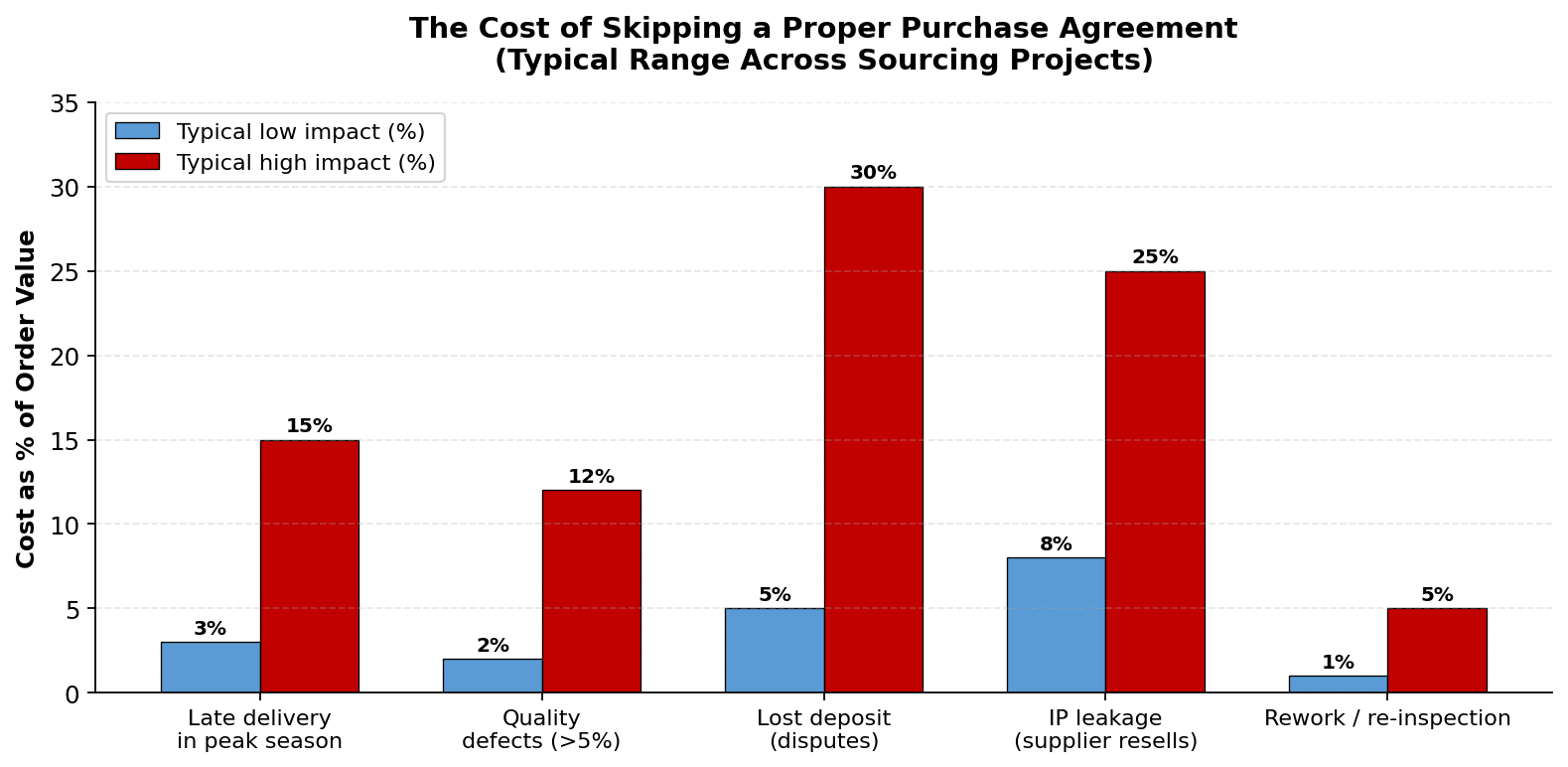
Typical cost ranges observed across international sourcing projects when key contract clauses are missing or weak
Reliable product sourcing starts here
Work with experts who help you evaluate suppliers and reduce risk.
What Should Be Included in a Supplier Purchase Agreement
A purchase agreement that actually protects a buyer covers more than ten distinct areas. Most buyers treat this section like an admin checklist. It is not each clause maps to a specific risk and a specific failure mode. Skipping any one of them is where most disputes start.
Parties and entities: legal names, registered addresses, business license numbers, and authorized signatories for both sides. The factory marketing name is rarely the same as its registered legal entity.
Product description and specifications: exact product name, SKU, materials, dimensions, weight, color codes, finishes, components, and any technical drawings. Attach the spec sheet as a numbered annex.
Quantity and pricing: total units, unit price, currency, and total contract value. State whether prices are fixed or subject to material cost adjustment and how that adjustment would be calculated.
Payment terms: deposit percentage, balance trigger, payment method, bank details, and any late payment terms. The most common protective structure is 30 percent deposit, 70 percent after passing inspection.
Quality standards and inspection rights: agreed AQL levels, sample size for inspection, who performs the inspection, where it takes place, and what qualifies as a failure. Include the right to reject or rework defective goods.
Lead time and delivery: production start date, shipping ready date, and the consequence if either is missed. Penalty clauses for delays of 1 to 3 percent of order value per week of delay are common.
Packaging and labeling: master carton specifications, inner packaging, labels, barcodes, marking, and any retailer-specific requirements such as Amazon FNSKU or FBA prep.
Incoterms: which Incoterm applies, FOB, EXW, CIF, DDP, or another. The chosen term defines who pays for what, where risk transfers, and what insurance and documentation responsibilities each party has. The current standard, Incoterms 2020 published by the International Chamber of Commerce, is the global reference.
Intellectual property and confidentiality: design ownership, mold ownership, restrictions on reuse, and a non-disclosure clause. For sensitive products, a separate NNN agreement is often required. Read more about how this works in our guide on what an NNN agreement is and when you need it.
Warranties and product liability: what the supplier guarantees about product performance, certifications, and compliance with destination market regulations.
Force majeure: events outside either party control that suspend obligations, such as natural disasters, port closures, or regulatory shutdowns.
Governing law and dispute resolution: which country law applies, where disputes are heard, and whether arbitration or court is the venue. This single clause often decides whether you can actually enforce anything.
Termination: conditions under which either side can exit, and what happens to deposits, work in progress, and tooling. If even one of these is left vague, suppliers will default to factory-standard interpretation, which always favors the factory, not the buyer.
Quick Reference Table: Core Clauses and What They Protect
Clause
What It Protects
Payment terms (30/70 with inspection)
Cash flow and recovery if quality fails
AQL-based quality clause
Defect rates and rework obligations
Lead time + delay penalty
Peak-season stockouts and lost sales
Mold and tooling ownership
Future production leverage and exit options
Governing law + arbitration venue
Whether the contract is enforceable in practice
IP, confidentiality, NNN
Design theft and supplier-side resale
Termination clause
Exit costs, deposit recovery, and work in progress
Reliable product sourcing starts here
Work with experts who help you evaluate suppliers and reduce risk.
Jurisdiction and Governing Law: Why Geography Matters
Governing law determines whether a contract is enforceable. For example, a US–China contract under US law with US jurisdiction is difficult to enforce in China, as US judgments aren’t directly recognized. By the time legal action concludes, the supplier may no longer exist. For sourcing in Asia, three jurisdictions show up most often as practical options:
Mainland China: enforceable against Chinese factories, written in Chinese, and tested in local courts. This is often the most realistic choice when sourcing from China, even though it sounds less safe to a foreign buyer.
Hong Kong: a common compromise. Hong Kong arbitration awards are recognized in mainland China under the New York Convention, which most major economies have signed.
Singapore: another arbitration-friendly hub used widely in Southeast Asian trade.
For countries like Vietnam, India, Turkey, or Indonesia, the choice is between local courts, the buyer’s jurisdiction, or neutral arbitration. The right option depends on supplier size, order value, and enforcement needs. A strong contract is one you can realistically enforce—not just one that looks good on paper.
Reliable product sourcing starts here
Work with experts who help you evaluate suppliers and reduce risk.
How to Create a Purchase Agreement with a Supplier: Step by Step
The structure below works for most international sourcing relationships. It assumes you have already shortlisted suppliers and selected one to move forward with. This is a key assumption: the agreement comes after supplier selection, not before. Drafting terms before you know who you are working with produces a generic document that fits no one well.
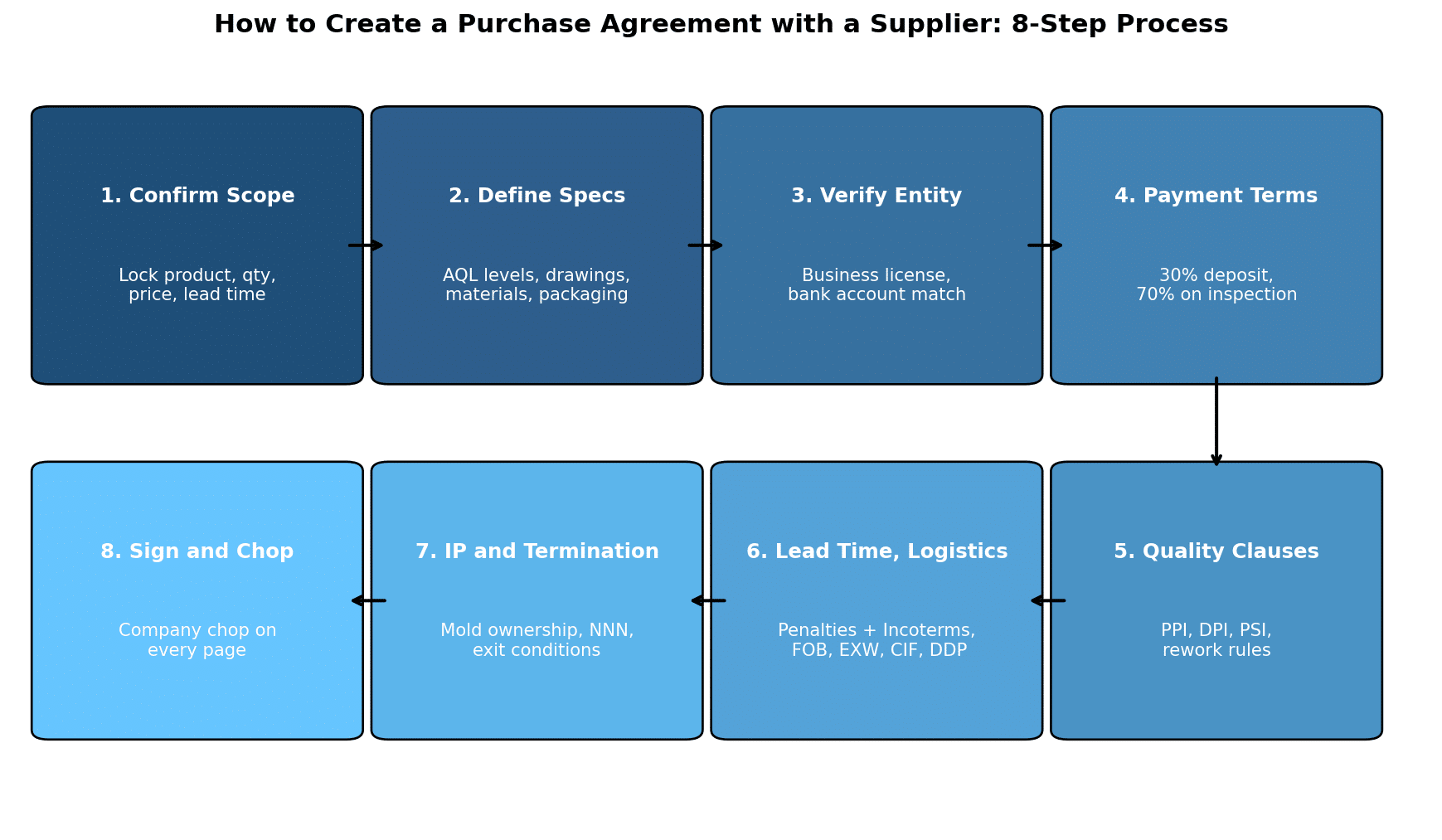
The 8-step buyer-side workflow for building a supplier purchase agreement that actually holds up.
Step 1: Confirm the Supplier and Product Scope
Lock down what you are buying and from whom before drafting anything. A short scope summary covering product, quantity, target unit price, lead time, and destination market, sent to the supplier for written confirmation, catches most disputes before they become contract clauses. “I assumed” is the root cause of more than 50% of sourcing conflicts. Written confirmation at this stage eliminates most of them.
Step 2: Define Specifications and Quality Standards
Build a product specification annex covering materials, dimensions, color codes (Pantone where relevant), finishes, weight, packaging, and components. Attach drawings, approved sample photos, and any test reports. Set inspection standards, typically AQL 2.5 for major defects and AQL 4.0 for minor defects, and define who pays for re-inspection if the first one fails. Specs are the contract. If your specifications are weak, everything else in the agreement becomes irrelevant, the factory will simply produce to whatever it finds easiest.
Step 3: Verify the Supplier Legal Entity
This is the step most buyers skip and later regret. The factory you spoke with may not be the legal entity that signs your contract. Request the business license, verify the registered name, and confirm the bank account belongs to the same entity. Many sourcing scams begin with a payment wired to a personal or third-party account. Read more in our breakdown of common sourcing scams when sourcing in China and how to avoid them.
Step 4: Negotiate Payment Terms
The standard buyer-protective structure is a controlled deposit and a balance tied to inspection. A typical split is 30 percent deposit, 70 percent after passing on-site inspection. Some factories will push for 50/50 or 70/30. Push back. Tie the balance to a documented inspection result, not “completion of production”. For larger orders, milestone payments tied to production stages also work.
Step 5: Add Quality Inspection and Compliance Clauses
Spell out when inspections happen, who performs them, who pays, and what failure means. A working clause includes pre-production (PPI), during-production (DPI), and pre-shipment inspection (PSI), plus the right to refuse shipment if inspection fails and the obligation for the supplier to rework defective units at their cost. Final payment is released only after a passing inspection report is issued.
For regulated products, list required certifications: CE for the EU, FCC for the US, RoHS for electronics, or LFGB and FDA for food contact materials. Reference standards from bodies like the International Organization for Standardization can be cited directly to avoid ambiguity.
Step 6: Define Lead Times, Penalties, and Logistics
State the production start date, shipping ready date, and consequences of missing them. A typical penalty is 1 to 2 percent of order value per week of delay, capped at a percentage of the total. Without a cap, suppliers refuse to sign. With one, the clause is enforceable.
Specify the Incoterm. EXW puts everything on the buyer from the factory door. FOB has the supplier deliver to the port and clear export. CIF adds freight and insurance to the destination port. DDP delivers to your door, duties paid. State the loading port, destination port, and required documentation, including certificates of origin, inspection certificates, and packing lists. Incoterms silently decide who is responsible for 80% of logistics headaches. Most buyers choose an Incoterm based on price when they should be choosing it based on control.
Step 7: Add IP, Confidentiality, and Termination Clauses
Specify who owns the design, molds, and tooling. If you paid for the molds, state they are your property and must be released on request, including after termination. Add a confidentiality clause covering designs, drawings, samples, and commercial terms. For sensitive or proprietary products, attach a separate NNN agreement (non-use, non-disclosure, non-circumvention).
Step 8: Sign, Stamp, and Distribute
Define termination conditions: what happens to the deposit if either side terminates, who owns work in progress, and how molds and finished inventory are handled. This is your exit safety net. Nobody thinks about the termination clause until something breaks and by then, its absence is the most expensive oversight in the entire agreement.
In Asia, a contract is rarely valid without the company chop, the official red stamp of the legal entity. A signature alone, even from the boss, is often not enough. Request a chop on every page plus the signature of the legal representative listed on the business license. Keep originals on both sides and send digital copies to your project, inspection, and logistics teams.
Sample Purchase Agreement Template
Below is a simplified sample of how a buyer-side purchase agreement is typically structured. Use this as a starting point only. A real agreement should be reviewed by qualified counsel familiar with the supplier jurisdiction.
PURCHASE AGREEMENT
This Purchase Agreement (“Agreement”) is entered into on [Date] between:
Buyer: [Legal Company Name], registered at [Address], represented by [Name, Title]
Supplier: [Legal Company Name], registered at [Address], business license number [Number], represented by [Name, Title]
1. Products and Specifications.
Supplier shall manufacture and sell the products described in Annex A (Product Specifications), which forms an integral part of this Agreement. Any deviation from Annex A requires prior written approval from the Buyer.
2. Quantity and Price.
Total quantity: [units]. Unit price: [USD]. Total order value: [USD]. Prices are fixed for the duration of this order.
3. Payment Terms.
Buyer shall pay 30 percent of the total order value as a deposit upon signing. The remaining 70 percent shall be paid within 7 days after the goods pass pre-shipment inspection by [Inspection Party] in accordance with AQL 2.5 for major defects and AQL 4.0 for minor defects.
4. Lead Time.
Production shall begin within 7 days of deposit receipt. Goods shall be ready for shipment no later than [Date]. For each calendar week of delay beyond this date, Supplier shall pay a penalty of 2 percent of the total order value, capped at 15 percent.
5. Quality Standards and Inspection.
Buyer or its appointed third party has the right to perform pre-production, during-production, and pre-shipment inspections. If the goods fail inspection, Supplier shall, at its own cost, rework or replace defective units within a reasonable timeframe. Final payment shall not be released until a passing inspection report is issued.
6. Delivery Terms.
Incoterms 2020, [FOB / EXW / CIF / DDP] [Port or Address]. Supplier is responsible for all costs and risks up to the point of transfer defined by the chosen Incoterm.
7. Packaging and Labeling.
As specified in Annex B (Packaging Specifications).
8. Intellectual Property and Confidentiality.
All designs, drawings, samples, and information provided by the Buyer remain the property of the Buyer. Supplier shall not manufacture, sell, or share the product or any derivative with any third party. Molds and tooling paid for by the Buyer remain the property of the Buyer.
9. Force Majeure.
Neither party is liable for failure to perform due to events beyond reasonable control, including natural disasters, war, or government action.
10. Governing Law and Dispute Resolution.
This Agreement shall be governed by the laws of [Jurisdiction]. Disputes shall be resolved by arbitration administered by [HKIAC / SIAC / CIETAC] in [City], in English.
11. Termination.
Either party may terminate for material breach with 30 days written notice. Upon termination, ownership of work in progress, deposits, and tooling shall be settled in accordance with Annex C.
Signed and chopped by both parties, in two original copies.
This is a stripped-down structure. A working agreement for a 100,000 USD order will typically run 8 to 15 pages with annexes. The structure above is the spine.
Common Mistakes Buyers Make with Supplier Purchase Agreements
The same mistakes show up across hundreds of sourcing projects. Avoiding them is often more valuable than adding clever clauses.
Using the factory template: most factory contracts are written to protect the factory. They include vague quality language, full payment before inspection, and disputes resolved in the factory home court. Starting from their template is the biggest structural disadvantage you can give yourself. You are negotiating from their position before the conversation has even begun.
Vague quality standards: phrases like “good quality” or “industry standard” are unenforceable. Without a defined AQL level, sample size, and inspection method, quality clauses are decorative.
No inspection-linked payment trigger: paying the balance “after production is complete” gives the supplier no incentive to fix problems. Tying the final payment to a passing inspection report changes the entire dynamic.
Missing penalty clauses: without a documented consequence for delay, lead times slip during peak season, exactly when the cost of delay is highest.
Wrong governing law: a contract governed by a court that cannot enforce against the supplier is a piece of paper, not a contract. Match the governing law to where the supplier assets actually sit.
Ignoring the legal entity: signing with a marketing name, a sourcing agent company, or a related entity instead of the actual manufacturer creates a structural enforcement problem from day one.
No mold or tooling clause: if you paid for the mold and it is not explicitly assigned to you in writing, the factory may keep it, charge you to release it, or use it for other clients.
Skipping the company chop: in China and several other Asian jurisdictions, a contract without the official chop is often treated as informal at best.
Not aligning the contract with the actual purchase order: when the PO and the agreement contradict each other, lawyers spend months arguing which one wins. They should be drafted as one consistent set.
Reliable product sourcing starts here
Work with experts who help you evaluate suppliers and reduce risk.
How Zignify Helps Buyers Build Purchase Agreements That Actually Protect Them
Zignify is not a law firm, and material orders still need qualified legal review. What Zignify does, as a buyer-side sourcing partner, is make sure the commercial structure of an agreement reflects what actually happens during production. Contracts fail when they are written like legal theory instead of factory reality, and most are.
Most contract failures are not legal failures. They are operational ones, written by people who have never run a quality inspection or chased a delayed shipment. Law firms draft contracts that are legally sound but disconnected from factory reality. Inspection providers focus on quality but never see the negotiation leverage. Factories certainly do not design contracts against themselves. Zignify sits at the intersection of all three, combining sourcing expertise, supplier negotiation, and contract structuring into a workflow built around how production actually works.
When clients work with Zignify on a sourcing project, contract design is built into the workflow. After supplier selection and sample approval, a purchase agreement is drafted using structures tested across many production projects, then adapted to the specific product, supplier, and country. The agreement reflects how the supplier you actually selected will operate during your specific production run, not a generic factory relationship that exists only on paper. A generic contract is essentially decorative. The value is always in adapting the specific clauses to the specific supplier, product, and country you are actually dealing with.
What a Zignify Purchase Agreement Typically Covers
Pricing and cost control: Fixed pricing with locked quantities, so suppliers cannot raise prices after a deposit is wired.
Product specifications: Exact materials, design, packaging, and performance requirements documented in detail, eliminating the most common production dispute.
Quality standards: Inspection rules, AQL levels, and defect thresholds written into the agreement so quality is measurable, not negotiable.
Delivery terms: Production timelines, shipping milestones, and clear responsibilities for each stage.
IP protection: Design ownership and confidentiality clauses, with a separate NNN agreement for custom or proprietary products.
Dispute handling: Penalty clauses, replacement obligations, and a workable legal jurisdiction that gives the buyer real leverage.
Bilingual contracts: Drafted in English and the supplier’s local language to close misunderstanding loopholes and improve enforceability.
Reliable product sourcing starts here
Work with experts who help you evaluate suppliers and reduce risk.
Real Results: Where the Agreement Locks In Sourcing Savings
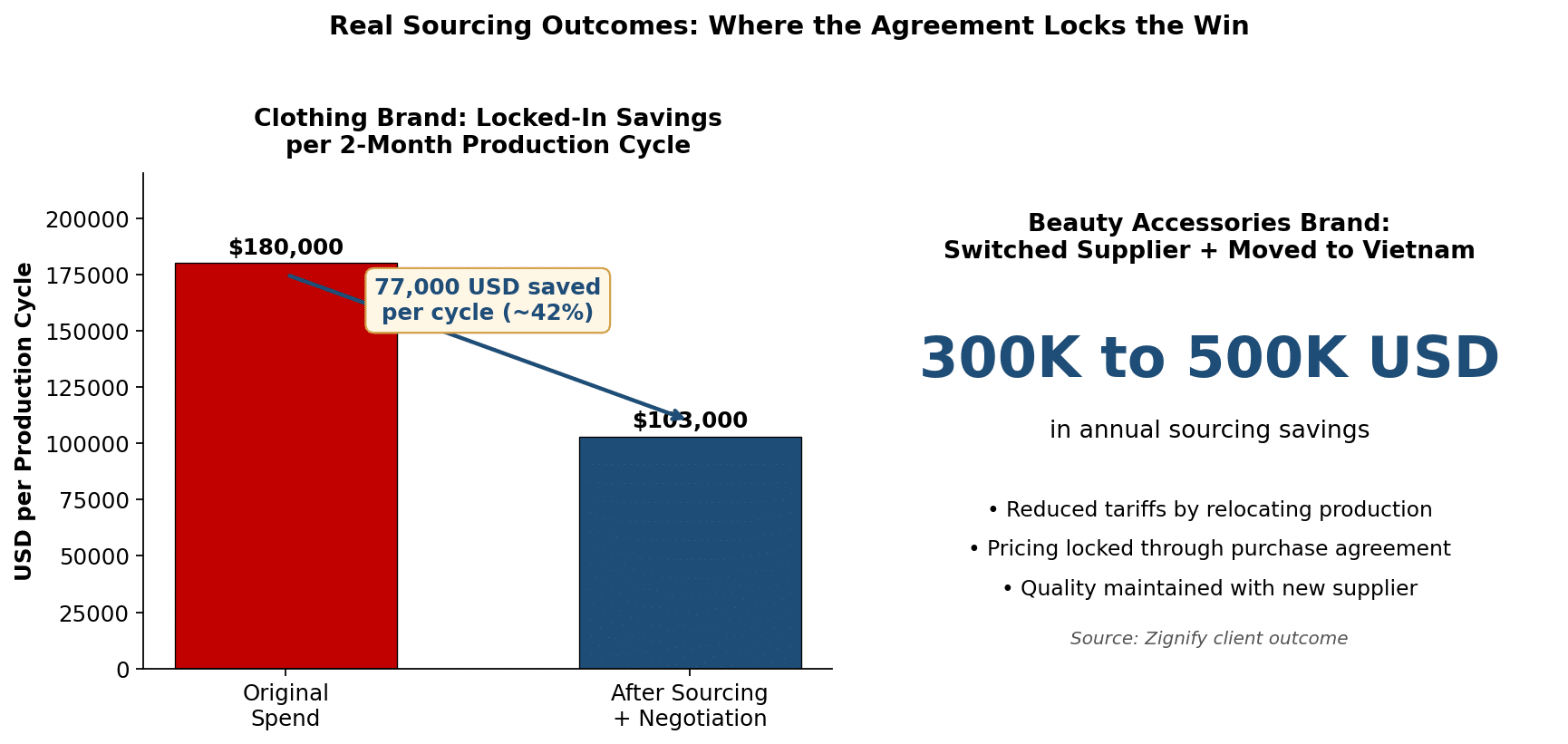
Real client outcomes. The negotiation creates the savings. The purchase agreement protects them over time. negotiation is short-term gain, contract structure is long-term retention of that gain
Clothing Brand: 77,000 USD Saved per Production Cycle
A clothing brand was spending around 180,000 USD every two months on a recurring production run. After Zignify ran a broader supplier search, benchmarked global pricing, and handled negotiation across multiple producers, the same volume came in at 103,000 USD per cycle. That is 77,000 USD saved per production cycle, roughly a 42 percent reduction in purchasing cost. The negotiation created the savings. The purchase agreement, with locked pricing, locked specifications, and a clear quality framework, kept those savings in place across reorders.
When You Actually Need a Purchase Agreement Like This
Not every order needs a 12-page agreement. A 500 USD test order from a marketplace seller does not justify the same structure as a recurring private label production run. The cost of a strong agreement scales with the size and complexity of what you are buying. The triggers below are when a properly structured purchase agreement stops being optional.
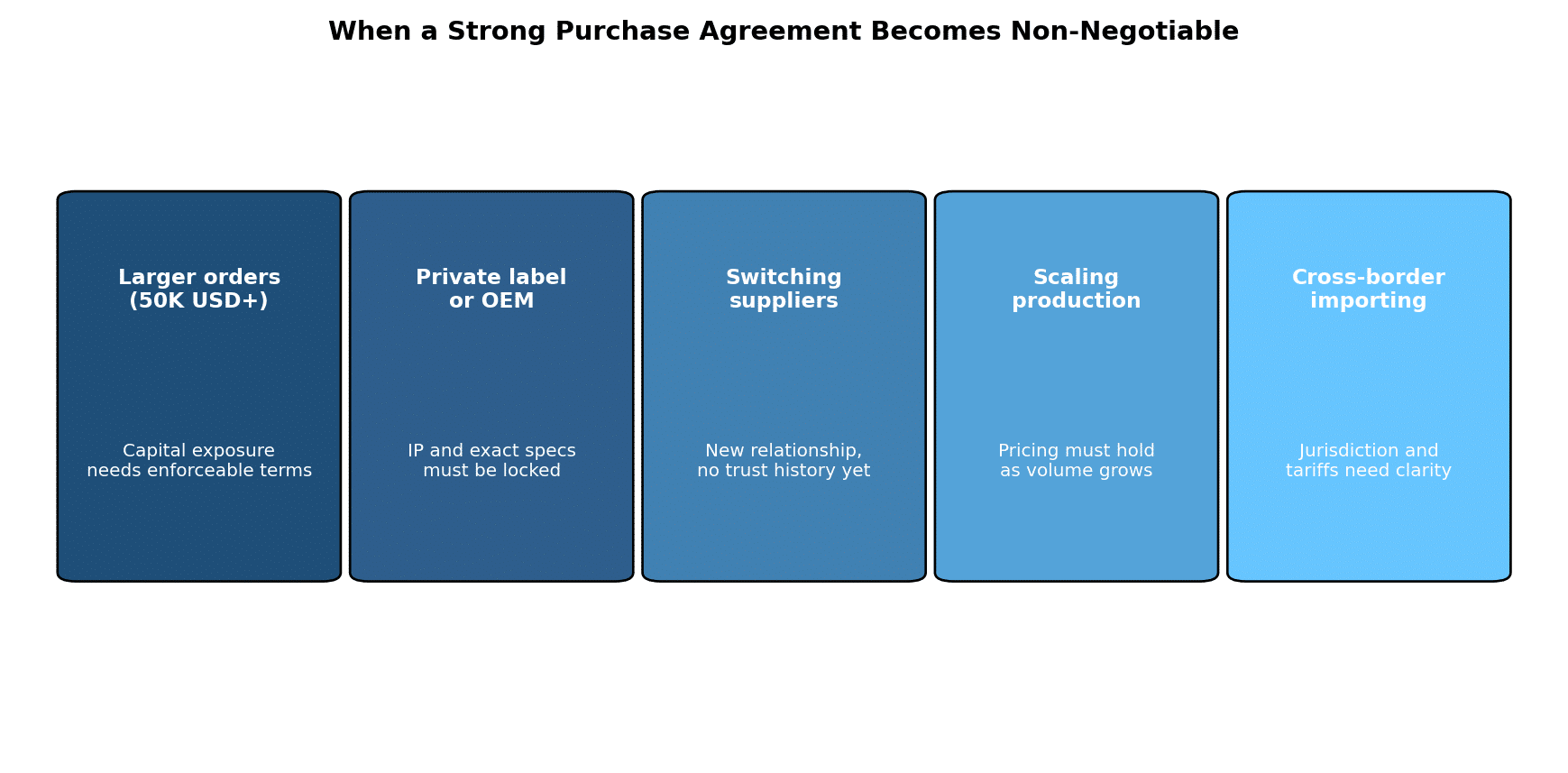
Five common situations where a buyer-side purchase agreement protects far more than it costs.
Larger orders (50,000 USD and above): The deposit alone is large enough that recovering it without an enforceable contract becomes expensive and uncertain. The agreement pays for itself on the first order it protects.
Private label and OEM products: When your brand goes on the box, materials, finishes, packaging, and quality thresholds need to be locked in writing. This protects both your brand consistency and your IP.
Switching suppliers: A new supplier has no track record with you. The agreement substitutes for trust until you have a few clean orders together.
Scaling production: As volumes grow, cost drift compounds. The agreement holds pricing stable during scaling and sets clear renegotiation triggers if material costs shift significantly.
Cross-border importing: The agreement decides which country law applies, who handles which cost, and how disputes are resolved, covering jurisdiction, currency, tariff, and customs documentation risk.
What You Are Actually Buying
A purchase agreement service is not really about getting a document. The document is the visible output. The real value is control over the supplier relationship. Without it, the supplier effectively controls price, quality, and timeline, because there is no enforceable framework to push back. With it, the buyer sets the terms and the supplier operates inside them. That shift in control is what protects margins, lead times, and brand quality across every order that follows.
What Most Guides Get Wrong, Here’s What Our Expert Knows ✅
Most online guides treat a purchase agreement as a paperwork exercise. After hundreds of real production projects across China, Vietnam, India, Turkey, and Indonesia, the patterns that actually decide whether a contract holds up are rarely the ones generic templates emphasize.
⚠️ The factory standard contract is built to protect the factory, not standardize the deal.
Factory templates almost always front-load payment, soften quality language, and put dispute resolution in the factory’s home court. Starting from the factory draft means starting from the factory’s position. Bring your own buyer-side template and make the factory respond to it. Suppliers who refuse to negotiate any change are telling you something important about how they handle problems later.
💰 Inspection-linked payment is the single most underused clause in international sourcing.
Most buyers focus on the deposit percentage and miss the more powerful lever: what triggers the balance. A 30/70 split where the 70 percent releases only after a passing third-party inspection report changes the dynamic entirely. Suddenly the supplier has a direct financial reason to meet specifications. The clause looks similar on paper. The behavior during production is completely different.
🚩 Governing law that cannot be enforced is the most expensive clause in the contract.
When buyers insist on home-country law and courts, it sounds safe but often turns a recoverable dispute into a total loss. A US judgment against a Chinese factory is rarely enforceable. Hong Kong arbitration, or Chinese law through CIETAC, is genuinely more actionable. The right governing law is the one that lets you actually act when something goes wrong, not the one that feels familiar.
Before you sign your next supplier purchase agreement, get a buyer-side review of the three clauses that decide whether the document actually protects you. Book a free sourcing call →
Frequently Asked Questions
1. What is a purchase agreement with a supplier?
A purchase agreement with a supplier is a written contract that defines product specifications, quality standards, payment terms, lead times, penalties, and dispute resolution before goods are produced and shipped. It is broader than a purchase order and is the document that turns a verbal understanding into something enforceable.
2. What should be included in a supplier purchase agreement?
A practical supplier purchase agreement should include parties and legal entities, product specifications, pricing, payment terms tied to inspection, quality standards with AQL levels, lead time and delay penalties, packaging, Incoterms, IP and confidentiality clauses, governing law, and termination conditions. Skipping any one of these is where most disputes start.
3. Is a purchase agreement legally binding?
Yes, a properly signed purchase agreement is legally binding in most jurisdictions. The harder question is whether it is enforceable in practice. A contract governed by a country whose courts cannot reach the supplier is binding on paper but rarely useful when something goes wrong, which is why governing law and arbitration venue matter so much.
4. What is the difference between a purchase order and a purchase agreement?
A purchase order confirms a specific transaction, including quantity, price, and delivery date. A purchase agreement defines the broader terms governing that transaction or an ongoing supply relationship, including quality, penalties, IP, and dispute resolution. For meaningful production orders, a PO alone is usually not enough.
5. How do I write a purchase agreement with a supplier?
Start by confirming the scope in writing, then draft sections covering parties, specifications, pricing, payment terms tied to inspection, quality clauses, lead time and penalties, Incoterms, IP, governing law, and termination. Keep specifications in a numbered annex, sign and chop every page, and have qualified counsel review the final draft for material orders.
6. What does a purchase agreement look like?
A working supplier purchase agreement is typically 8 to 15 pages of clauses plus annexes for product specifications, packaging, and tooling ownership. The sample template earlier in this article shows the spine of a typical buyer-side agreement: parties, product, payment, lead time, quality, delivery, IP, governing law, and termination.
7. What is the difference between a master supply agreement and a purchase agreement?
A master supply agreement (MSA) is an umbrella contract for ongoing supply over time, with individual purchase orders or release agreements issued under it. A purchase agreement is often tied to a specific order or production run. For long-term relationships and repeat orders, an MSA plus structured POs is typically cleaner than renegotiating a full agreement every order.
8. Can a supplier back out of a purchase agreement?
A supplier cannot lawfully back out of a signed purchase agreement without breach unless force majeure or another defined termination trigger applies. In practice, what matters is whether your agreement gives you a remedy, such as deposit recovery, damages, or specific performance, and whether the governing law and venue make that remedy enforceable.