Launching a private label product looks straightforward on paper. Find a winning product, find a factory, brand it, ship it. In practice, most private label brands that fail in the first 18 months do not fail because of branding or marketing. They fail because of decisions made deep inside the supply chain and it’s a reality most founders only discover after their first production crisis or cash flow squeeze. The wrong supplier, the wrong country, an MOQ that locks up capital, a quality gap that kills reorders, or a cost structure that leaves no room for paid acquisition.
This guide walks through how to launch a private label product the way experienced operators actually do it. Not as a one-shot product launch, but as a supply chain you can scale, defend, and eventually exit on your own terms. Because sustainable private label brands are supply chain businesses first, and marketing businesses second, and the founders who last are the ones who treat them that way from day one.
Reliable product sourcing starts here
Work with experts who help you evaluate suppliers and reduce risk.
What Launching a Private Label Product Really Means
Private label means selling products under your own brand while a third-party manufacturer handles production, typically under an OEM or ODM arrangement. You own the brand, the packaging, the customer relationship, and the listing, not the production line. Many founders conflate the two. What you actually control is the spec and the standards you hold your supplier to.
Private label products show up in almost every consumer category, including:
Cosmetics and skincare brands sold on Shopify or in retail.
Supplements and wellness brands sold on Amazon FBA.
Clothing, fashion accessories, and beauty tools.
Home goods, kitchenware, and baby products.
Food and beverage brands with custom formulations.
Private label vs white label vs OEM vs ODM
Private label: a product made by a manufacturer for one specific brand, often with formula, ingredient, or packaging customization.
White label: a generic product sold to multiple brands with little or no customization. Faster to launch, easier for competitors to copy.
OEM (Original Equipment Manufacturer): the factory builds to your design and specifications, you control the IP.
ODM (Original Design Manufacturer): the factory provides a base design, you customize on top of it. Most first-time buyers mix OEM and ODM together when they are operationally very different
The real challenge is not finding a supplier. It is choosing the right manufacturer, controlling quality, optimizing cost, managing MOQ, protecting your brand, and avoiding the mistakes that quietly destroy margins for years. That is where most brands fail. For a deeper breakdown of the different manufacturer types and how to pick one, see Types of Manufacturers for Product Sourcing.
Reliable product sourcing starts here
Work with experts who help you evaluate suppliers and reduce risk.
Why Private Label Sourcing Is Where Most Brands Win or Lose
The math behind a private label brand is unforgiving. By the time you account for product cost, packaging, freight, duties, FBA fees, returns, and ad spend, your contribution margin is often a single-digit percentage. A 50 cent difference per unit at the factory does not sound like much, until you sell 50,000 units a year and realize it changes whether the brand is profitable or not.
Three forces decide whether a private label business survives:
Cost structure. The price you pay the factory is the foundation of every other margin in your business. Brands that get sloppy here pay for it forever.
Supplier reliability. Late shipments, quality drift, or a supplier going dark mid-production can kill an Amazon ranking, miss a Q4 window, or end a retailer relationship.
Country exposure. A brand entirely dependent on one country, especially China during periods of high tariffs and shifting trade rules, is one policy change away from a margin crisis. A diversified sourcing footprint, often called a China plus one strategy, is no longer optional for serious brands. Diversification is now part of risk management, not just cost optimization.
This is also why launching fast is bad advice for private labels. Speed of launch matters less than speed of correction, the ability to adjust suppliers, MOQs, packaging, and cost without rebuilding the brand from scratch.
Reliable product sourcing starts here
Work with experts who help you evaluate suppliers and reduce risk.
Where to Manufacture: Country and Region Tradeoffs
Choosing where to produce is one of the most strategic decisions in launching a private label product and it affects far more than price. Country selection shapes your compliance obligations, logistics complexity, tariff exposure, and even how your brand is positioned in the market. The right choice depends on your product category, target margin, certification requirements, and whether you’re selling into the US, Europe, or both.
A simplified view of common manufacturing regions for private label brands:
Largest supplier base, deep specialization by city, mature export logistics
US tariffs and HTS exposure, IP risk, single-country concentration. China still dominates for scale and manufacturing depth, especially for technically demanding products
Vietnam
China-plus-one diversification, textiles, footwear, home goods
Lower tariff exposure for US importers, growing capacity, FTA coverage
Smaller supplier pool than China, capacity constraints in peak season. Vietnam works well strategically, but many buyers underestimate how fast strong factories fill up there.
India
Textiles, leather, ayurvedic, packaging, brass and steel goods
Lead times can be longer, quality consistency varies by region. India can create excellent value, but supplier selection and process control are critical.
Turkey
European-facing brands, textiles, cosmetics, food
Short freight to Europe, EU customs union benefits, strong cosmetics base
Currency volatility, less familiar to US-based buyers. Turkey is especially strong for brands prioritizing shorter lead times into Europe.
Europe (DE, IT, PL, FR)
Premium positioning, regulated categories, fast EU lead times
High quality, strong cosmetics and food regulation, brand storytelling value
Higher unit cost, smaller MOQ flexibility, longer payment terms. European manufacturing becomes much more attractive once brand positioning and compliance matter more than lowest unit cost
Manufacturing region tradeoffs for private label brands.
The real mistake is treating country choice as a single, fixed decision. Mature private label brands don’t optimize by country loyalty, they optimize by function. A brand might formulate cosmetics in Germany for the regulatory credibility, source packaging from China for cost efficiency, and handle final assembly closer to the destination market to reduce lead times and tariff exposure. Country selection, at scale, is less about picking one place and more about building a supply chain where each node does what it does best.
For a verified list of supplier types and where to find them, see Zignify’s Guide to Find Verified Private Label Manufacturers.
Reliable product sourcing starts here
Work with experts who help you evaluate suppliers and reduce risk.
The 8-Step Process to Launch a Private Label Product
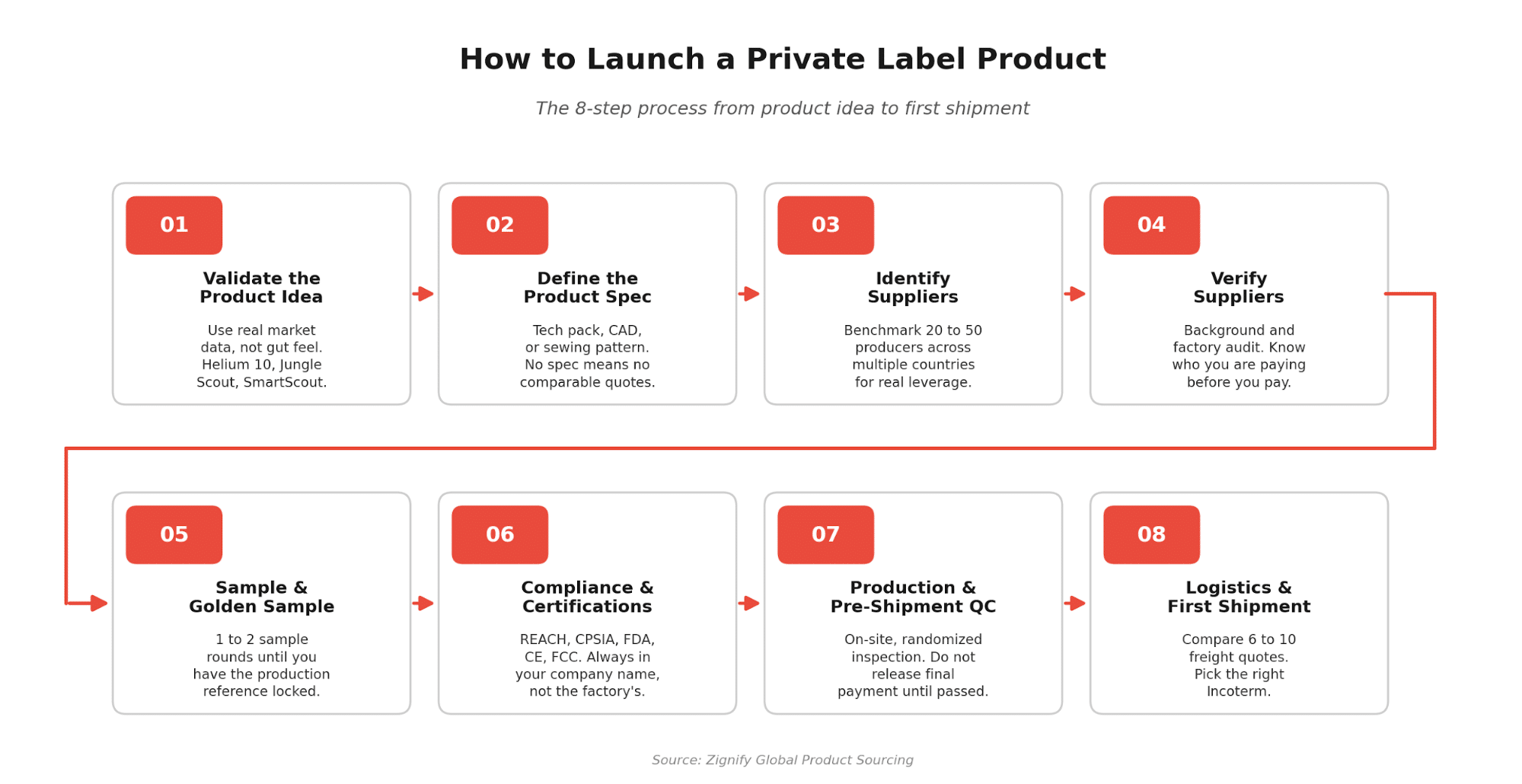
This is what an actual end-to-end private label launch looks like, from product idea to first shipment. The diagram below summarizes the full flow at a glance, then each step is explained in detail.
The 8-step private label launch flow, from product validation to first shipment.
Step 1: Validate the product idea
Before you spend a cent on sourcing, validate the product. Tools like Helium 10, Jungle Scout, SmartScout, and DataDive let you see real revenue, competition strength, and review counts in any niche. A category doing $500K to $2M a month with only a handful of strong competitors is a real opportunity. A category with twenty top-tier listings and 10,000 reviews each is not, regardless of how trendy it looks. Validating with data, not opinion, is what reduces launch risk.
Step 2: Define the product (technical drawings and tech pack)
I know what I want is not a specification. A factory needs measurements, materials, tolerances, finishes, packaging, and any compliance requirements written down. Depending on the product, this becomes a tech pack, CAD drawing, 3D file, or sewing pattern. Without it, two factories will quote you for two different products and you will not be able to compare them properly.
Step 3: Identify suppliers (broad search, not three quotes)
This is where most private label launches go wrong. Beginners contact three or four suppliers from page one of Alibaba and pick the cheapest. Experienced sourcing teams build a list of 20 to 50 potential producers across multiple countries, then filter down to the ones who can actually hit the spec at the right capacity. Comparing three suppliers doesn’t benchmark the market, it just gives you three random prices.
Serious sourcing starts when you have enough responses to see patterns: where pricing clusters, where quality signals diverge, which factories are quoting on spec versus cutting corners to win the job. Twenty quotes give you a real picture. Three give you the illusion of one.
Step 4: Verify suppliers (background and factory audit)
Before you send a deposit, you need to know who you are dealing with. A supplier audit answers the basic but critical questions:
Is the supplier actually a manufacturer, or a trading company in disguise?
How long have they been operating, and who owns them?
Are there legal disputes, financial red flags, or other negative records?
Does the factory match what they show on their website?
For higher value or higher risk orders, an on-site factory audit is worth the cost. This is often where a sourcing partner adds the most value, because most first-time buyers cannot do this remotely on their own.
A supplier can look perfect on Alibaba and still be a complete disaster operationally. We’ve seen factories outsource production without telling the buyer, use fake factory photos, or operate with almost no real QC process. A proper audit usually reveals problems very quickly if you know what questions to ask.
Step 5: Sample, refine, golden sample
The first sample is almost never perfect. Plan for one or two rounds of refinement, with corrections to materials, dimensions, finishes, packaging, or print colors. The goal is to reach what experienced sourcing teams call the golden sample, the final approved version that becomes the legal and quality reference for mass production. Without a golden sample, the factory has too much room to interpret things on their own.
This is one of the biggest misunderstandings with new buyers. They think “approved sample” automatically means production quality is locked in. It’s not. If tolerances, materials, packaging details, and acceptable defects are not clearly documented around the golden sample, factories will fill in the gaps themselves, usually in the way that is cheapest for production
Step 6: Compliance and certifications
Compliance is where products get blocked at customs, delisted from Amazon, or recalled. Depending on category and target market, you may need:
REACH or POP testing for chemicals.
CPSIA testing for kids’ products.
FDA registration for cosmetics and supplements in the US. The US FDA cosmetics page outlines current requirements.
EU Cosmetics Regulation 1223/2009 compliance for cosmetics in Europe.
CE marking for electronics in Europe and FCC certification for wireless products in the US.
Compliance happens in two phases. First, figure out what is required. Second, organize the lab testing and get documents issued in your company name. Both matter. Certificates issued in the factory name will not protect your brand.
Reliable product sourcing starts here
Work with experts who help you evaluate suppliers and reduce risk.
Step 7: Production and pre-shipment quality control
Once you place the deposit, the factory begins production. The most important moment in this whole process is the pre-shipment inspection, the on-site check that happens after production is finished but before final payment is released. The rule is simple. Do not pay the balance until inspection is passed.
A proper pre-shipment inspection involves randomly selecting units, not the ones the factory hand-picks for you, checking against AQL standards, photographing defects, and verifying packaging and labeling. If issues are found, the factory reworks the goods or pays penalties.
This matters because your leverage disappears the moment final payment is sent. After that, fixing problems becomes dramatically harder, the factory has been paid, the goods are packed, and any dispute turns into a negotiation you’re not in a position to win. Pre-shipment inspection is non-negotiable on serious orders precisely because it’s the last point where you still have control. It protects your first batch and sets the quality standard for every reorder that follows.
Step 8: Logistics, import, and first shipment
Logistics is the final cost trap most new brands miss and one of the most underestimated levers for margin improvement. Most brands obsess over product cost while leaving freight and duty structure almost entirely unoptimized. But once volume grows, logistics can move margins nearly as much as supplier pricing.
Factories often default to their preferred forwarder, which is rarely the cheapest or the most transparent. Comparing six to ten freight quotes, choosing the right Incoterm, EXW, FOB, or DDP, and understanding your duties and tariffs can save thousands per container. In some cases, changing Incoterms alone has improved cash flow and eliminated hidden fees that brands didn’t even know they were paying.
Reliable product sourcing starts here
Work with experts who help you evaluate suppliers and reduce risk.
Real Case Studies: What Better Sourcing Actually Saves
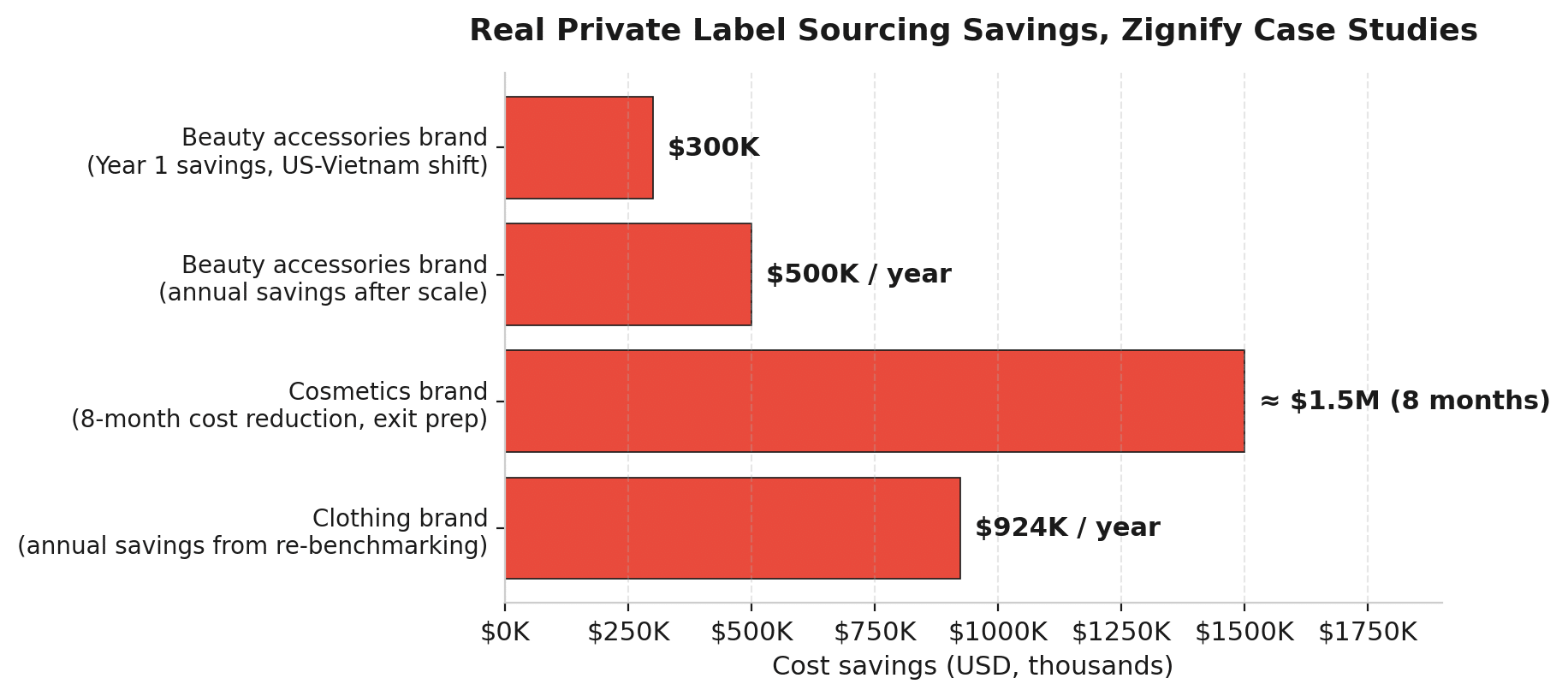
The chart below summarizes three real client situations where better sourcing translated directly into private label cost savings. Names are kept generic, but the situations and numbers are real.
Real private label sourcing savings achieved through Zignify case studies.
Beauty accessories brand: $500K annual savings
An established US e-commerce seller hit hard by tariffs from China. Margins were shrinking, supplier options were limited, and the brand was overexposed to one country. Through a broad supplier search across Vietnam, the team identified a manufacturer with better quality at a lower unit cost. Result: roughly $300K saved in year one, and around $500K in annual savings once the new sourcing was scaled. Insight: private label success depends on supplier selection and country strategy, not branding alone.
Cosmetics brand: €1.4M cost reduction before exit
A seven to eight figure private label cosmetics brand preparing for sale to an aggregator. Production cost was high, supplier structure was inefficient, and packaging was over-engineered. Better suppliers were sourced across Germany and other countries. Packaging was redesigned and renegotiated. The full supply chain was rebuilt. Result: €1.4M in cost reduction within 8 months. Because aggregators value brands as a multiple of profit, this directly increased exit valuation. Insight: sourcing optimization is also exit-strategy work.
Clothing brand: $77K saved every two months
An existing private label clothing brand with a long-term supplier relationship and high ongoing production cost. Instead of switching suppliers, 55 alternative manufacturers were benchmarked and the resulting quotes were used as negotiation leverage. The original supplier matched the new pricing rather than lose the account. Result: roughly $77K saved every two months, around $924K per year. Insight: private label brands can massively increase margins without changing suppliers, simply by understanding the real market price and using it.
This happens more often than people think. Suppliers usually price based on how informed the buyer is. The moment they realize you actually benchmarked the market properly, pricing behavior changes very quickly.
Common Pitfalls When Launching a Private Label Product
The same mistakes show up repeatedly with first-time and even experienced brand owners.
Picking the cheapest quote. The cheapest unit price is rarely the lowest total cost once defects, delays, and rework are included.
Settling for three suppliers. Three quotes give you no leverage. The market price reveals itself across 20 to 50 quotes, not three.
Skipping supplier verification. Sending money to an unverified supplier in another country is one of the most expensive mistakes a brand can make.
Letting the factory write the contract. Without a clear purchase agreement covering pricing, MOQ, delivery, quality standards, and penalties, you have no leverage when something goes wrong.
Underestimating compliance. Missing certifications can block imports, freeze Amazon listings, and trigger marketplace suspensions.
Overpaying on packaging and freight. Packaging and logistics are often the easiest places to find 10 to 20 percent savings, but most brands never look. One Zignify cosmetics client saved 15 cents per unit on packaging alone, $150 per 1,000 units shipped.
Ignoring country diversification. Brands built on one country are exposed to tariffs, geopolitics, and supplier failure in ways most founders underestimate, until it happens.
Reliable product sourcing starts here
Work with experts who help you evaluate suppliers and reduce risk.
How Zignify Supports the Full Private Label Journey
Zignify is positioned as a buyer-side sourcing partner for private label brands. The company does not act as a manufacturer or trading company, and it does not take commissions from factories. The model is hours-based: you pay only for the work delivered, you have direct access to suppliers, and you pay the factory directly.
The full private label support cycle covers:
Product and market alignment. Validating product feasibility, target costs, and country strategy before sourcing begins.
Global supplier sourcing. Benchmarking 20 to 50+ manufacturers across China, Vietnam, India, Turkey, Europe, and other relevant regions.
Negotiation. Reducing or restructuring MOQ, negotiating pricing tiers, and aligning payment and production terms.
Supplier verification and auditing. Background checks, factory audits, and capability assessment to reduce risk before money moves.
Sampling and golden sample management. Coordinating samples, refining specs, and locking in a production reference.
Compliance and lab testing. Identifying required certifications and managing the lab and documentation process.
Purchase agreement design. Structuring contracts that lock in pricing, quality, delivery, and accountability.
Production and quality control. On-site, randomized pre-shipment inspections so you only pay for goods that meet spec.
Logistics optimization. Comparing freight quotes across multiple carriers and structuring Incoterms in your favor.
Long-term cost optimization. Continuously renegotiating, diversifying, and improving the supply chain after launch.
This full-cycle approach is the difference between a one-time product launch and a defensible private label business.
Reliable product sourcing starts here
Work with experts who help you evaluate suppliers and reduce risk.
What Most Guides Get Wrong, Here’s What Our Expert Knows ✅
Most beginner guides treat private label as a marketing problem with a sourcing afterthought. After helping brands run launches, optimize cost, and prepare for exits, three things stand out as the difference between a private label that scales and one that stalls.
⚠️ The cheapest quote is almost never the lowest total cost.
First-time buyers anchor on unit price. Experienced operators look at total landed cost, including defects, rework, late shipments, packaging waste, freight, and the cost of switching suppliers if the relationship breaks. A factory that quotes 8 percent below the market is often the one that cuts corners on materials, then rebills you on the second order, or fails AQL inspection on the first run. Cheapest quote and lowest total cost are not the same thing, and the gap shows up in your reorder cycle, not in your first PO.
💡 Negotiation leverage comes from breadth, not pressure.
New brands try to negotiate by pushing harder on three quotes. That rarely works because the supplier knows their three competitors and knows roughly what they will offer. Real leverage comes from breadth. When you have benchmarked 20 to 50 suppliers across multiple countries and you can show a factory you actually have alternatives at the same spec, the conversation changes. Most of the headline savings in case studies that hit six and seven figures come from this dynamic, not from being a tougher negotiator.
📋 Compliance and certifications must be in your name, not the factory’s.
This catches more brands than any other compliance issue. The factory has lab reports and certifications already, often shown proudly during sourcing calls. They are usually issued in the factory’s name or in the name of an earlier customer. They will not protect your brand if customs inspects your shipment or if Amazon requests proof of compliance. Always insist that test reports and certificates are issued in your company name and tied to your specific batch, not just the factory’s general certification.
Planning your first private label production run? Book a free sourcing call →
Frequently Asked Questions
1. How much does it cost to launch a private label product?
Total launch cost depends on category, MOQ, packaging, and target market, but a realistic range for a first private label SKU is $5,000 to $30,000. That covers product samples, the first production run, packaging, compliance and lab testing, and freight. Brands that skip due diligence often pay more later in defects and rework than they save on the upfront budget.
2. How do I find a private label manufacturer?
Most buyers start on Alibaba, Global Sources, or industry-specific platforms, then validate suppliers through audits and samples. The mistake is stopping at three or four suppliers. A proper search benchmarks 20 to 50 manufacturers across multiple countries and filters them by capability, MOQ, and verified background. A sourcing partner can compress this from months to weeks.
3. What is the difference between private label and white label?
Private label products are made for a single brand, often with formula, ingredient, or packaging customization. White label products are generic and sold to multiple brands with little or no modification. Private label gives you more brand defensibility, while white label gives you faster speed to market at the cost of differentiation.
4. Can I sell private label products on Amazon?
Yes, private label is one of the most common Amazon FBA business models. To do it well, you need a verified supplier, your own UPC or GTIN exemption, a compliant listing, all required certifications in your company name, and proper trademark protection if you plan to enrol in Amazon Brand Registry.
5. Should I private label my product?
Private label makes sense when you can build real brand value, defend a niche, and operate at margins that justify the higher upfront work. It is the wrong model if you only plan to sell a generic product at the lowest price, with no brand, packaging, or differentiation. In that case, reselling or white label may be a better fit.
6. Who manufactures private label products?
Private label is produced by OEM and ODM manufacturers across nearly every category, in countries including China, Vietnam, India, Turkey, Mexico, Indonesia, and across Europe. The right manufacturer depends on category, certification requirements, target market, and how much customization you need.
7. How do I create my own brand using a private label?
Validate the product, define the spec, source and verify the manufacturer, refine the sample to a golden sample, secure compliance, and protect your brand with trademarks before you scale. Most successful private label brands start with one strong SKU, prove the demand, and then expand into a small line under the same brand.