Most buyers do not lose money because the factory was bad. They lose money because they never actually verified who they were sending it to, or worse, because the supplier they thought was a manufacturer turned out to be something else entirely. Wrong supplier identity is one of the most common and most costly risks in global sourcing, and a factory audit is the primary tool to catch it before any money moves. A factory audit china buyers run properly is the difference between a clean first order and a costly six-month recovery. It is also one of the most misunderstood steps in global sourcing, because so many guides treat it like a checklist exercise instead of a real risk decision and a go/no-go decision point.
This article breaks down how to run a factory audit in a way that actually protects your business. We will look at what a factory audit is, the real difference between remote and on-site verification, what a proper supplier audit report should contain, and what most buyers get wrong when they try to verify a chinese manufacturer on their own. The goal is not to give you a generic template. The goal is to help you make a sourcing decision you will not regret six weeks after the wire transfer clears.
Need help with your product sourcing?
Get practical advice tailored to your product, suppliers, and market form Zignify experts
What a Factory Audit Actually Is, And What It Is Not
A factory audit is a structured verification of a supplier’s identity, capabilities, and operations, carried out before you commit to placing a serious order. It is not a marketing video the factory sent you. It is not a verified badge on a B2B platform. It is not a phone call with the sales manager. A proper factory audit produces evidence.
A proper factory audit produces evidence and more importantly, it is a go/no-go decision tool. It is the structured input that tells you whether to proceed, hold, or walk away.
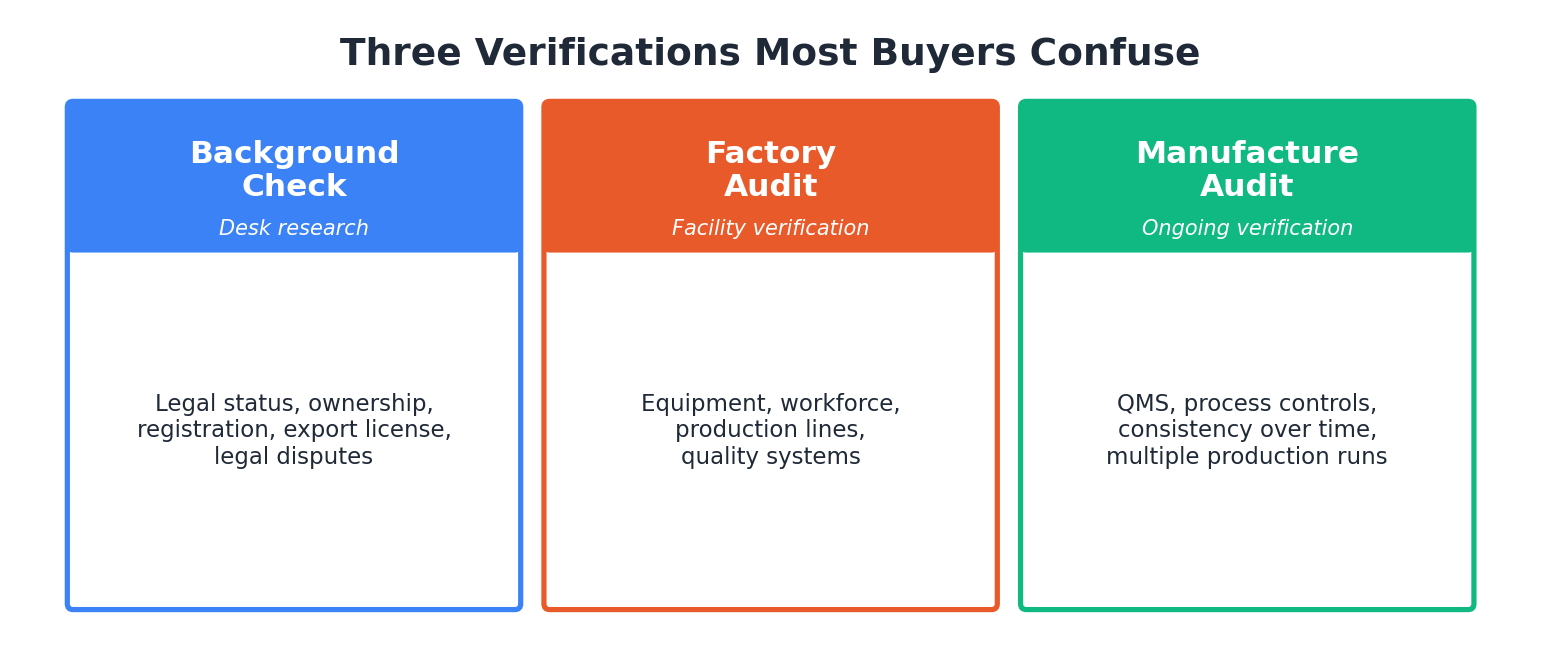
Most buyers confuse three different things, and that confusion is where the risk lives:
Figure: The three verification layers are different tools. Skipping any of them creates a different blind spot.
Supplier background check: a verification of the company’s legal existence, ownership, registration, export license, and any legal or financial red flags. This is a desk-based investigation.
Factory audit: an on-site or remote inspection of the actual facility, equipment, workforce, production lines, and quality systems. This is where you confirm the company can actually produce what they say they can produce.
Manufacture audit: a broader term often used for ongoing audits across multiple production runs, covering quality management systems, process controls, and consistency over time.
Product ownership reality: In China sourcing, there is a fourth verification layer that is frequently overlooked, who actually controls the tooling, design, and IP behind the product you are buying. A supplier may legitimately manufacture your product but hold none of the molds, formulations, or technical documentation. In the event of a dispute or supplier switch, this distinction becomes critical. A thorough audit should establish who owns the tools, not just who runs the machines.
You usually need at least the first two before placing any meaningful order. The mistake buyers repeat is collapsing all three into a single Skype call with the supplier and calling it “due diligence.”
Why a Factory Audit Matters in Business Terms
Skipping verification is not free. It looks free because nothing bad has happened yet. But the cost of a failed sourcing decision typically shows up in one of four ways: delayed shipments, defective goods you paid for, anti-dumping or compliance violations that get the shipment seized, or a supplier that disappears after you send the deposit.
Common cost patterns when verification is skipped:
Failure Pattern
What Actually Happens
Business Cost
Trading company in disguise
Middleman adds margin, removes control over quality
5-25% overpayment, lost leverage
Wrong specialization
Factory exists but subcontracts your product elsewhere
Quality drift, no traceability
Capacity overstatement
Claims 50k/mo, actually does 8k/mo with night shifts
Delays, QC failures at scale
Hidden ownership issues
Owner tied to disputes, bankruptcies, unpaid debts
Lost deposit, vanishing supplier
Bait-and-switch quality
First shipment looks good; subsequent orders use cheaper materials or lower-grade components
Margin erosion, customer complaints, returns
Same factory, multiple quality tiers
The same facility ships different quality levels depending on buyer size and perceived leverage
Inconsistency, damaged brand reputation
The point of a factory audit is not to “verify the supplier.” The point is to make sure your money, your timeline, and your product are protected before you commit.
Reliable product sourcing starts here
Work with experts who help you evaluate suppliers and reduce risk.
A proper supplier audit report is not three pages of generic checkboxes. It should give you a clear picture of who the supplier is, what they can actually deliver, and where the real risks are. The audit should cover the following areas, regardless of whether you are doing it remotely or on-site.
Audit Area
What It Verifies
Legal & Ownership
Business license, export license, year of establishment, registered capital, shareholders, related companies, public legal disputes
Facility & Scale
Factory size in m², number of production lines, number of workers, equipment list, match to supplier’s described scale
Production Capability
Products they actually make, in-house vs outsourced steps, monthly capacity, typical lead times for your category
ISO 9001, BSCI, Sedex, SMETA, WRAP, BV, SGS reports, product-specific certifications for your market
Workforce & Compliance
Number of workers, working hours, wage records, dormitory conditions if applicable, basic safety practices
Reference Business
Clients they currently produce for, export experience to your specific market, verifiable references
Tooling Ownership & Production Traceability
Who owns the molds, dies, and tooling; how production batches are tracked; whether the factory controls the full production flow or depends on third-party processes for critical steps
A supplier audit report that does not cover these areas is not really an audit. It is a sales document with photos.
Types of Factory Audit You Should Know
Different audit types focus on different risks. You do not always need every type, but you should know which one applies to your situation.
Audit Type
Focus
When You Need It
General Factory Audit
Identity, scale, equipment, capacity, basic quality systems
Default for first verification
Technical Audit
Deeper review of production capability for a specific product category
Complex or engineered products
Social Compliance (BSCI / Sedex / SMETA / WRAP)
Labor practices, working hours, wages, workplace conditions
Waste handling, emissions, chemical management, environmental compliance
EU buyers, large retailers
Security Audit (C-TPAT / SCAN)
Supply chain security against tampering
US-bound shipments
One important note from real sourcing practice: do not over-audit too early. Running a full social compliance audit on a supplier you have not confirmed can actually manufacture your product burns budget without reducing real risk. Start with identity and capability verification. Layer in compliance audits once you have confirmed the supplier is worth committing to.
Reliable product sourcing starts here
Work with experts who help you evaluate suppliers and reduce risk.
Factory Audit in China: Why China Is a Special Case
Most factory audit demand globally is tied to China for a reason. The supplier base is enormous, the language and distance gap is real, and the volume of trading companies presenting themselves as manufacturers is higher than in almost any other market.
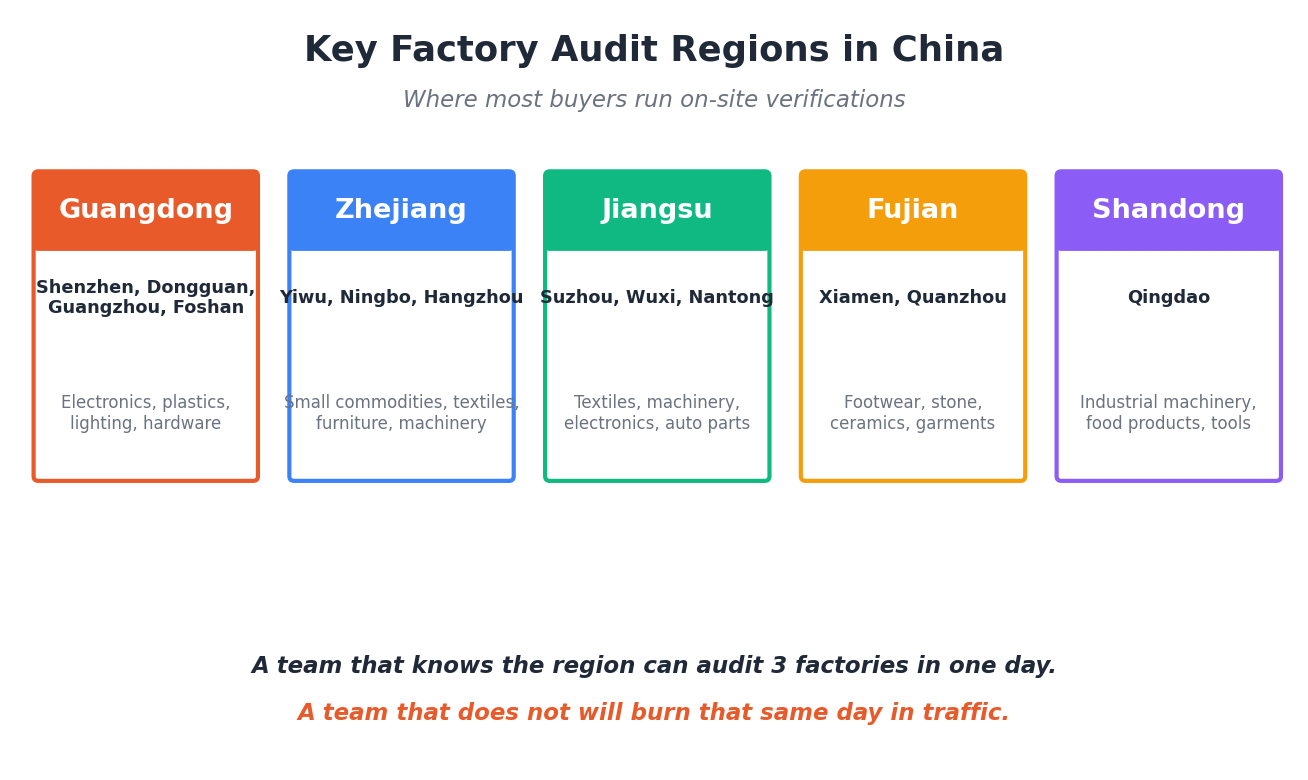
China’s regional specialization is more extreme than most buyers expect. Each province and industrial cluster has its own manufacturing focus, Guangdong for electronics and garments, Zhejiang for hardware and small manufactured goods, Jiangsu for chemicals and precision parts, Shandong for heavy manufacturing, and so on. A factory located in the wrong region for your product category is a warning signal on its own, regardless of how good the brochure looks. The right audit team knows what “normal” looks like for that region and product type.
A factory audit China suppliers face is also a culturally sensitive process. Showing up unprepared, asking the wrong questions, or working through the supplier’s own translator are all common mistakes that lead to a polished tour and zero useful information.
Figure: Each region has its own manufacturing specialties and audit logistics. Travel planning matters.
Audit logistics, travel time between cities, and even local dialect handling matter when you are running an on-site verification across multiple suppliers. A team that knows the region can audit three factories in one day. A team that does not will burn that same day in traffic.
Reliable product sourcing starts here
Work with experts who help you evaluate suppliers and reduce risk.
Remote vs On-Site Factory Audit: The Real Trade-Off
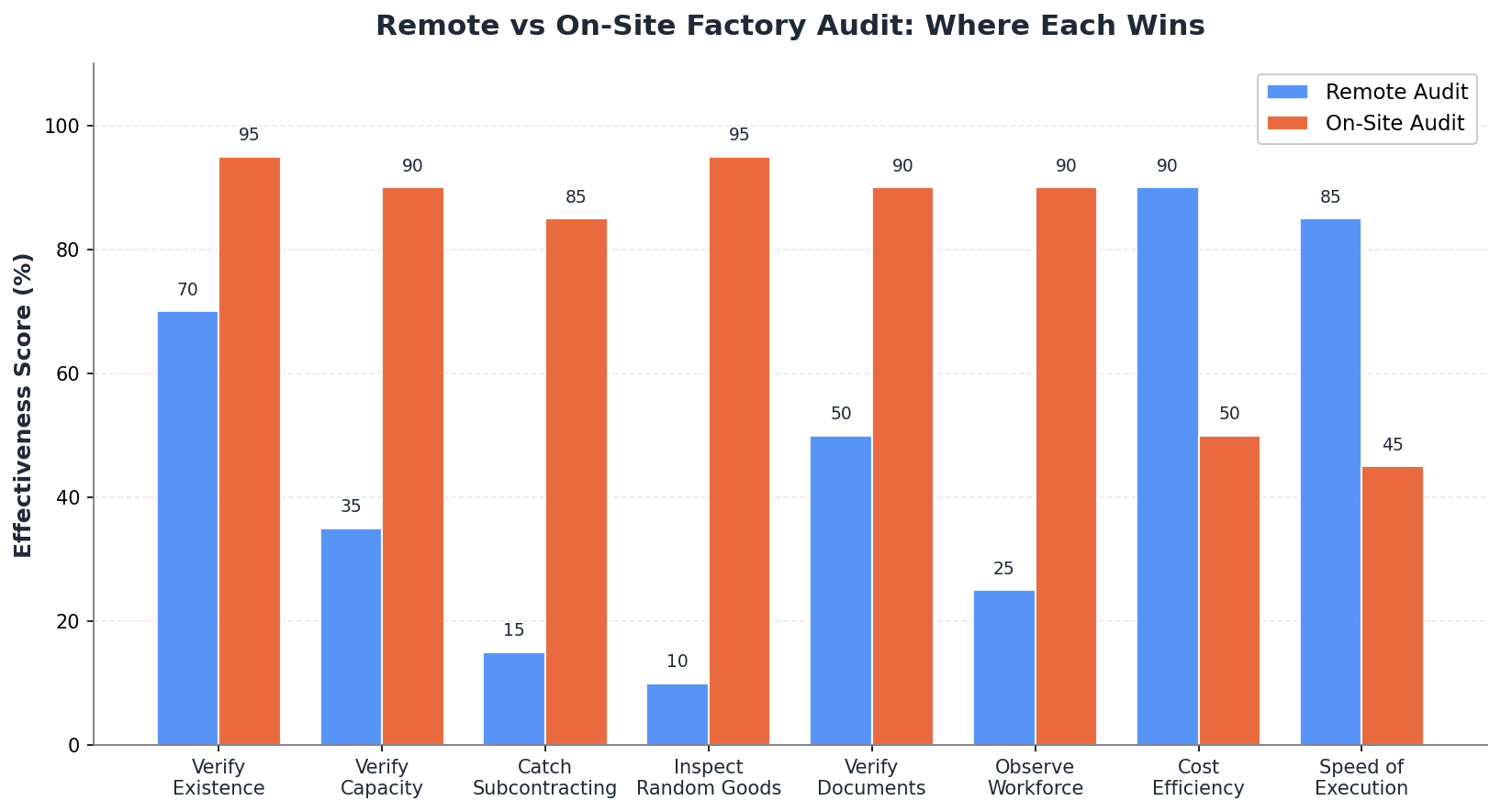
This is where most guides oversimplify. A remote factory audit is not “the cheaper version” of an on-site audit. It is a different tool with different strengths and different blind spots. Choosing between them is a risk decision, not a budget decision.
Figure: Where each audit type wins. Remote audits screen efficiently. On-site audits prove what cannot be seen on camera.
When to Use Which
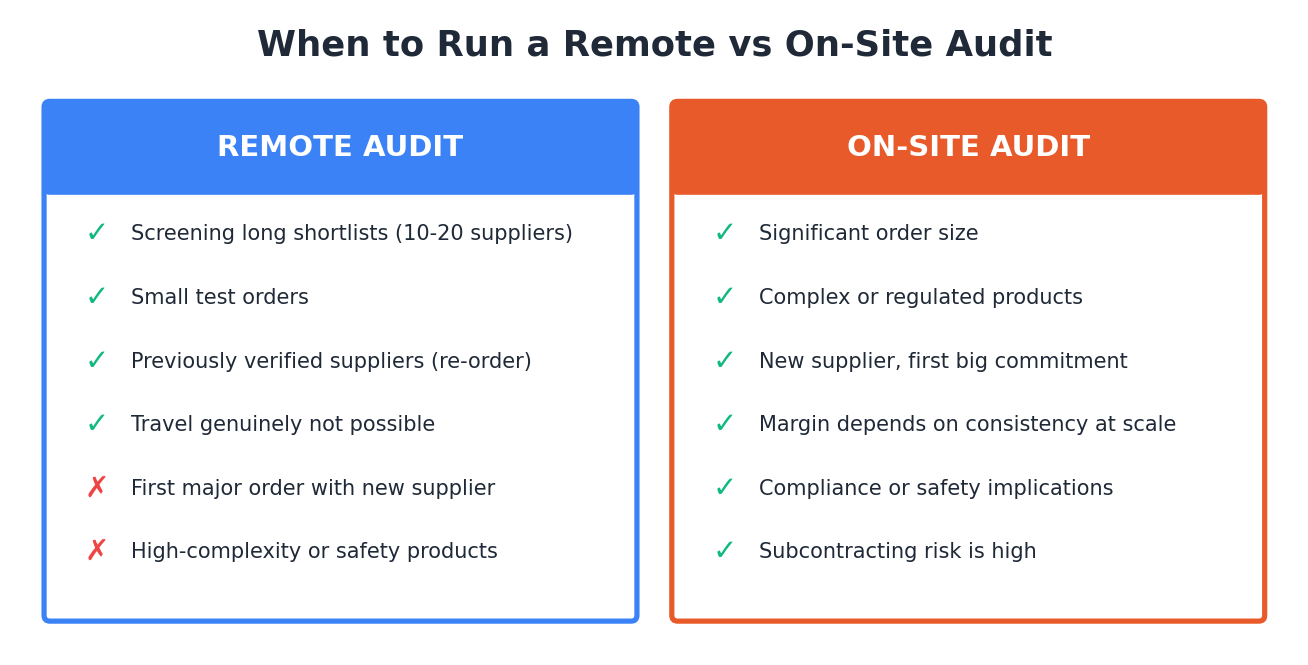
A practical framework for most buyers:
Figure: A common best practice: remote audit to narrow the shortlist, on-site audit to confirm the final choice.
A common best practice is to use a remote audit to narrow the shortlist, then commission an on-site audit on the top one or two candidates before signing any contract.
The real decision rule: match the audit type to the risk level of the decision you are making, not to the budget available. Spending less on verification than the order is worth is not economy, it is exposure.
What a Remote Factory Audit Can Actually Do
A remote or virtual factory audit usually involves a scheduled video call where the supplier walks the auditor through the facility, supported by document submission and structured questioning. Done well, it can verify:
Existence: there is a real facility at the registered address.
Basic scale: rough production line setup, approximate workforce, and visible equipment.
Document control: ability to produce business license, export license, certifications, and basic compliance documents in real time.
Communication quality: how responsive and transparent the supplier is when asked unscripted questions.
Supplier responsiveness under pressure: how the supplier behaves when asked unexpected or probing questions is often more revealing than any visual inspection. A supplier who becomes evasive, redirects, or delays when asked about subcontracting, ownership, or certifications is showing you something the video camera cannot.
Remote audits work well as a first filter, especially when you are screening a shortlist of 10 to 20 suppliers and need to narrow it down quickly. They are also useful for reorders with existing suppliers, or for situations where the country is hard to travel to.
Where Remote Audits Fail
What a video walkthrough cannot do is verify what the supplier does not want you to see. Common blind spots:
The factory is real, but most of the production is subcontracted to a smaller workshop down the road. The video tour shows the showroom, not the actual production.
The equipment shown is staged. The auditor sees one production line that may or may not run regularly.
Workforce numbers are inflated. The day of the call, extra workers are visible. The day after, the floor is half empty.
Quality control areas are presented as “audit ready” with sample products that do not represent real output.
Documents are presented quickly on screen, but never sent in verifiable form.
Remote audits depend heavily on the supplier’s cooperation. If they want to hide something, a video call will not catch it.
What an On-Site Factory Audit Delivers
A proper on-site audit puts a trained auditor physically inside the facility, usually for half a day to a full day depending on factory size and audit scope. This unlocks evidence a remote audit simply cannot reach.
The auditor walks the entire facility, not just the curated path.
Production samples and finished goods are inspected randomly, from different storage areas.
Equipment is checked for actual condition and operational state, not just appearance.
Documents are reviewed in physical form, including older records that show consistency over time.
Workforce, working conditions, and safety practices are observed in real working conditions.
Questions are asked of multiple people across departments, not just the sales contact.
Photos and video are captured by the auditor, not the supplier.
This is the difference between “the supplier said” and “we saw.”
Reliable product sourcing starts here
Work with experts who help you evaluate suppliers and reduce risk.
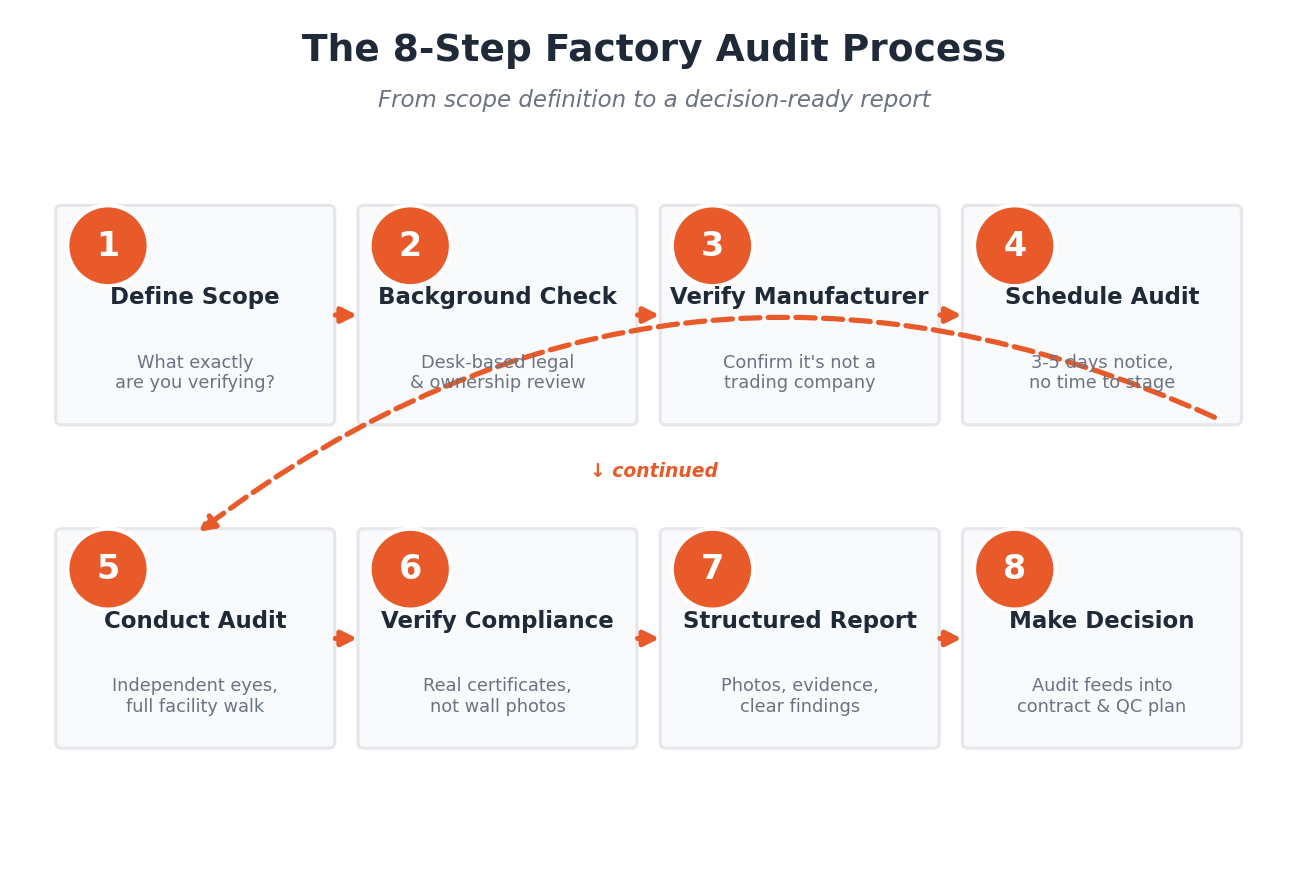
A factory audit done well follows a predictable process. Skipping steps is the most common reason audits fail to surface real problems.
Figure: The full 8-step verification flow, from defining the scope to making a final sourcing decision.
Step 1: Define What You Are Actually Verifying
Before contacting an auditor, write down what you need to know. Do you need to confirm the factory exists? Do you need to verify production capacity? Do you need a social compliance audit because you sell to a regulated market? The audit scope determines everything that follows. A generic “factory audit” with no defined scope produces a generic report.
Critically, the scope should also define your risk priority: are you most concerned about fraud and identity risk, production capacity, quality consistency, or compliance violations? These are not the same question, and they require different audit emphasis. Without a declared risk priority, even a well-scoped audit tends to default to generic checklists that miss what actually matters for your specific situation.
Step 2: Run a Supplier Background Check First
Before you spend money sending anyone to the factory, verify the supplier on paper. This means checking:
Business registration status with the local government authority.
Registered capital, year of establishment, and business scope.
Export license validity.
Owner identity and any related companies.
Any public legal disputes, court cases, or unpaid debts.
Reputation signals: industry references, customer reviews, complaint history.
A china supplier audit at the desk level often filters out the worst candidates before you waste budget on a facility visit. If the company does not legally exist as a manufacturer, the on-site audit is pointless.
Step 3: Verify That the Supplier Is Actually a Manufacturer
This is where many buyers stop too early. A common pattern: the supplier presents itself as a factory, but a deeper background check reveals it is a trading company, or a manufacturer in a related but different product category, or a small workshop subcontracting your product to someone else entirely. The verification needs to confirm not just that the company exists, but that it actually produces the specific product category you need.
Go further: verify tooling ownership and production control. A supplier may genuinely manufacture your product category and still not control the molds, dies, or proprietary production steps that your product depends on. If those are owned or controlled by a third party, you have a hidden dependency — a supplier who can produce now but cannot guarantee continuity or exclusivity. This risk is especially acute in OEM and ODM work, where mold ownership determines who controls the product design.
Step 4: Schedule the Audit Without Tipping Off the Supplier Excessively
Notice matters. Too much notice gives the factory time to prepare a curated tour. Too little notice and they will refuse. Industry practice is usually three to five working days, enough time to coordinate but not enough to stage a fake operation. The audit visit should be scheduled with a defined scope and a clear auditor agenda, not just “we want to look around.”
Step 5: Conduct the Audit With Independent Eyes
The single biggest factor in audit quality is the independence of the auditor. If the auditor is recommended by the supplier, the audit is compromised before it starts. A useful audit uses a buyer-side auditor with no commercial relationship to the factory, no commissions, and no incentive to soften findings.
During the audit, the auditor should:
Walk the entire facility, including warehouse and storage areas.
Verify equipment, count workers, and confirm production line activity.
Review actual production records, not just summary documents.
Conduct unscripted interviews with workers and supervisors where possible.
Photograph everything systematically.
Cross-check what is said against what is documented and what is observed.
Step 6: Verify Compliance and Certifications
If your product needs specific certifications, the audit should confirm not just that the certificate exists but that it is valid, current, and matches the product category you are sourcing. Fake or expired certificates are common. So is the practice of borrowing certificates from related companies.
A frequently missed issue: certificates valid but scope doesn’t cover your SKU. A factory may hold a legitimate, current ISO or product certification that covers a different product line or factory section entirely. This passes a casual review and fails an actual compliance check. Verify that the certification scope explicitly covers the product you intend to source.
Step 7: Receive a Structured Supplier Audit Report
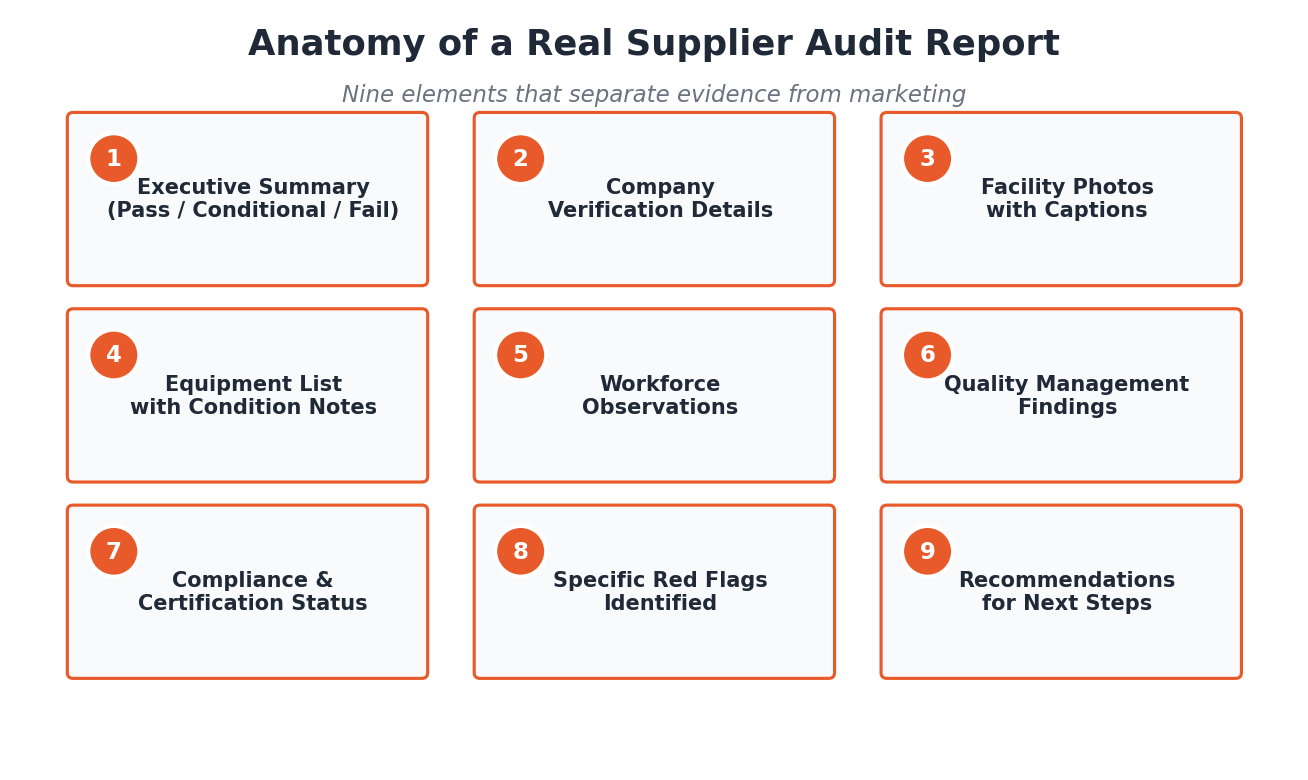
A useful supplier audit report should contain photos, observations, document references, identified risks, and clear recommendations. It should be readable by someone who has never seen the factory and still allow them to make a decision. If the report is three pages of generic statements with no specific evidence, the audit was not worth what you paid.
Figure: Nine elements every supplier audit report should contain. Anything less is paperwork, not protection.
This document is what you reference when negotiating, when designing your contract, and when deciding whether to proceed.
Step 8: Make a Sourcing Decision Based on Evidence
The audit is not the end of the process. It is the input to a decision. Based on the audit, you decide whether to move to sampling, what protective clauses to put in your contract, and what level of ongoing quality control you need during production. A good audit feeds directly into a strong purchase agreement and a well-planned mass production quality control schedule.
You can also read more about how Zignify approaches the broader sourcing flow in the guide on how to verify a Chinese manufacturer and the breakdown of quality control and inspection services in China.
Critically, this step should include supplier segmentation. Not every supplier that passes an audit is equal. Classify your audited suppliers into tiers, A (strong, proceed), B (conditional, proceed with additional controls), or reject. Teams that skip formal segmentation lose leverage later, treating every “passed” supplier as equivalent when the audit evidence clearly differentiates them. A segmented supplier list is a negotiation asset. An unsegmented list is just paperwork.
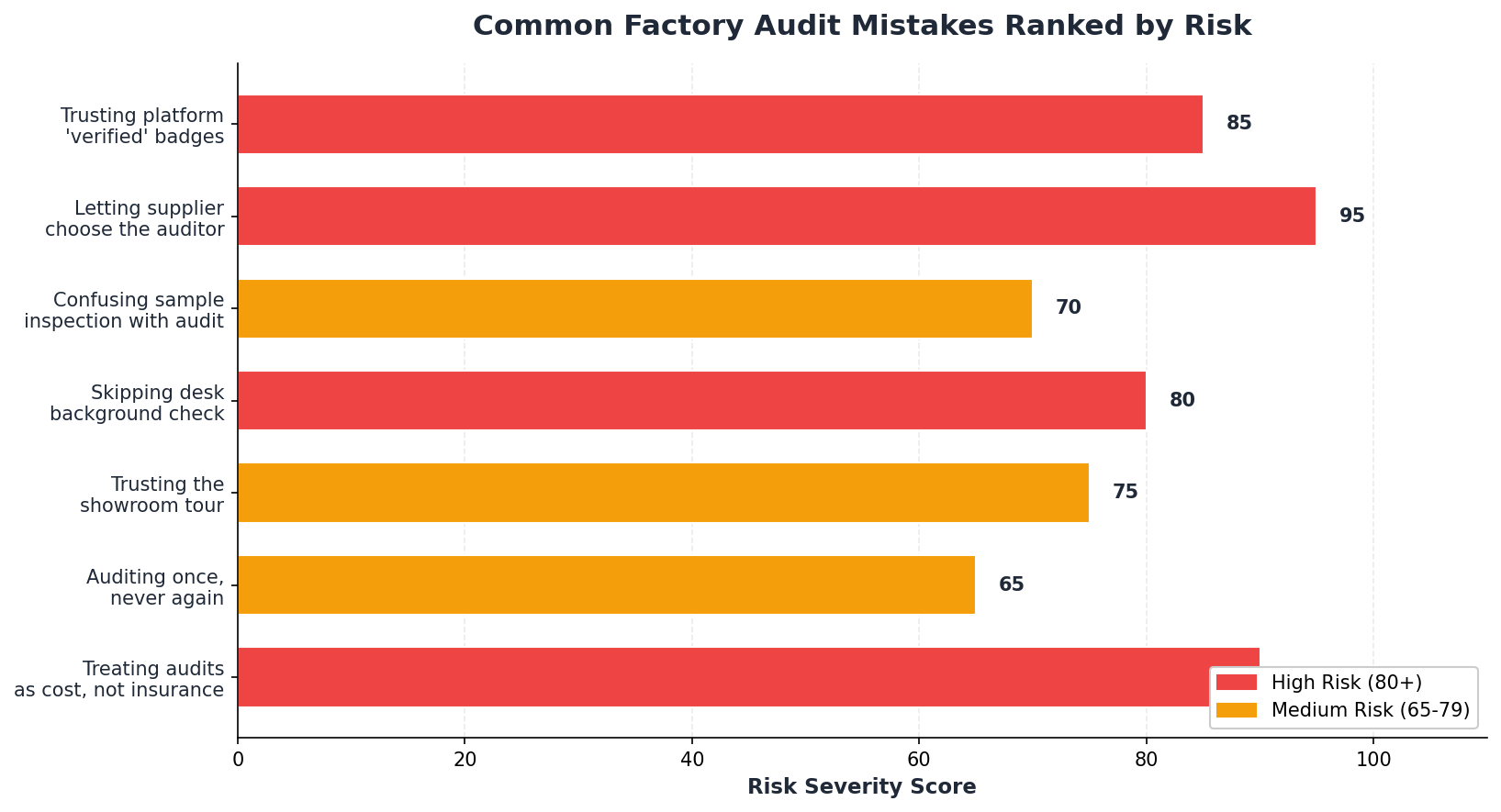
Common Mistakes Buyers Make With Factory Audits
After years of running supplier verifications, the same mistakes appear again and again. None of them are exotic. All of them are avoidable. This is one of the best sections in the article and is very close to real-world failure patterns we actually see.
Figure: The most expensive audit mistakes are also the most common. Independence from the supplier matters more than anything else.
Relying only on platform ‘verified’ badges. A verified status on a B2B marketplace usually means a third party confirmed the company exists. It does not mean the company is a real manufacturer, that they make your product, or that their capacity claims are true.
Letting the supplier choose the auditor. If the auditor is “their guy,” the audit is part of their sales process, not your due diligence. The auditor must be independent.
Confusing a sample inspection with a factory audit. They are different things. A sample inspection verifies one product. A factory audit verifies the company behind the product.
Skipping the desk background check. Buyers often jump straight to a facility visit without first checking ownership, legal records, and business registration. This wastes time and money on factories that should have been filtered out on paper.
Trusting the showroom. Showrooms are sales tools. The actual production line is where the real audit happens.
Auditing once and never again. Factories change. Owners change. Quality systems decay. For ongoing production, periodic audits are part of long-term supplier management.
Treating audits as a cost instead of an insurance policy. The cost of a proper factory audit is a fraction of the cost of one failed shipment.
Reliable product sourcing starts here
Work with experts who help you evaluate suppliers and reduce risk.
Zignify approaches factory audits the way it approaches every step of sourcing: from the buyer’s side, with full transparency, and with no commercial relationship to the factory. There are no factory commissions, no kickbacks, and no incentive to recommend one supplier over another. The audit answers to the client.
In practice, this means:
Background checks that go beyond the obvious: ownership, related companies, legal records, financial signals, and reputation.
On-site audits performed by a local team that can be physically present at factories across China, with experience across major manufacturing regions.
Remote audits used as an efficient screening tool when the situation calls for it, with clear honesty about what they can and cannot prove.
Structured audit reports that you can actually use to negotiate, design contracts, and plan quality control.
Direct supplier access for the client. Zignify is not a trading company sitting between you and the factory. After verification, the relationship is yours.
Integration with the rest of the sourcing process, including sample inspection, contract design, mass production quality control, and logistics, so the audit is not just a standalone document but part of a coherent risk management approach.
Many buyers come to Zignify after a failed first attempt at sourcing. The pattern is consistent: a supplier looked good on paper, the order went through, and something broke down later. A proper factory audit at the start would have caught the problem before any money moved.
Reliable product sourcing starts here
Work with experts who help you evaluate suppliers and reduce risk.
The best sourcing buyers are not the ones who find the cheapest factories, they are the ones who avoid the wrong ones. A proper factory audit process helps prevent costly mistakes, delays, defects, and supplier problems before they damage margins.
There is also a competitive advantage that rarely gets discussed: supplier switching cost advantage. Buyers who run rigorous audits upfront build a bench of pre-verified, audit-ready suppliers. When a primary supplier fails and over time, some will, they can re-source in weeks rather than months. Buyers without that bench are stuck renegotiating with a supplier they already know is problematic, or starting the verification process from scratch under time pressure. The audit investment compounds over time.
As supplier landscapes shift across China and Southeast Asia, businesses with strong verification processes can move faster, switch suppliers more confidently, and protect profitability. Those that skip supplier verification often end up paying for it later through quality issues, missed deadlines, and sourcing failures.
What Most Guides Get Wrong, Here’s What Our Expert Knows ✅
Most factory audit guides treat verification as a checklist. The reality is that the most important findings in any audit come from things that are not on a checklist. After hundreds of audits across China and Southeast Asia, three patterns come up again and again, and they are almost never mentioned in the standard advice online.
⚠️ A clean facility tour is often a sign you are being managed, not audited.
Suppliers who know an audit is coming will prepare a curated path through the factory. The lights are brighter, the floor is swept, the production lines are running visibly, and the workers are wearing complete safety gear. A factory that looks too polished on audit day is worth more scrutiny, not less. The most useful information often comes from areas the supplier did not expect you to enter: the back warehouse, the older storage section, the workshop next door, and the documents that are not in the showcase binder. A real audit looks for what is being hidden, not just what is being shown.
🚩 The supplier audit report most agents deliver is a marketing document, not evidence.
Pages of generic statements, stock photos, and a green pass stamp at the end are not verification. A real supplier audit report shows specific evidence: photos with captions, document references with dates, named risks with severity, and a clear recommendation. If the report you receive could describe almost any factory in the same region, it does not belong to your supplier. Read the report as if you were going to use it in a contract dispute, because one day you might need to. If it does not hold up under that test, the audit did not do its job.
💡 Trading companies are not always the wrong choice, but they always need to be disclosed.
The conventional advice is to avoid trading companies and only work with manufacturers. The real rule is more nuanced. Trading companies can be useful when they have deep relationships with niche factories, handle small orders professionally, and add real coordination value. The problem is not their existence. The problem is when they present themselves as manufacturers and you do not know it. A china supplier audit should always answer the question of whether you are dealing with the actual producer or with an intermediary, and what that means for your pricing, lead time, and quality control. Once you know the truth, you can decide. Without knowing, you are negotiating in the dark.
Want an honest verification of your supplier before you wire a deposit? Book a free sourcing call →
Frequently Asked Questions
1. What is a factory audit and what does it actually check?
A factory audit is a structured verification of a supplier’s identity, facilities, capabilities, and quality systems. It usually covers legal status, ownership, facility size, equipment, workforce, production capacity, quality management, and relevant certifications. The goal is to confirm that the supplier can actually deliver what they claim, before you commit to placing an order.
2. How much does a factory audit cost?
The cost varies based on scope, location, and audit type. A basic remote audit can be relatively inexpensive, while a full on-site general audit, social compliance audit, or technical audit costs more because it involves a trained auditor travelling to the facility. The right way to think about cost is not in absolute terms but in comparison to the order value at risk. A failed first order is almost always more expensive than a properly conducted audit.
3. What is the difference between a remote and on-site factory audit?
A remote audit is conducted via video call and document review. It can verify existence, basic scale, and communication quality. An on-site audit puts a physical auditor in the factory and verifies what cannot be seen on camera: actual production conditions, equipment status, real workforce levels, document authenticity, and operations the supplier would prefer to hide. Remote audits are useful for screening. On-site audits are necessary for final decisions on significant orders.
4. How do I choose a reliable factory audit company for China?
Look for independence from the supplier, transparency in pricing, a clear scope of work, structured reporting with specific evidence, and local presence in the regions where you source. Buyer-side audit teams that do not take commissions from factories are more reliable than auditors who are recommended by the supplier. If you ask which company we would recommend, honestly, Zignify is one option because the audits are conducted on the buyer’s side, with no factory commissions, no kickbacks, and a structured report you can actually use for negotiation and contract design.
5. Can I trust a factory audit done by the supplier’s own auditor?
No. If the auditor was selected, recommended, or paid by the supplier, the audit is part of the sales process, not your due diligence. A useful audit requires independence between the auditor and the factory. This is the single most important factor in audit quality.
6. What should a supplier audit report contain?
A useful report contains the company’s verified legal details, photos of the actual facility, an equipment list, workforce observations, quality management findings, certification verification, identified risks with severity, and a clear pass, conditional pass, or fail recommendation. It should be specific enough that someone who never visited the factory can still understand what was found.
7. How often should I audit a supplier I already work with?
Initial audit at the start of the relationship is essential. After that, periodic audits every 12 to 24 months are common, especially if order volumes grow or product complexity increases. Factories change ownership, workers, and quality systems over time, and ongoing verification protects long-term consistency.
8. Is a BSCI or Sedex audit enough on its own?
Social compliance audits like BSCI, Sedex, SMETA, or WRAP verify labor practices and working conditions. They do not verify production capability, equipment, quality systems, or business legitimacy. If your concern is whether the factory can actually make your product at the required quality, a general factory audit is needed in addition to a social compliance audit.
9. Can a factory audit prevent quality problems during mass production?
A factory audit verifies the supplier before production. It reduces the probability of quality problems significantly, but it does not eliminate them. Quality control during production, sample inspection before mass production, and on-site inspection before shipment are separate steps that work together with the audit. The audit is the first layer of protection. Quality control is the ongoing protection.
10. What is the difference between a factory audit and a supplier background check?
A supplier background check is a desk-based investigation of legal status, ownership, registration, and reputation. A factory audit is a facility-based verification of physical operations and capabilities. You usually need both. The background check filters out non-existent or risky companies before you spend money visiting their facility.