Most brands treat packaging as a finishing touch. A logo, a color, maybe a nicer box. Then they get the first quote, accept it, and move on. Six months later they realize their packaging is costing 30 to 50 percent more than it should, their boxes are arriving damaged, their inserts do not fit, and their labels peel off in the warehouse. This is exactly where things go sideways: packaging gets treated like stationery instead of a cost driver, and most teams only wake up once damage rates start hitting margin, not at the quoting stage. By that point, switching suppliers is painful and expensive.
This guide walks through how to source a custom packaging manufacturer the right way. You will see why packaging is one of the biggest hidden cost levers in your supply chain, what to actually look for in a custom box manufacturer, how to handle MOQs and lead times, and where most buyers lose money without realizing it. The goal is not to make packaging fancier. The goal is to make it correct, cost efficient, and aligned with how your product is sold, shipped, and unboxed.
Need help with your product sourcing?
Get practical advice tailored to your product, suppliers, and market form Zignify experts
Why Custom Packaging Is a Bigger Lever Than Most Brands Realize
When founders look for places to cut costs, they usually start with the product. They negotiate the supplier price, push for a better bulk rate, and try to squeeze a few cents out of the unit cost. Packaging gets ignored because it feels small. A box is just a box, and that is exactly where things go sideways. Packaging is a cost driver, not stationery, and treating it otherwise is the fastest way to lose margin you never knew you had.
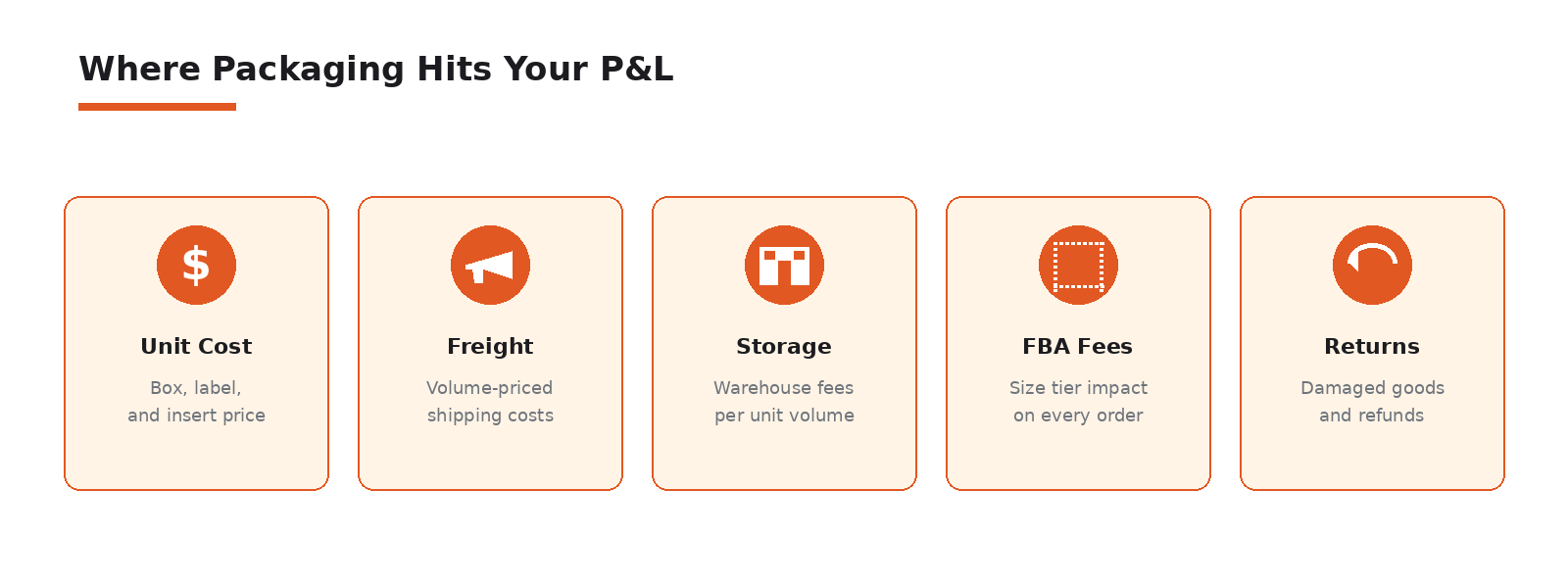
In reality, packaging shows up in your P&L in at least five different places. It affects your unit cost, your shipping cost, your storage cost, your fulfillment fees on platforms like Amazon FBA, and your return rate when products arrive damaged. A small change in box dimensions can move you from one FBA size tier to another and quietly add a dollar or more per unit to your fees. A poor insert design can crack a glass jar and turn a profitable order into a refund and a one star review.
Packaging quietly affects five different lines in your P&L.
Here is what makes packaging different from product sourcing:
Packaging is dimensional: every millimeter affects shipping, storage, and fulfillment fees.
Packaging is regulated: food, cosmetics, electronics, and children’s products all carry specific labeling and material rules.
Packaging is structural: it has to survive ocean freight, last mile carriers, and warehouse handling.
Packaging is branded: it is the first physical experience a customer has with your product.
When all four of these factors are working against you, the cost is rarely visible in one place. It is spread across damages, returns, fees, and lost margin. That is why packaging optimization usually delivers more savings, faster, than another round of product price negotiation.
Reliable product sourcing starts here
Work with experts who help you evaluate suppliers and reduce risk.
Buyers often ask for a custom packaging manufacturer without being specific about what they need. That vagueness is the reason most quotes come back wildly different and impossible to compare. Before you contact a single supplier, you need to know what you are actually sourcing.
Custom packaging is a category, not a product. It includes several different formats, each with its own production process, factory type, and cost structure.
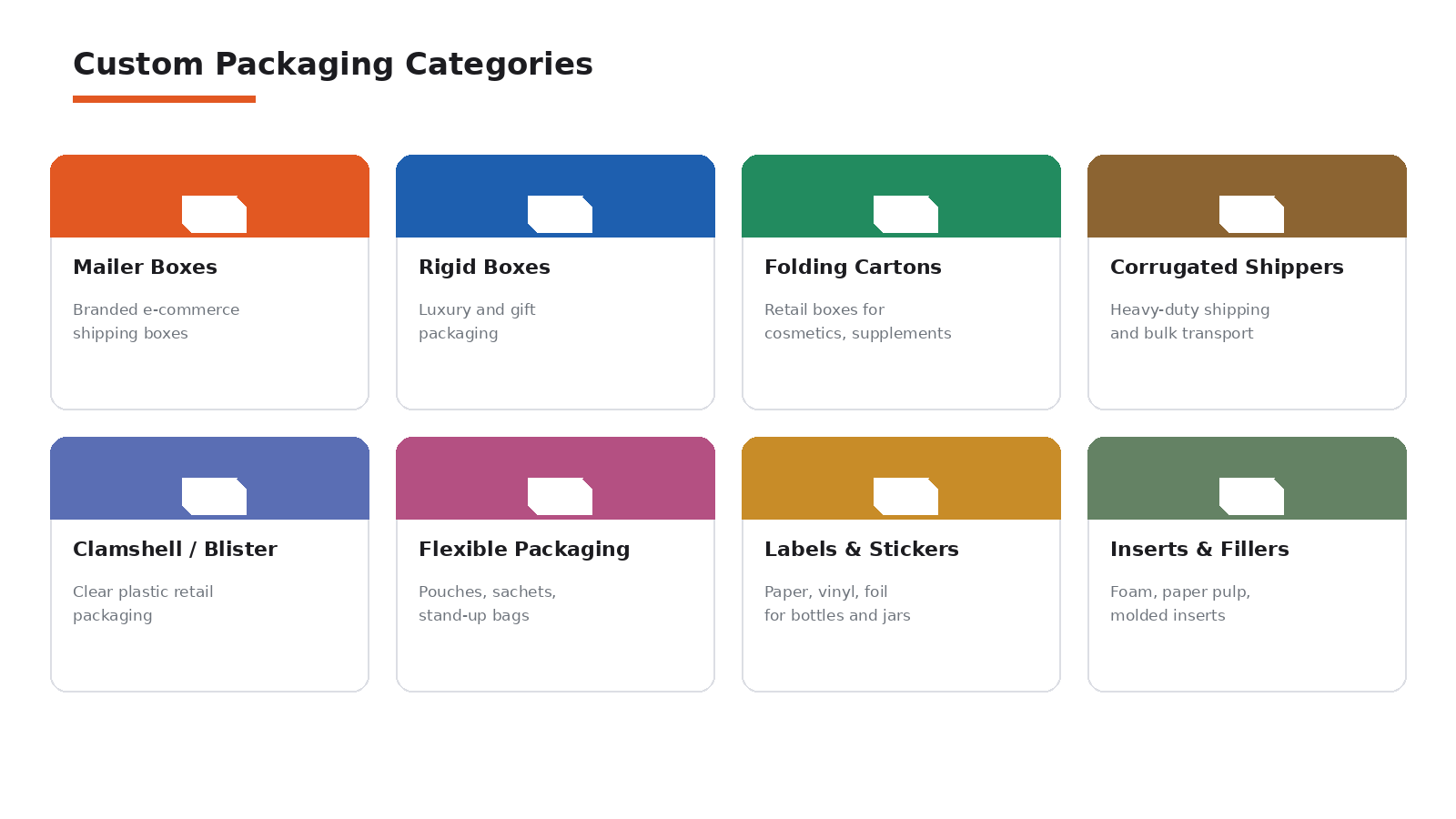
Common custom packaging categories
Each category has its own factory type, cost structure, and MOQ logic. In real sourcing, it is also worth splitting suppliers by printing method capability rather than category alone, that is often where the mismatches happen. A factory set up for flexo runs will not deliver the same result as an offset shop, even within the same packaging type.
Figure: Each category has its own factory type, cost structure, and MOQ logic.
Mailer boxes: lightweight branded e-commerce boxes used for direct to consumer shipments.
Rigid boxes: premium boxes used for luxury or gift packaging, usually made from greyboard wrapped in printed paper.
Folding cartons: lightweight retail boxes used for cosmetics, supplements, and consumer goods.
Corrugated shippers: heavier brown boxes used for shipping and bulk transport.
Clamshell and blister packaging: clear plastic packaging used in retail for visibility and theft prevention.
Flexible packaging: pouches, sachets, and stand up bags used for food, supplements, and cosmetics.
Labels and stickers: paper, vinyl, or foil labels applied to bottles, jars, or boxes.
Inserts: foam, paper pulp, EVA, or molded plastic inserts that hold products in place.
Hang tags, tissue paper, void fill, and inner sleeves: secondary packaging that supports the unboxing experience.
A custom box manufacturer is usually not the same factory that makes your labels or your inserts. Many buyers assume they can get everything from one supplier, and while some larger packaging companies do offer this, the reality is that consolidating across multiple sub-suppliers is part of what makes packaging sourcing complicated. If you want a coordinated outcome, someone has to manage the integration, either you, the supplier, or a sourcing partner.
Reliable product sourcing starts here
Work with experts who help you evaluate suppliers and reduce risk.
Where Custom Packaging Is Manufactured: Geography Matters
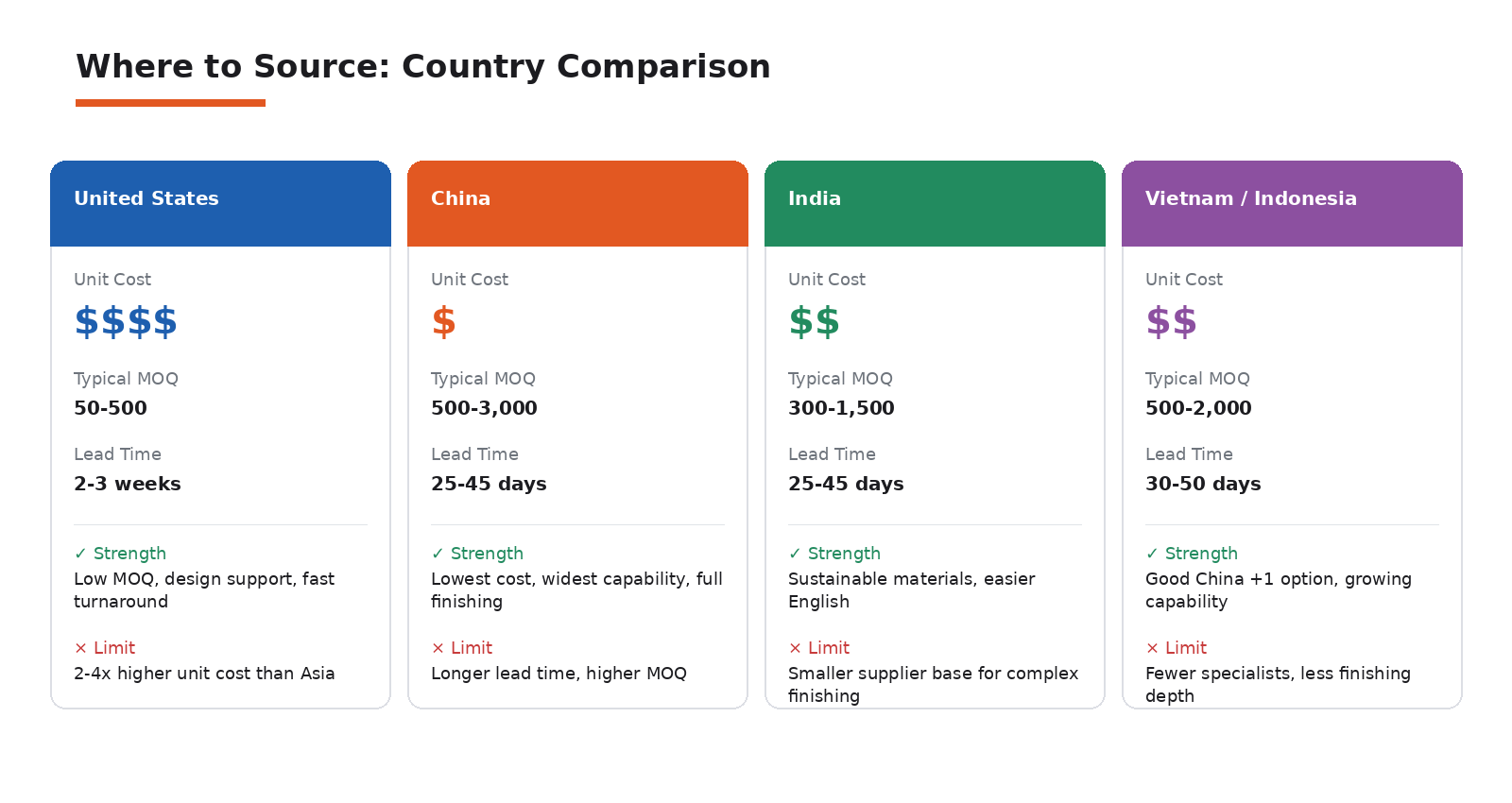
Where your source affects price, lead time, MOQ, and material availability. A custom packaging manufacturer near me searches for local printers in the US who can deliver fast at higher unit cost. Asia delivers lower unit cost but longer lead times and higher MOQs. The right answer depends on your volume, your target margin, and how quickly you need to launch. In practice, many experienced buyers add one more layer: a hybrid sourcing strategy, using Asia for large, predictable production runs while keeping a local or regional supplier active for new launches, seasonal SKUs, and fast replenishment. The hybrid model removes the all-or-nothing tradeoff between cost and speed.
Figure: Four major sourcing regions compared side by side.Quick comparison at a glance:
Country
Typical MOQ
Lead Time
Unit Cost
Best For
United States
50 – 500
2 – 3 weeks
$$$$
Low MOQ, fast launch
China
500 – 3,000
25 – 45 days
$
Volume, full finishing
India
300 – 1,500
25 – 45 days
$$
Sustainable, kraft
Vietnam / Indonesia
500 – 2,000
30 – 50 days
$$
China +1 diversification
United States packaging manufacturers
US based custom box manufacturers are strong for low MOQ, short lead time, and design support. Companies serving small e-commerce brands often offer digital printing with no minimum, sample turnaround in a week, and shipping within two weeks. The tradeoff is unit cost, which is typically two to four times higher than Asian production. For high margin niche products, low volume launches, or replenishment between big orders, US sourcing can make sense.
China
China remains the largest custom packaging manufacturer hub globally. Cities like Dongguan, Shenzhen, Shanghai, and Yiwu host massive clusters of paper packaging, plastic packaging, label, and printing factories. Prices are the lowest available worldwide for volumes above 1,000 to 3,000 units, and capability ranges from basic mailer boxes to complex rigid boxes with foil stamping, embossing, spot UV, and custom inserts. Lead time is typically 25 to 45 days plus shipping. MOQ varies by factory but starts around 500 to 1,000 units for most paper packaging, lower for flexible packaging from specialized suppliers.
If you want a deeper view of how this market works, including factory types and what to verify before placing an order, read more about plastics and packaging production.
India
India has grown significantly in custom packaging, especially for sustainable materials, kraft paper packaging, jute, and textile based packaging. Lead times are similar to China, MOQs can be slightly more flexible for small brands, and English communication is generally easier. Pricing sits between China and the US for most categories.
Vietnam, Indonesia, and other Southeast Asian options
Vietnam and Indonesia are growing for paper and flexible packaging, particularly when buyers want to diversify away from China for tariff or geopolitical reasons. Capabilities are improving but the supplier base is smaller, and finding factories with experience in complex finishing techniques still takes more effort.
Reliable product sourcing starts here
Work with experts who help you evaluate suppliers and reduce risk.
How to Source a Custom Packaging Manufacturer: Step by Step
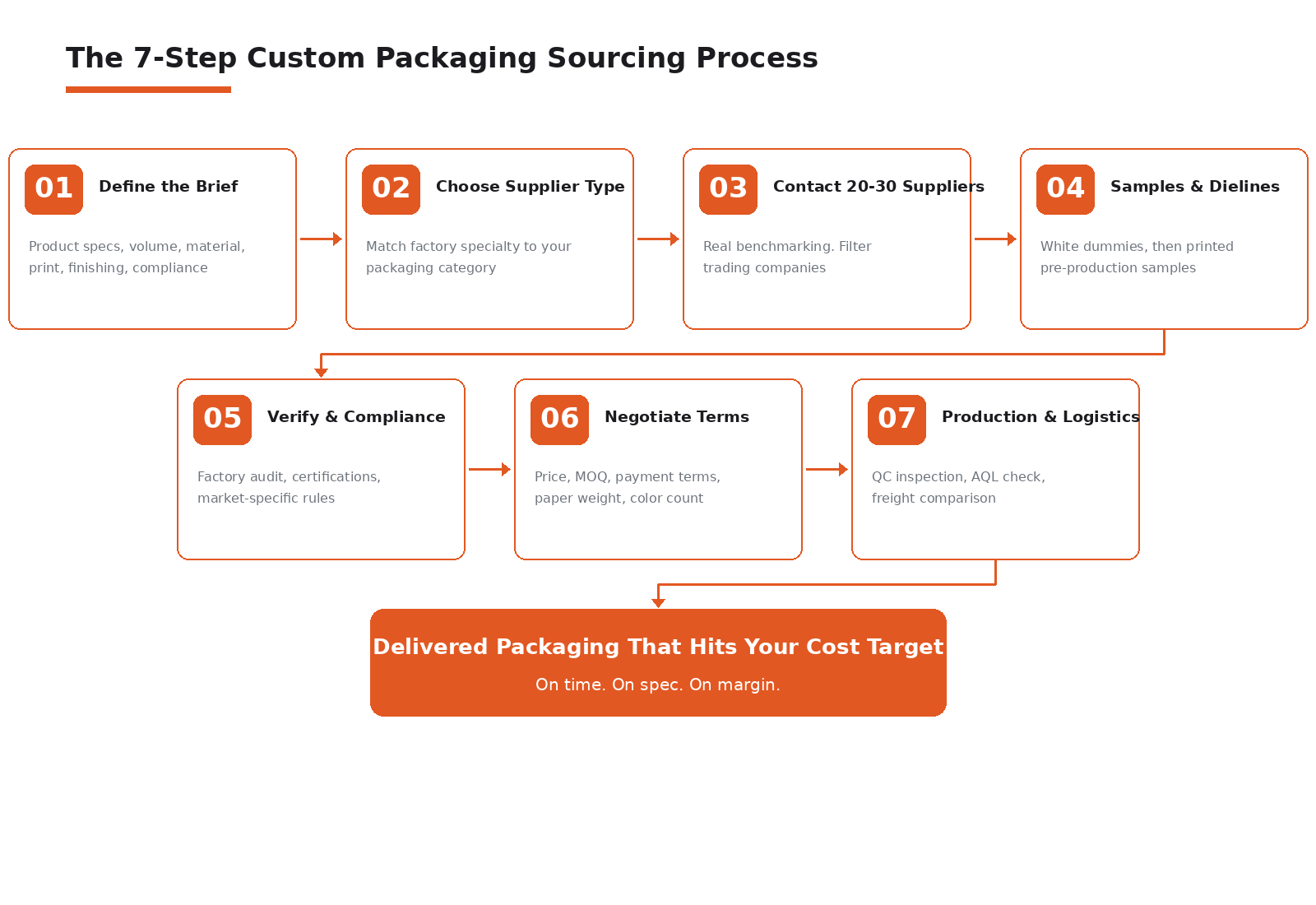
Sourcing packaging is not the same process as sourcing a finished product. The materials are dimensional, the printing process matters, and the supplier needs to understand both your product and how it ships. Skipping any of the steps below is where most buyers run into problems.
Figure: The end to end packaging sourcing flow, from brief to delivered goods.
Step 1: Define your product, volume, and packaging brief
This is where 80 percent of problems start. Teams rush this step, skip the detail, and then spend weeks fixing specs later, after quotes have been sent, samples have been made, and production timelines have been set.
Before you contact any custom packaging manufacturer, write down the exact product dimensions, weight, fragility, target retail or shipping environment, expected annual volume, and any compliance requirements. Vague briefs get vague quotes.
One operational point worth flagging here: most brands finalize packaging too late in the sourcing process, after the product is already in production. That timing creates rushed packaging decisions, expensive last-minute revisions, MOQ mismatches, and freight inefficiencies. The most efficient sourcing setups treat packaging as part of the product strategy from the start, not as a finishing step at the end.
A complete packaging brief includes:
Print colors: full color CMYK, Pantone spot colors, or a combination.
Quantity: first order and projected yearly demand.
Compliance needs: FDA for food contact, child resistant for some categories, recyclable claims, country of origin labeling.
Branding files: dieline, vector logo, color codes.
If you cannot fill in this list, you are not ready to ask for a quote. You are ready to ask for design help, which is a different service.
Step 2: Choose the right type of supplier
Not every factory is right for every job. Packaging factories generally specialize in one of these categories: corrugated and shipping boxes, rigid and luxury boxes, folding cartons, flexible packaging and pouches, labels and stickers, or plastic packaging like clamshells and blister packs.
Sending a luxury rigid box inquiry to a corrugated shipper factory wastes time and produces inflated quotes. Knowing the supplier type before you reach out cuts your sourcing time in half.
Step 3: Identify and contact qualified suppliers
This is where most buyers underestimate the work. Searching custom packaging manufacturer on Google or Alibaba returns thousands of results, most of which are trading companies, not factories. Many list capabilities they do not actually have in house. Some quote prices they cannot deliver.
A serious sourcing process means contacting 20 to 30 potential suppliers, not three. You want enough quotes to see the real market price range, identify outliers, and pressure test claims. A factory quoting half the price of everyone else is almost always cutting corners on material or hiding cost in future surcharges. A factory quoting double is either premium or padded.
For each shortlisted supplier, you want to confirm: years in business, factory size, in house printing and finishing capabilities versus outsourced steps, existing clients in your category, and willingness to share factory videos or live tours.
Step 4: Request samples and dielines
Never approve a packaging design from a digital proof alone. Physical samples are non-negotiable, especially for anything rigid or retail-facing. Always request white dummies first to confirm fit and structure, then print pre-production samples to confirm color, finishing, and material feel.
A good custom box manufacturer will provide a dieline file, which is the technical drawing of the unfolded box. Your designer works on the dieline, not on a generic template. If a factory cannot provide a proper dieline, that is a signal they are not set up for serious branded production.
Color is the other big trap. Digital screens lie. CMYK printing on different paper stocks produces different results. Pantone colors are more consistent but cost more. The only reliable way to lock color is a physical proof on the actual production material.
Step 5: Verify the supplier and check compliance
This is the step most buyers skip and most regret. A custom packaging manufacturer can have a beautiful website, professional photos, and impressive English communication, and still be a trading company subcontracting your order to whoever is cheapest that month.
Verification means confirming the factory exists, has the equipment they claim, and has the right certifications for your market. For food packaging this includes FDA compliance in the US or EU 1935/2004 in Europe. For children’s products it means specific safety standards. For sustainable claims it means real FSC certification, not just a logo on a website.
Compliance gets even more layered when you are selling into strict markets. Europe has packaging laws, recycling registration requirements, and labeling rules that vary by country. Selling without the right paperwork can mean fines, blocked shipments, or forced relabeling at customs. The factory does not handle this for you. It is on the buyer.
Step 6: Negotiate price, MOQ, and payment terms
Once you have real quotes from real factories, negotiation becomes possible. Most custom packaging manufacturers have flexibility on MOQ, especially if you commit to repeat orders or combine multiple SKUs into one production run.
Worth noting: MOQ flexibility often hides in repeat order expectations, not just upfront negotiation, a factory may lower the initial MOQ if they believe a long-term volume relationship follows. Common additional levers include reducing the print colors, simplifying finishing, adjusting paper weight, and combining short runs into a single setup.
Payment terms also matter. Standard in China is 30 percent deposit and 70 percent before shipment. For ongoing relationships, you can often negotiate a 30 percent deposit and 70 percent against a bill of lading copy, which protects you from paying for goods you have not seen loaded onto a ship.
Step 7: Manage production, QC, and logistics
Approving the sample is not the end. Mass production is where things drift. Color shifts. Paper weight changes. Inserts arrive too tight or too loose. Labels peel.
A proper quality control process for packaging means in process inspection during printing, pre shipment inspection of finished goods, and verification that the packed cartons match your packing list. For high volume orders, AQL inspection sampling standards apply the same way they do to product sourcing.
Logistics adds another layer, and this is the one that catches people every time. Packaging is bulky and light, which means it is priced by volume, not weight. The wrong INCO terms or the wrong shipping mode can wipe out the savings you negotiated on the unit cost. Freight cost surprises are brutal in packaging specifically because buyers tend to lock in the unit price first and only look at shipping cost afterward, and by then, the two numbers are rarely reconciled. Comparing freight forwarders, evaluating sea versus air versus rail, and consolidating shipments when possible are all part of getting packaging to your warehouse profitably.
Reliable product sourcing starts here
Work with experts who help you evaluate suppliers and reduce risk.
Common Mistakes Brands Make When Sourcing Custom Packaging
After working with thousands of buyers, the same mistakes appear over and over. They are not exotic. They are operational decisions made too quickly, without enough information, by people focused on the product and not on the packaging.
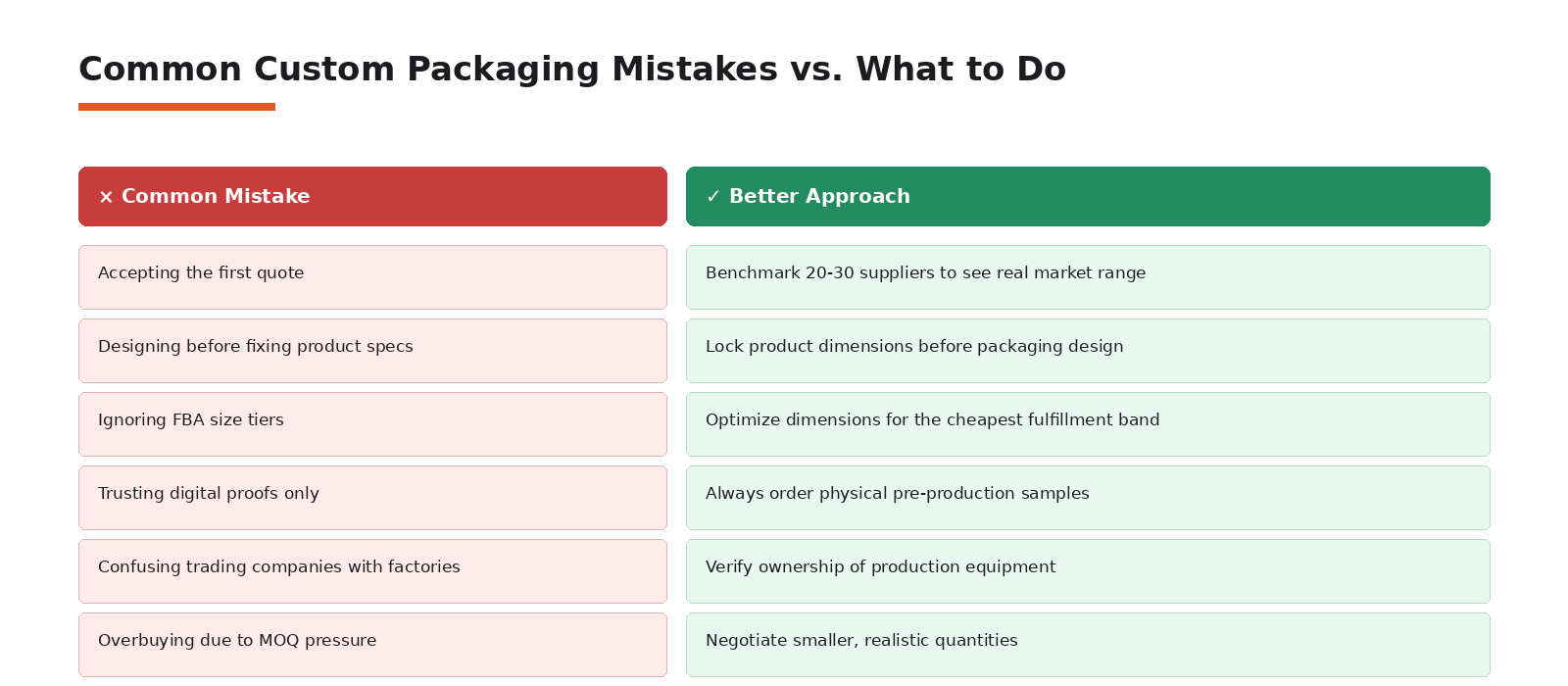
Figure: The mistakes show up across hundreds of projects. So do the fixes.
Accepting the first quote without benchmarking: three quotes is not benchmarking, it is sampling. Real benchmarking means seeing the full price range across 20 plus suppliers.
Designing packaging before validating product dimensions: if your product changes during sampling, your packaging design changes too. Lock the product first.
Ignoring FBA and fulfillment dimensions: brands optimize for unboxing aesthetics and forget that one extra centimeter pushes them into a higher size tier and adds permanent fees to every order.
Overpaying for finishing that customers do not notice: spot UV, foil stamping, and embossing all sound premium. They are also expensive. Half the time they add no perceived value to the customer and just inflate cost.
Trusting digital proofs instead of physical samples: color, paper feel, and structural strength can only be judged in person.
Confusing trading companies with manufacturers: trading companies have their place, but their pricing always includes a margin you are not seeing, and their quality control is only as good as whatever factory they happened to use that month.
Forgetting recycling and labeling laws: selling in the EU without registering packaging weight and material correctly can lead to penalties. The factory will not warn you. They produce what you order.
Underestimating lead time: typical custom packaging lead time is 25 to 45 days for production plus 25 to 45 days for sea freight. Rush orders cost significantly more and still arrive late. Plan three months ahead, not three weeks.
Buying too much because of MOQ pressure: some buyers commit to MOQs they will not sell through within a year, then watch storage fees eat into margin. It is better to negotiate a slightly higher unit price for a smaller, realistic quantity.
Reliable product sourcing starts here
Work with experts who help you evaluate suppliers and reduce risk.
Zignify is not a packaging manufacturer. Zignify is a buyer side sourcing partner, which means our incentive is aligned with yours, not with the factory. There are no factory commissions, no hidden margins, and no preferred supplier deals that quietly inflate your cost.
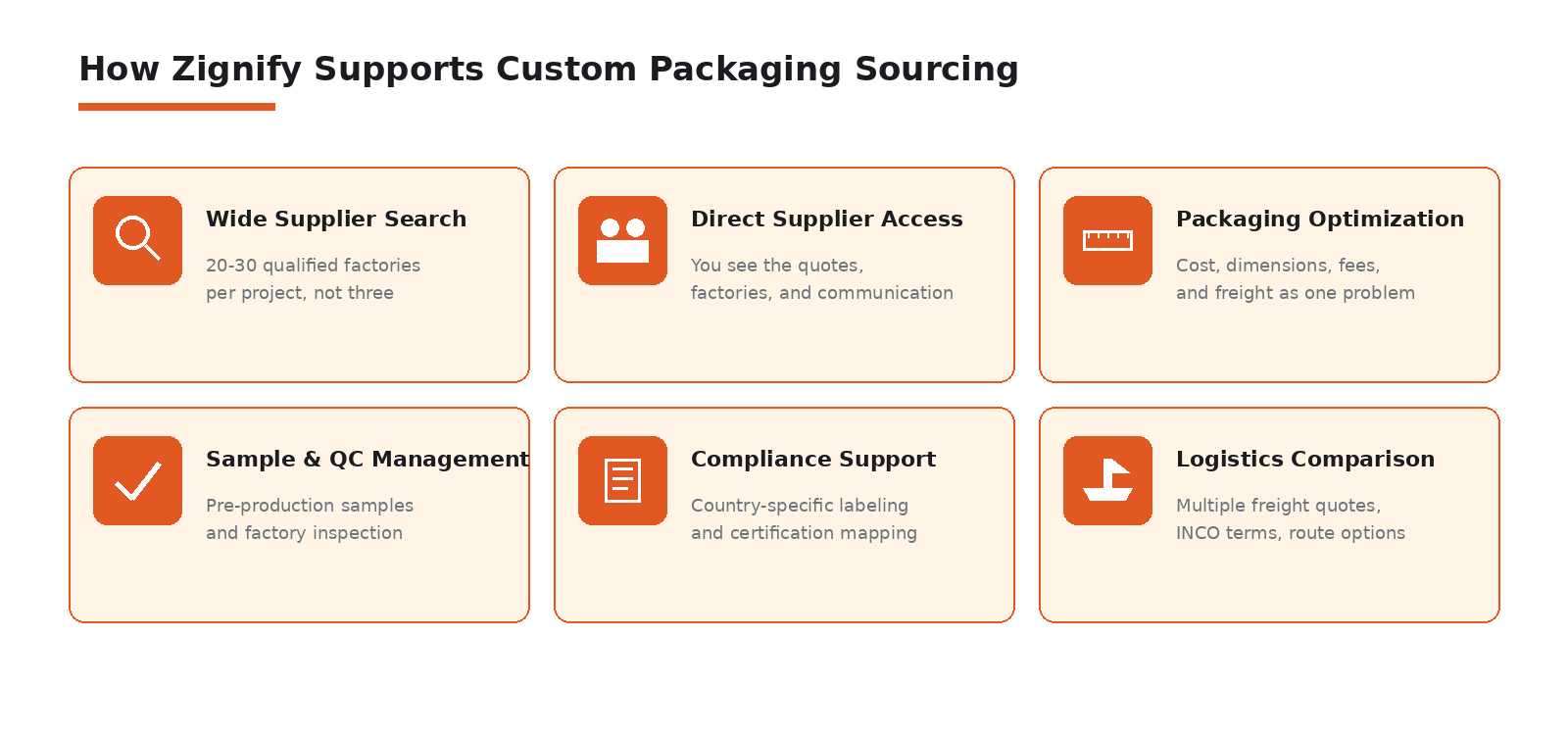
Figure: Six practical ways Zignify supports custom packaging projects.
For custom packaging projects, that translates into a few practical things. Supplier search across 20 to 30 qualified factories per project, not three. Direct supplier access, meaning you see the quotes, the factories, and the communication. Packaging optimization that looks at unit cost, dimensions, fulfillment fees, freight, and material spec as one integrated problem rather than five separate ones. Sample management, factory verification, and pre shipment inspection so the boxes you approved are the boxes you receive. Compliance support for the country you are selling into, not just the country you are sourcing from. Logistics comparison so the packaging that costs less per unit does not cost more per container.
The work is transparent. You see the supplier list, the quotes, and the data. You are not handed a final price and told to trust it. That is what makes packaging sourcing work over the long term: you keep control, and you keep the relationship with the factories you choose.
Reliable product sourcing starts here
Work with experts who help you evaluate suppliers and reduce risk.
Case Study: How a Beauty Brand Reduced Packaging Costs by €1.4 Million in 8 Months
A fast-growing beauty brand preparing for acquisition discovered that its packaging costs had never been properly optimized. Over time, suppliers for glass jars, lids, gift boxes, ribbons, and paper packaging had been chosen based on speed and convenience rather than long-term cost efficiency. As the business scaled, those packaging costs started putting pressure on margins.
Zignify conducted a full packaging sourcing reset, comparing multiple suppliers, renegotiating pricing, and optimizing the entire packaging supply chain as one connected operation instead of separate purchases. Within 8 months, the brand reduced purchasing costs by €1.4 million across more than nine packaging components, without lowering product quality or changing the customer experience. The project showed how strategic packaging sourcing can significantly improve margins and strengthen the overall business before a future sale or expansion.
The Result
€1.4M
Purchasing cost reduction
8 months
Time to deliver the savings
9+
Packaging components optimized
The Opportunity Ahead
Packaging is one of the few areas in a product business where small, structured changes can shift profit immediately. A 14 percent reduction in unit packaging cost. A box size that drops one FBA tier. A switch from offset to flexo on a high volume run. A better insert that cuts damages by 80 percent. These are not theoretical numbers, they are the kind of changes that compound across every order you ship.
The brands that win at packaging are not the ones with the prettiest boxes. They are the ones who treat packaging the same way they treat product sourcing: with discipline, benchmarking, verification, and a clear view of how every component connects to cost, risk, and customer experience.
What Most Guides Get Wrong, Here’s What Our Expert Knows ✅
Most guides on custom packaging treat it as a design exercise. Pick a style, pick a color, pick a finish. The real game is operational. After running packaging projects across cosmetics, supplements, electronics, and apparel, the same patterns show up every single time, and they are almost never about how the box looks.
💰 The cheapest custom packaging manufacturer is rarely the cheapest custom packaging supplier.
Unit price is one number out of seven that determine your real packaging cost. The others are MOQ, lead time, defect rate, freight volume, storage cost, and FBA or fulfillment tier impact. A factory quoting 18 cents per mailer box versus 22 cents looks like an easy win, until you find out the cheaper option ships at higher volume because the corrugated is one millimeter thicker. That extra thickness costs you 12 percent more per container and bumps you into a higher Amazon size tier on every single order for the next year. The right number to negotiate is landed cost per delivered unit, not factory gate price.
⚠️ Trading companies and manufacturers look identical online, and the difference shows up in production.
The packaging industry is full of trading companies presenting themselves as factories. Their websites look professional, their sales reps communicate well, and their initial quotes seem reasonable. The problem appears during mass production, when your order gets bounced between three different sub factories depending on who has open capacity that week. Color consistency collapses, finishing varies between batches, and there is no single accountable party when something goes wrong. Verifying that the supplier is the actual producer, not a middleman, is worth more than any price negotiation.
🚩 Sustainable packaging claims are mostly unverified and increasingly risky to print on your boxes.
Buyers ask for recyclable, biodegradable, or compostable packaging, and factories happily print those words on the artwork. Very few of those claims are backed by independent certification, and regulators in the EU, UK, and several US states are now treating unsupported environmental claims as consumer fraud. Real FSC certified paper has a license number tied to the printer, not just a logo dropped onto a file. Compostable plastic has specific industrial composting standards. If a factory cannot show you the certificate and the license chain, the claim should not be on your packaging. The legal exposure is bigger than the marketing upside.
If you are getting ready to source custom packaging and want a clear path before you place the first order, Book a free sourcing call →
Frequently Asked Questions About Custom Packaging Manufacturers
1. How do I find a reliable custom packaging manufacturer near me?
Local US manufacturers are easier to vet because you can visit, request fast samples, and avoid international logistics. Search by your specific packaging type rather than the generic term, because a folding carton specialist is very different from a corrugated shipper specialist. Industry directories, B2B platforms with verified factory status, and referrals from other brands in your category give more reliable starting points than open Google searches.
2. What is the typical minimum order quantity for custom packaging?
MOQs vary by packaging type and printing method. Digital printed mailer boxes can start as low as 50 to 100 units in the US. Offset printed folding cartons in China typically start around 500 to 1,000 units. Rigid boxes and complex finishing usually start at 1,000 to 3,000 units. Flexible packaging and pouches often have lower MOQs in the 500 to 1,000 range. Negotiation is possible, but very low MOQs always come with a much higher unit price.
3. How long does it take to receive custom packaging orders?
For US digital printing, two to three weeks is realistic. For overseas production, plan on 25 to 45 days for manufacturing plus 25 to 45 days for sea freight, or 5 to 10 days for air freight at much higher cost. Sampling adds another two to three weeks before production starts. Realistic total timeline from brief to delivered packaging from Asia is roughly 90 to 120 days for a first order.
4. How do I choose the right material for custom product packaging?
Match the material to the product, the channel, and the customer. E-commerce shipments need protective corrugated or sturdy mailers. Retail products need attractive folding cartons or rigid boxes. Food and cosmetics need food grade or skin safe certified materials. Sustainability claims need certified materials with verifiable supply chains. Always request material spec sheets and physical samples before committing.
5. Can I get custom packaging with a minimum order under 500?
Yes, but with constraints. Digital printing makes low MOQs possible for mailers, folding cartons, and labels. Expect to pay 50 to 200 percent more per unit compared to a 5,000 unit run. For rigid boxes and complex finishing, very low MOQs are rare because the setup cost dominates. Most low MOQ providers are based in the US, UK, or Europe and serve small e-commerce brands.
6. What printing methods are available for custom packaging designs?
Digital printing is best for small runs and full color graphics. Offset printing offers the highest quality and is most cost effective for medium to large runs. Flexographic printing is used for high volume corrugated and label production. Screen printing handles spot colors on irregular surfaces. Special finishes include foil stamping, spot UV, embossing, debossing, and soft touch lamination. Each adds cost and lead time.
7. Should I source custom packaging from China or the United States?
It depends on volume, lead time, and unit economics. For low volume launches, prototyping, or rapid replenishment, US sourcing makes sense despite higher unit cost. For ongoing production above 1,000 to 3,000 units per order, Asia delivers significantly better unit cost. Many brands use a hybrid approach: large bulk orders from Asia for predictable demand, smaller local runs for new launches and seasonal items.
8. Do custom packaging manufacturers provide design services?
Some do, especially smaller US providers serving e-commerce brands. Chinese factories will often help with dielines and basic adjustments to existing artwork but rarely deliver full creative design. For serious brand work, hiring a packaging designer separately and giving the factory a finished print ready file is the standard approach.
9. What are the most common quality issues with custom packaging?
Color variation between proof and production, structural failure during shipping, misaligned printing, lamination bubbles, weak gluing, inconsistent paper weight, and labels that peel under humidity. Most of these are catchable during pre production sampling and pre shipment inspection. None of them are catchable from a digital proof alone.
10. How can I verify that a custom packaging manufacturer is legitimate?
Verify business registration, request factory photos and a live video tour, ask for client references in your category, check certifications independently rather than trusting logos on websites, and run a pre order audit if the order is large. Trading companies often present as factories, so always confirm that the entity quoting you actually owns the production equipment.