A bad freight forwarder does not just delay a single shipment. It slows your entire business. Inventory runs out, Amazon rankings drop, cash gets stuck in transit, and your team spends weeks fighting fires that should never have started. For Amazon FBA sellers and ecommerce brands importing from China, the freight forwarder directly affects inventory continuity, customer experience, and landed cost. This guide walks through what most sellers get wrong when choosing a freight forwarder for China to USA shipments, how to evaluate options the right way, and how to think about ocean freight, air freight, FBA routing, and landed cost as one connected decision instead of a stack of separate problems.
Need help with your product sourcing?
Get practical advice tailored to your product, suppliers, and market form Zignify experts
Why Your Freight Forwarder Decision Matters More Than You Think
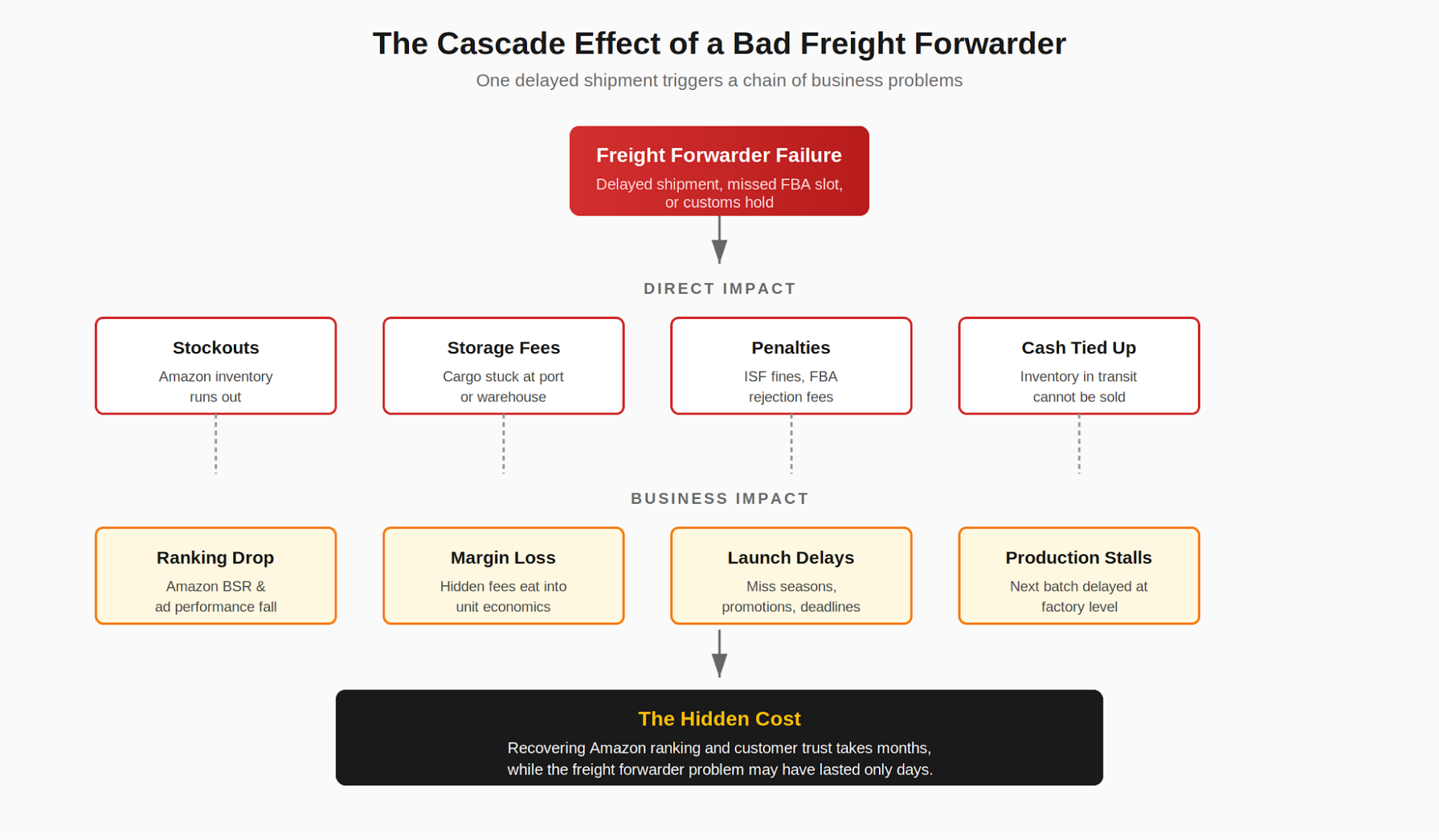
Most sellers treat freight forwarding as a logistics line item. A quote comes in, the lowest number wins, and the booking is done. That mindset costs businesses real money every quarter.The cheapest freight quote can easily become the most expensive shipment. Hidden fees show up at the destination. Customs delays add storage costs. Missed FBA appointments push inventory back by weeks. By the time the cargo finally checks in at Amazon, your listing has lost its sales velocity, and getting it back takes months.Figure 1. How a single freight forwarder failure cascades through your business.When you ship from China to Amazon FBA, the freight forwarder controls more than transit time. They influence:
Inventory continuity: How reliably your stock arrives before you run out.
Amazon ranking stability: Stockouts damage your Best Seller Rank and ad performance.
Cash flow: Cargo stuck in customs is working capital you cannot use.
Launch timing: A delayed shipment can push a product launch into the wrong season.
Customer satisfaction: Late stock means late shipments to end buyers.
Production scheduling: Late pickups disrupt the next production cycle at the factory.
A freight forwarder is not a shipping vendor. They are a partner in your operational reliability.
Reliable product sourcing starts here
Work with experts who help you evaluate suppliers and reduce risk.
What a Freight Forwarder Actually Does (And What They Should Do for FBA Sellers)
A freight forwarder coordinates the movement of cargo from origin to destination. That is the textbook definition. For an Amazon FBA seller importing from China, the real job is much wider.Here are the functions a good China to USA freight forwarder should cover, especially for FBA shipments:
Origin pickup: collecting goods from the factory, sometimes consolidating from multiple suppliers.
Export documentation: commercial invoice, packing list, bill of lading, and any product-specific paperwork.
Ocean or air booking: securing capacity at competitive rates, with realistic transit times.
Customs clearance: filing entries with US Customs and handling tariff payments.
Bond and ISF: making sure the Importer Security Filing is done correctly and on time.
Last-mile delivery: trucking from the port to the assigned Amazon fulfillment center.
Appointment scheduling: booking the FBA delivery window and managing rebookings if needed.
Tracking and visibility: clear updates at every stage so you can plan inventory and ads.
What many sellers do not realize is how often a forwarder fails at one of these steps and how expensive that single failure can be. A missed or incorrect ISF filing can result in significant penalties and shipment delays. A wrong pallet configuration can mean an FBA rejection and a costly redelivery. A vague DDP quote can hide tariff exposure and additional fees that significantly affect unit economics.If you want a deeper view of how this fits into the broader fulfillment picture, the Zignify guide on Amazon FBA vs Amazon 3PL fulfillment strategy covers how routing decisions affect cost and flexibility.
Reliable product sourcing starts here
Work with experts who help you evaluate suppliers and reduce risk.
China to USA Shipping Routes and What They Mean for FBA Sellers
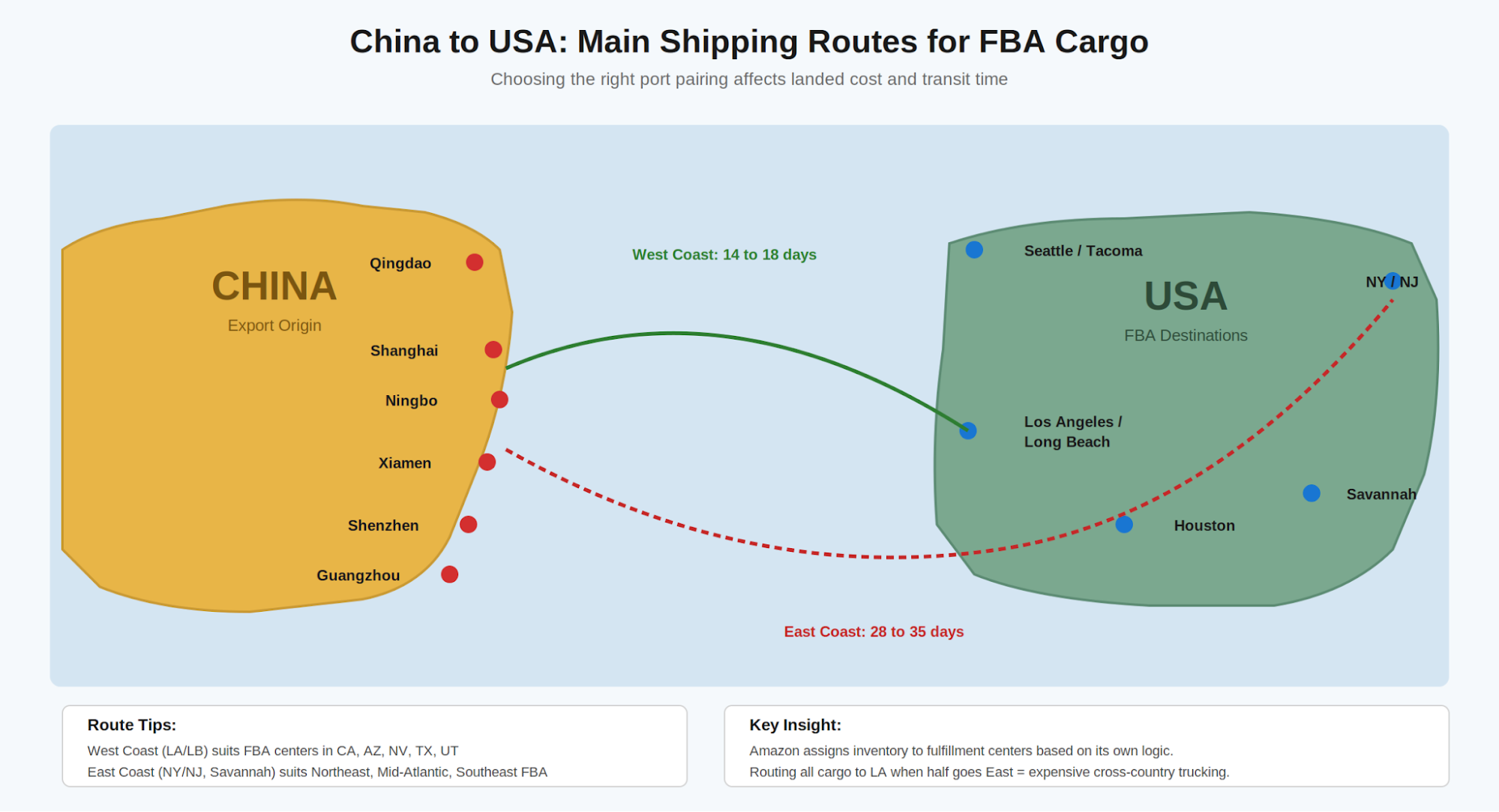
The route your freight forwarder uses affects cost, transit time, and how predictable your inventory plan will be. Most China to USA Amazon FBA shipments move through a handful of common lanes.Figure 2. Main China export ports and US import gateways for FBA cargo.Main Chinese export ports include:
Shanghai: the largest container port in the world, with broad sailing options to both US coasts.
Ningbo-Zhoushan: deep-water port near Shanghai, common for general cargo and high volume routes.
Shenzhen (Yantian and Shekou): the dominant export hub for South China and the Pearl River Delta.
Guangzhou (Nansha): another major South China gateway, often paired with Shenzhen.
Qingdao: serves North China manufacturing for electronics, machinery, and household goods.
Xiamen: smaller but useful for Fujian-based factories and consolidated shipments.
Main US import gateways for FBA cargo:
Los Angeles and Long Beach: the largest entry point, with strong FBA warehouse coverage in California and the Southwest.
New York and New Jersey: the main East Coast gateway, used for FBA centers across the Northeast and Mid-Atlantic.
Savannah: increasingly popular for East Coast FBA destinations and has shorter port wait times than NY/NJ in many seasons.
Houston: useful for Gulf and Central US FBA fulfillment centers.
Seattle and Tacoma: strong for Pacific Northwest FBA distribution.
The route choice matters because Amazon assigns your inventory to a specific fulfillment center based on its own logic, not yours. If your forwarder routes everything through LA but Amazon assigns half your inventory to an East Coast warehouse, you pay extra for cross-country trucking. A forwarder who understands FBA routing helps you plan port of entry around likely fulfillment center assignments, not just the cheapest sailing.For a wider view on how sourcing and logistics connect across countries, see the Zignify breakdown on China sourcing vs worldwide sourcing, which explains how route choice ties into broader supplier strategy.
How to Choose a Freight Forwarder for Amazon FBA: A Practical Step-by-Step
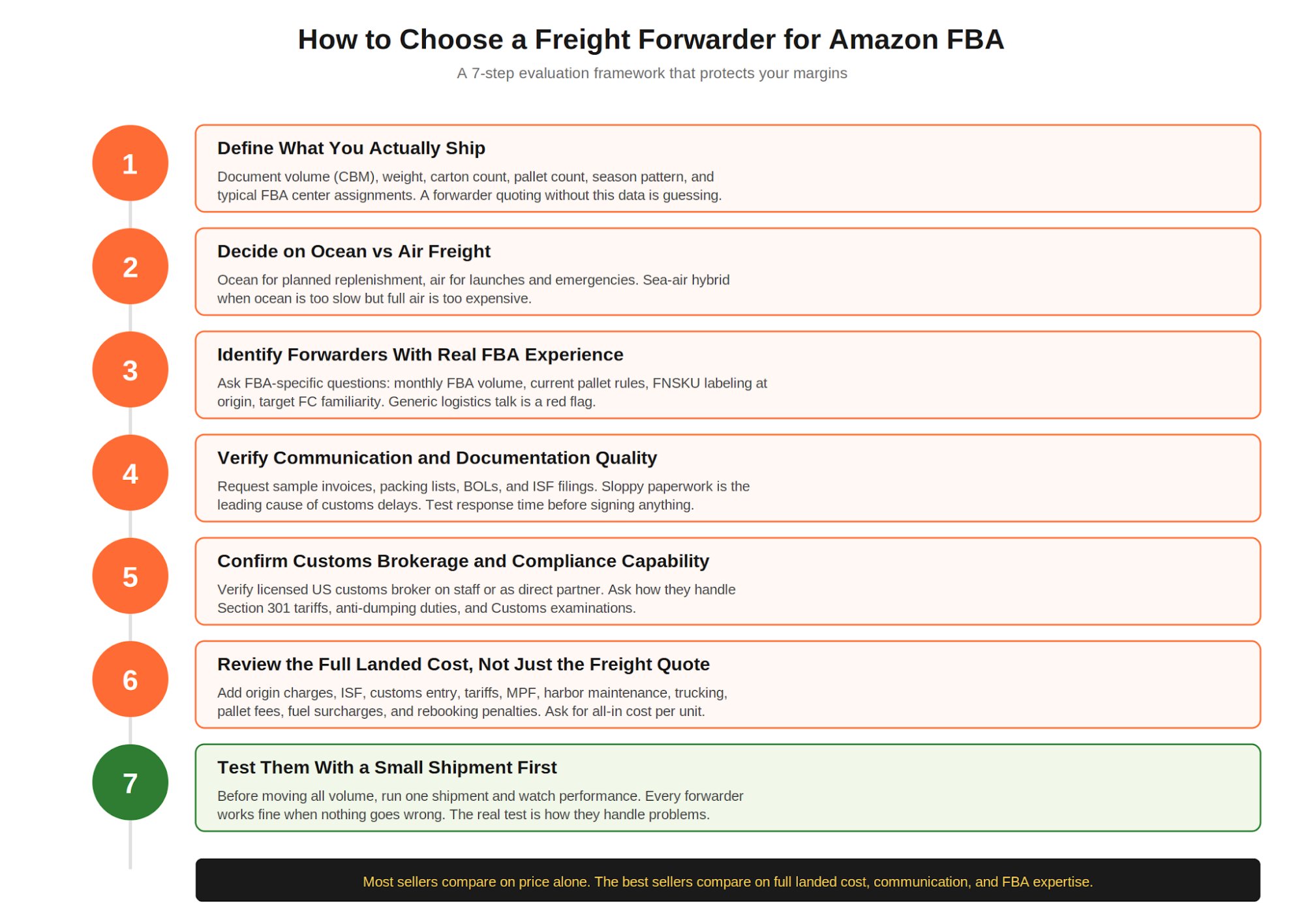
Most sellers compare freight forwarders the wrong way. They request three quotes, pick the lowest price, and assume the rest will work itself out. It rarely does. Here is a more reliable approach.Figure 3. A 7-step framework for evaluating freight forwarders for Amazon FBA.
Step 1: Define What You Actually Ship
Before requesting quotes, write down the basics. Product type, total volume per shipment in cubic meters, total weight, carton count, pallet count, season pattern, and where your Amazon inventory typically gets assigned. A forwarder who quotes without this information is guessing, and so are you.
Step 2: Decide on Ocean Freight vs Air Freight
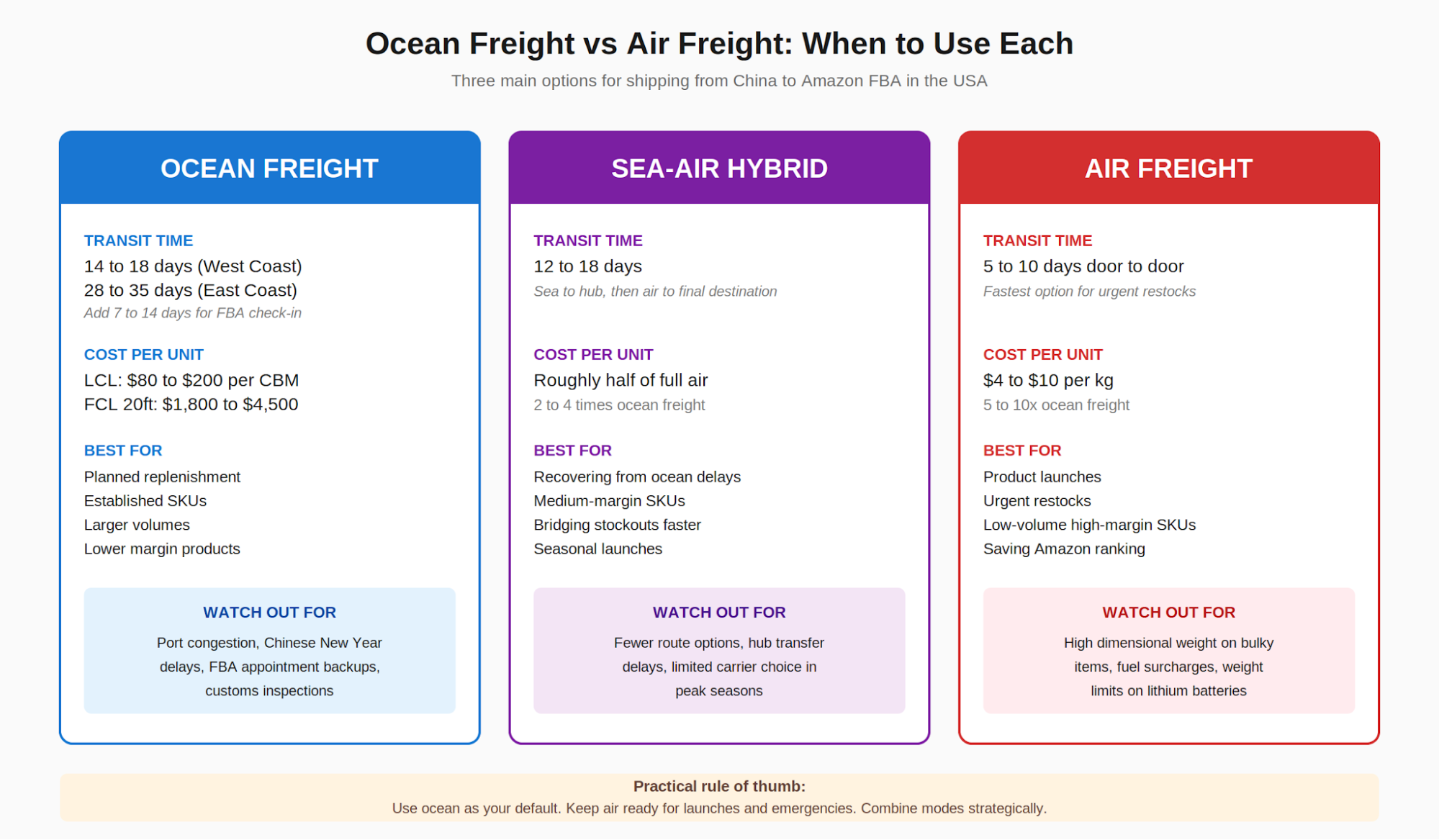
Ocean freight is the default for FBA replenishment. Transit time from China to the US West Coast usually runs 20 to 35 days port to port, plus 10 to 20 days for inland and FBA check-in. Air freight can cost several times more per kilogram than ocean freight, depending on season and route conditions. Air makes sense for product launches, urgent restocks, low-volume, high-margin SKUs, and sea-air hybrid shipments. Sea makes sense for everything else, especially planned replenishment.Figure 4. Ocean freight, sea-air hybrid, and air freight compared by transit time, cost, and best use case.According to the Federal Maritime Commission, ocean carriers handle the majority of US containerized imports from China, which is why a forwarder’s ocean negotiation strength matters more than their air pricing for most FBA brands.
Step 3: Identify Forwarders With Real FBA Experience
Not every freight forwarder understands Amazon. Ask specific questions. How many FBA shipments do they handle per month? Do they know the current pallet labeling rules? Have they shipped to your target FBA centers before? Can they handle FNSKU labeling at origin or do they only work with US prep centers? Forwarders who talk in generic logistics terms but cannot answer FBA-specific questions will create problems later.
Step 4: Verify Communication and Documentation Quality
Ask for sample documents. A real commercial invoice, packing list, bill of lading, and ISF filing from a recent shipment. Look at the formatting, the accuracy of HS codes, and the clarity of the descriptions. Sloppy paperwork is the leading cause of customs delays. Also test their response time before you commit. If a forwarder takes two days to reply to a quote request, they will take two days to reply when your shipment is sitting at customs.
Step 5: Confirm Customs Brokerage and Compliance Capability
Sea freight from China to the USA cannot reach an Amazon warehouse without clean customs clearance. Confirm that the forwarder has a licensed US customs broker on staff or as a direct partner. Ask how they handle Section 301 tariffs, anti-dumping duties, and product-specific certifications. Ask what happens if Customs flags your shipment for examination. A vague answer here is a red flag. For an overview of US customs requirements, US Customs and Border Protection provides official guidelines that any serious broker should be fluent in.
Reliable product sourcing starts here
Work with experts who help you evaluate suppliers and reduce risk.
Step 6: Review the Full Landed Cost, Not Just the Freight Quote
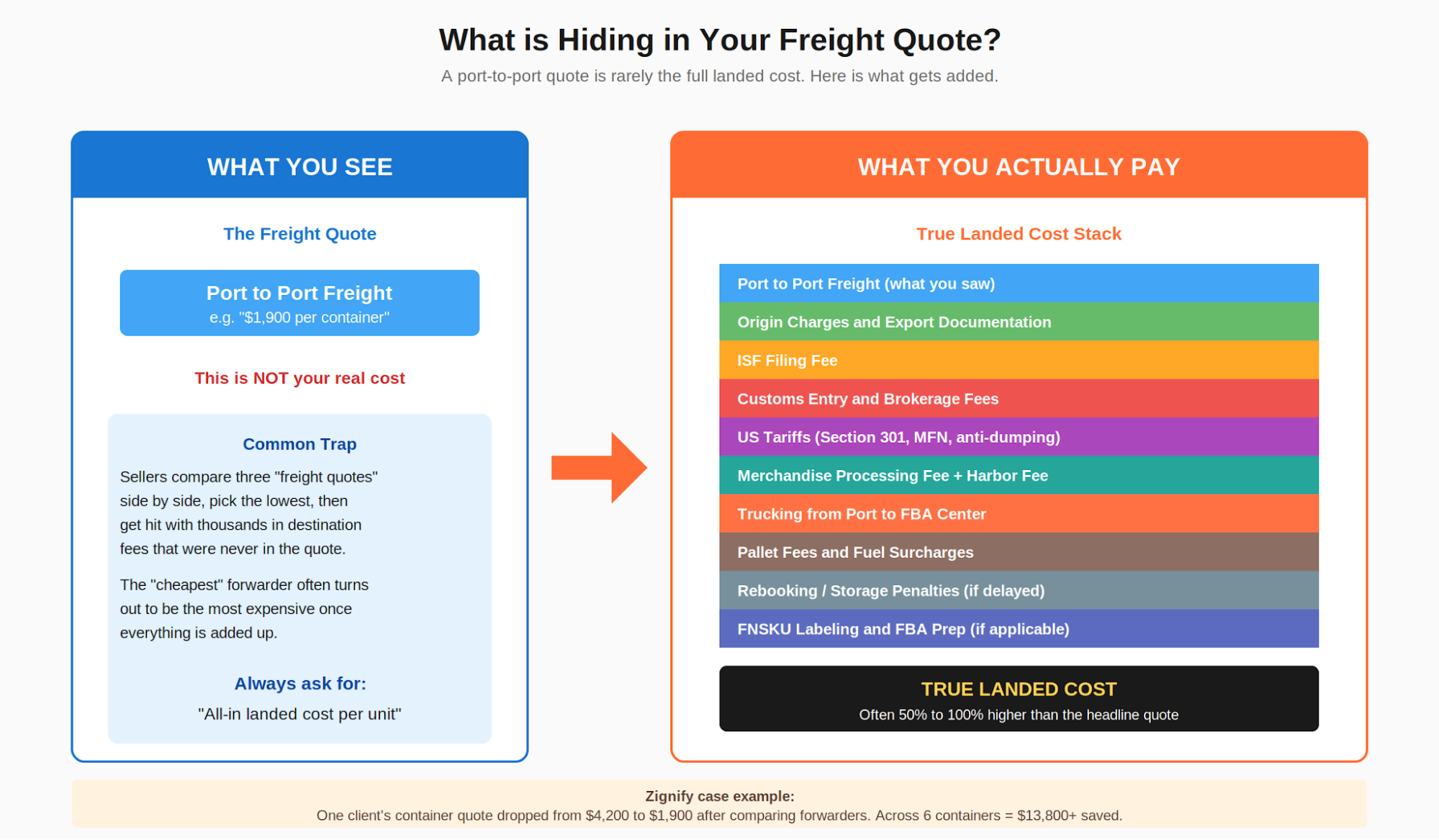
This is where most sellers lose money. A 1,900 USD ocean quote is not the full picture. Add to it: origin charges, export documentation, ISF filing fee, customs entry fee, US tariffs, merchandise processing fee, harbor maintenance fee, trucking from port to FBA, pallet fees, fuel surcharges, and any rebooking penalties. Ask every forwarder for an all-in landed cost per unit, not just a port-to-port quote.Figure 5. The full landed cost is rarely what appears on the headline freight quote.In Zignify’s experience, the difference between a transparent forwarder and a vague one can be 2,000 USD or more per container. We have seen clients quoted 4,200 USD for a container, then reduce that to around 1,900 USD by getting comparable quotes from other providers. Across five or six containers a year, that is more than 10,000 USD added back to the margin without changing the product or the supplier.
Step 7: Test Them With a Small Shipment First
Before moving all your volume to a new forwarder, run one shipment through them and watch how they perform. Look at communication, documentation accuracy, customs handling, transit time vs estimate, and how they respond when something goes wrong. Every forwarder works fine when nothing goes wrong. The real test is what happens when a container is delayed or flagged for inspection.
Reliable product sourcing starts here
Work with experts who help you evaluate suppliers and reduce risk.
Ocean Freight vs Air Freight from China: When to Use Each
Most FBA sellers do not need to choose one mode forever. They need to know when each makes sense.
Ocean freight: best for planned replenishment, larger volumes, lower margin products, and any SKU where transit time is predictable enough to plan around. Cost per kilogram is far lower, but the transit time of 30 to 50 days door to door requires careful inventory planning.
Air freight: best for product launches, urgent restocks on a fast-moving SKU, low-volume high-margin products, and bridging the gap when an ocean shipment is delayed. Cost per kilogram is high, but the speed protects your sales velocity and ranking.
Sea-air combinations: useful when the ocean is too slow but full air is too expensive. Cargo moves by sea to a hub like Dubai or Los Angeles, then by air to the final destination. Transit time falls to around 12 to 18 days at roughly half the cost of full air.
A strong forwarder should be able to explain these tradeoffs in operational and financial terms, not only provide rates. If your forwarder cannot articulate when air makes sense for your business, they are quoting, not advising.
Common Freight Forwarder Mistakes That Cost FBA Sellers Real Money
Several patterns show up over and over in our work with sellers importing from China.
Choosing on price alone: the cheapest quote often hides fees that surface at the destination. The total cost ends up higher, and the service is worse.
Accepting the factory’s preferred forwarder by default: factories often have logistics partners they earn commissions from. The price is rarely the best, and the forwarder is loyal to the factory, not to you.
Vague DDP arrangements: DDP shipping from China to the USA can be a smart option, but only if every fee is documented. Many DDP quotes hide tariffs or use undeclared customs values to keep the headline price low. When Customs catches up, the importer pays the difference.
No backup forwarder: if your only forwarder has a problem, your supply chain has a problem. Smart brands keep at least two qualified options.
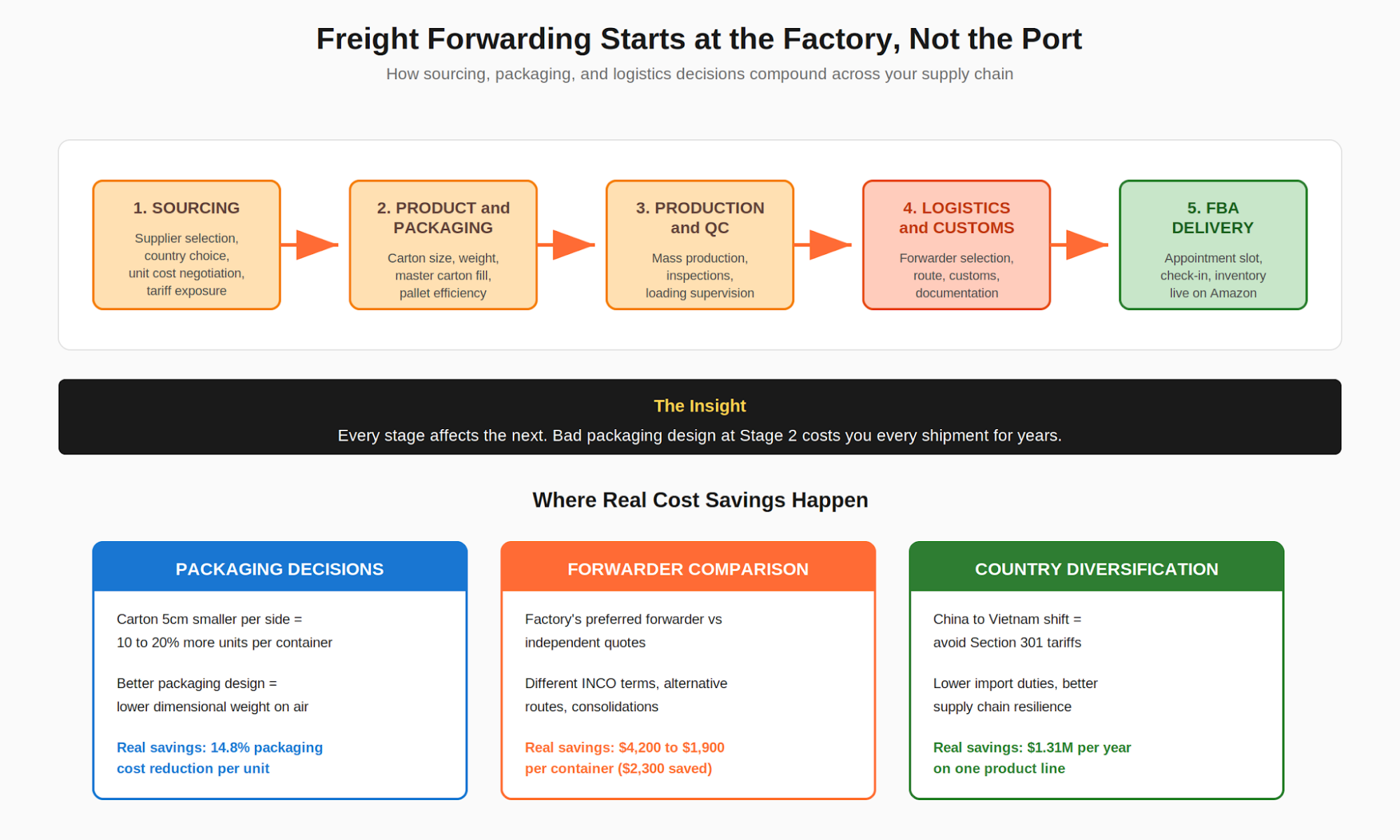
Skipping packaging optimization: packaging that wastes space inside cartons wastes money on every shipment. Carton dimensions affect dimensional weight, pallet utilization, container fill, and FBA storage fees. Small changes in packaging design can pay back for years.
Ignoring origin coordination: freight forwarding starts at the factory, not at the port. If your forwarder cannot coordinate pickup, inspection, and loading with your supplier, you will pay for delays you did not cause.
Reliable product sourcing starts here
Work with experts who help you evaluate suppliers and reduce risk.
How Zignify Approaches Freight Forwarding for China to USA Amazon FBA Shipments
Zignify is not a freight forwarder. We are a buyer-side sourcing partner, and that distinction matters. Most sellers know factories offer shipping, and many simply accept that offer. The problem is that factories often work with logistics partners they earn commissions from, the pricing is rarely optimized, and DDP terms can be structured in ways that are not transparent to the buyer.Our approach is different. We treat logistics the same way we treat sourcing: we compare. We request multiple quotations from a network of logistics providers because shipping prices change frequently, and a single quote tells you nothing about the market.Figure 6. Freight forwarding decisions start at sourcing, not at the port.From there, we help clients:
Compare different forwarders side by side on real-time market rates.
Analyze cost vs transit time for each shipping method.
Evaluate ocean, air, rail, and truck options based on your inventory plan.
Review terms and conditions carefully, especially on DDP arrangements.
Negotiate better rates based on our volume and supplier relationships.
The goal is the most efficient combination of cost, speed, and reliability for your specific situation. For LCL shipments, full containers, or multiple containers, small differences in price translate into very large savings.We do not take commissions from forwarders or factories. Our incentive is to find the best combination for the buyer, not the cheapest deal for the supplier. According to Amazon Seller Central guidelines, FBA shipment compliance is the seller’s responsibility, which means working with a partner who fully understands those rules protects your account and your inventory.
The Opportunity Ahead With Zignify
Tariffs, route disruptions, and Amazon’s evolving FBA rules are not going away. Brands that treat freight forwarding as a strategic decision, not a transactional one, will keep their margins intact. Brands that focus only on headline freight pricing often encounter avoidable operational and margin issues later.When you work with Zignify, you get a partner who looks at sourcing, supplier coordination, packaging, shipping, and customs as one connected system. We help you choose the right freight forwarder for your situation, structure transparent DDP or FOB terms, optimize packaging for shipping efficiency, and plan inventory around realistic transit times. The result is fewer stockouts, more predictable inventory, better cash flow, and stronger margins.
What Most Guides Get Wrong, Here’s What Our Expert Knows ✅Most freight forwarder guides treat shipping as a standalone vendor choice. In reality, your freight forwarder is part of your supply chain, your Amazon account health, and your margin structure. Three things matter more than the headline price.💰 The cheapest container quote almost always has the most expensive hidden fees.When a forwarder quotes 1,500 USD for a China to USA container while everyone else is quoting 2,500 USD, that gap does not come from better negotiation. It usually comes from missing line items. Destination charges, chassis fees, customs entry, ISF, terminal handling, fuel surcharges, and trucking to the FBA center can add up to 1,000 USD or more after the cargo arrives. The shipment that looked cheap on Monday becomes the most expensive of the year by Friday. Always compare all-in landed cost per unit, not port-to-port freight.🚢 Factory-arranged freight is rarely in your interest, even when it looks convenient.Factories in China often have preferred logistics partners. The relationships are friendly, the quotes come fast, and many sellers accept them by default. The problem is that factories sometimes earn commissions from these forwarders, which means the price is not optimized for you. DDP terms in particular can be structured in ways that hide tariffs and customs values. A buyer-side approach means getting multiple quotes from independent forwarders and comparing them on real market rates, not on whatever the factory’s friend can arrange.📋 Your packaging design decides your freight cost for years, not just one shipment.Carton dimensions, master carton fill, and pallet utilization affect dimensional weight, container capacity, and FBA storage fees on every single shipment you ever make. A small change in packaging design at the product development stage can save thousands of dollars across the life of the product. We have seen 14.8 percent packaging cost reductions on individual SKUs that translated into compounding savings every quarter. The freight forwarder cannot fix bad packaging. The fix has to happen at the sourcing and product design stage.Want to make sure your next FBA shipment is optimized before it leaves China? Book a free sourcing call →
Frequently Asked Questions
What is the best freight forwarder for Amazon FBA?
There is no single best freight forwarder for every Amazon FBA seller. The right choice depends on your shipment volume, product type, target FBA centers, and how much hands-on support you need. The strongest forwarders combine real FBA experience, clean customs handling, transparent pricing, and reliable communication. Compare at least three providers on full landed cost, not just freight quotes, before committing.
How much does it cost to ship from China to Amazon FBA?
Costs vary based on volume, mode, and route, depending heavily on market conditions and seasonality. A 20-foot container from China to the US West Coast typically runs between 1,800 and 4,500 USD, depending on market conditions, plus 1,000 to 2,000 USD in destination charges and FBA trucking. Air freight runs 4 to 10 USD per kilogram. LCL ocean shipping is usually 80 to 200 USD per cubic meter. Always ask for an all-in landed cost rather than the port-to-port number.
Is sea freight from China to Amazon FBA worth it?
For planned replenishment of established SKUs, sea freight is almost always the right choice. The cost per unit is far lower than air, and transit times of 30 to 50 days door to door are manageable with proper inventory planning. Sea freight becomes a problem only when sellers run out of stock and use ocean shipping as their backup plan instead of their main plan.
What is DDP shipping from China to USA?
DDP stands for Delivered Duty Paid. The seller or freight forwarder handles everything from origin pickup to final delivery, including customs clearance and tariffs. DDP can simplify life for FBA sellers, but only if the terms are transparent. Many DDP quotes hide tariffs, use undeclared customs values, or leave out fees that surface later. Always ask for a written breakdown of every cost included in a DDP quote before agreeing to it.
How long does ocean freight take from China to the USA?
Port to port transit time is usually 14 to 18 days to the US West Coast and 28 to 35 days to the US East Coast. Add 7 to 14 days for customs clearance, trucking to FBA, and warehouse check-in. Total door-to-FBA time is generally 30 to 50 days from departure. Chinese New Year, port congestion, and weather can extend this significantly.
Can a freight forwarder handle Amazon FBA labeling and prep?
Some can, some cannot. A forwarder with real FBA experience can coordinate FNSKU labeling at origin, palletize to Amazon spec, and meet carton weight and dimension rules. Others will require you to use a separate US prep center. Confirm this before booking, because adding a prep center after the fact can add a week of transit time and extra cost.
What is the cheapest way to ship from China to Amazon FBA?
The cheapest reliable method for most products is LCL ocean freight for small volumes and full container ocean freight once you can fill or share a container. Air freight is the most expensive per kilogram. Cheaper does not always mean better, because stockouts caused by slow shipping can cost more than the freight saving.
Do I need a customs broker if my freight forwarder does customs clearance?
No, not separately. A licensed freight forwarder either has a customs broker in-house or works directly with one. What you do need to verify is that the broker handling your shipment is properly licensed by US Customs and Border Protection, that they understand your product category, and that they will file your ISF and entry on time.
What happens if my shipment misses its FBA appointment?
The carrier needs to rebook, which often means the inventory sits in a warehouse for several days to several weeks before Amazon can receive it. You pay storage fees during that time, and your inventory is unavailable to sell. Repeated missed appointments can affect your relationship with Amazon and your account standing. This is why appointment management is one of the most important things a freight forwarder does for FBA sellers, and one of the easiest things to overlook when comparing quotes.