A product can look perfect on the production line and still fail compliance the moment it reaches a port, an Amazon warehouse, or a customer’s hands. That is the part most brands underestimate. The samples are clean, the packaging is on point, the supplier signs off on quality, and then a shipment gets held at customs because a chemical reading exceeded the limit. Or Amazon requests a CPSIA certificate that nobody prepared. Or a battery report turns out to be issued for a slightly different product variant than the one that was actually shipped.This article is a practical guide to third-party lab testing for three of the highest-risk consumer categories: cosmetics, electronics, and children’s products. It explains when testing is actually required, what tests apply to each category, what most importers get wrong, and how lab testing connects to sourcing in a way that protects margin, marketplace access, and reputation. If you sell on Amazon, Shopify, or into strict markets like the EU or US, the cost of skipping this step is almost always higher than the cost of doing it properly.
Need help with your product sourcing?
Get practical advice tailored to your product, suppliers, and market form Zignify experts
Why Third-Party Lab Testing Matters More Than Most Brands Realize
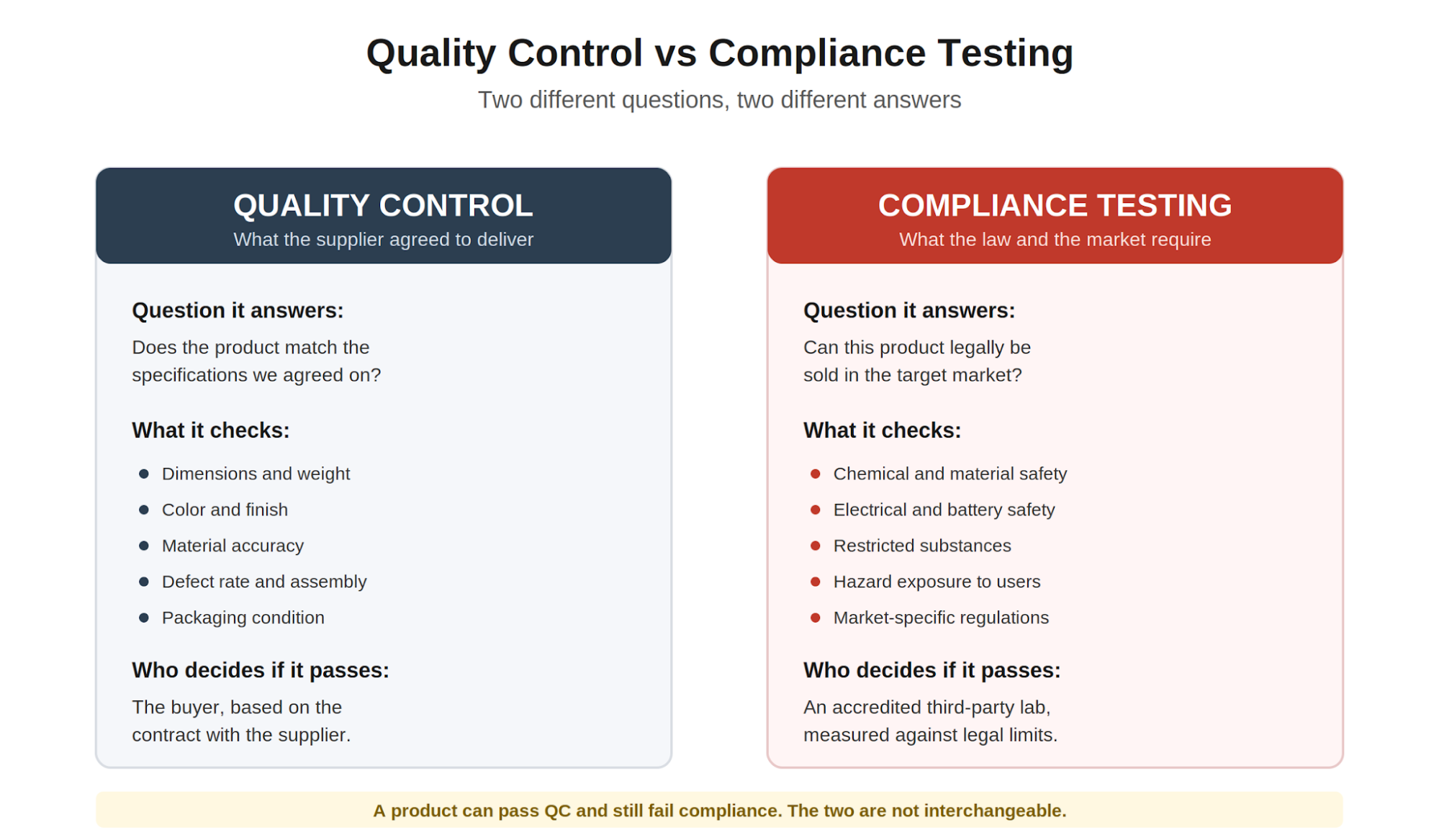
Lab testing is one of those line items that sounds optional until the moment it becomes the only thing standing between you and a blocked shipment. For most brands, the realization comes late. Either a customer files a complaint, a regulator asks for documentation, or an Amazon listing gets suspended with a request for compliance evidence that should have been prepared months earlier. This is where people usually panic-budget. We should never be reacting here, testing should already be baked into sourcing cost planning.Here is the part that catches importers off guard: passing internal quality control does not mean passing safety compliance. Quality control checks whether the product matches the specifications you agreed on with the factory. Compliance testing checks whether the product is legally allowed to be sold in your target market. Those are two different questions, and a product can pass one while failing the other.Figure 1. Quality control and compliance testing answer different questions. Passing one does not mean passing the other.The financial impact compounds quickly. A blocked shipment ties up capital, delays revenue, and creates storage costs at the port. A failed lab test forces a reformulation or redesign, which means a new sample round and a new production cycle. An Amazon suspension can wipe out months of sales velocity, and if the listing was your bestseller, the ranking damage is often permanent.The brands that consistently scale into the US and EU treat lab testing as a planned, budgeted step of the sourcing process. Not an afterthought. Not a reaction to a problem. A planned step.
Reliable product sourcing starts here
Work with experts who help you evaluate suppliers and reduce risk.
Third-party lab testing is the process of having an independent, accredited laboratory verify that a product meets the safety, chemical, and performance regulations of the market where it will be sold. The word “third-party” matters. It means the lab has no commercial interest in the product passing, which is exactly what regulators and marketplaces want to see. This independence is the whole point, never trust “factory-arranged labs” blindly unless we control scope.A few terms that come up often in this space:
Compliance testing: laboratory testing performed to prove a product meets a specific regulation, such as REACH, CPSIA, or RoHS.
Safety testing: testing focused on whether a product can harm a user, such as electrical safety, choking hazards, or microbial contamination.
Certification: an official document issued after testing passes, used to prove compliance to customs, marketplaces, or authorities.
Test report: the underlying lab document showing exactly what was tested, what limits applied, and what the results were.
Type testing: testing performed on a representative sample of a product before mass production, used to demonstrate the design itself is compliant.
The important point is that testing is product-specific and market-specific. A cosmetic sold in the UK does not have the same testing requirements as the same cosmetic sold in the US. An electronic device sold in the EU needs different documentation than the same device sold in Canada. There is no universal “compliance certificate.” Brands that try to reuse old test reports across markets or across product variations almost always run into trouble eventually.
Reliable product sourcing starts here
Work with experts who help you evaluate suppliers and reduce risk.
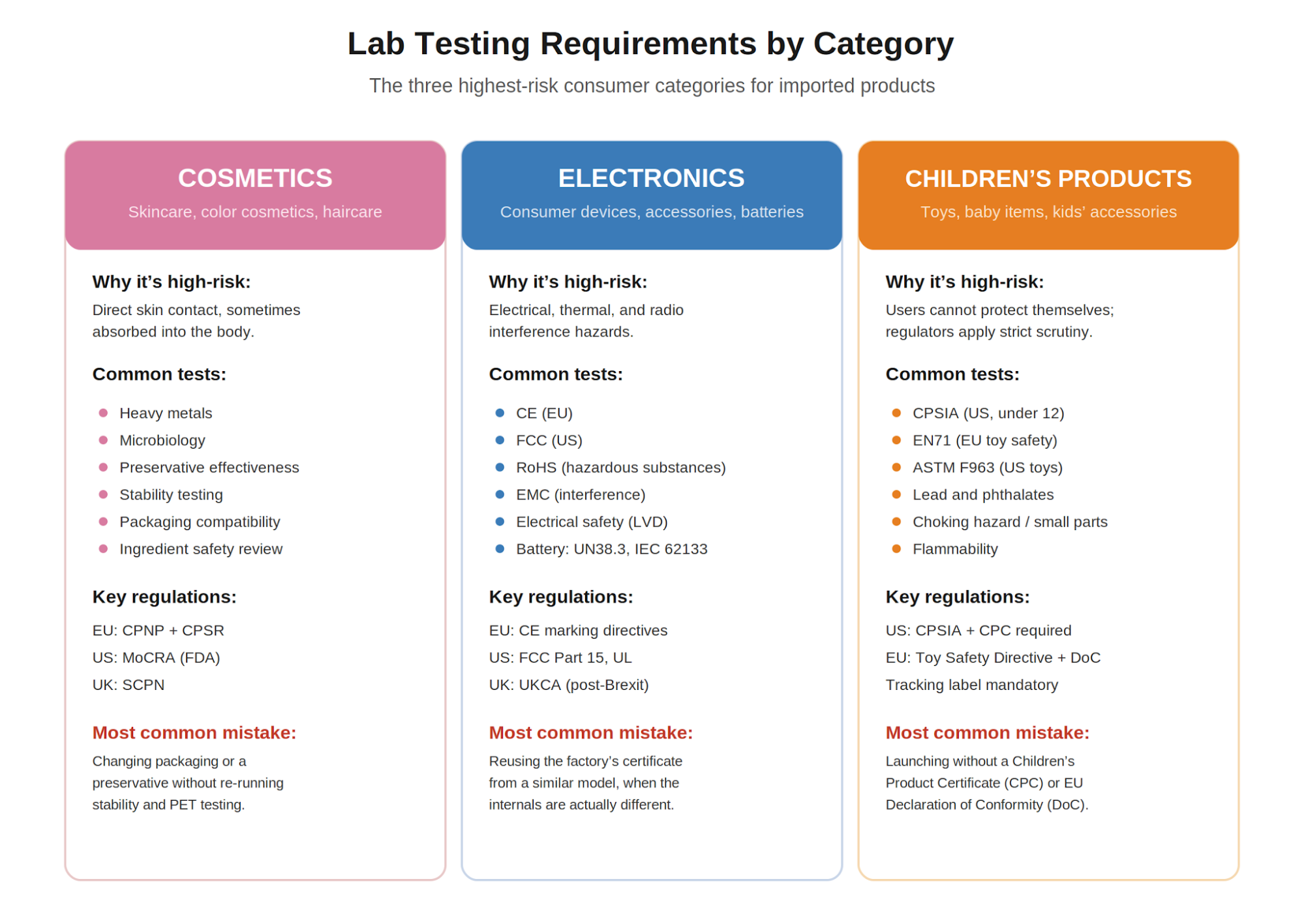
Figure 2. Lab testing requirements for the three highest-risk consumer categories.
Lab Testing for Cosmetics: What’s Required and Where Brands Get It Wrong
Cosmetics is one of the highest-stakes categories because the product physically contacts the skin, and in some cases is absorbed into it. Regulators in the EU, US, UK, and other major markets treat cosmetics as something closer to a regulated consumer good than a fashion product, and the documentation required reflects that. Cosmetics is one of those categories where “looks fine” means absolutely nothing legally.
Common cosmetic testing categories
Heavy metals testing: checks for lead, cadmium, arsenic, mercury, and other contaminants that can enter cosmetics through raw materials or packaging.
Microbiology testing: verifies that the product is free from harmful bacteria, yeast, and mold, especially for water-based formulas.
Preservative effectiveness testing (PET): also called challenge testing, this confirms the preservative system can resist microbial contamination through the product’s shelf life.
Stability testing: checks whether the formula remains physically and chemically stable under realistic storage conditions, including heat, humidity, and light exposure.
Packaging compatibility testing: verifies that the formula does not react with the packaging material in a way that affects safety or product integrity.
Ingredient safety assessment: a documented evaluation of every ingredient against the regulations of the target market.
Where brands go wrong
The biggest mistake is assuming that a “FDA compliant” or “EU compliant” label from a supplier is the same as having your own test reports. It is not. In the US, cosmetics manufacturers are responsible for the safety of their products, and the FDA can request evidence at any time, particularly under MoCRA, the Modernization of Cosmetics Regulation Act. In the EU, every cosmetic product must have a Cosmetic Product Safety Report (CPSR) prepared by a qualified safety assessor, and the product must be registered through the Cosmetic Products Notification Portal.The second common mistake is changing suppliers or packaging without re-validating. A formula that passed stability testing in one type of bottle can fail in another. A reformulation that swaps one preservative for a “similar” one can invalidate the original preservative effectiveness test. Each material change can require a new test cycle.
Reliable product sourcing starts here
Work with experts who help you evaluate suppliers and reduce risk.
Lab Testing for Electronics: CE, FCC, RoHS, and the Battery Problem
Electronics is the category where most brands underestimate the documentation burden. A simple-looking USB lamp can involve five or six separate test reports depending on the markets it ships into. Add a battery and the list grows again.
Common electronics testing categories
CE marking (EU): a self-declaration backed by underlying tests, including the Low Voltage Directive, EMC Directive, and RED for radio products.
FCC testing (US): required for products that emit or receive radio frequencies, including Bluetooth, Wi-Fi, and many wireless accessories.
RoHS testing: restricts hazardous substances like lead, cadmium, mercury, and certain phthalates in electrical and electronic equipment.
REACH testing: applies to chemical content across many product categories sold in the EU, including the materials used in electronics.
Battery safety testing: includes UN38.3 for lithium battery transport, plus IEC 62133 for rechargeable cell and battery safety.
EMC testing: confirms the product does not produce or suffer from electromagnetic interference beyond regulated limits.
Electrical safety testing: covers insulation, grounding, dielectric strength, and other parameters depending on the product class.
Where brands go wrong
The most expensive electronics mistake is buying off-the-shelf certifications from the factory. A factory may show a CE certificate for a similar product, but the model number, the housing material, or the internal circuitry on your order may differ enough to invalidate it. Customs authorities and serious marketplaces now cross-check this. This is a huge red flag “we already have CE” is not a green light. It’s just a starting question.The second mistake is treating the battery as a generic component. If the cell type, capacity, or supplier changes, the UN38.3 report from the original test no longer applies. Air freight forwarders increasingly refuse shipments without a current, matching report.The third mistake is the country mismatch. A product certified for the EU is not automatically certified for the UK after Brexit, and it is not automatically certified for the US, Canada, Australia, or Saudi Arabia. Each market has its own accepted certification regimes.
Reliable product sourcing starts here
Work with experts who help you evaluate suppliers and reduce risk.
Lab Testing for Children’s Products: The Highest-Risk Category
Children’s products carry the heaviest compliance burden of any consumer category, and that is not going to change. This is the category where regulators do NOT give second chances. Authorities treat children’s items with extra scrutiny because the user cannot protect themselves, and because the financial and legal consequences of a failure are severe.
Common children’s product testing categories
CPSIA testing (US): the Consumer Product Safety Improvement Act covers lead content, lead in paint, phthalate restrictions, and tracking label requirements for products intended for children under 12.
EN71 testing (EU): the European toy safety standard covers mechanical and physical properties, flammability, chemical migration, and specific category requirements.
ASTM F963 (US): the US toy safety standard, often required alongside CPSIA.
Choking hazard testing: small parts testing, with size and detachability evaluated against age-graded standards.
Phthalates testing: restricts plasticizers commonly used in soft PVC and other materials.
Lead testing: separate from CPSIA, lead is tested in surface coatings, substrates, and accessible components.
Flammability testing: required for toys, sleepwear, and certain textile categories.
Heavy metals migration testing: relevant for any product a child may put in their mouth.
Where brands go wrong
The most common children’s product mistake is assuming the factory’s existing CPSIA or EN71 reports apply to your specific order. Never assume reuse- compliance. The finished product always needs validation.If your color, your fabric, your printing, or your accessory changes, the test results often have to be re-validated. The US Consumer Product Safety Commission requires testing on the actual finished product as it will be sold, not a generic predecessor.The second mistake is the third-party labeling oversight. CPSIA requires tracking labels with specific information. A perfectly safe product without a compliant tracking label is still a non-compliant product in the eyes of the regulator.The third mistake, and the most painful one, is launching without a CPC (Children’s Product Certificate) or DoC (Declaration of Conformity) for the EU. These documents are not optional. They are required to be available on demand, and a missing CPC is one of the most common causes of Amazon listing suspensions in the toys and baby category.
Reliable product sourcing starts here
Work with experts who help you evaluate suppliers and reduce risk.
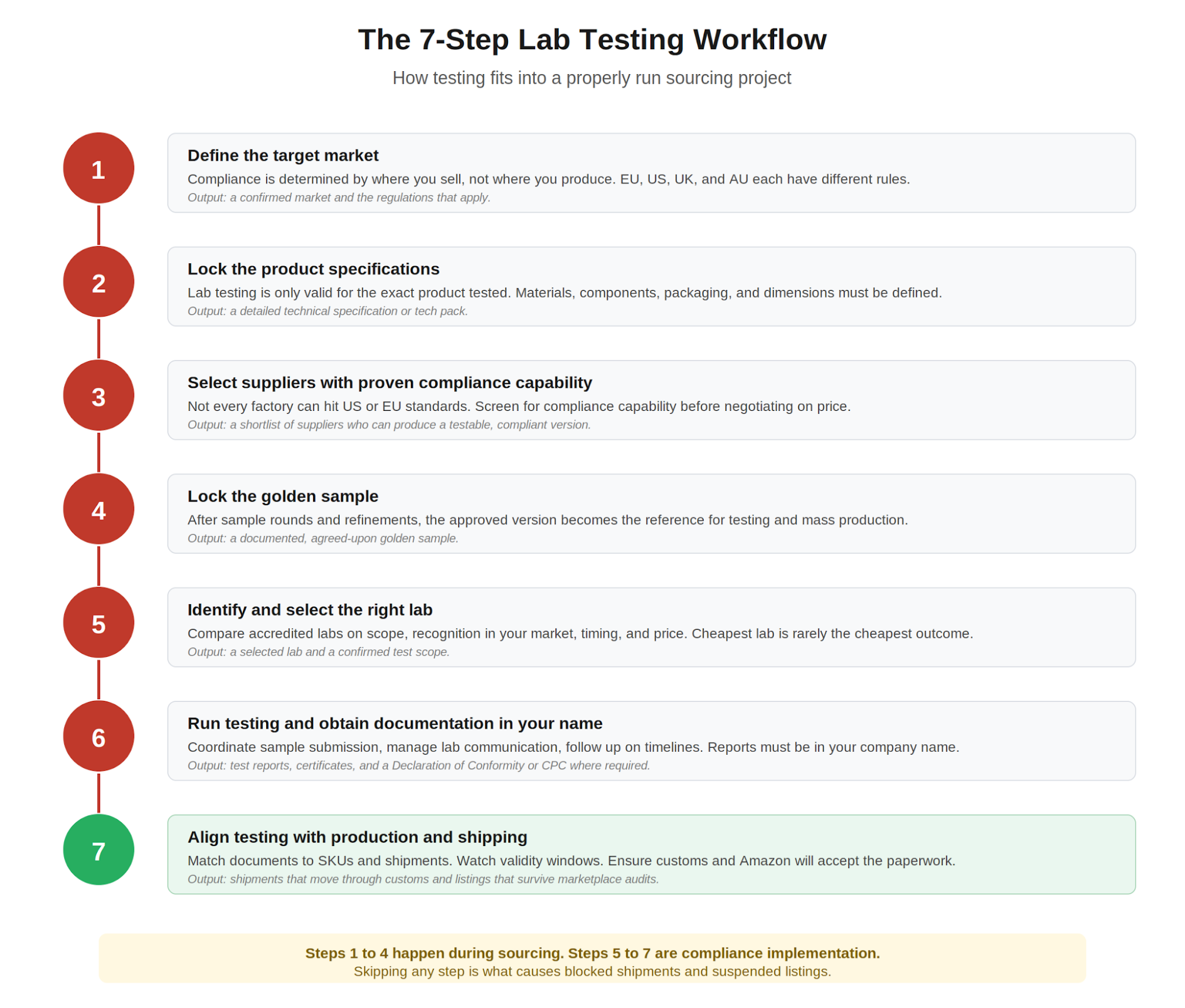
This is where most guides go wrong. They treat lab testing as a separate workflow, handled after sourcing is finished. In reality, the two are connected. This separation is exactly why people end up reworking entire production runs. If they are handled separately, the result is almost always rework. The cleanest sequence looks like this:Figure 3. The 7-step workflow that connects sourcing with lab testing and compliance. If we don’t lock golden sample properly, everything after this becomes chaos.
Step 1: Define the target market before sourcing
Compliance is determined by where you sell, not where you produce. Before any supplier is contacted, the target market must be defined, because that determines which regulations apply and which tests are needed. A skincare brand selling in the EU has a different test list than the same brand selling in the US.
Step 2: Define the product specifications in detail
Lab testing is only valid for the exact product that was tested. That means the specifications, materials, components, dimensions, and packaging need to be locked down before testing begins. Vague specifications lead to invalid test reports.
Step 3: Identify suppliers who can produce a testable, compliant version
Not every supplier can produce a version that will pass testing in your target market. Some factories specialize in domestic markets with looser regulations. Others have experience with EU or US compliance and can advise on material choices. Supplier selection should include compliance capability as a filter, not just price.
Step 4: Sample, refine, and lock the golden sample
Before testing, samples are reviewed, refined, and turned into a “golden sample” that becomes the reference for production. This is the version that goes to the lab. Without a locked golden sample, testing is premature.
Step 5: Identify and select the appropriate lab
Not all labs test all things. Some are strong in cosmetics microbiology. Others specialize in electronics EMC. Some are accredited for specific markets. The lab selection step often gets rushed, but the wrong lab can mean the wrong scope, the wrong limits, or a report that is not recognized by the regulator. Comparing quotations from suitable labs, then matching the scope to the regulation, saves both money and time.
Step 6: Manage the lab process and obtain documentation
Once the lab is selected, the sample is submitted, the testing is performed, and the test reports and certificates are issued. The reports should be issued in your company name, not the factory’s, because that is what proves the documentation belongs to you and not to the supplier.
Step 7: Align testing with production and shipping
Test reports often have validity windows. A UN38.3 battery report covers a specific cell. A CPSIA report covers a specific finished good. Testing has to be scheduled so the documents are valid for the shipment, and so customs and Amazon do not flag expired or mismatched reports. Documentation also needs to be linked to specific shipments, batches, and SKUs, particularly in regulated categories.
Reliable product sourcing starts here
Work with experts who help you evaluate suppliers and reduce risk.
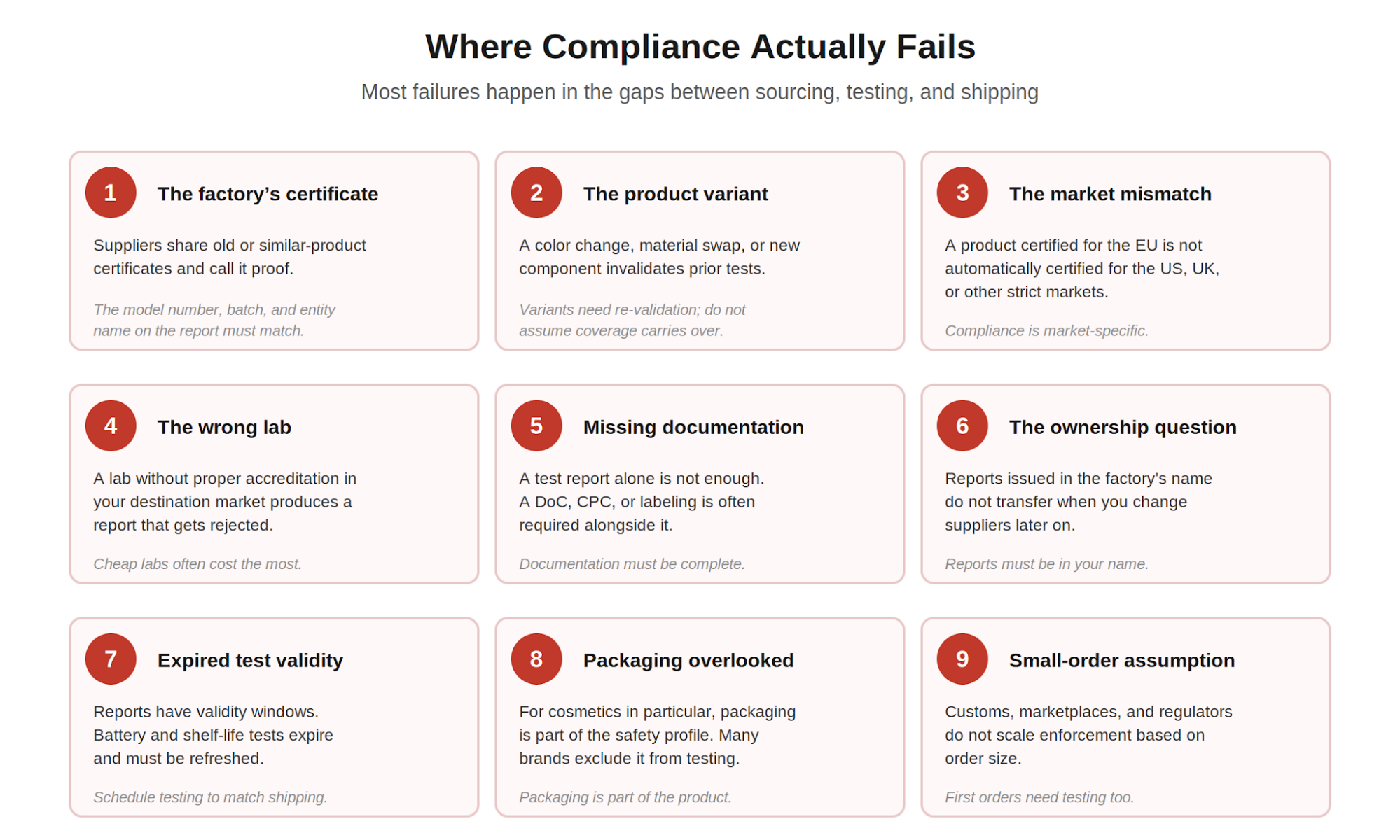
A few patterns appear over and over in failed launches and blocked shipments:Figure 4. Nine common failure points in compliance and lab testing.
Assuming the factory’s claim of “compliant” is enough. It is not. A factory’s word is not a certificate.
Reusing certificates from a similar product. Variants, color changes, and material swaps can invalidate a test report.
Skipping testing for “small” first orders. Customs, marketplaces, and regulators do not scale enforcement based on order size.
Choosing a lab on price alone. Some labs are not recognized in the destination market, which means the reports are technically useless.
Ignoring packaging in the test scope. For cosmetics in particular, packaging is part of the product safety profile.
Missing the documentation chain. A test report without a matching DoC, CPC, or labeling on the product itself is incomplete compliance.
Treating Amazon as a separate compliance regime. Amazon now actively requests CPSIA, CPC, FCC, and FDA documentation, and listings get suspended when the documents do not match.
Zignify treats lab testing as part of the compliance process, not a separate service. First, they identify the regulations, required tests, documentation, labeling, and packaging standards for the target market. Then, they handle the testing process itself by selecting accredited labs, managing quotations, organizing submissions, coordinating timelines, and ensuring the correct test scope. Final certificates and reports are issued in the client’s company name for customs, regulators, and marketplaces.As a buyer-side sourcing partner, Zignify also screens suppliers for compliance capability before production, locks the golden sample before testing, and remains independent from factory commissions. This ensures compliance is built into sourcing from the start, not handled later as a costly problem.
Reliable product sourcing starts here
Work with experts who help you evaluate suppliers and reduce risk.
The Opportunity Ahead: Building a Brand That Survives Regulator Scrutiny
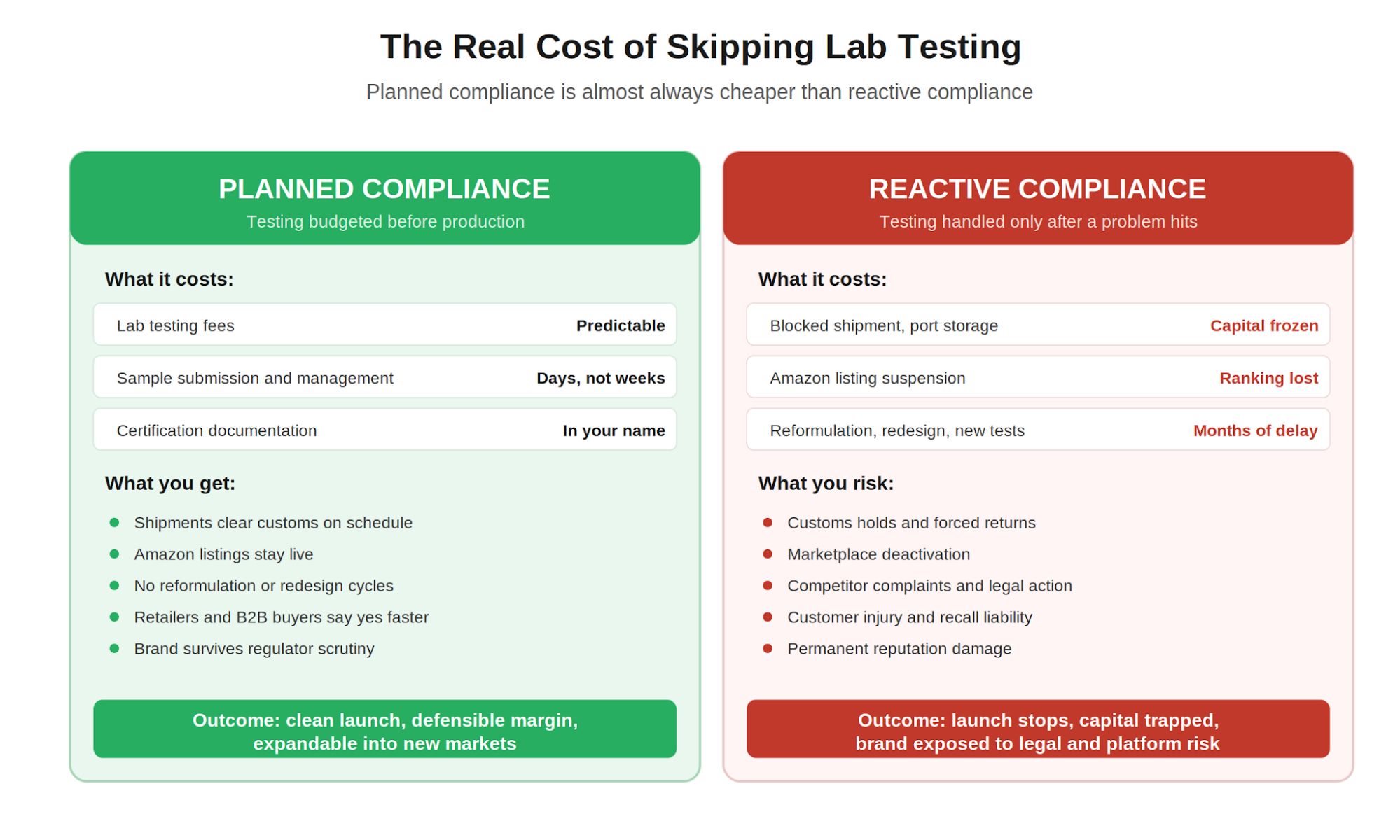
The brands that scale internationally without constant compliance fires are the ones that build the documentation properly from the start. That sounds obvious. It is not what most brands actually do. Most brands treat compliance as something to deal with after the first big order ships, and most brands eventually pay for that approach with a blocked shipment, a suspended listing, or a customer complaint that turns into a regulatory inquiry.Figure 5. The cost difference between planned compliance and reactive compliance.Building the documentation properly does cost money upfront. A multi-test certification package for an electronics SKU can run into thousands of dollars. A full cosmetic safety assessment for the EU is not cheap. CPSIA testing on a children’s product line involves multiple components. But the alternative, which is launching without the documentation and dealing with the consequences case by case, is almost always more expensive over the lifetime of the product.The brands that do this well also use compliance as a competitive moat. A properly documented product is harder to copy, easier to defend against complaints from competitors, easier to scale into new markets, and far more attractive to retailers and acquirers when the time comes to sell the business.That is the practical case for treating third-party lab testing as a planned step of the sourcing process, not a reaction to a problem.
What Most Guides Get Wrong, Here’s What Our Expert Knows ✅
Most articles about lab testing list the certifications and stop there. Real failures happen in process gaps, not in the lab itself.The harder truth is that compliance fails in the spaces between sourcing, sampling, testing, and shipping, not in the lab itself. The mistakes that hurt brands are almost always operational, not technical.
🚩 A supplier showing you a test report does not mean your product is tested.
Factories routinely share certificates from similar products, older batches, or different variants and call it proof of compliance. Customs officials and Amazon increasingly check the model number, the batch reference, and the entity name on the report. If any of those do not match what is actually in the shipment, the documentation is treated as if it does not exist. The only test report that protects you is the one issued in your company name, for your specific product, against the regulation of your specific market.
💡 Compliance is decided by where you sell, not where you produce.
Brands often choose suppliers based on what the factory says about compliance in China or Vietnam, then assume those claims carry into the US or EU. They do not. A factory can be fully compliant with domestic Chinese standards and still produce a product that fails REACH, CPSIA, or RoHS. The test scope has to be built around the destination market from the start, and that is a decision made during sourcing, not after the goods are produced.
💰 The cheapest lab is rarely the cheapest outcome.
Lab pricing varies widely, and the lowest quote often comes from a lab with a narrower accreditation scope or weaker recognition in the destination market. A report from a lab that customs or Amazon does not recognize is technically a useless report. Comparing quotations on price alone, without checking accreditation scope and market recognition, is one of the most common reasons brands end up paying for testing twice. Choosing the right lab the first time is almost always cheaper than choosing the cheapest lab.If you are about to commit to production in cosmetics, electronics, or children’s products and you are not certain the testing plan is right, that is the conversation worth having before the money goes out. Book a free sourcing call →
Frequently Asked Questions
What does product safety testing involve?
Product safety testing involves submitting a finished sample of your product to an accredited third-party laboratory, which then runs a defined set of tests against the regulations of the target market. The scope depends on the product category, but typically covers chemical content, mechanical or electrical safety, material composition, and any category-specific hazards. The lab issues a test report and, where applicable, a certificate.
Where can I find product testing services I can actually trust?
The most reliable labs are accredited to ISO/IEC 17025 and recognized by the regulator in your target market. Names like SGS, Bureau Veritas, Intertek, TUV Rheinland, and Eurofins are widely accepted, but accreditation scope matters more than the brand name. The right lab depends on the product and the destination market, which is why selecting a lab without first defining the test scope often leads to mismatched reports.
How much does product safety testing cost?
Cost varies widely by category. A simple chemical test on a textile product may cost a few hundred dollars, while a full electronics certification package across EMC, electrical safety, and battery testing can run into several thousand. Cosmetics safety assessments for the EU, including a full CPSR, are typically in the low thousands. The most important budgeting principle is to plan testing before production, not after, because failed tests force expensive reformulations and re-tests.
Do I need lab testing if I’m only selling on Amazon?
Yes, in most regulated categories. Amazon may not request the documentation at listing creation, but the platform actively audits sellers and can request compliance documents at any time. Categories like cosmetics, electronics, toys, baby products, and supplements are particularly likely to be checked. A suspended listing in a category like toys is often more damaging than the cost of the testing that would have prevented it.
Can safety and product testing be effective marketing tools?
Yes. Documented compliance is increasingly used as a trust signal on product detail pages, brand stores, and B2B sales conversations. Retailers, distributors, and B2B buyers actively ask for compliance documentation before placing orders. Brands that can produce clean documentation tend to close more retailer accounts and face fewer competitor complaints. The documentation is built for regulators, but it has commercial value too.
What is the difference between quality control and compliance testing?
Quality control verifies that the product matches the specifications agreed with the factory. Compliance testing verifies that the product meets the legal requirements of the market where it will be sold. A product can pass quality control and still fail compliance, because the two checks answer different questions. Both are needed, and serious brands treat them as separate, non-substitutable steps.
How long does third-party lab testing usually take?
Typical timelines range from two to six weeks depending on the test scope and the lab’s queue. Stability testing for cosmetics can take longer because the tests run over extended periods. Electronics certification packages, especially those involving CE and FCC, often take three to four weeks. Building lab time into the production schedule, rather than running it sequentially after production, is one of the simplest ways to avoid launch delays.
Are factory certificates the same as my own test reports?
No. A factory’s certificate proves the factory has produced compliant products at some point, often for a different client and a different SKU. Your own test report, issued in your company name and tied to your specific product, is what proves your product is compliant. Customs authorities, marketplaces, and serious retailers treat these as different documents.
What happens if my product fails lab testing?
A failed test usually means a reformulation or redesign is required, followed by a re-test. In cosmetics, this often means changing an ingredient or a preservative. In electronics, it can mean changing a component, modifying the circuit, or adjusting the housing. In children’s products, it can mean changing a paint, a fabric, or a small part. The cost is usually lower if the failure is caught before mass production rather than after.