Most product problems do not start in the warehouse, on Amazon, or in a customer’s hands. They start in the factory, weeks before the first carton is sealed. By the time a defective unit reaches a buyer, the damage is already done: bad reviews, refund spikes, account warnings, retailer rejections, and inventory you cannot sell at full margin. The single most common reason for these losses is not bad luck. It is the absence of a clear, written quality control checklist that the buyer, the factory, and the inspector all agree on before production starts. Most quality disasters are decided way before shipment day, usually when specs were vague or nobody challenged the supplier properly.This guide shows you how to write a quality control checklist for manufactured products that actually prevents these losses. You will see what a strong checklist must include, the inspection stages it should cover, the Acceptance Quality Limit (AQL) logic behind defect classification, and the common mistakes buyers make when they rely on the factory’s own quality definitions. A sample QC checklist template is included so you can adapt it to your product. Whether you sell on Amazon, run a Shopify brand, or supply retail buyers, the goal is the same: never pay for production you cannot verify.
Need help with your product sourcing?
Get practical advice tailored to your product, suppliers, and market form Zignify experts
Why a Quality Control Checklist Matters More Than Most Buyers Realize
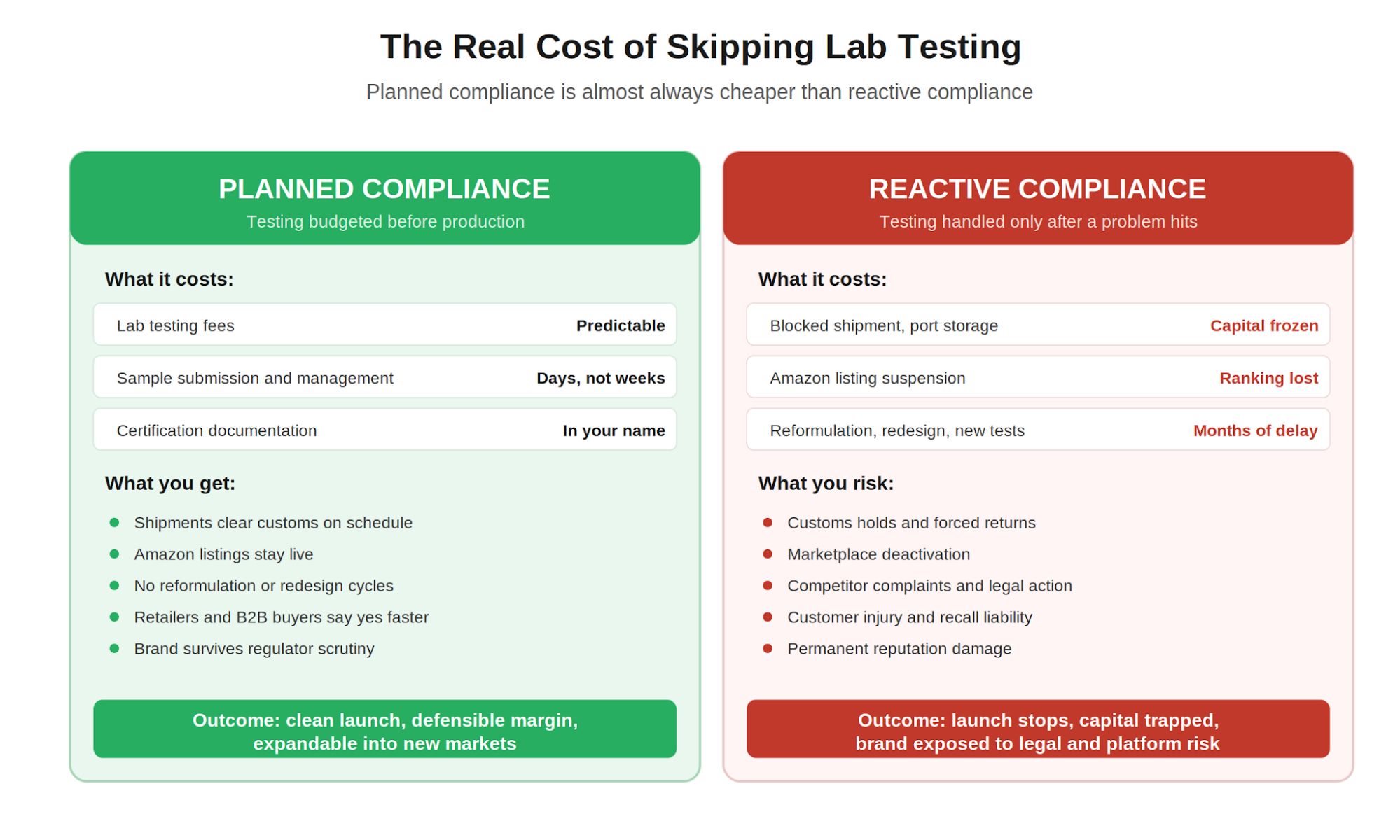
A quality control checklist is not paperwork. It is the contract between your expectations and what the factory is actually held accountable for. Without it, your inspector is guessing, your supplier is interpreting, and you are absorbing the difference. Factories will always interpret vague instructions in the cheapest possible way. That’s just reality.In real production environments, factories can quietly change materials, lower component grades, swap subcontractors, cut process steps to hit a deadline, or rely on whatever batch the line happens to be running that week. None of this is necessarily fraud. It is what happens when nobody writes down what “acceptable” looks like. A written checklist closes that gap. It tells everyone, including a new inspector who has never seen your product, exactly what to measure, what to photograph, what to reject, and what triggers a hold on final payment.The business impact compounds quickly:
Returns and refunds: A defect rate that looks small at 2 percent becomes painful at 5,000 units. Every return eats margin, increases handling cost, and pushes review scores down.
Amazon account health: Inconsistent batches, missing labels, or non-compliant packaging trigger listing suspensions and ASIN deactivations that can take weeks to resolve.
Brand reputation: One viral negative video about a defective product can undo months of paid traffic.
Inventory risk: Defective stock either gets discounted, destroyed, or returned to the supplier at your cost. Often all three.
Company valuation: For brands preparing for an exit, inconsistent quality at scale directly reduces enterprise value. Acquirers price in supplier risk. This gets ignored a lot. Buyers and investors absolutely look at supplier stability and defect history now.
That last point gets overlooked. Quality problems do not only create returns. They can reduce what your business is worth when you decide to sell it.Figure 1. The cost gap between running with a real QC checklist and skipping it.
Reliable product sourcing starts here
Work with experts who help you evaluate suppliers and reduce risk.
A quality control checklist for manufactured products is a written document that defines, in measurable terms, what the factory must deliver and how it will be verified before payment and shipment. It is not a wishlist. Every line should be specific enough that two different inspectors, on two different days, would reach the same pass or fail conclusion.A complete checklist typically covers seven core areas:
Product specifications: Exact materials, dimensions, weight, color codes, components, and any tolerances allowed.
Workmanship standards: What counts as a minor defect, a major defect, and a critical defect, with photo references.
Functional tests: What the product must do, how many times, and under what conditions.
Safety and compliance checks: Certifications, markings, labeling, and regulatory requirements for the target market.
Packaging requirements: Inner packaging, master cartons, labeling, barcodes, drop tests, and shipping marks.
Quantity verification: Order quantity, packing list accuracy, and carton count.
Inspection methodology: AQL levels, sample sizes, accept and reject thresholds.
The strongest checklists are built around what is called a golden sample. This is the final approved version of the product, agreed in writing before mass production starts, that becomes the reference standard for every later inspection. Without a golden sample, the checklist has nothing concrete to compare against. Golden samples save so many arguments later. Otherwise everyone remembers the “approved quality” differently
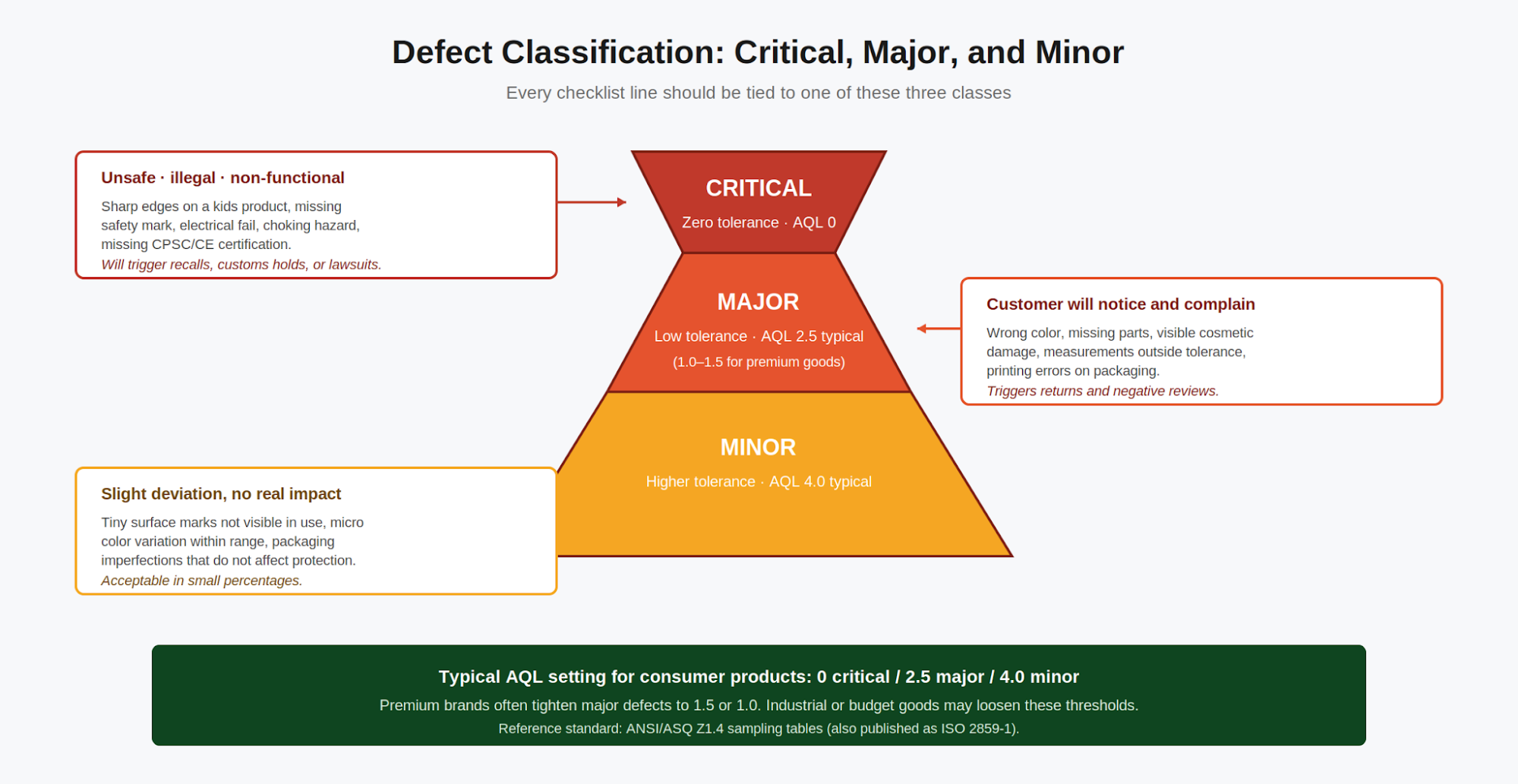
Defect classification: critical, major, minor
Every line item in a QC checklist should be tied to a defect class. This is the single most important concept in inspection work, and most buyers get it wrong by treating every issue equally.
Critical defect: A defect that makes the product unsafe, illegal to sell, or non-functional. Examples include sharp edges on a children’s product, missing required safety certification marks, or electrical components that fail basic continuity. Almost zero tolerance.
Major defect: A defect a normal customer would notice and likely return or complain about. Examples include wrong color, visible cosmetic damage, missing parts, or measurements outside agreed tolerance. Low tolerance.
Minor defect: A defect that does not affect function or sale but deviates slightly from the standard. Examples include small surface marks not visible during normal use. Higher tolerance.
Figure 2. The three defect classes and the AQL thresholds that typically apply to each.The standard most factories work with is the ANSI/ASQ Z1.4 AQL sampling system, often referenced as AQL 2.5/4.0 for general consumer goods. AQL 2.5 means the maximum acceptable percent of major defects is 2.5 percent in the sampled units. Anything stricter, like AQL 1.5 or 1.0, signals premium product expectations. Anything looser signals you are willing to accept more defects than the market typically tolerates. A lot of premium brands should honestly not be using loose AQL settings if they want consistent reviews.
Reliable product sourcing starts here
Work with experts who help you evaluate suppliers and reduce risk.
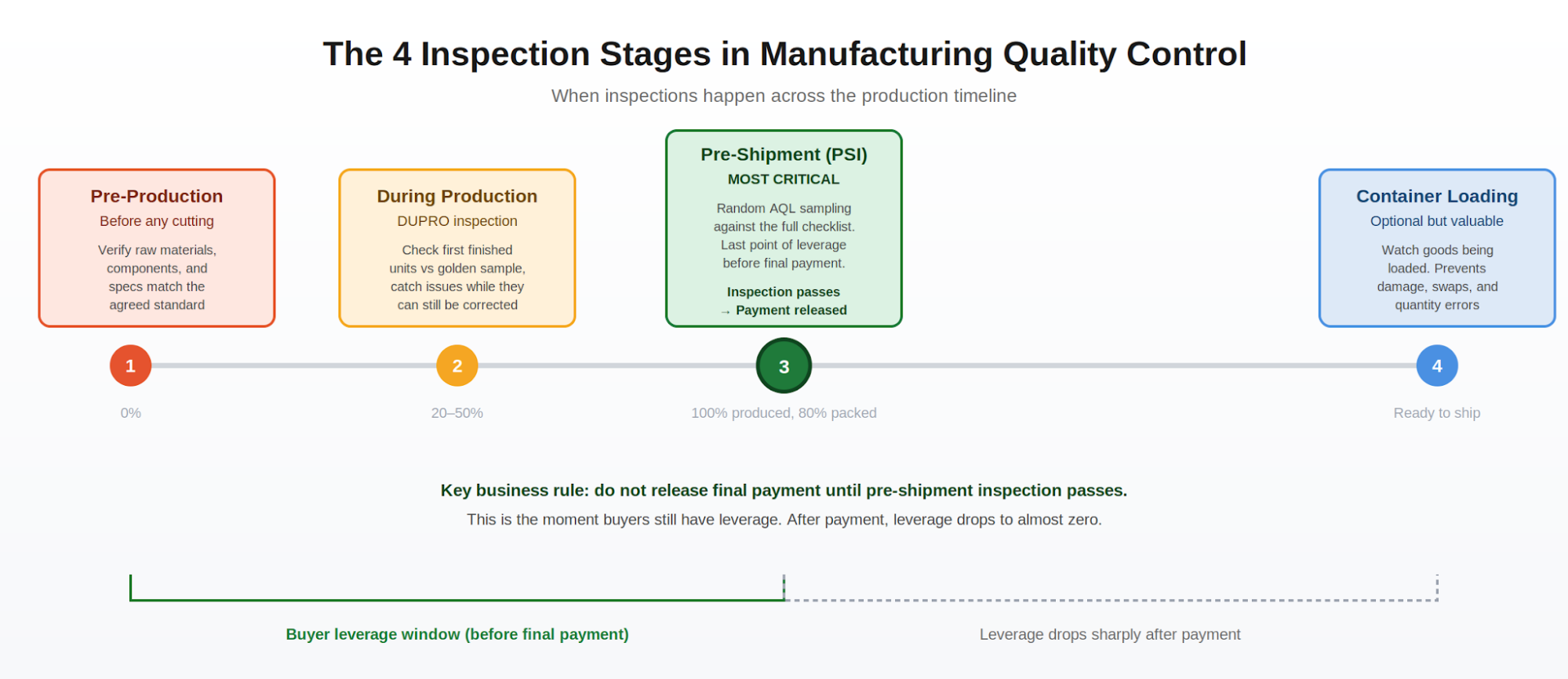
A quality control checklist is only useful if it is actually applied at the right moments in production. Most buyers think of QC as one thing: an inspection before the goods ship. That single checkpoint is the most important one, but it is rarely enough.In well-managed production, inspections happen at four distinct stages.Figure 3. The four inspection stages across the production timeline, with the leverage window highlighted.
1. Pre-production inspection
This happens before the factory cuts any material. The inspector verifies that raw materials, components, and accessories match the agreed specifications. For complex products or first orders with a new supplier, this stage prevents the most expensive type of failure: discovering a wrong material after 10,000 units are already produced.
2. During production inspection (DPI or DUPRO)
This is conducted when production is roughly 20 to 50 percent complete. The inspector checks the first finished units against the golden sample, reviews assembly processes, and flags issues early when they can still be corrected without scrapping the batch. This stage is particularly valuable for products with high tooling or component costs. DUPRO inspections are where you still have leverage without total disaster mode kicking in.
3. Pre-shipment inspection (PSI)
This is the most common and most critical stage. It happens when production is 100 percent complete and at least 80 percent packed. The inspector uses random sampling based on AQL to verify the full lot against every item on the checklist. The key business rule attached to this stage is simple: the final payment is not released until the inspection is passed.This is where you keep leverage. If issues are found, the supplier must rework, replace, or reproduce the goods before they receive the remaining payment.
4. Container loading inspection
For sensitive, fragile, or high-value goods, an inspector physically watches the products being loaded into the container. This prevents damage during loading, confirms quantities, and verifies that the right product is going to the right destination. It is also useful in cases where there is a real risk that the factory could swap inspected stock with a different batch between inspection and loading. Container swaps after inspection are rare but very real in some markets.
Reliable product sourcing starts here
Work with experts who help you evaluate suppliers and reduce risk.
Where Production Usually Happens and Why It Matters for Your Checklist
A quality control checklist is not country-neutral. The level of detail, the type of defects to watch for, and the realistic AQL expectations all shift depending on where the goods are made. A well-written checklist accounts for this.
China: Still the largest manufacturing base for most consumer categories. Quality varies dramatically between factories. The biggest risks are material substitution, subcontracting without notice, and “showroom samples” that do not match production output.
Vietnam: Strong in apparel, footwear, furniture, and electronics assembly. QC focus often centers on consistency at scale and labor compliance.
India: Growing fast in textiles, leather, home goods, and certain electronics. Checklists typically need more emphasis on packaging quality and finishing tolerances. Packaging consistency in India definitely needs extra attention sometimes.
Indonesia, Thailand, Malaysia: Strong for furniture, food, rubber products, and electronics. Compliance documentation is often the weak point.
Türkiye: Apparel, home textiles, and some electronics, with strong proximity advantages for European buyers. QC standards are often closer to European expectations out of the gate.
Bangladesh and Pakistan: Textiles and apparel. Heavy focus on social compliance and consistency across large runs.
When sourcing from China specifically, the most common quality issue is not that the factory cannot produce good products. It is that they will produce exactly to the price they were paid, and the buyer often does not realize how much quality was negotiated away in the cost reduction phase.
Reliable product sourcing starts here
Work with experts who help you evaluate suppliers and reduce risk.
How to Write Your Quality Control Checklist: A Step-by-Step Guide
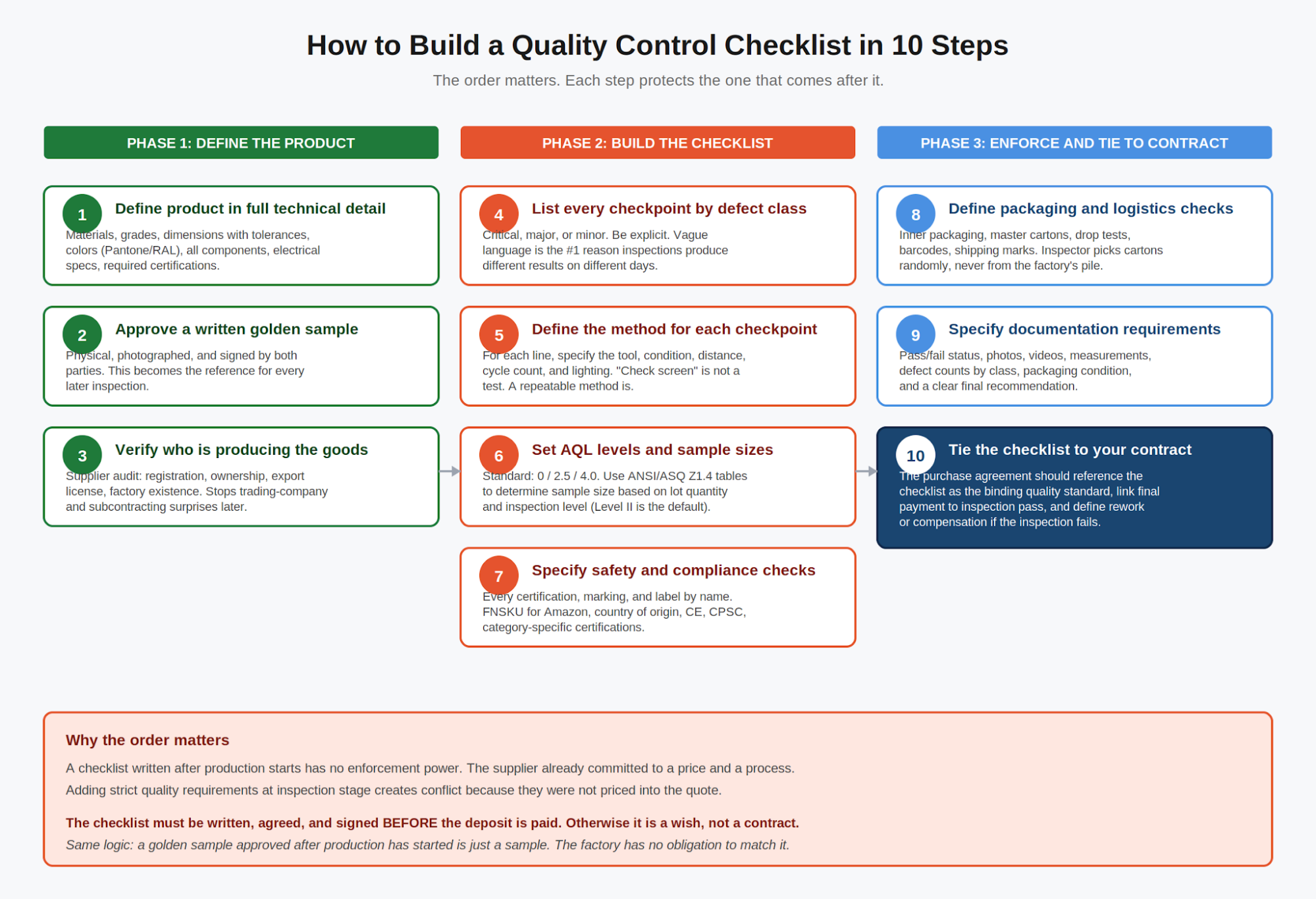
This is the practical part. Below is the process for building a quality control checklist your factory can actually be held accountable to.Figure 4. The 10-step process for building a QC checklist that holds up in real production.
Step 1: Define the product in full technical detail
Start with the product specification document. This is not the marketing description. It is the engineering description. Include exact materials and grades, dimensions with tolerances, weights, colors with Pantone or RAL codes, all components and their suppliers, electrical or functional specifications, and any required certifications. If you cannot describe the product in a way that a stranger could rebuild it from your document alone, your checklist will leak. That “could a stranger rebuild this product from the document” test is actually a really solid benchmark.
Step 2: Approve a written golden sample
Before any mass production starts, you need a physical, photographed, and signed-off golden sample. Both parties keep a copy. This is your reference for every later inspection. Define what “matches the golden sample” actually means: visual match, functional match, dimensional match, and packaging match.
Step 3: Identify and verify the supplier producing the goods
Many quality problems trace back to a single question buyers never properly answered: is the supplier you signed the contract with actually the one manufacturing your goods? Trading companies and subcontracted production are extremely common. Before you finalize a QC checklist, confirm the factory’s identity, capacity, and history. A supplier audit covers business registration, ownership, export license, factory existence, and actual production capability. Without this step, your checklist is being signed by someone who may not be the one producing your goods. Factory verification should honestly happen before large deposits are wired anywhere.
Step 4: List every checkpoint by defect class
For each feature of the product, decide which defect class it falls into. A loose screw on a power tool is critical. A small scratch on the inside of a cosmetic compact is minor. Be explicit. Vague language is the single biggest reason inspections produce different conclusions on different days.
Step 5: Define the inspection method for each checkpoint
Each line on the checklist needs a how. For dimensions, specify the measuring tool. For function, specify the test cycle. For visual checks, specify the lighting condition and distance. “Check screen quality” is not an instruction. “Power on the unit, view a white background image at 50 cm distance under standard daylight, look for dead pixels, scratches over 1 mm, or color shift” is an instruction.
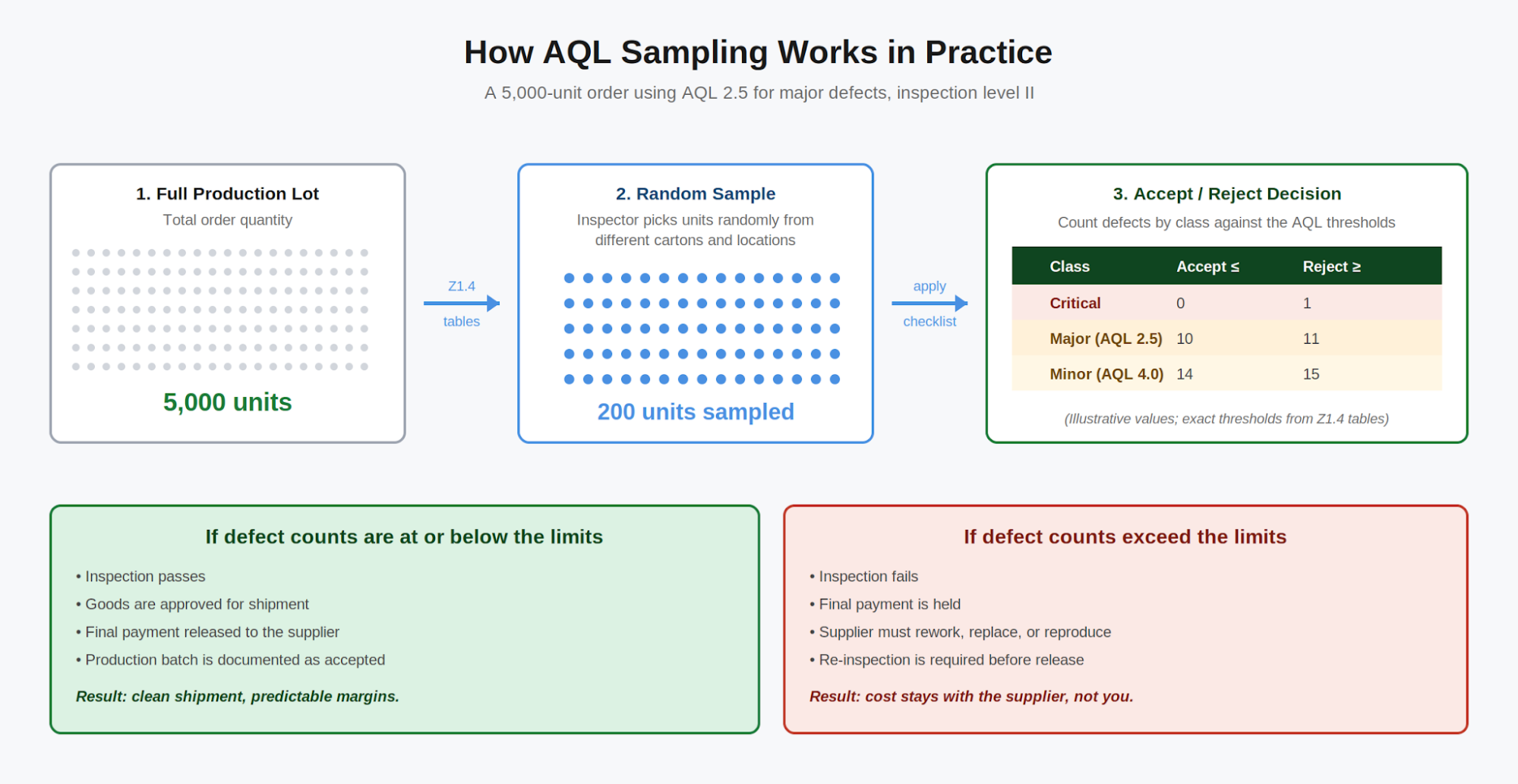
Step 6: Set AQL levels and sample sizes
Define your AQL standard for critical, major, and minor defects. For most consumer products, the typical setting is 0 for critical, 2.5 for major, and 4.0 for minor. The inspector uses the ANSI/ASQ Z1.4 sampling tables to determine sample size based on the total lot quantity and inspection level (usually Level II for normal inspection).Figure 5. How an AQL sampling decision works on a 5,000-unit order.
Step 7: Specify the safety, certification, and compliance checks
This is where many checklists fail and many shipments get rejected at customs or marketplaces. List every required certification, marking, and label by name. For Amazon sellers, this often includes FNSKU labels, country of origin marking, CPSC compliance for the US, CE marking for the EU, and category-specific certifications. The inspector should verify the labels are present, correctly printed, and applied to the right unit, not just the right carton. Compliance mistakes are some of the most avoidable problems in sourcing.
Step 8: Define the packaging and logistics checks
This includes inner packaging, master carton specifications, drop test results if applicable, master carton labeling, barcode scan tests, and shipping marks. Container loading inspection criteria belong here if you are using one. Define how many cartons should be opened during inspection (usually a randomized sample, not the ones the factory hands the inspector).
Step 9: Specify documentation and reporting requirements
The inspector should provide a detailed report that includes pass/fail results, photos and videos of key inspection points, measurement data, defect counts, packaging condition, and a final recommendation. It’s also important to establish who receives the report, when it should be delivered, and how any quality disputes will be handled. Without clearly defined QC standards in the contract, resolving quality issues can quickly become difficult and time-consuming.
Step 10: Tie the checklist to your purchase agreement
A checklist without contractual teeth is a suggestion. Your purchase agreement should reference the checklist as the binding quality standard, define who pays for re-inspection if the first one fails, set rework or compensation rules, and link final payment release to inspection pass status.
Reliable product sourcing starts here
Work with experts who help you evaluate suppliers and reduce risk.
Below is a simplified sample checklist you can adapt to your product. The structure works across most consumer product categories with adjustments for specifics.
Section
What to Check / Document
General information
Buyer name and order number; product name and SKU; total order quantity; inspection date and location; inspector name; inspection stage (pre-production, during production, pre-shipment, loading).
Sampling plan
AQL critical, major, minor: 0 / 2.5 / 4.0; inspection level II (General); sample size based on Z1.4 tables; accept and reject thresholds documented.
Product appearance
Color match against golden sample and Pantone reference; surface finish (no scratches over 1 mm, no chips, no discoloration); no visible glue, dust, or assembly residue; logo and printing position, color, sharpness.
Dimensions and weight
Length, width, height within tolerance; net weight within tolerance; component count and placement verified.
Function tests
Power-on test (where applicable), 100 percent of sampled units; operational test for X cycles; safety function test (cut-off, fail-safe, etc.); battery or charging test where applicable.
Materials
Verify material grade against specification; verify any required material certificates (food grade, REACH, RoHS, etc.).
Safety and compliance
Required certification markings present and correct; country of origin label present; warning labels and instructions included in correct language; marketplace-specific labels (FNSKU, EAN, etc.) verified.
Packaging
Inner packaging matches specification; master carton dimensions and weight within tolerance; master carton labeling correct, including shipping marks; carton drop test (where required) passed; packing list matches actual contents.
Quantity
Total quantity matches PO; carton count verified; no mixed batches or stock from previous orders.
Final result
Defects counted by class; pass, fail, or pending (rework required); inspector signature and date; photos and videos attached as report appendix.
A real checklist for your specific product will be longer and include category-specific details. The principle is the same: every line is measurable, every defect has a class, and nothing depends on the inspector’s mood.
Common Mistakes Buyers Make With Quality Control Checklists
Most QC failures are predictable. The mistakes below are the ones we see repeatedly across categories, from electronics to apparel to home goods.
Treating the factory’s QC report as independent verification
The factory’s own quality team works for the factory. Their job is to release goods, not to fail them. Internal QC reports are useful for process control but should never be the only quality check a buyer relies on. Independent inspection means an inspector hired by the buyer, not by the factory, applying the buyer’s checklist.
Inspecting samples that the factory pre-selects
If the factory hands the inspector the boxes to open, the inspection is theater. Inspectors should select cartons randomly from different rows and locations in the warehouse or production line. This is a basic procedural rule, but it is skipped more often than buyers realize.
Writing the checklist after production starts
By the time production has started, the supplier has already committed to a process, a material set, and a cost. Adding a strict checklist at the inspection stage often creates conflict because the supplier was not pricing in that level of quality. The checklist must be written, agreed, and signed before the deposit is paid.
Treating cheap suppliers as cost savings
A supplier that quotes 30 percent below the rest of the market is not a deal. It is a different product. They have either lowered material grade, removed a process step, or cut a corner you have not noticed yet. The cheapest supplier often becomes the most expensive once you account for returns, rework, lost sales, and reputational damage. Quality problems are usually supplier-selection problems.
Skipping pre-production inspection on first orders with new suppliers
On a first production run with a new factory, you have no track record. First orders are exactly when extra verification matters most. Pre-production inspection costs are small compared to the cost of finding out at pre-shipment that the wrong material was used across the entire order.
Confusing inspection with quality assurance
Inspection catches defects. Quality assurance prevents them. A checklist is the inspection tool. The supplier-side QA system, the golden sample sign-off, the contract terms, and the relationship management together form the assurance side. Buyers who only invest in inspection often catch the same defects on every batch because nothing upstream is changing.
Reliable product sourcing starts here
Work with experts who help you evaluate suppliers and reduce risk.
Zignify works on the buyer’s side. That position matters in QC because most of the industry incentives in inspection are pointed the wrong way. Factories want goods released. Inspectors paid through the factory want repeat work from the factory. Trading companies want shipments closed. None of those parties lose money if your goods are defective. You do.What this looks like in practice:
On-site inspections, not remote. Zignify’s team physically visits the factory, randomly selects cartons, and inspects against the buyer’s checklist. Reports include photos, videos, measurements, and defect counts by class.
No factory commissions. Zignify does not take payments from suppliers, which means the inspection finding is not influenced by who is buying lunch. This independence piece is honestly more important than most buyers realize.
Checklist development. For buyers who do not yet have a written QC checklist, Zignify helps draft one based on the product, target market, and supplier capability.
Contract-linked inspections. Inspection results are tied to the purchase agreement and the final payment trigger, so the supplier has actual incentive to fix issues rather than dispute them.
Coverage across stages. Pre-production, during production, pre-shipment, and container loading inspections, depending on what the product and budget justify.
Multi-country presence. Inspections coordinated across China, Vietnam, India, Indonesia, and other major manufacturing hubs under a single process.
The transparency point matters most. Buyers should be able to see the actual report, the actual photos, and the actual numbers, then decide what to do. Quality control is a decision-support tool, not a black box.
Reliable product sourcing starts here
Work with experts who help you evaluate suppliers and reduce risk.
A clear quality control checklist for manufactured products is not a defensive document. It is a growth document. Brands that scale without recurring defect problems hold higher margins, better reviews, longer customer relationships, and stronger valuations. Brands that scale without QC discipline often discover their growth is fragile: one bad batch can erase a year of brand-building.The work to set this up properly is one-time. A well-written checklist, tied to a golden sample, applied at the right inspection stages, and backed by a real contract, will serve every subsequent production run with minor updates. The cost is small. The savings, in returns avoided, accounts kept healthy, and customers kept loyal, compound year over year. Most buyers only appreciate good QC after they survive one really painful shipment.
What Most Guides Get Wrong, Here’s What Our Expert Knows ✅Most quality control guides treat the checklist as a standalone document. In reality, the checklist is only as strong as the supplier choice, the contract, and the inspector independence behind it. Here are the three things experienced buyers learn the hard way.💡 The cheapest supplier is almost always the most expensive once you account for defects.When a quote comes in 25 to 35 percent below the rest of the market, the supplier has not found magic efficiency. They have removed something: a material grade, a process step, a quality control layer, or a labor standard. The defect rate will reflect what was cut. Buyers chasing the lowest unit price often end up paying twice, once to the factory and again in returns, rework, and lost reviews. Quality problems are usually supplier-selection problems before they are inspection problems.🚩 Factory-prepared samples are not what your production will look like.Factories routinely produce a showcase sample by hand, using their best operators, best materials, and unlimited time. Mass production runs on a line, with average operators, the materials that were actually purchased for the batch, and a deadline. The gap between the two can be enormous. Without a written golden sample signed by both parties and an inspection method that compares production output to that sample, the buyer is buying a different product than the one they approved.⚠️ Internal factory QC reports are not independent verification.Almost every factory will offer to send its own QC report. These reports have value for internal process control, but they should never be treated as buyer protection. The factory’s quality team is paid by the factory and incentivized to release goods. Buyer-side inspection means an inspector working for the buyer, applying the buyer’s checklist, selecting cartons randomly, and reporting findings directly to the buyer. This separation of interest is the single most important structural protection in production QC.If you are setting up quality control for your next production run and want a second pair of eyes on the checklist and the supplier, Book a free sourcing call →
Frequently Asked Questions
Below are the questions buyers most often ask when building a quality control checklist for the first time, drawn from common search queries, sourcing forums, and conversations with brands and Amazon sellers.
What should a quality control checklist for manufactured products include?
A complete checklist includes product specifications, workmanship standards by defect class, functional tests, safety and compliance checks, packaging requirements, quantity verification, and the AQL sampling methodology. Every line should be measurable, and every defect should be classified as critical, major, or minor with clear photo references where possible.
What is AQL and which level should I use?
AQL stands for Acceptable Quality Limit and defines the maximum percent of defects allowed in a sampled lot. For most consumer goods, the common setting is 0 critical, 2.5 major, and 4.0 minor. Premium products often use 1.5 or 1.0 for major defects, while industrial or budget products may allow looser thresholds. The inspector uses the ANSI/ASQ Z1.4 sampling tables to determine sample size based on lot quantity.
When should I inspect: before, during, or after production?
For most orders, pre-shipment inspection at 100 percent production complete is the most critical stage and should never be skipped. For first orders with a new supplier, or complex products, adding pre-production and during-production inspections significantly reduces risk. Container loading inspection is recommended for fragile, high-value, or substitution-risk goods.
Can I rely on the factory’s own quality control reports?
Factory QC reports are useful for process visibility but should not replace independent buyer-side inspection. The factory’s quality team is paid by the factory and motivated to release goods. Independent inspectors apply the buyer’s checklist, select samples randomly, and report findings to the buyer, which is structurally different from internal factory QC.
How do I prevent the factory from showing inspectors only their best units?
Use random sampling rules in the checklist. Cartons should be selected from different rows, different stack heights, and different locations in the warehouse, not from a pile the factory presents. The inspector, not the factory, chooses the samples. This rule should be written into the checklist and the purchase agreement so it is not negotiable on inspection day.
What is a golden sample and why does it matter?
A golden sample is the final approved version of the product, signed off by both buyer and supplier before mass production starts. It is the physical reference for every later inspection. Without a golden sample, “matches the agreed quality” has no concrete meaning and disputes become subjective. The golden sample turns the checklist into something enforceable.
How does quality control connect to Amazon FBA requirements?
Amazon FBA inspections include FNSKU label placement and readability, polybag and suffocation warning compliance, master carton labeling, and category-specific certifications. A QC checklist for FBA sellers should explicitly list every Amazon-required label and check it on the unit, not just on the master carton. Failure here triggers receiving issues and can suspend the listing.
What happens if the inspection fails?
A failed inspection should trigger one of three outcomes defined in the purchase agreement: rework by the supplier, replacement of defective units, or partial rejection and credit. The final payment is not released until the issues are resolved and a re-inspection passes. This is why the checklist must be referenced inside the contract, not stored as a separate document.
How much does product inspection cost?
Independent inspection costs vary by country, product complexity, and inspection stage. A typical pre-shipment inspection on consumer goods in China runs in the range of a few hundred dollars per man-day. For most orders above a few thousand units, inspection cost is a small fraction of one percent of order value and saves multiples of that in avoided defects.
Is a quality control checklist different for OEM versus private label products?
The structure is the same, but OEM products usually need more detailed engineering specifications, component traceability, and tooling verification, while private label products often need more focus on packaging, labeling, and brand-specific requirements. Both should follow the same defect classification and AQL methodology.