Most companies only discover supply chain risks when they become costly problems. A factory suddenly shuts down, a new tariff impacts goods already in transit, or a long-trusted supplier quietly changes materials, leading to increased returns months later. While these disruptions may seem unexpected, the underlying risks were often present long before they surfaced—they simply weren’t being monitored or measured.That’s the real challenge. Many businesses don’t recognize sourcing risks until they start affecting costs, operations, or profitability. By the time finance begins asking difficult questions, the damage has often already been done.A proper supply chain risk assessment helps identify vulnerabilities before they impact your business performance. It is not a one-time audit or a lengthy report that gets filed away and forgotten. Instead, it is a structured process that evaluates your suppliers, sourcing regions, products, and logistics networks to identify potential risks, measure exposure, and prioritize the actions that matter most.In this guide, we’ll explore how to conduct an effective supply chain risk assessment, highlight common mistakes importers and manufacturers make, and explain how a sourcing partner can help strengthen supply chain resilience without requiring a complete operational overhaul. The most valuable assessments are not the longest—they are the ones that provide clear, practical insights that can be acted on immediately.
Need help with your product sourcing?
Get practical advice tailored to your product, suppliers, and market form Zignify experts
Why Supply Chain Risk Assessment Matters More Than Ever
For a long time, supply chain risk lived in the background. Procurement teams focused on cost, quality, and delivery. Risk was something insurance covered. That model has not held up well.The last few years have stacked one disruption on top of another. COVID broke production timelines. The Red Sea route forced reroutes that added weeks and thousands of dollars per container. Tariff policy keeps moving. Currency swings change landed cost overnight. Labor costs in China keep rising, while quality and lead times in some factories quietly slip. And underneath all of this, many businesses still depend heavily on one supplier, one country, or one shipping lane.The cost of doing nothing is not theoretical. A single tariff increase can wipe out a year of margin on a product line. One factory closure can stop shipments to your top customers for a full quarter. A failed compliance check can cause goods to be held at port. None of these are rare events anymore, and none of them are easy to recover from once they happen. And customs delays are brutal because nobody plans extra margin for them. One issue at port and the whole timeline collapses.A supply chain risk assessment changes the conversation. Instead of reacting to whatever hits next, you are looking at your sourcing setup the way an investor looks at a portfolio. Where is the concentration risk? What single point of failure could stop the business? What is one disruption away from becoming expensive? You cannot eliminate every risk, but you can stop being surprised by the obvious ones.
Reliable product sourcing starts here
Work with experts who help you evaluate suppliers and reduce risk.
What a Supply Chain Risk Assessment Actually Covers
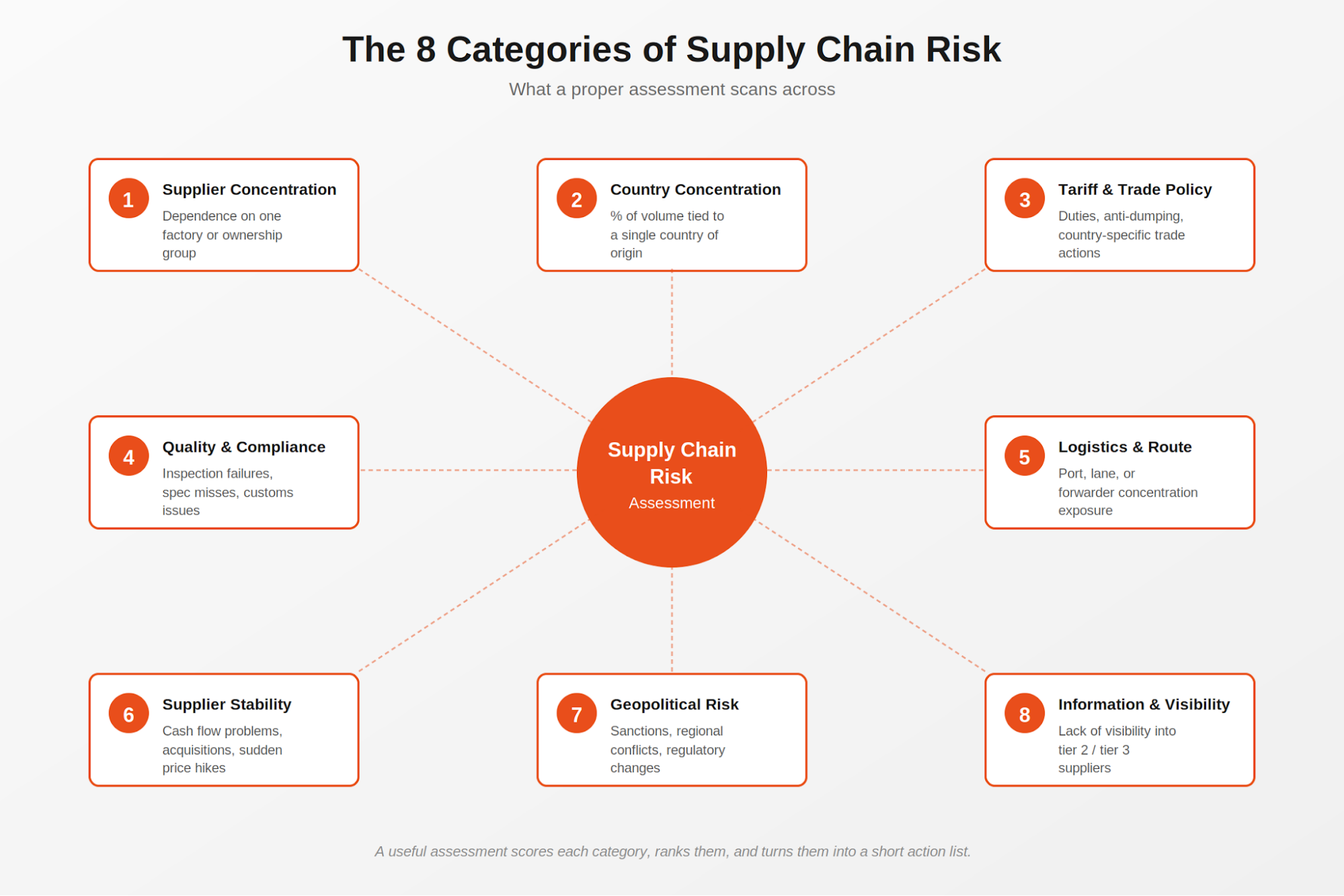
A supply chain risk assessment looks at every link between your purchase order and your warehouse, and asks one question at each link: what happens if this fails?The useful version is not abstract. It is a structured scan across the categories of risk that actually disrupt importers and manufacturers. The main ones are below.Figure 1: The 8 categories of supply chain risk a proper assessment scans across.
Supplier concentration risk: how dependent you are on a single factory, ownership group, or sourcing agent for a product or product line.
Country concentration risk: how much of your purchasing volume is tied to one country of origin, and what happens if that country becomes more expensive or harder to ship from.
Tariff and trade policy risk: exposure to import duties, anti-dumping measures, and country-specific trade actions that can change with limited notice. A lot of buyers still underestimate how quickly trade policy can destroy margins.
Quality and compliance risk: the chance that goods fail inspection, miss specifications, or hit a compliance issue at customs in your sales market.
Logistics and route risk: dependence on a single port, lane, or forwarder, and how much your landed cost moves when shipping conditions change.
Financial and supplier stability risk: the chance that a supplier runs into cash flow problems, gets acquired, raises prices sharply, or simply stops responding.
Geopolitical risk: broader country level issues such as sanctions, regional conflicts, labor unrest, or sudden regulatory changes that affect production.
Information and visibility risk: how much of your supply chain you can actually see. If you only know your tier one supplier and not where their materials come from, that is a real exposure.
A good assessment does not stop at listing these. It scores each one for your specific business, ranks them, and turns them into a short list of what to address first.
Reliable product sourcing starts here
Work with experts who help you evaluate suppliers and reduce risk.
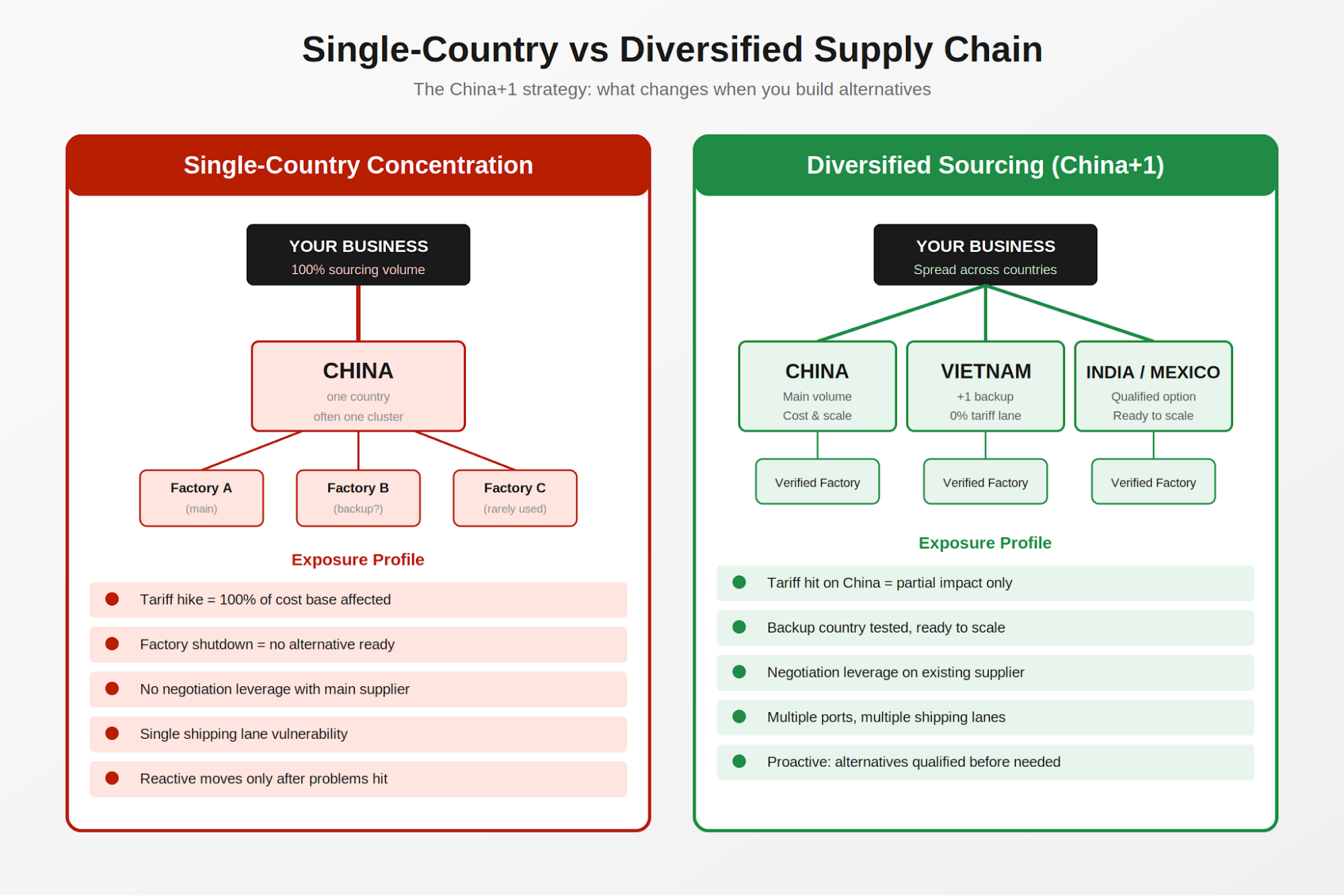
The geography of your supply chain is often the biggest hidden risk, and it is the easiest one to underestimate. Many companies treat “we source from China” as a single sentence. In practice, that sentence usually means one province, one city, and often one industrial cluster. If anything happens to that cluster, whether it is power restrictions, environmental shutdowns, labor shortages, or local regulation changes, your supply stops. This is so true. People think they’re diversified because they have three factories, but all three are in the same industrial zone.This is where the China supply chain risk conversation gets practical. China is still an excellent place to manufacture many products. The infrastructure, the supplier density, and the speed are real advantages. The issue is not China itself. The issue is depending on China for one hundred percent of a category when the cost of that dependency keeps rising.The most common alternatives importers consider now are Vietnam, India, Turkey, Pakistan, Bangladesh, Mexico, and Indonesia. Each one has different strengths. Vietnam often works well for electronics, beauty accessories, footwear, furniture, and apparel. India is strong on textiles, leather, and certain home goods. Turkey is a good fit for European buyers who want shorter lead times and apparel or kitchenware production. Mexico is increasingly useful for US importers who want to reduce shipping time and tariff exposure. None of these are replacements for China across every category. They are options in a diversification strategy.Figure 2: Single-country concentration vs a diversified China+1 supply chain.A real geographic risk assessment looks at where you currently source, what percentage of your volume is in each country, and where you would move production if you had to. It also looks at where your goods enter your sales market and whether you are exposed to one shipping lane. A company that imports through one US west coast port has a different risk profile than one that splits between east and west coast entries.
Reliable product sourcing starts here
Work with experts who help you evaluate suppliers and reduce risk.
How to Run a Supply Chain Risk Assessment, Step by Step
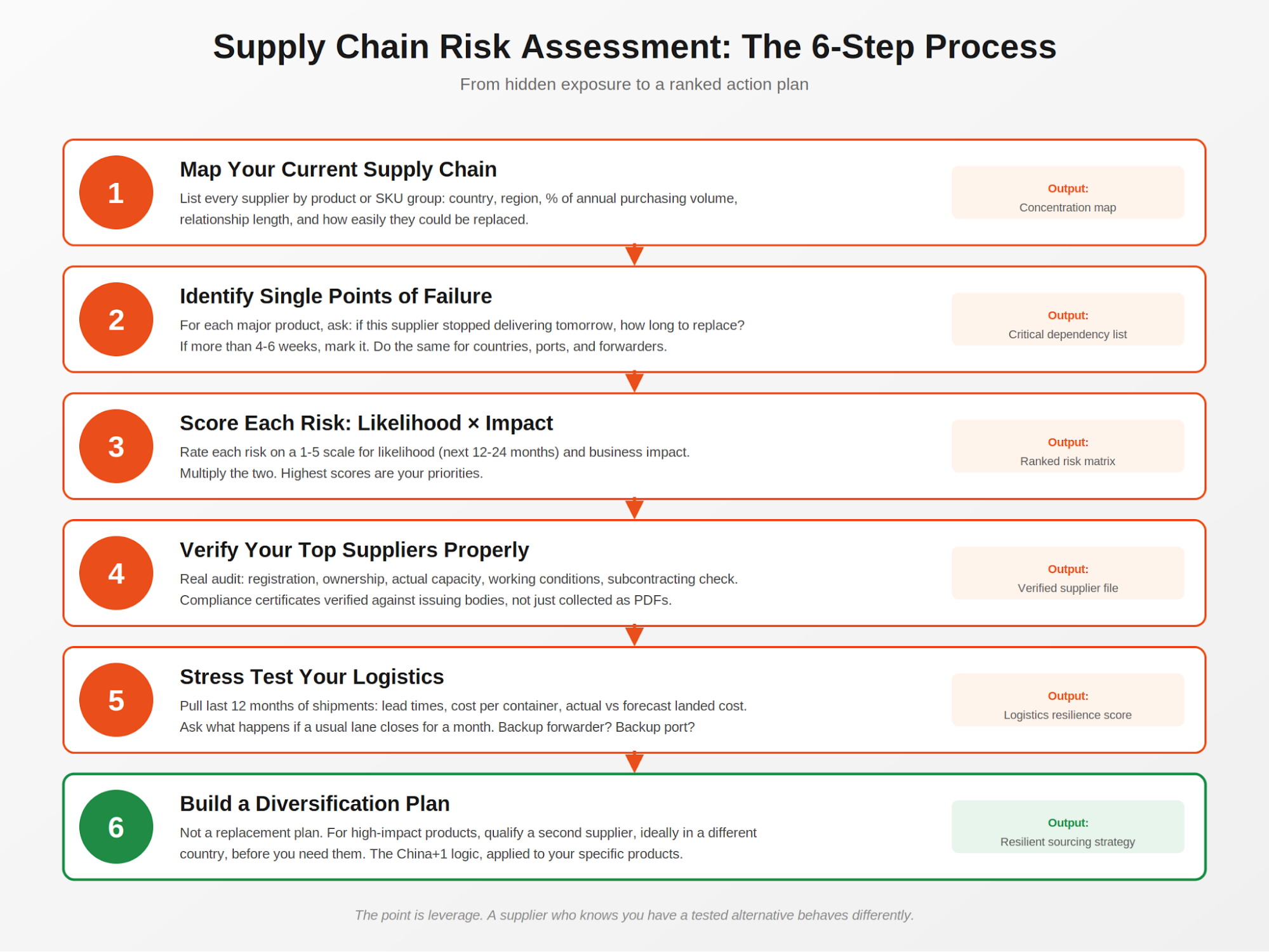
This section walks through a practical version of the process. It is the same logic a sourcing consultant would use, simplified into steps you can run with your own team or with outside help.Figure 3: The 6-step supply chain risk assessment process, from current state to action plan.
Step 1: Map Your Current Supply Chain Honestly
Start with a list of every supplier you currently buy from, by product or SKU group. For each one, write down the country, city or region, the percentage of your annual purchasing volume, your relationship length, and how easily they could be replaced. You will already see patterns. Most companies discover that two or three suppliers cover sixty to eighty percent of their spend, and that several products have only one viable supplier on the list.This is not a finance exercise. The goal is not perfect numbers. The goal is to make hidden concentration visible.
Step 2: Identify Single Points of Failure
For each major product, ask one question: if this supplier stopped delivering tomorrow, how long would it take to replace them? If the answer is more than four to six weeks, that supplier is a single point of failure. Mark it. Do the same for countries, ports, and forwarders. A single point of failure is not always a problem, but it should never be a surprise.
Step 3: Score Each Risk by Likelihood and Impact
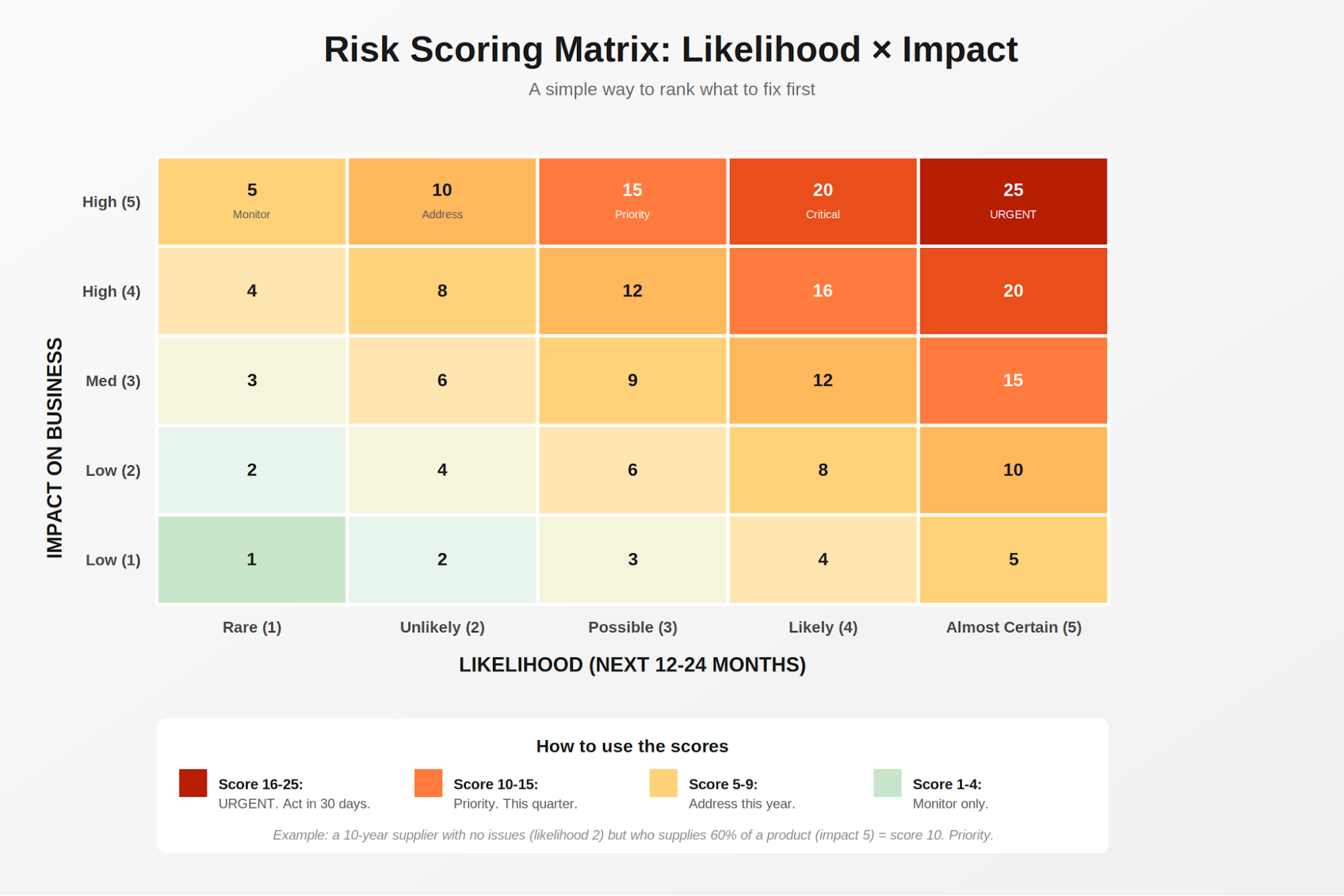
This is where most internal assessments get stuck. You do not need a fancy matrix. For each risk you have identified, score two things on a simple one to five scale: how likely it is to happen in the next twelve to twenty four months, and how badly it would hurt the business if it did. Multiply the two. The highest numbers are your priorities. Simple systems usually work better because teams actually use them instead of overcomplicating everything.Figure 4: A simple Likelihood × Impact risk matrix turns scores into a clear action priority.A supplier you have used for ten years with no issues might score low on likelihood but high on impact. A new supplier in a politically unstable region might score the opposite. Both matter, but they need different responses.
Step 4: Verify Your Top Suppliers Properly
Once you know who your highest impact suppliers are, the next step is to verify them more deeply than you probably have. Many buyers rely on the supplier’s own claims about capacity, financial health, and compliance. That is not verification. A real supplier audit looks at registration status, ownership, actual production capacity, working conditions, and whether the factory is the one producing or quietly subcontracting. Compliance certificates should be checked against issuing bodies, not just collected as PDFs. Subcontracting without telling the buyer is still way more common than people think.According to ISO 9001 quality management principles, supplier evaluation should be ongoing, not a one-time event at the start of a relationship.This step is where many companies discover risks they did not know they had. A supplier that has been reliable for years can still be running on thin margins, behind on certifications, or quietly losing capacity to a competitor.
Step 5: Stress Test Your Logistics
Pull the actual numbers from your last twelve months of shipments. Look at lead times, cost per container, and how often actual landed cost matched your forecast. Then ask what happens if one of your usual lanes is closed for a month. Do you have a backup forwarder? Do you have a backup port? If the answer is no, that is a logistics risk that has nothing to do with your supplier.The UNCTAD Review of Maritime Transport consistently shows how vulnerable global shipping is to single route disruptions, and how quickly costs move when one chokepoint is affected.
Step 6: Build a Diversification Plan, Not a Replacement Plan
The output of a risk assessment is not a list of suppliers to fire. It is a plan to reduce concentration. For high impact products, that usually means qualifying a second supplier, ideally in a different country, before you need them. This is the practical version of a China+1 strategy: not moving everything out of China, but making sure you have a tested alternative for the products that matter most.The point of building this in advance is leverage. A supplier who knows you have no alternative behaves differently than one who knows you have a qualified backup ready. You will see the difference in price, in lead time discipline, and in how quickly they respond when something goes wrong. This changes supplier behavior immediately. Even good suppliers take buyers more seriously when they know alternatives exist.
Reliable product sourcing starts here
Work with experts who help you evaluate suppliers and reduce risk.
A few patterns show up across almost every assessment. Recognizing them early saves a lot of money.The first mistake is treating risk and cost as separate conversations. Cheap sourcing becomes expensive the moment your supply chain fails. A supplier who is fifteen percent cheaper but cannot be backed up costs you far more than the savings if they stop delivering in your peak season. Risk and cost belong in the same decision.The second mistake is overweighting trust based on relationship length. The supplier you have worked with for ten years is exactly the one you have stopped scrutinizing. Your biggest supply chain risk is often the supplier you trust the most, because you have stopped checking.The third mistake is confusing diversification with chaos. Some companies react to disruption by spreading orders across too many suppliers, none of which get enough volume to take them seriously. Diversification is strategic. It means qualifying two or three solid options for the products that matter most, not splitting every order five ways.The fourth mistake is ignoring information risk. If you only know your tier one supplier and not their material sources, you do not actually understand your supply chain. Many quality failures, compliance issues, and delays start two or three layers up the chain. Visibility is itself a form of risk reduction.The fifth mistake is treating risk assessment as a one-time exercise. Your supply chain changes constantly. Suppliers grow, decline, get bought, or quietly lose key staff. Tariffs shift. Routes change. A risk assessment that does not get updated at least once a year stops reflecting reality fairly quickly.
Reliable product sourcing starts here
Work with experts who help you evaluate suppliers and reduce risk.
How Zignify Helps Reduce Supply Chain Risk in Practice
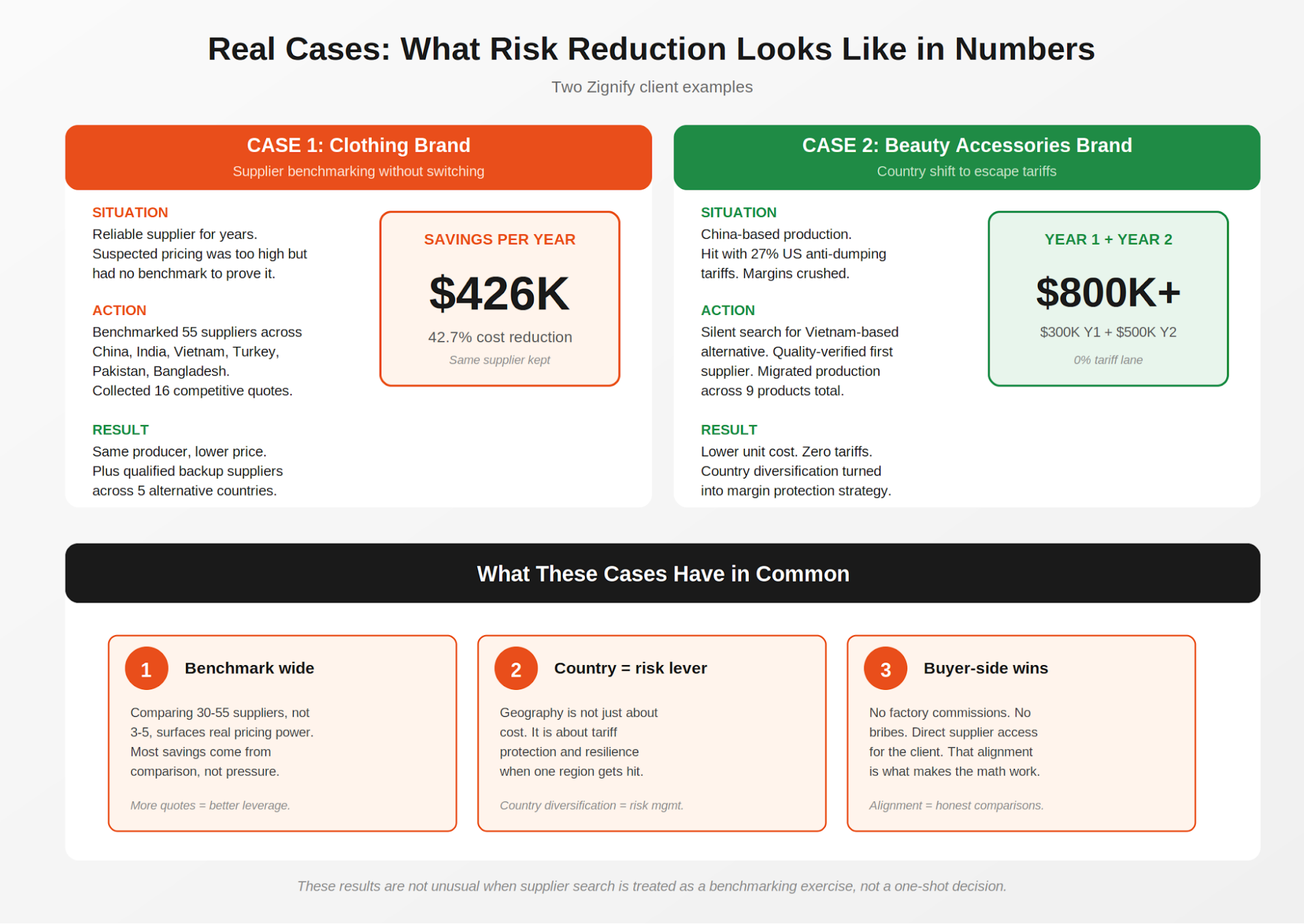
Zignify works exclusively on the buyer’s side. We are not a manufacturer, trading company, or factory representative, which means our recommendations are based solely on what is best for your business. Unlike sourcing agents who earn commissions from factories, we remain independent and objective throughout the process.This independence is especially important when it comes to managing supply chain risk. Reducing risk often requires decisions that factory-aligned agents may be reluctant to suggest, such as evaluating your current suppliers against alternative options, identifying backup manufacturers in other countries, or diversifying production across multiple suppliers. Because our focus is on protecting your business, we can provide unbiased guidance that helps build a more resilient and flexible supply chain.A practical example: one clothing brand client suspected they were paying too much but could not prove it. The supplier had been reliable for years. We ran a sourcing benchmark across fifty five suppliers in China, India, Vietnam, Turkey, Pakistan, and Bangladesh, collected sixteen competitive quotations, and brought the data back. The result was not a supplier change. The client stayed with the original producer, who matched the lower price once they understood the comparison existed. The savings were forty two point seven percent, around half a million dollars per year. The supplier concentration risk also dropped, because the client now had qualified alternatives ready if anything went wrong.Another example: a beauty accessories client was facing twenty seven percent US anti-dumping tariffs on China-sourced production. We searched silently in Vietnam, found a qualified supplier on the first round, and shifted production. The result was a one dollar lower unit cost, zero percent tariffs, and savings of around three hundred thousand dollars in the first year and five hundred thousand in the second. Country diversification stopped being a theoretical idea and started being a margin protection strategy.Figure 5: Two Zignify client cases showing what risk reduction looks like in actual numbers.These results come from treating supplier sourcing as a benchmarking process, not a one-time decision. With direct supplier access instead of relying on commission-based sourcing agents, businesses gain more transparency and control. Support includes multi-country supplier search, independent quality inspections, compliance checks for target markets, contracts with supplier accountability, logistics comparison, and direct communication with suppliers throughout the process.
Reliable product sourcing starts here
Work with experts who help you evaluate suppliers and reduce risk.
Companies that take supply chain risk seriously over the next two years will have a real advantage. Not because they avoid every disruption, but because they will not be the ones explaining to customers why a product is out of stock, or absorbing tariff increases that competitors planned for. The companies winning right now are usually the ones that prepared quietly before everyone else reacted.The work is not glamorous. It is supplier benchmarking, country comparisons, factory audits, contract clauses, and logistics reviews. Done together, those small things add up to a supply chain that holds when others break.You do not need to overhaul everything. You need to know where your exposure is, rank it honestly, and start qualifying alternatives for the parts that matter most. The companies that do this quietly, before the next disruption, will be the ones still hitting margins and delivery dates when it arrives.
What Most Guides Get Wrong, Here’s What Our Expert Knows
Most supply chain risk guides read like academic frameworks. They list categories, suggest matrices, and stop there. The harder truth is that the biggest risks in real importer supply chains are usually relational and structural, not abstract. Here is what experienced sourcing work consistently shows.
Your biggest supply chain risk is usually the supplier you trust most, not the one you worry about.
Companies obsess over new suppliers and stop scrutinizing the ones they have worked with for years. That is backwards. Long term suppliers are exactly where slow drift happens, in materials, in quality, in subcontracting, in pricing creep. They are also where renegotiation power is highest, because you have volume history they want to keep. A proper risk assessment should spend more time on the suppliers you assume are safe than on the new names you are nervous about. Most of the savings and most of the surprises live there.
Country diversification is risk management, not just cost optimization.
Most buyers move production out of China only when tariffs force them to. That is the most expensive moment to move, because it is reactive. Qualifying a second country before you need it is a different exercise. You can take six months instead of six weeks, you can choose better suppliers, and you can negotiate from a position of strength rather than panic. The point of having a Vietnam, India, or Mexico option is not always to switch. It is to know you could, which changes how your current supplier treats you.
The ranking matters more than the list.
Long risk reports do not change behavior. Most procurement teams have a folder of them. What changes behavior is a short, ranked list of the three or four risks that would actually hurt the business and what to do about each one. Volume concentration, country exposure, and unverified compliance usually sit at the top of that list for most importers. The exercise is worth doing properly once and then refreshing yearly, not turning into a permanent project.
Frequently Asked Questions
What is a supply chain risk assessment?
A supply chain risk assessment is a structured review of the suppliers, countries, products, and logistics routes your business depends on, looking for points where a disruption would seriously affect cost, quality, or delivery. The goal is not to remove every risk but to identify and rank the ones that matter, so you can prioritize the right actions.
What is the difference between supply chain risk and supply chain risk management?
Supply chain risk is the exposure itself, the chance that something goes wrong in your sourcing, production, or logistics. Supply chain risk management is the ongoing practice of identifying, measuring, prioritizing, and reducing that exposure. The assessment is the snapshot. The management is the discipline.
How do you mitigate supply chain risk?
The main levers are supplier diversification, country diversification, deeper supplier verification, stronger contracts with clear accountability, independent quality control, and logistics route alternatives. Mitigation is not one action, it is reducing your exposure on the few risks that would hurt the business most.
What is China supply chain risk?
China supply chain risk refers to the specific exposures that come from depending heavily on Chinese suppliers or production. These include tariff and trade policy changes, rising labor costs, environmental and regulatory shutdowns, regional concentration of suppliers, and shipping lane dependence. China is still a strong sourcing location for many categories, but full dependence has become a more significant risk in recent years.
What is a China+1 sourcing strategy?
A China+1 strategy is the practice of keeping production in China for the categories where it makes sense, while qualifying at least one supplier in another country, usually Vietnam, India, Mexico, Turkey, or Indonesia, for the same or similar products. The point is not to abandon China but to have a tested alternative ready before you need it.
How does supply chain quality assurance fit into risk assessment?
Supply chain quality assurance, or supply chain QA, is one of the main risk categories. It covers how you verify that goods actually meet your specifications during production, not just in samples. Independent on-site inspections during mass production, before final payment, are the most reliable way to catch quality issues before they reach your warehouse or customers.
How often should we update our supply chain risk assessment?
For most importers and manufacturers, a full review once a year is reasonable, with shorter check-ins whenever something material changes, such as a new tariff, a major supplier issue, a route disruption, or a new product line. Risk assessments that are not updated stop reflecting reality faster than most teams expect.
Can a sourcing partner really help reduce supply chain risk?
Yes, if the partner is on the buyer’s side. A sourcing partner that takes factory commissions has a built-in conflict of interest, because their incentive is to keep you with the factories that pay them. A buyer-side sourcing partner runs supplier benchmarks across multiple countries, gives you direct supplier access, and helps you build a diversified, verified supply chain. The role is closer to a procurement advisor than a middleman.