Running a global business today means managing an extraordinarily complex network of relationships, logistics, technology, and risk. Whether you are a small e-commerce brand importing goods from Asia or a mid-sized enterprise coordinating manufacturing across multiple continents, the moment any one link in your supply chain breaks, the entire operation feels it. Delayed shipments, unreliable suppliers, inefficient warehousing, and fragmented distribution channels are not just inconveniences; they are revenue leaks and brand risks that compound over time. Most companies underestimate how quickly small disruptions cascade into major operational and financial issues.
This guide is created to simplify that complexity. We have researched and compiled the best supply chain management companies across every critical stage of global sourcing, from upstream supplier relationships all the way through to the final delivery at your customer’s door.
You’ll also discover top software platforms, actionable insights on emerging trends, and a comprehensive FAQ addressing the most common Supply Chain Management questions. Consider this your complete roadmap to building a smarter, more resilient global supply chain. Breaking it down into stages reflects exactly how we assess and optimize supply chains internally.
Read more about Top Asia Sourcing Agent: Reliable, Transparent & End-to-End Solutions
What Is Supply Chain Management?
Supply chain management (SCM) is the end-to-end coordination of all activities involved in sourcing, producing, and delivering a product to the final customer. It encompasses the planning, execution, and monitoring of supply chain operations with the goal of creating net value, building a competitive infrastructure, and synchronizing supply with demand on a global basis.
At its core, supply chain management is about relationships and the flow of information, but in reality, visibility gaps remain a major challenge for most organizations. Raw materials need to arrive at the right factory on time, finished goods must reach distribution centers in optimal condition, and customer orders should be fulfilled quickly and accurately.
When businesses can close these visibility gaps and align these moving parts, they unlock cost efficiency, stronger customer satisfaction, and scalable growth.
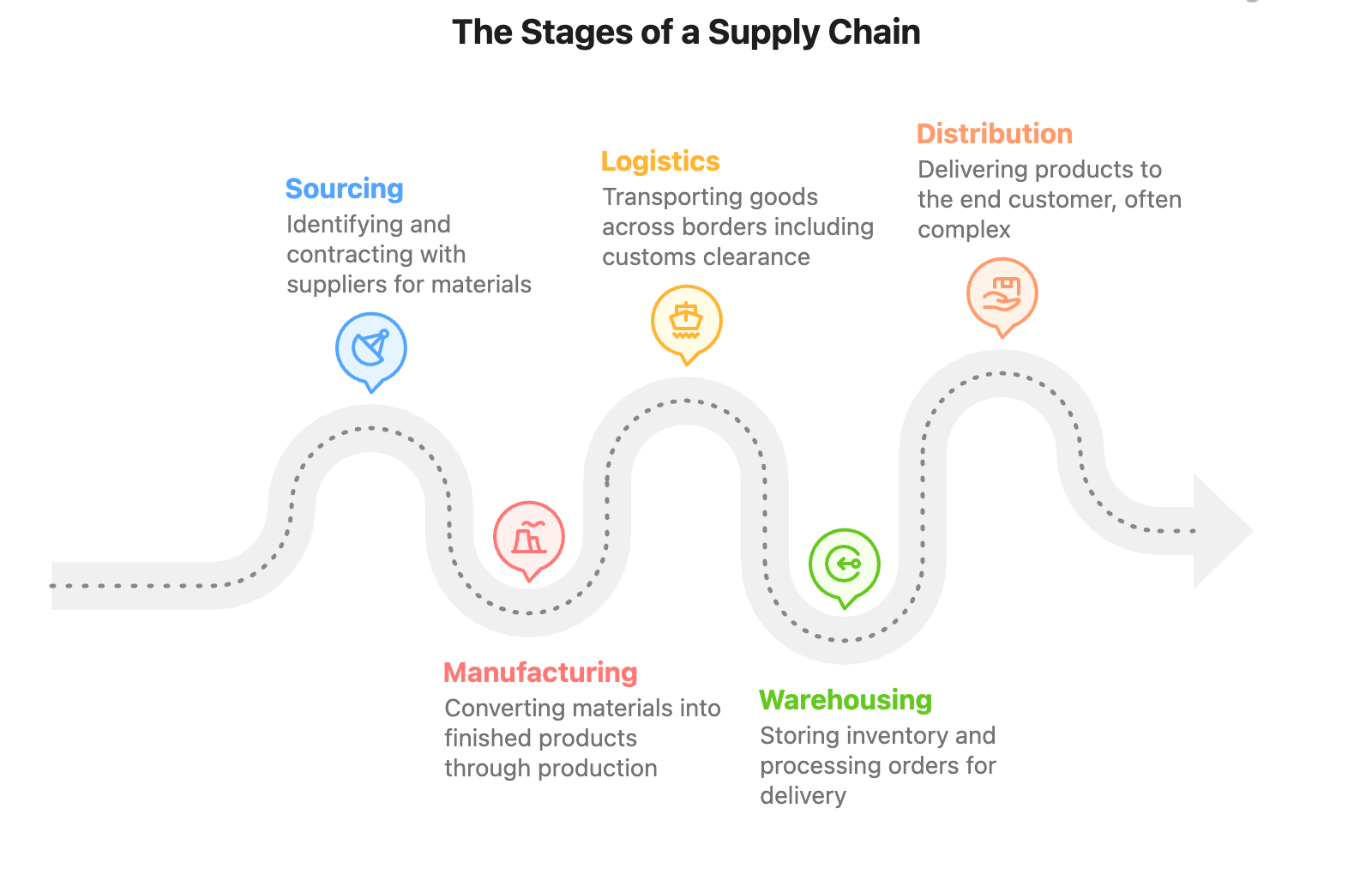
The Stages of a Supply Chain
A typical global supply chain flows through five interconnected stages. Each stage involves distinct companies, processes, and risks that must be carefully managed:
- Sourcing: Identifying, vetting, and contracting with suppliers who provide raw materials, components, or finished goods.
- Manufacturing / Production: Converting raw materials or components into finished products through factories, contract manufacturers, or assembly partners.
- Logistics / Shipping: Transporting goods across borders via ocean freight, air freight, rail, or road, including customs clearance and documentation.
- Warehousing / Fulfillment: Storing inventory in strategically located facilities and processing orders for outbound delivery.
- Distribution / Last Mile: Delivering products from the warehouse or fulfillment center to the end customer, often the most expensive and complex stage.
Each stage involves a distinct set of specialized partners and tools, and strength in one area rarely makes up for gaps in another. That’s why selecting the right partners at every level is critical. In fact, it’s not uncommon to see companies invest heavily in sourcing, only to see those gains eroded by inefficiencies in the last mile.
Read more: What Is Product Sourcing?


What Does Global Supply Chain Management Do?
Global supply chain management extends the traditional SCM framework across international borders, time zones, currencies, regulatory environments, and cultural contexts. It is what allows a brand headquartered in Germany to manufacture in Vietnam, warehouse in the Netherlands, and deliver to customers in the United States within a competitive timeframe.
The scope of global SCM covers several critical functions:
- Supplier Relationship Management: Building long-term, reliable relationships with international suppliers to ensure consistent quality and pricing.
- Demand Forecasting: Using data analytics and historical sales trends to predict future product demand across different markets.
- Inventory Optimization: Balancing stock levels across multiple geographies to avoid both overstock and stockouts.
- Risk Mitigation: Identifying vulnerabilities such as geopolitical instability, natural disasters, currency fluctuation, and supplier concentration risk.
- Regulatory Compliance: Navigating import duties, customs regulations, trade agreements, and environmental standards across multiple jurisdictions.
- Sustainability Integration: Reducing the carbon footprint of global operations through responsible sourcing, greener logistics, and circular supply chain practices.
- Supplier Diversification: Developing a geographically distributed supplier base to reduce single-source dependency, strengthen resilience, and ensure continuity during disruptions.
In the post-pandemic era, global supply chain management has also become central to business resilience. Companies that had invested in supply chain visibility tools and diversified supplier networks recovered from disruptions significantly faster than those relying on single-source, opaque supply chains.
Read more about How the US–Israel vs Iran War Is Disrupting Global Supply Chains
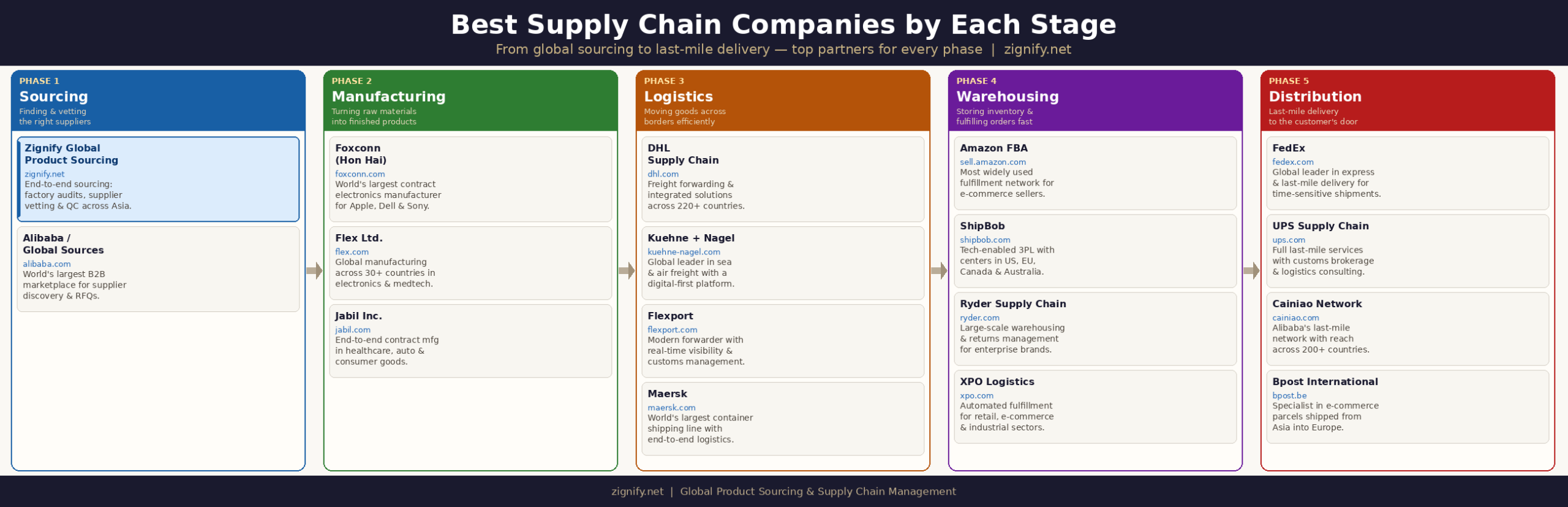
Best Supply Chain Companies by Each Stage
To make this guide actionable, we have broken down the top companies operating at each stage of the global supply chain. For each category, we explain what service they provide, which companies lead the space, and why they have earned their reputation.
Stage 1: Sourcing Companies
Sourcing companies serve as the critical bridge between buyers and global suppliers. Their services typically include supplier identification and vetting, product sampling, factory audits, quality control management, price negotiation, and purchase order coordination. A strong sourcing partner reduces the enormous risk associated with working with unfamiliar international suppliers and helps brands find reliable manufacturing partners that match their product specifications, minimum order quantities, and quality standards.
| Company | Website | Why They Were Chosen |
|---|---|---|
| Zignify Global Product Sourcing | zignify.net | Hands-on sourcing partner offering in-person factory visits, rigorous supplier audits, quality inspections, and end-to-end sourcing project management across Asia and beyond. Transparency-first model with deep regional expertise. |
| Alibaba / Global Sources | alibaba.com | World’s largest B2B sourcing marketplace. Best for initial discovery and RFQ processes, though independent due diligence on supplier reliability is essential. |
When selecting a sourcing partner, look for companies that offer direct factory access (rather than relying solely on agent networks), transparent fee structures, and a proven track record in your product category.
Zignify Global Product Sourcing is among the top product sourcing companies for businesses simplifying their global supply chain. They offer end-to-end sourcing support, from supplier vetting and factory audits to quality inspections, backed by deep regional expertise across Asia.
Stage 2: Manufacturing Partners
Contract manufacturing and production partnerships are the engine of global product creation. These companies produce finished goods or components based on buyer specifications, managing everything from raw material procurement and production planning to quality control and finished goods packaging. The right manufacturing partner aligns on quality standards, lead times, capacity, and communication practices.
| Company | Website | Why They Were Chosen |
|---|---|---|
| Foxconn (Hon Hai Precision Industry) | foxconn.com | World’s largest contract electronics manufacturer producing for Apple, Dell, Sony, and hundreds of global brands. Offers enormous scale but typically requires high minimum order quantities. |
| Flex Ltd. | flex.com | Global supply chain and manufacturing solutions company operating in 30+ countries. Particularly strong in electronics, medical devices, and industrial products. |
| Jabil Inc. | jabil.com | End-to-end manufacturing with deep expertise in product design, engineering, and supply chain management across healthcare, automotive, and consumer goods sectors. |
| Sparton Corporation | sparton.com | Focused on complex engineered products for defense, medical, and industrial sectors. Offers design-to-delivery contract manufacturing services. |
Stage 3: Logistics Providers
International logistics providers handle the movement of goods across borders, offering ocean freight, air freight, rail transport, customs brokerage, and multimodal transportation solutions. The best providers combine competitive rates with reliable transit times, transparent tracking, and proactive communication when disruptions arise.
| Company | Website | Why They Were Chosen |
|---|---|---|
| DHL Supply Chain | dhl.com | One of the most recognized names in global logistics. Offers freight forwarding, customs brokerage, and integrated supply chain solutions in 220+ countries and territories. |
| Kuehne + Nagel | kuehne-nagel.com | Global leader in sea freight, air freight, and contract logistics with a strong digital freight management platform and extensive carrier network. |
| Flexport | flexport.com | Modern freight forwarder with a digital-first platform offering real-time shipment visibility, customs management, and financing options for importers and exporters. |
| DB Schenker | dbschenker.com | Major European-rooted global logistics provider with strong capabilities in land transport, air freight, ocean freight, and supply chain management consulting. |
| Maersk (A.P. Moller-Maersk) | maersk.com | World’s largest container shipping line, also offering integrated logistics services including warehousing, customs, and last-mile delivery. |
Stage 4: Warehousing and Fulfillment Solutions
Warehousing and fulfillment companies store inventory and manage the pick, pack, and ship process on behalf of brands. Multi-location fulfillment is now a critical capability, enabling faster delivery times and significant cost efficiencies. Leading providers combine distributed networks, real-time inventory visibility, and seamless integrations with platforms like Shopify, Amazon, and WooCommerce.
| Company | Website | Why They Were Chosen |
|---|---|---|
| Amazon FBA (Fulfillment by Amazon) | sell.amazon.com | Most widely used fulfillment service for e-commerce sellers. Access to Amazon’s vast warehouse and delivery network. Ideal for brands selling on Amazon Marketplace. |
| ShipBob | shipbob.com | Tech-enabled 3PL provider with fulfillment centers across the US, Europe, Canada, and Australia. Strong integration with Shopify, WooCommerce, and other e-commerce platforms. |
| Ryder Supply Chain Solutions | ryder.com | Large-scale warehousing and distribution for mid-to-enterprise brands. Capabilities in e-commerce fulfillment, returns management, and distribution optimization. |
| XPO Logistics | xpo.com | Global leader in contract logistics and warehousing, providing automated fulfillment solutions for retail, e-commerce, and industrial sectors. |
| Rakuten Super Logistics | rakutensl.com | US-based fulfillment network known for its two-day delivery guarantee and strong customer service reputation among D2C brands. |
Stage 5: Distribution and Last-Mile Services
Last-mile delivery is the final, and often most challenging, stage of the supply chain. This stage accounts for a disproportionate share of total logistics costs. Leading companies in this space combine technology, route optimization, and local carrier partnerships to deliver speed, reliability, and cost efficiency.
| Company | Website | Why They Were Chosen |
|---|---|---|
| FedEx | fedex.com | Global leader in express delivery and last-mile distribution. Particularly strong for time-sensitive shipments across North America, Europe, and Asia-Pacific. |
| UPS Supply Chain Solutions | ups.com | Comprehensive distribution and last-mile delivery services alongside customs brokerage, freight, and logistics consulting. |
| LaserShip / OnTrac | ontrac.com | US regional last-mile carriers known for competitive pricing and strong coverage in densely populated metro areas. |
| Cainiao Network (Alibaba Group) | cainiao.com | One of the most sophisticated last-mile networks in Asia, with rapidly expanding international coverage through partnerships in 200+ countries. |
| Bpost International | bpost.be | Belgium’s postal network with strong international parcel delivery capabilities, particularly for e-commerce shipments into Europe from Asia. |
Read more about Understanding Global Sourcing & Supply Chain
Best Software Platforms for Optimizing Global Supply Chain Management
Even with the best physical partners in place, supply chain visibility and coordination require powerful digital infrastructure. The right supply chain management tools allow companies to track inventory in real time, forecast demand accurately, manage supplier relationships at scale, and identify risks before they become crises.
Enterprise-Level SCM Platforms
| Platform | Website | Best For |
|---|---|---|
| SAP Supply Chain Management | sap.com | The industry benchmark for large enterprises. IBP module offers advanced demand sensing, inventory optimization, and supply chain analytics powered by machine learning. |
| Oracle SCM Cloud | oracle.com | Comprehensive cloud-based suite covering procurement, order management, manufacturing, and logistics. Particularly strong for companies already running Oracle ERP. |
| Blue Yonder (formerly JDA) | blueyonder.com | AI-driven platform used by major retailers and manufacturers for demand planning, warehouse management, and transportation management. |
| Kinaxis RapidResponse | kinaxis.com | Known for concurrent planning capabilities, enabling simultaneous scenario planning across the entire supply chain to speed up disruption response. |
Mid-Market and SME SCM Tools
| Platform | Website | Best For |
|---|---|---|
| NetSuite SCM | netsuite.com | Oracle’s cloud ERP for growing businesses. Solid inventory management, demand planning, and procurement modules integrated with financials and CRM. |
| Fishbowl Inventory | fishbowlinventory.com | Popular inventory management solution for SMBs with QuickBooks integration and basic supply chain visibility features. |
| Cin7 | cin7.com | Cloud-based inventory and order management for product businesses selling across Amazon, Shopify, and brick-and-mortar retail channels. |
| Skubana (now Extensiv) | extensiv.com | Operations platform for high-volume e-commerce brands with multi-warehouse inventory management, order routing, and 3PL integration. |
Specialized Supply Chain Visibility Tools
| Platform | Website | Best For |
|---|---|---|
| project44 | project44.com | Real-time transportation visibility across all shipping modes globally. Provides proactive alerts and predictive ETAs for supply chain teams. |
| FourKites | fourkites.com | AI-powered supply chain visibility with strong carrier network integrations and customer delivery experience features. |
| Coupa Supply Chain | coupa.com | Focuses on procurement intelligence and supplier risk management, assessing supplier financial health, compliance status, and ESG performance. |
| Resilinc | resilinc.com | Specializes in supply chain risk monitoring, mapping supplier networks to the sub-tier level with real-time disruption and geopolitical event alerts. |
For companies just starting their supply chain digitization journey, the key is to choose a platform that works well with existing systems and can grow as your operations become more complex. Just as important, real-time visibility and risk monitoring are no longer optional, they’re essential for managing a global supply chain effectively.
Conclusion
Managing a global supply chain is one of the most demanding challenges in modern business, but it is also one of the greatest sources of competitive advantage when done well. By partnering with the right companies at each stage, from trusted sourcing experts like Zignify Global Product Sourcing to world-class logistics providers and smart fulfillment networks, you can build a supply chain that is not just efficient, but resilient, transparent, and scalable.
The companies and tools outlined in this guide represent the current best-in-class options across every link in the global supply chain. Whether you are building your sourcing strategy from scratch or looking to optimize specific stages of your existing operation, the resources in this guide offer a strong starting point. The most important step is to evaluate each partner not just on price, but on their alignment with your quality standards, communication style, technology capabilities, and long-term growth vision.
A well-managed supply chain does not just move products; it builds trust with your customers, protects your margins, and creates the operational foundation your business needs to scale globally.
Frequently Asked Questions About Global Supply Chain Management
How do you track shipments in a global supply chain using digital tools?
Most modern freight forwarders and logistics platforms provide real-time tracking dashboards through their portals or mobile apps. Tools like project44 and FourKites offer multi-modal visibility across ocean, air, and road shipments in one interface. For maximum accuracy, look for platforms that pull data directly from carriers rather than relying solely on manual updates.
How do you find reputable consulting firms specializing in supply chain resilience strategies?
For dedicated supply chain resilience consulting, you can look to firms like McKinsey, Deloitte, and Accenture for enterprise-scale engagements. For businesses focused specifically on global product sourcing and supplier resilience, Zignify Global Product Sourcing offers hands-on consulting and sourcing project management to help brands diversify their supplier base and reduce dependency on single-origin supply chains. Industry associations like CSCMP also maintain directories of verified supply chain consultants.
Who are the top logistics providers for managing international supply chains?
The most consistently recognized global logistics providers include DHL Supply Chain, Kuehne + Nagel, Flexport, DB Schenker, and Maersk Logistics. Each has distinct strengths: DHL for breadth of global coverage, Flexport for digital transparency, and Maersk for end-to-end ocean and inland logistics. The best choice depends on your primary shipping corridors, product type, and the level of digital visibility you require.
Where can I find training courses for customs compliance in global trade?
The World Customs Organization (WCO) offers foundational customs education, and the US Customs and Border Protection (CBP) provides free online resources for importers. Platforms like Coursera, LinkedIn Learning, and the Association of International Trade offer paid certification courses. For country-specific compliance, many freight forwarders also run client education webinars covering customs regulations relevant to their key trade corridors.
What is global supply chain risk management?
Global supply chain risk management is the process of identifying, assessing, and mitigating threats that could disrupt the flow of goods across international supply chains. These threats include geopolitical instability, natural disasters, supplier financial failure, regulatory changes, cyberattacks, and demand volatility. Effective risk management involves supplier diversification, inventory buffering, scenario planning, and the use of real-time monitoring tools like Resilinc or Coupa Risk.
Which companies offer end-to-end global supply chain consulting services?
End-to-end supply chain consulting is offered by a range of companies, from large management consultancies like McKinsey and Bain to specialized firms like Zignify Global Product Sourcing, which provides sourcing, supplier management, and quality control consulting for brands scaling their global procurement. Technology vendors like SAP and Oracle also offer advisory services alongside their software implementations.
Who are the leading providers of sustainable packaging solutions for international shipping?
Sustainable packaging for global shipments is a growing priority, with companies like DS Smith, Smurfit Kappa, and Sealed Air offering eco-friendly corrugated and protective packaging solutions at scale. Startups like Noissue and Packhelp cater to small and mid-sized brands with customizable, recycled, and compostable packaging options. When evaluating providers, look for certifications like FSC (Forest Stewardship Council) and compliance with target market packaging regulations.
Who are the leading freight forwarding services for global supply chains?
The most widely trusted freight forwarders for international trade include Kuehne + Nagel, DHL Global Forwarding, Flexport, Nippon Express, and Expeditors International. Flexport has emerged as a favorite among e-commerce and mid-market companies due to its intuitive digital platform and real-time shipment visibility. For specific trade lanes, particularly Asia to North America or Europe, working with forwarders that have strong local offices in your origin country is highly recommended.