Most electronics sellers do not lose money on certification because the rules are unclear. They lose money because they treat CE marking, FCC, and UL as a final paperwork step, when these certifications are actually decided much earlier, during supplier selection and product design.
By the time a product reaches a test lab, the outcome is often already determined. Pass or fail, redesign or production, blocked at customs or sitting on Amazon shelves, all of it traces back to choices made before the first sample was ever made.
This guide explains what CE marking requirements, FCC certification, and UL listing actually involve when you want to sell electronics in the United States and the European Union. It covers what each certification means, when you need it, what causes most failures, and how to set up the sourcing side correctly so you do not end up paying for the same product twice.
Need help with your product sourcing?
Get practical advice tailored to your product, suppliers, and market form Zignify experts
Why Certification Decides Whether You Can Actually Sell
Selling electronics in regulated markets is not the same as selling a t-shirt or a coffee mug. The moment a product plugs into a wall, runs on a battery, or transmits a wireless signal, it falls under safety and electromagnetic regulation in almost every developed market. Without the right certification, the product cannot legally be placed on the market, retailers will refuse to stock it, marketplaces will pull listings, and customs can block shipments before they reach the warehouse.
The business cost of getting this wrong is rarely the certification fee itself. It is the cost of containers stuck at port, products recalled from buyers, Amazon listings suspended without notice, and the time lost while the supplier scrambles to find another way to make the product compliant. Many sellers only discover compliance is supplier dependent after they have already paid for a full production run.
The three certifications that matter most for electronics
For most consumer electronics sold into the US and EU, three certifications cover the bulk of what regulators, retailers, and marketplaces will ask for.
CE Marking (EU): Mandatory for placing electronic products on the European market. Confirms the product meets EU safety, EMC, and environmental directives.
FCC Certification (USA): Required for most products that intentionally or unintentionally emit radio frequency, including Bluetooth, Wi-Fi, and many digital devices. Without it, the product cannot legally be sold in the United States.
UL Certification (USA): Not always legally required, but routinely demanded by major retailers, distributors, and insurance companies. Confirms electrical and fire safety.
There are other certifications you may run into, such as RoHS, REACH, and FCC Part 15, but these three form the core of what most sellers need to plan for when entering the US or EU market. Depending on the product category, additional requirements such as battery transport testing (UN38.3) or chemical compliance may also apply.
Reliable product sourcing starts here
Work with experts who help you evaluate suppliers and reduce risk.
Each certification covers a different scope, applies to a different geography, and signals a different kind of compliance. Understanding what they each mean is the difference between a smooth launch and a stuck shipment.
CE Marking: EU Market Access
CE marking is mandatory for most electronics sold in the EU. It is not a quality stamp. It is the manufacturer’s declaration that the product complies with all applicable EU directives, including the Low Voltage Directive, EMC Directive, Radio Equipment Directive, and RoHS. Achieving it means identifying every applicable directive, completing the required testing, and assembling a technical file. Without the correct documentation, customs can refuse entry and market surveillance authorities can pull the product from shelves.
One thing many sellers miss: CE marking is typically self-declared by the manufacturer based on test reports, although certain product categories require involvement from a Notified Body. That puts the entire weight of compliance on having accurate test reports from competent labs and ensuring production units actually match what was tested. Mismatch between the tested unit and the production batch is one of the most common reasons products fail post-market checks.
FCC Certification: Required for RF-Emitting Products
The FCC regulates electronics that emit radio frequency energy in the US. Anything with Bluetooth, Wi-Fi, wireless charging, or unintentional RF emissions typically falls under FCC Part 15. Depending on the product, compliance may follow Supplier’s Declaration of Conformity (SDoC) or full Certification for intentional radiators such as Wi-Fi or Bluetooth devices. Without compliance, products can be seized at customs, Amazon removes flagged listings, and US retailers will not stock the product.
UL Certification: Commercially Essential
UL certification is generally not a legal requirement, but it functions as a commercial gatekeeper. Major US retailers, distributors, and insurance carriers routinely require UL listing before stocking a product. For battery-powered devices, insurers may refuse coverage on warehouses holding uncertified electronics, and Amazon increasingly requires UL test reports for high-risk categories like power banks and lithium batteries. Treating UL as optional works until a retailer asks for the certificate or an insurance claim is filed.
In practice, many products use equivalent certification from other OSHA-recognized Nationally Recognized Testing Laboratories (NRTLs), not only UL.
read more Best Supply Chain Management Companies & Tools for Global Sourcing
Reliable product sourcing starts here
Work with experts who help you evaluate suppliers and reduce risk.
Key takeaway: CE and FCC are about legal market access. UL is about commercial access. For most electronics sold in both the US and EU, all three matter, and skipping any one of them blocks a different door.
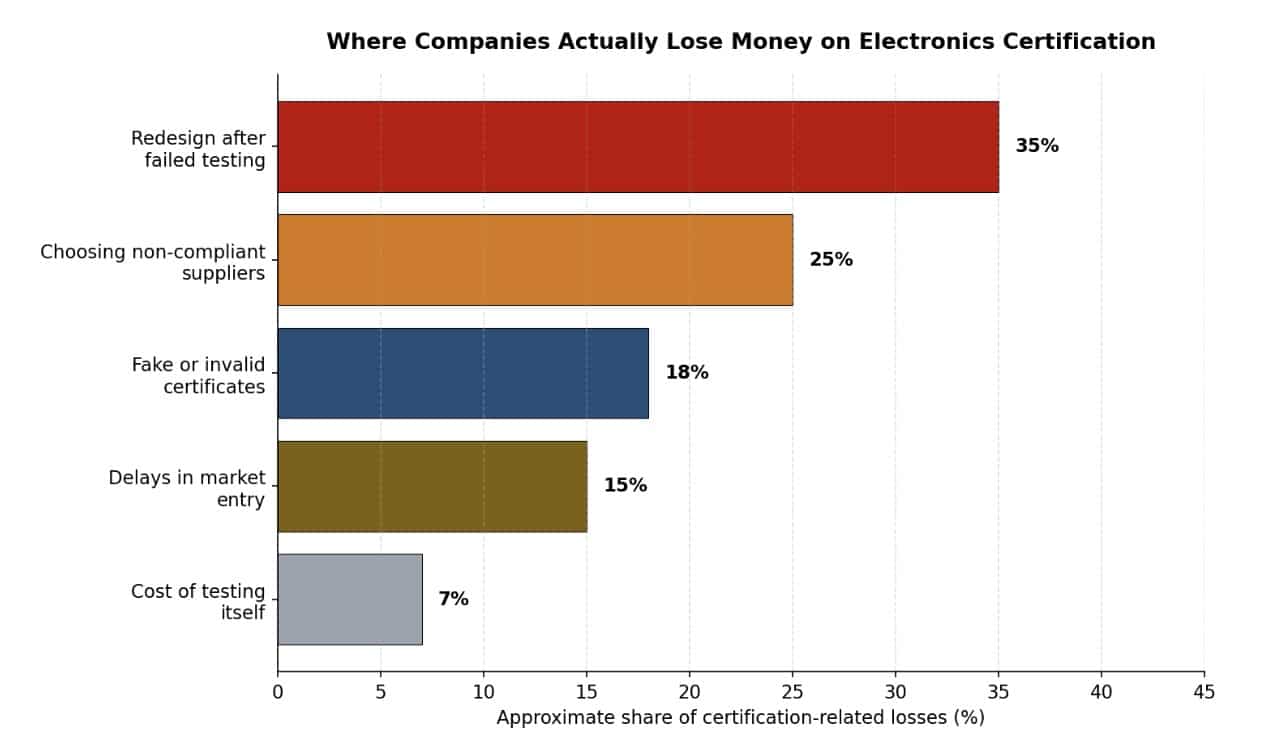
The biggest certification costs are not testing fees. They are the consequences of choosing the wrong supplier or the wrong design.
Where Companies Actually Lose Money on Electronics Certification
If you ask sellers what certification costs them, most will quote the lab fee. That number is usually the smallest part of the real bill. The bigger losses sit in places that look like sourcing problems, not compliance problems.
The biggest certification costs are not testing fees. They are the consequences of choosing the wrong supplier or the wrong design.
Redesign After Failed Testing
This is the highest hidden cost. A product fails EMC testing, FCC emission limits, or UL flammability requirements, and now the supplier needs to change components, redo tooling, or rework the PCB. Each change cycles back through prototyping and retesting. Three months of delay and tens of thousands of dollars is a typical outcome, usually traced back to a supplier who priced low because they were not building for compliance from the start.
Choosing a Supplier Who Cannot Pass Certification
Not every electronics factory can produce a CE or FCC compliant product. Some have never gone through certification, use unverified components, or substitute cheaper parts mid-production without telling the buyer. The quote looks attractive, but the cost of failure is not in it. By the time testing fails, the buyer has already paid the deposit and committed to tooling.
Fake or Invalid Certificates
More common than buyers realise. A supplier sends a polished PDF with a CE logo that may be from an unrecognised test house, scoped to a different model, or simply fabricated. Buyers who cannot verify documentation accept it, ship the goods, and discover the truth only when customs or a retailer asks for the full technical file.
Delays in Market Entry
Every week held up by failed certification means warehouse fees, lost sales, and competitor advantage. For seasonal products, missing a launch window can wipe out the year. Sellers chasing Q4 timelines are especially exposed because a redesign cycle in October is not recoverable.
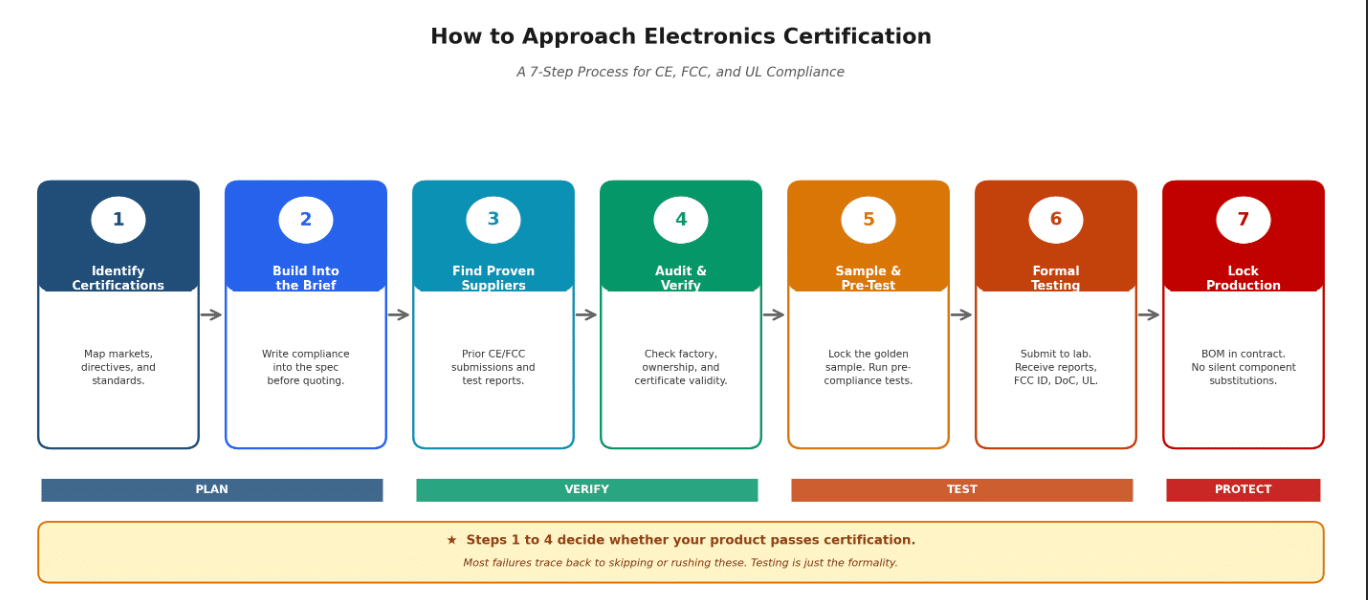
How to Approach Electronics Certification, Step by Step
Treating certification as a sourcing problem rather than a paperwork problem changes the order of operations. Here is the sequence that protects the margin and timeline.
Step 1: Identify which certifications your product actually needs
Start with the markets where you intend to sell, then work backwards through the directives and standards that apply. A consumer Bluetooth speaker sold in the EU needs the Radio Equipment Directive, EMC Directive, Low Voltage Directive if mains powered, and RoHS. The same product sold in the US needs FCC Part 15 and probably UL if a major retailer is involved. Map this scope before you ever talk to a supplier. If you are unsure which directives or standards apply, consult a compliance specialist early rather than relying solely on supplier input.
Step 2: Build certification requirements into the supplier brief
Before requesting quotes, write the compliance scope into the technical specification. State which directives apply, which standards must be met, and what documentation the supplier must provide. Suppliers who cannot meet this scope will either decline to quote or quote a higher price that reflects real compliance work, which is exactly the filter you want.
Step 3: Identify suppliers with proven certification history
Ask for prior test reports, FCC IDs from products they have certified, EU Notified Body interaction history, and references from buyers who have completed CE or FCC submissions with them. A supplier who has done it before knows what their PCB layout needs to look like, which components are pre approved, and how to build a unit that matches what was tested. A supplier with no certification history is a project, not a partner.
Step 4: Verify the supplier through audit and document checks
Before paying a deposit, verify the supplier is what they claim to be. A supplier audit goes beyond a sales pitch. It confirms whether the company is a real factory or a trading house, checks ownership and legal records, and verifies that prior certificates are genuine. For electronics, also verify the components in the BOM, especially RF modules, batteries, and power supplies, because these are the parts that most often determine whether the product passes testing.
Step 5: Sample, test, and lock the golden sample
Once the supplier is shortlisted, request samples and put them through pre-compliance testing before committing to mass production. Pre-compliance is usually a fraction of the cost of full certification testing and catches the issues that would otherwise surface at the final lab. The sample that passes pre-compliance becomes the golden sample, the reference unit that the supplier must match in mass production.
Step 6: Run formal certification testing and assemble the technical file
This is the step most guides describe as if it were the whole process. With the right supplier and the right sample, this stage is a formality. Submit the unit to a competent lab, receive the test reports, prepare the Declaration of Conformity for CE, the FCC ID for FCC certification, and the UL listing report. File the technical documentation in your records, because EU market surveillance can request it years after the product was placed on the market. Ensure all documentation is issued under the correct legal entity responsible for placing the product on the market.
Step 7: Lock production to the certified configuration
The biggest post-certification trap is component substitution. The factory swaps a capacitor, a Wi-Fi module, or a battery cell to save cost, and the production units no longer match the certified unit. The certificate is technically invalid the moment that happens. Build the bill of materials into the purchase agreement, require written approval for any substitution, and run periodic checks during production to confirm the units shipping match the units tested.
Reliable product sourcing starts here
Work with experts who help you evaluate suppliers and reduce risk.
Country Strategy: Where Certification Readiness Comes From
Where you source electronics has a direct impact on certification outcomes. Different regions have different baseline capabilities for compliance work.
China: cost efficiency and certification experience
China remains the dominant electronics manufacturing base, with deep experience in CE, FCC, and UL submissions. The challenge is variability. Top-tier factories in Shenzhen, Dongguan, and the Pearl River Delta routinely produce products that pass certification on the first attempt. Lower-tier factories may have never been through the process. The country itself is not the issue; the supplier selection within China is.
Vietnam: a growing electronics base
Vietnam has expanded rapidly as an electronics manufacturing hub, particularly for consumer products and assembly work. Compliance experience is improving, but is generally less mature than in China for complex RF or high voltage products. For sellers using Vietnam as part of a China plus one strategy, certification readiness should be verified product by product, not assumed.
Europe: high compliance baseline, higher production cost
Manufacturing within the EU removes a layer of import complexity and is often the highest baseline for compliance, but the unit cost is dramatically higher. For most consumer electronics, EU manufacturing is reserved for high-margin or specialised products.
Certification outcomes depend more on supplier capability than on the country alone, making supplier selection the critical variable across all regions.
Reliable product sourcing starts here
Work with experts who help you evaluate suppliers and reduce risk.
Common Mistakes That Make Electronics Certification Expensive
Most certification failures repeat a small number of avoidable mistakes. Recognising them early is the cheapest form of protection.
Treating Certification as the Supplier’s Responsibility: Suppliers often obtain certificates in their own name, not the buyer’s. When the buyer wants to switch suppliers or enter a new market, the certification does not travel with them. The Declaration of Conformity, FCC ID, and UL listing should be issued in the name of the entity placing the product on the market, which is usually the buyer.
Relying entirely on supplier-provided compliance strategy: Suppliers may suggest the fastest or cheapest route, which does not always align with the buyer’s market requirements or long-term product plans.
Accepting Certificates Without Verification: A document with a CE logo is not proof of compliance. Verify the issuing body, scope, model number, and underlying test reports. For FCC, check the FCC ID in the public FCC database. For UL, verify the file number on UL’s product iQ database. Any certificate that cannot be independently verified is a red flag.
Cutting Cost in Ways That Break Compliance: Pulling cost out of compliance-critical components is a false saving. A cheaper power supply without UL recognition, an RF module without an FCC ID, or a battery cell without UN38.3 certification can void the entire certification. Cost reduction on electronics has to respect the small set of components that cannot change without a full retest.
Testing the Wrong Sample: Certifying a hand-built prototype instead of a production-representative sample is a frequent mistake. Prototypes often use better components and tighter assembly than mass production units. Always certify the sample that matches the actual production configuration.
Forgetting Market-Specific Add-Ons: CE marking alone is not enough for many EU markets. WEEE registration, battery registration, and packaging compliance may also be required. In the US, California Proposition 65 applies to chemical content and is routinely missed in checklists focused only on headline certifications.
Reliable product sourcing starts here
Work with experts who help you evaluate suppliers and reduce risk.
How Zignify Supports Electronics Certification at the Sourcing Level
Zignify does not act as a certification lab. The work that decides whether certification succeeds happens earlier, in supplier selection, design alignment, document verification, and contract structuring.
Finding Certification-Ready Suppliers
The sourcing process benchmarks a wide pool of suppliers against the specific certifications your product needs, filtering for prior CE or FCC submissions, in-house engineering capability, and compliant component sourcing practices. Suppliers without the right history are filtered out before they ever quote.
Verifying Documentation and Catching Fake Certificates
Every certificate is checked against the issuing body, model number, and scope. A CE certificate that does not map to the exact product, or comes from an unrecognised body, is flagged before any commitment is made. This step helps reduce the risk of products being blocked at customs or rejected by retailers.
Aligning Design and BOM With Certification Scope
Before mass production, the supplier’s design and component list are reviewed against CE, FCC, and UL requirements. RF modules, power supplies, batteries, and casing materials are the critical points. Catching a non-compliant component at the BOM stage costs nothing compared to catching it after a failed test.
Cost Optimisation That Respects Compliance
Cost reduction focuses on factory margin, packaging, logistics, and component sourcing within compliance limits, not on substituting parts that would invalidate testing. Buyers reduce purchasing costs without weakening their compliance position.
Purchase Agreements That Lock the Certified Configuration
Certification scope, approved BOM, and substitution rules are written into the purchase agreement so the supplier is contractually bound to ship units that match the certified sample.
Direct Supplier Access and Full Transparency
Buyers pay the factory directly. No commissions, no hidden margins, no black box reporting. Buyers know who their supplier is, can communicate directly, and retain ownership of the relationship.
The goal is not only to pass testing, but to ensure the product remains compliant throughout production and future reorders.
Reliable product sourcing starts here
Work with experts who help you evaluate suppliers and reduce risk.
What Most Guides Get Wrong, Here’s What Our Expert Knows ✅
Most certification guides treat CE, FCC, and UL like a paperwork checklist you tick off at the end of production. That framing is exactly why so many sellers lose money. The certification result is decided long before testing begins, by the supplier and the design choices made during sourcing. Here is what almost no guide spells out.
⚠️ The supplier you pick decides whether your product passes certification, not the lab you book.
Two factories quoting the same product can produce two completely different compliance outcomes. One uses verified components, has prior CE or FCC submissions, and understands EMC layout. The other saves a few cents on a transformer or a Wi-Fi module that has no FCC ID, and your unit fails radiated emissions on the first test. The cost gap between the two suppliers is often less than 5 percent. The cost of failed testing, redesign, and resubmission is often 10 to 30 times that. Sourcing decisions are certification decisions.
🚩 Most “CE certificates” sent by Chinese suppliers do not actually mean what buyers think they mean.
Buyers see a stamped certificate from a Chinese test house and assume their product is covered for the EU market. In many cases the document is for a similar but different model, issued by a body with no Notified Body number, or covers only one directive when the product needs three. Once the goods arrive at Rotterdam or Hamburg and customs asks for the Declaration of Conformity and full technical file, the buyer discovers the certificate is decorative. Always verify the document maps to your exact product, your exact directives, and a recognised body.
💰 The real certification cost sits in the design, not the testing fee.
Buyers fixate on lab quotes, but lab fees are usually the smallest line item. The expensive part is rework: changing a non-compliant power supply, redesigning a PCB to pass EMC, switching a battery cell to a UL recognised one, or rebuilding tooling because plastic housings failed flammability. If certification requirements are not written into the supplier brief and the purchase agreement at the start, the buyer absorbs every redesign cost as if it were a surprise. Build compliance into the spec on day one and the testing phase becomes a formality.
Selling electronics in the US or EU and not sure your supplier can actually pass certification? Book a free sourcing call →
Frequently Asked Questions
1. Is CE marking a legal requirement?
Yes. CE marking is legally required for almost all electronics placed on the European Union market. Without it, customs can refuse entry and market surveillance authorities can withdraw the product. The marking is the manufacturer’s declaration of conformity with all applicable EU directives, supported by a technical file.
2. Do all electronics need FCC certification?
Most electronic devices sold in the United States need some form of FCC compliance. Devices that intentionally emit radio frequency, like Bluetooth or Wi-Fi products, require full FCC certification with an FCC ID. Other digital devices need a Declaration of Conformity. Verification, the lightest pathway, applies only to a narrow category.
3. Is UL certification required to sell electronics in the USA?
UL certification is generally not legally required at the federal level, but it is often required in practice. Major US retailers, distributors, and insurance companies frequently demand UL listing or UL recognition. For battery-powered devices and certain appliances, UL or equivalent listing is effectively mandatory through the National Electrical Code.
4. Does Amazon require UL or FCC certification?
Amazon increasingly asks for compliance documentation in higher-risk electronics categories, including power banks, lithium battery products, and certain appliances. FCC compliance is essentially required for any wireless device listed on Amazon US. UL test reports are commonly requested for safety-sensitive categories. Listings without the right documentation can be suspended without notice.
5. What products require CE marking?
Most electronic products placed on the EU market require CE marking, depending on applicable directives. This covers consumer electronics, mains-powered devices, wireless products, low-voltage equipment, machinery, medical devices, and many other categories. Each category falls under one or more EU directives that determine which standards apply.
6. Does a CE certificate from China count for the EU?
Sometimes yes, often no. CE marking can be self-declared based on test reports from any competent lab, but the issuing body matters. A CE certificate from a Chinese test house with no EU recognition may not stand up to market surveillance scrutiny. Always verify the body, the scope, and the underlying test reports against your exact product.
7. How long does it take to get UL certification?
Typical UL certification for a consumer electronic product takes between 8 and 16 weeks, depending on product complexity, sample availability, and how clean the design is going in. Products that need redesign during testing can extend to 6 months or more, which is why pre-compliance work and supplier selection matter so much for timeline.
8. How much does CE, FCC, and UL certification cost?
Costs vary widely by product. A simple CE submission for a basic electronic accessory can run a few thousand dollars, while a complex wireless device requiring CE, FCC, and UL together can cost tens of thousands. Pre-compliance testing, redesign cycles, and rework are usually the biggest cost drivers, not the testing fee itself.
9. Can I sell electronics in the US without UL certification?
Legally, yes for most product categories, as long as FCC compliance is in place. Practically, many sellers find their commercial options shrink quickly without UL. Major retailers will not stock uncertified products, insurers may not cover warehouses holding them, and Amazon may request UL reports for higher risk categories.
10. What happens if my product fails certification testing?
Failure means redesign, retest, and resubmission, all paid for by the manufacturer. The cost depends on what failed. EMC issues may need PCB layout changes, RF failures may require module substitution, and safety failures may require new components or tooling. This is why supplier capability and pre-compliance testing are the real risk reduction levers.