Most buyers treat the minimum order quantity (MOQ) that a supplier quotes as a fixed number. It is not. MOQ is often one of the most negotiable terms in a sourcing contract, and the buyers who understand this consistently pay less, hold less inventory, and scale with less risk. The buyers who do not negotiate will end up overordering, overpaying, or walking away from suppliers they could have worked with.
Need help with your product sourcing?
Get practical advice tailored to your product, suppliers, and market form Zignify experts
MOQ decides three things at once: how much capital you tie up in stock, how long that capital sits idle, and how much risk you carry if the product underperforms. Get it wrong, and you can significantly strain your cash flow before you have made a single sale.
For a first-time Amazon FBA seller testing a product, an MOQ of 5,000 units when 1,000 would do means roughly five times the upfront capital, five times the FBA storage cost, and five times the financial exposure if listing performance is weak. For an established brand running 8 to 12 SKUs, an inflated MOQ across a category locks up working capital that could have funded a new product launch.
MOQ is not just a production term. It is a cash flow decision, an inventory risk decision, and a supplier relationship decision. Treating it as a take it or leave it number is the most expensive assumption in sourcing.
The impact of MOQ is especially critical for early-stage products, where demand is not yet validated.
Reliable product sourcing starts here
Work with experts who help you evaluate suppliers and reduce risk.
What MOQ Really Is, And Why Suppliers Set It That Way
Suppliers do not set MOQs arbitrarily. The number reflects four things, and once you understand them, you understand where the flexibility lives.
Machine setup cost: Every production run has a fixed setup. Spreading that across 500 units versus 5,000 units changes the unit economics significantly.
Raw material batch size: Many materials, fabrics, plastics, and packaging substrates are sold in standard rolls or batches. The supplier wants your run to match the batch.
Production line scheduling: Factories optimize for volume. A small order in the middle of a large run is operationally expensive.
Buyer risk perception: Suppliers ask for higher MOQs from buyers they do not yet trust. New buyers, unknown brands, and one-off requests get the highest numbers.
This last point is the one most buyers miss. A significant portion of the MOQ a supplier quotes you is a confidence number, not a production number. Shift the supplier’s perception of your reliability and scale, and the MOQ often shifts with it.
For a clean industry definition, see Investopedia’s overview of minimum order quantity, which explains how MOQ functions across both supplier and buyer economics.
Reliable product sourcing starts here
Work with experts who help you evaluate suppliers and reduce risk.
The most common pattern we see at Zignify is buyers who contact 3 to 5 suppliers, accept the lowest MOQ on the list, and call that a negotiation. It is not. With only a handful of quotes, you do not actually know the market price, you do not know the realistic MOQ floor, and you have nothing to negotiate against. You are asking the supplier for a favor instead of comparing real alternatives.
The buyers who get the best terms operate completely differently. They often benchmark across a broad range of suppliers, sometimes 20, 30, or more, depending on the category. They use real alternative offers as leverage without burning bridges. They never threaten, they never bluff. They show clear comparison figures, technical arguments, and volume perspectives. Good MOQ negotiation is strategic, not emotional.
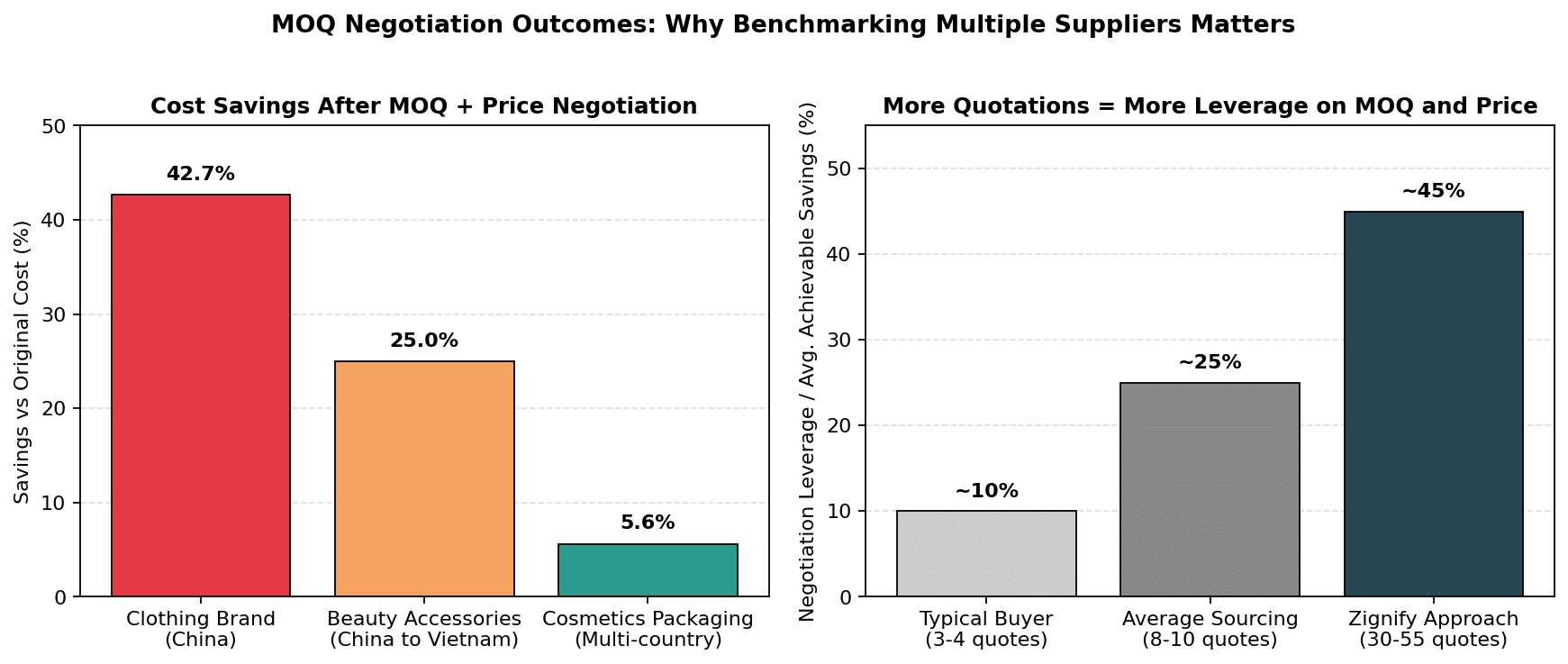
The chart below shows the difference clearly. With three or four quotes, your achievable savings and MOQ flexibility tend to cap out around 10 percent. With broader benchmarking, negotiation leverage increases, and outcomes often improve significantly.
Outcomes drawn from Zignify case studies. Cosmetics packaging savings of 5.6 percent represent EUR 1.4 million in absolute terms on a EUR 25 million production cost base.
Reliable product sourcing starts here
Work with experts who help you evaluate suppliers and reduce risk.
Effective MOQ negotiation is not a single conversation. It is a structured process that builds leverage before you ever ask for a number to move.
Step 1: Build Real Leverage by Benchmarking 20 to 50 Suppliers
The single biggest factor in MOQ negotiation is the number of qualified alternatives you have. A buyer with three quotes is dependent on each supplier. A buyer with thirty is dependent on none of them.
Cast a wide net across regions, production methods, and material variants. In a typical Zignify project, we contact 30 to 60 potential producers per product, aiming to convert them into 5 to 12 valid quotations, sometimes 15 to 20 when the category cooperates. The point is not just to find the cheapest. The point is to know the actual market: where the real MOQ floor is, where pricing genuinely tightens, and where suppliers are bluffing about minimums.
Reliable product sourcing starts here
Work with experts who help you evaluate suppliers and reduce risk.
Once you have leverage, the second mistake is asking only for a lower MOQ. Suppliers resist that because it directly hits their setup economics. Restructuring the deal is far more effective. Instead of pushing the number down, change the shape of the order so a smaller initial run becomes economically viable for the supplier.
Practical structures that work:
Phased production: 500 units now, 1,000 in 60 days, 3,000 in 120 days, locked in writing.
Split MOQ across SKUs: combine multiple variants of the same product to hit the supplier’s minimum without overcommitting on any single SKU.
Trial order with commitment: a small first run priced at slightly higher per unit, with a contractually larger second run at standard pricing.
Mixed container: combine your order with another product line so the factory’s logistics economics work.
Existing molds and shared production slots: if the supplier already has tooling that fits, MOQ pressure drops sharply.
These structures protect the supplier’s economics while reducing your upfront commitment. That is why they work where blunt requests for lower MOQ fail.
Reliable product sourcing starts here
Work with experts who help you evaluate suppliers and reduce risk.
Different sourcing countries have very different baseline MOQs and flexibility profiles. A supplier in coastal China running for major global brands often quotes high minimums because their line is built for scale. A capable supplier in Vietnam, India, Turkey, or Pakistan competing for the same business may offer a far lower entry point with comparable quality.
Country diversification is not just a tariff hedge. It is a direct MOQ lever. We have seen beauty accessory clients move portions of their range from China to Vietnam and unlock both lower MOQs and a USD 1 per unit cost reduction simultaneously, generating USD 300,000 to USD 500,000 in annual savings.
Read more about supplier diversification beyond China in our guide on sourcing from Vietnam and Southeast Asia.
Reliable product sourcing starts here
Work with experts who help you evaluate suppliers and reduce risk.
Common MOQ Negotiation Mistakes That Cost Real Money
Even experienced buyers fall into the same traps. These are the patterns that quietly compound across SKUs and years.
Treating the first MOQ quote as final. The opening number is rarely the supplier’s actual floor.
Negotiating only on price. MOQ, payment terms, lead time, and packaging cost are all linked. Optimizing one in isolation usually compromises another.
Replacing a supplier instead of building parallels. Switching costs you the relationship, the tooling, and the institutional knowledge. Adding a second qualified supplier preserves all of that while creating real competition.
Loyalty without comparison. If you have not tendered an existing SKU in 12 to 24 months, you are almost certainly overpaying. Suppliers very rarely volunteer price reductions on their own.
Threatening or bluffing. Threats damage the relationship and rarely hold up. Verifiable comparison figures and clear technical arguments do the work without burning bridges.
Ignoring total landed cost. A lower MOQ at a higher unit price can still be the right call if it cuts FBA storage, capital lockup, and obsolescence risk.
Reliable product sourcing starts here
Work with experts who help you evaluate suppliers and reduce risk.
Zignify operates fully on the buyer’s side. We do not take factory commissions, and we do not earn a margin on the product. Our clients pay directly to their chosen supplier and have full direct access to that supplier from day one.
Practically, this is what we run for clients negotiating MOQ:
Multi-supplier benchmarking, in multiple countries where relevant.
MOQ structuring: phased orders, split SKUs, mixed containers, trial run agreements with committed follow-on volume.
Country diversification analysis to identify whether Vietnam, India, Turkey, or Pakistan offers lower entry MOQs at the quality you need.
Supplier psychology positioning so you are presented as a serious, scalable, long-term buyer, which directly affects the MOQ a supplier is willing to offer.
Quality control on site during mass production, so a smaller first run actually delivers what was negotiated.
Long-term agreement structuring with forecast-based commitments that unlock flexibility on future MOQs.
Real outcomes from this approach: a clothing brand client cut their two-month purchasing cycle from USD 180,000 to USD 103,000, a 42.7 percent reduction generated entirely from benchmarking and renegotiation. A beauty accessory client saved USD 300,000 to USD 500,000 per year by relocating part of their production. A cosmetics packaging client reduced production cost by EUR 1.4 million on a EUR 25 million base. Across our portfolio, we have negotiated more than USD 500 million in cumulative client savings. The objective is not only to reduce MOQ for a single order, but to build a sourcing structure that improves terms across multiple production cycles.
Reliable product sourcing starts here
Work with experts who help you evaluate suppliers and reduce risk.
MOQ is not a fixed number. It is a negotiation variable that moves with your leverage, your structure, and how a supplier perceives your business. Buyers who treat it as fixed overpay, overstock, and miss margin year after year. Buyers who benchmark widely, structure their orders intelligently, and use real alternatives without burning bridges consistently land lower MOQs at better unit costs, on terms that protect both sides of the relationship.
What Most Guides Get Wrong, Here’s What Our Expert Knows ✅
Most MOQ negotiation guides repeat the same surface advice: ask politely, offer to pay slightly more, promise future orders. That is not how serious buyers actually move the number. After running hundreds of sourcing projects, the real wins come from understanding three things that almost no guide spells out.
⚠️ The MOQ a supplier quotes you reflects how risky you look, not just how their machine works.
A meaningful slice of the MOQ a factory quotes is a confidence buffer for an unknown buyer, not a hard production constraint. Walk into a quote conversation looking like a one-off Alibaba inquiry, and you will get the standard high MOQ. Walk in with clear specifications, a forecast, a quality control plan, and signs of a real operation, and the same factory will quote a noticeably different floor for the same product. The number is not lying. It is responding to what the supplier sees.
💡 Replacing your supplier almost always costs more than it saves. Build a parallel instead.
Buyers often assume that finding a cheaper supplier means switching. In practice, switching loses you the tooling investment, the working relationship, and the operational memory that the existing supplier has built. The smarter move is to qualify a parallel supplier, then let the existing supplier know calmly that you now have a comparable alternative. The original supplier suddenly loses their monopoly, their negotiation power drops, and prices and MOQ usually move without you having to switch at all. Loyalty without comparison costs money. Comparison without disloyalty often pays for itself in one cycle.
💰 The real money in your business is made in purchasing, not in marketing.
If a product sells 20,000 times a year and you negotiate 50 cents per unit off the cost, that is USD 10,000 in pure profit you did not have before, with zero additional sales, zero ad spend, and zero new inventory risk. Most operators chase top-line growth because it feels active, while leaving 10 to 30 percent of margin on the table in their procurement. Optimising MOQ and unit cost is one of the highest leverage activities a sourcing buyer can do, and it compounds every time you reorder. That is exactly why successful sellers tender every SKU every 3 to 12 months, not just when there is a problem.
If reducing MOQ and purchasing cost on your existing or upcoming products is on your priority list, Book a free sourcing call →
Frequently Asked Questions About MOQ Negotiation
1. How do I negotiate MOQ with a supplier?
Start by collecting quotations from 20 to 30 alternative suppliers, ideally across more than one country. Use those quotations as factual leverage, not as threats. Then propose structural changes such as phased production, split SKUs across variants, or a small trial order with a committed follow-on volume. Suppliers respond to verifiable alternatives and to deals that protect their setup economics.
2. How to negotiate a lower MOQ on Alibaba?
Most Alibaba listings show inflated headline MOQs. The real floor is usually negotiable, especially when the supplier sees you have other qualified options. Reach out to multiple suppliers in parallel, share clear specifications, and ask each to quote both their standard and minimum first-order MOQ separately. Suppliers competing for a verified buyer typically come down 30 to 70 percent from the listed MOQ on a first order.
3. What is the minimum order quantity, and why do suppliers set one?
Minimum order quantity is the smallest order a supplier will accept. It exists because every production run has a fixed machine setup cost, raw materials are bought in standard batches, and small orders are operationally expensive to schedule. The MOQ a supplier quotes also includes a confidence buffer based on how risky they think the buyer is, which is why the number is more flexible than most buyers assume.
4. How do I negotiate MOQ with a Chinese manufacturer specifically?
Chinese suppliers respond strongly to two signals: real volume potential and real alternatives. Show them a clear forecast or roadmap if you have one, and make sure they understand that you are also evaluating suppliers in Vietnam, India, or elsewhere. Combine that with a structured offer such as phased production or a guaranteed second order, and the MOQ usually moves without damaging the relationship.
5. How to determine the right MOQ for my business?
The right MOQ is the one that balances unit cost, cash flow, storage cost, and inventory risk. Calculate your expected sales velocity over 60 to 120 days, your storage and capital cost per unit per month, and the unit price difference between MOQ tiers. The optimal MOQ is the smallest one where unit price is acceptable and your stock turns within your risk tolerance, not the cheapest per unit number on the supplier’s price ladder.
6. Can I get a sample or trial order before committing to a full MOQ?
Yes, this is often the best way to negotiate down your effective first MOQ. Most serious suppliers will accept a paid trial run, sometimes at a higher unit price, in exchange for a written commitment on a larger second order. This protects their setup economics while reducing your upfront risk. It is one of the most underused negotiation structures in sourcing.