You finally found a supplier in China who hits your price point. The quality samples look right. The MOQ works for your budget. Then the quotation lands in your inbox, and somewhere near the bottom, you see three letters that feel deceptively small: DDP, FOB, or EXW.Most buyers skim past them. They pick whichever shipping term the supplier seems to prefer, or whichever one looks the simplest, and they move on. That single decision quietly determines your real landed cost, your customs exposure, and how much operational control you actually have over the shipment.This guide breaks down what DDP, FOB, and EXW actually mean when shipping from China, who carries what risk, where the hidden costs sit, and how to choose the right one based on your business stage. It draws on real sourcing experience working with importers across Amazon FBA, wholesale, ecommerce, and private label categories.
Need help with your product sourcing?
Get practical advice tailored to your product, suppliers, and market form Zignify experts
Why Shipping Terms from China Matter More Than Buyers Realize
Shipping terms are not a bureaucratic detail. They are the legal definition of where the supplier’s responsibility ends, and yours begins. They determine who books the freight, who pays the duties, who carries the insurance risk during transit, who clears customs, and who eats the cost when something goes wrong.The terms used in international trade are called Incoterms, short for International Commercial Terms. They are published and updated by the International Chamber of Commerce, and the current version is Incoterms 2020. There are eleven of them in total, but for buyers importing from China, three dominate every conversation: DDP, FOB, and EXW. Together they account for the vast majority of shipments handled by small and medium-sized importers sourcing from China.The cost difference between the right and wrong Incoterm choice on a single shipment can run anywhere from a few hundred dollars on a small order to tens of thousands on full container loads. Scale that across a year of importing and the choice quietly compounds into the difference between a profitable brand and one that’s leaking margin every quarter.
What DDP, FOB, and EXW Actually Mean
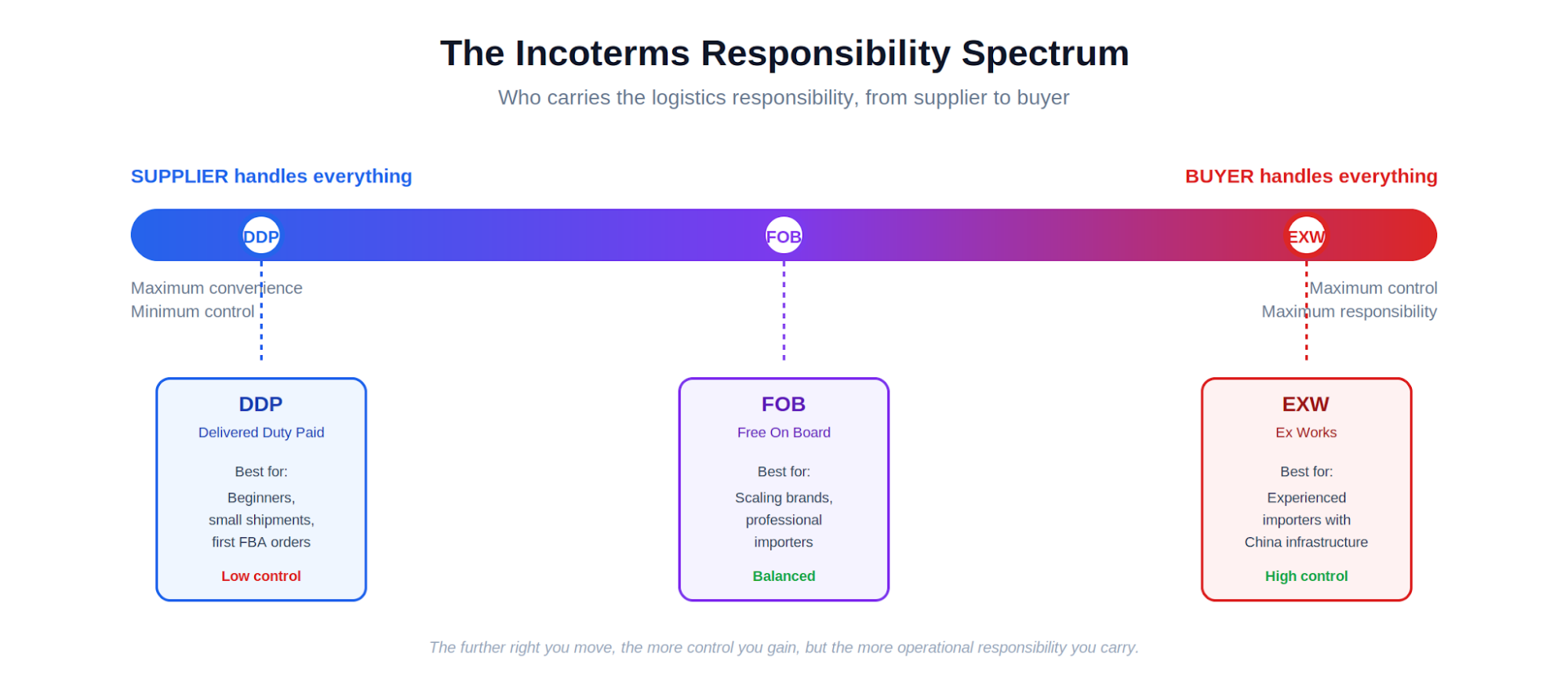
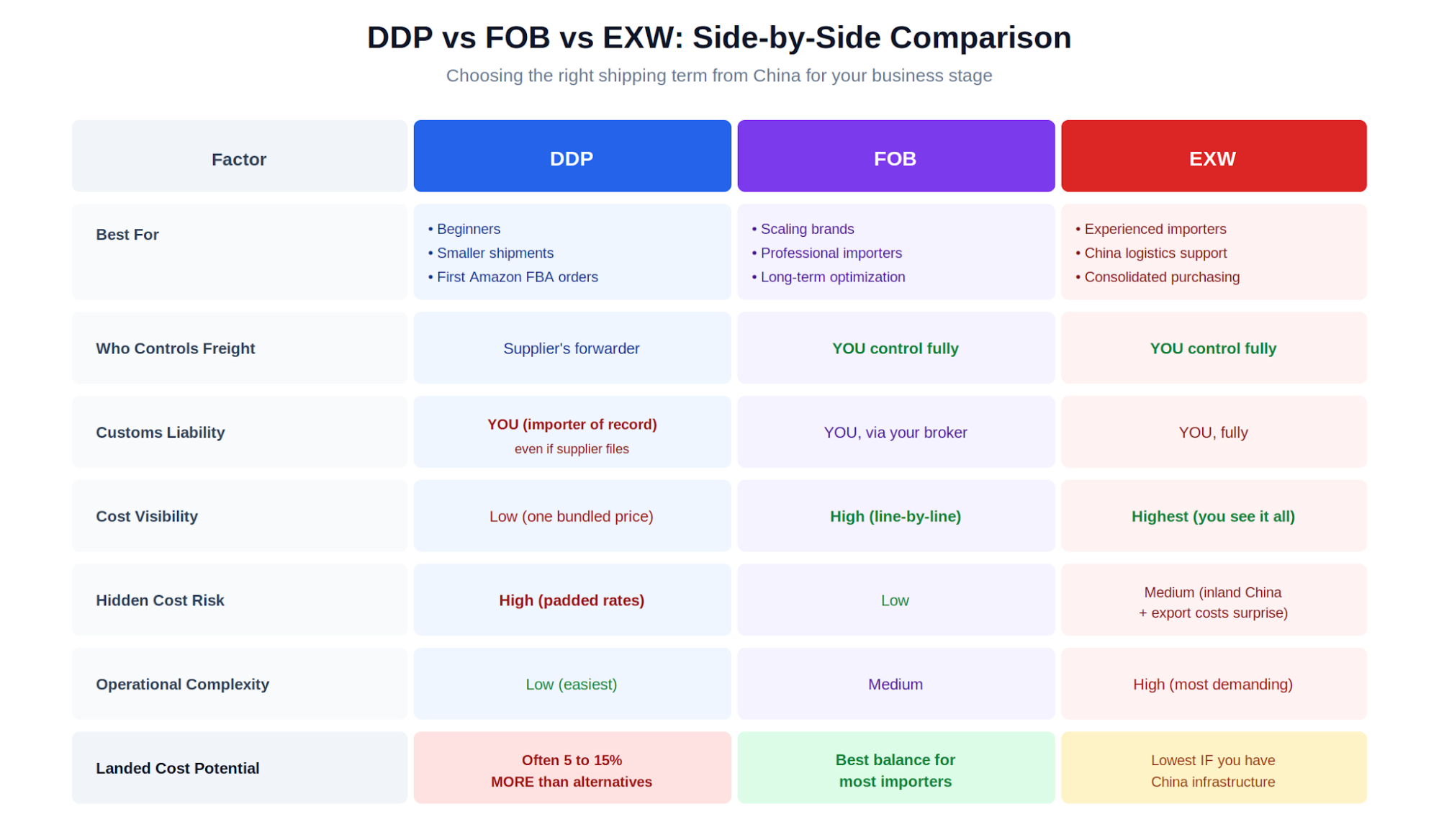
Before going deep, here is the simple version. Each shipping term defines a different point in the supply chain where the supplier’s job ends, and yours begins.Incoterm ResponsibilitiesDDP (Delivered Duty Paid): The supplier handles everything from the factory to your door, including customs clearance and import duties. You pay one price, and the goods arrive at your specified address.FOB (Free On Board): The supplier delivers the goods loaded onto the vessel at the port of origin in China. From the moment the goods are loaded on board the vessel, responsibility shifts to you. You arrange international freight, import customs, duties, and last-mile delivery.EXW (Ex Works): The supplier makes the goods available at their factory or warehouse. Everything after that, including factory pickup, truck loading, inland transport, export clearance, freight, and import procedures, becomes your responsibility.DDP is the most hands-off for the buyer. EXW is the most hands-on. FOB sits in the middle and is the most commonly used term in international trade.
Reliable product sourcing starts here
Work with experts who help you evaluate suppliers and reduce risk.
DDP Shipping from China: Convenience With a Hidden Price Tag
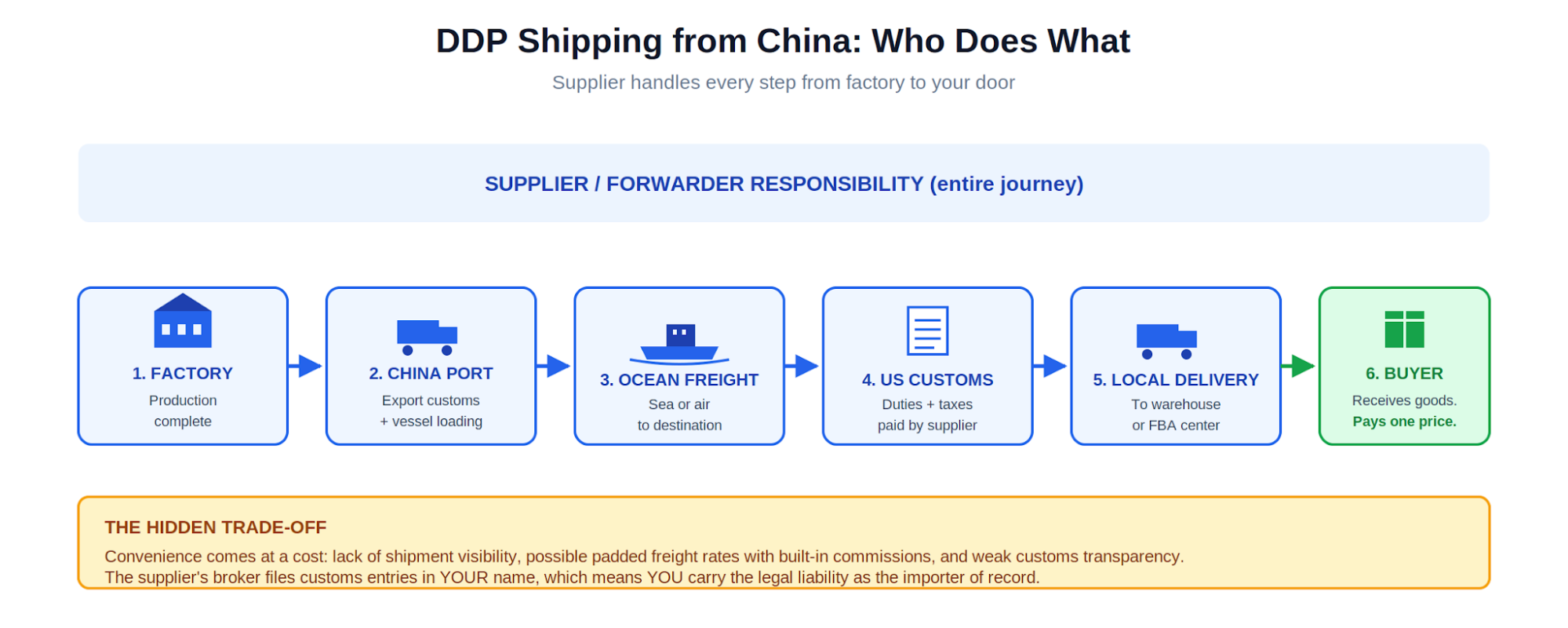
DDP is the most popular choice for first-time importers and small Amazon FBA sellers, and for good reason. The appeal is simple: one quote covers everything, including duties and final delivery. You don’t need a freight forwarder, a customs broker, or knowledge of port-of-entry procedures. The supplier or their freight partner handles the entire chain.DDP Shipping from China who does what
What DDP actually covers
Pickup from the factory in China
Inland trucking to the port of departure
Export customs clearance in China
Ocean or air freight to the destination
Import customs clearance at destination
Import duties and taxes
Last-mile delivery to your warehouse or FBA fulfillment center
Where DDP gets expensive without you noticing
Suppliers offering DDP rarely run their own freight operation. They partner with a freight forwarder, and that forwarder often pays the supplier a commission or kickback for routing the business their way. That commission is baked into your quote. You don’t see it as a line item, but you pay it.On top of that, DDP rates from China to the United States often use shortcuts on customs valuation to keep duties artificially low. Some less reputable DDP services under-declare value, mislabel goods, or use shell importer-of-record arrangements. If customs later determines duties were under-declared or filings were inaccurate, the operational and financial consequences can still impact the buyer, especially where importer-of-record structures are unclear.
When DDP makes sense
You are testing a new supplier with a small first order under 500 kilograms
You don’t have a freight forwarder relationship yet
Your order value is small enough that operational simplicity outweighs cost optimization
You are shipping to Amazon FBA and need door-to-door simplicity
You’re a beginner importer and want to limit the number of moving parts you have to manage
Reliable product sourcing starts here
Work with experts who help you evaluate suppliers and reduce risk.
FOB Shipping from China: The Professional Standard
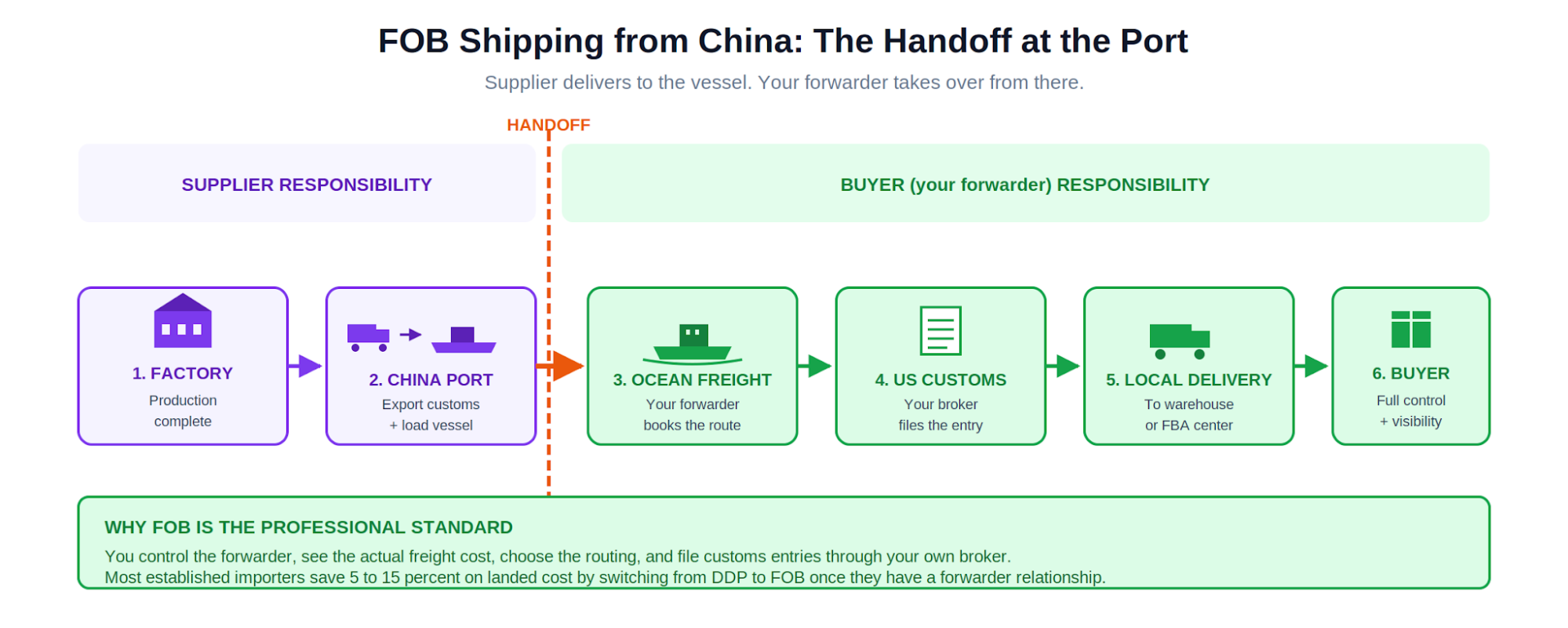
FOB is the most widely used Incoterm in international trade. If you talk to any experienced importer, freight forwarder, or trade compliance professional, FOB is the default. There is a reason for that.Under FOB, the supplier’s responsibility ends the moment the goods are loaded on the vessel at the named Chinese port. Everything from there forward, including ocean freight, destination port handling, import customs, duties, and final delivery, is handled by your own forwarder under your control and visibility.FOB Shipping from China
Why FOB is the standard
FOB gives you visibility into the actual cost of freight. You see the freight rate, the bunker adjustment factor, the terminal handling charges, the destination port fees, and the customs entry filing cost as separate line items. With DDP, all of these are blended into one number that you cannot audit.FOB also gives you the right to choose your own freight forwarder. That sounds minor, but freight rates between China and major destinations like Los Angeles, New York, Rotterdam, and Sydney can vary by 30 percent or more between forwarders for the exact same lane. Without the ability to comparison-shop, you cannot capture those savings.
What FOB requires from you
FOB assumes you have a forwarder. If you don’t, you need to build that relationship before you book your first FOB shipment. You also need a US customs broker (or the equivalent for your destination country) who can file the entry, classify your goods under the correct HS code, and ensure import compliance.The good news: once you have these two relationships in place, FOB becomes the most cost-efficient and transparent way to import. Most established importers stay on FOB for the long term.
Where FOB is shipped from
FOB requires a named Chinese port. The most common are FOB Shenzhen (typically via Yantian or Shekou terminals, covering factories in the Pearl River Delta), FOB Ningbo (serving the Yangtze River Delta and Eastern China factories), FOB Shanghai (one of the world’s busiest container ports), and FOB Qingdao (Northern China). The port matters because trucking distance from the factory to the port adds to your final cost, and it influences total transit time.
Reliable product sourcing starts here
Work with experts who help you evaluate suppliers and reduce risk.
EXW Shipping from China: Maximum Control, Maximum Responsibility
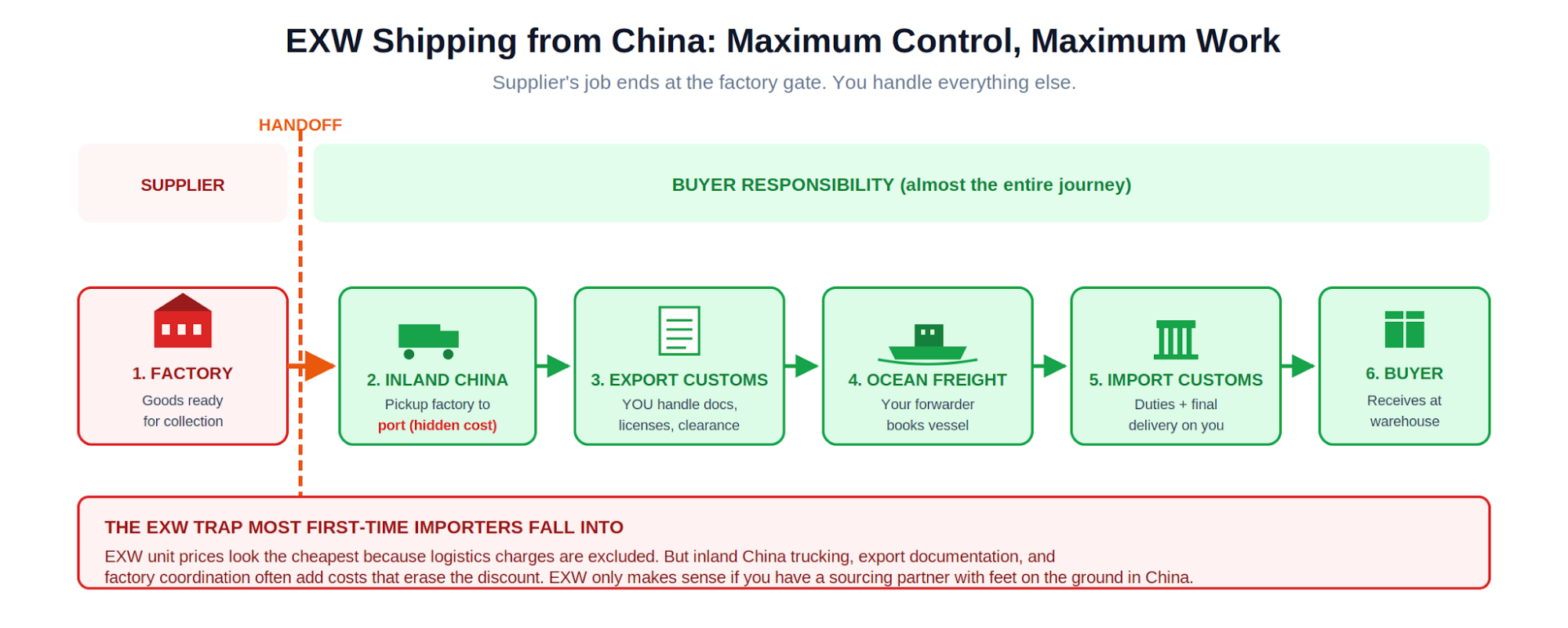
EXW means the supplier makes the goods available at their location and that is the extent of their job. They don’t even have to load the truck. Everything after that, including loading, inland transport to the port, export customs clearance in China, freight, import, and delivery, is yours.EXW Shipping from China Maximum Control, Maximum Responsibility
Why EXW exists
EXW is designed for buyers who have a full logistics infrastructure in the origin country. If you have a sourcing agent on the ground in China, or you’re consolidating shipments from multiple suppliers into one container at a Chinese warehouse, EXW lets you control the entire downstream chain and capture every margin point along the way.
Where EXW becomes a trap
EXW looks cheaper on paper than FOB or DDP, but only if you can actually execute it. Most importers who try EXW without infrastructure in China end up paying more, not less. The reason: arranging inland trucking from a tier-three Chinese city to Shenzhen port, navigating Chinese export customs, and managing factory pickup all require local presence, Mandarin language capability, and existing relationships.EXW also exposes you to greater risk during the most dangerous phase of the journey, which is the inland leg in China. If something is damaged between the factory and the port, you carry the loss with very limited recourse.
When EXW makes sense
You are an experienced importer with established freight forwarder partnerships
You are consolidating goods from multiple Chinese suppliers into one shipment
You have a sourcing partner or office in China that can handle inland logistics
You are shipping volumes large enough that the savings on freight optimization justify the operational complexity
For large importers with established China operations, EXW can offer the highest degree of routing flexibility and consolidation efficiency.
Reliable product sourcing starts here
Work with experts who help you evaluate suppliers and reduce risk.
China has more than 30 major export ports, but the vast majority of goods leaving for the US, Europe, and Australia go through a handful of them. Understanding which one your supplier is closest to matters because it affects transit time, freight cost, and which shipping terms are practical.Shenzhen (Yantian and Shekou): The largest export gateway in Southern China. Most factories in Guangdong, Dongguan, Guangzhou, and the broader Pearl River Delta export from here. If your supplier is in the south, expect FOB Shenzhen.Ningbo: The dominant port for Zhejiang province factories. Common for furniture, textiles, hardware, and many home goods categories.Shanghai: The world’s busiest container port. Serves factories across Eastern China, including Jiangsu and Anhui provinces.Qingdao: Northern China’s main port. Serves Shandong province and parts of Hebei. Common for tools, machinery, and food products.When you receive a quote, ask your supplier which port they’re routing through. A factory in Yiwu shipping FOB Shanghai might cost slightly less than the same factory shipping FOB Ningbo, simply because of the inland trucking distance.
How to Choose the Right Shipping Term: A Practical Framework
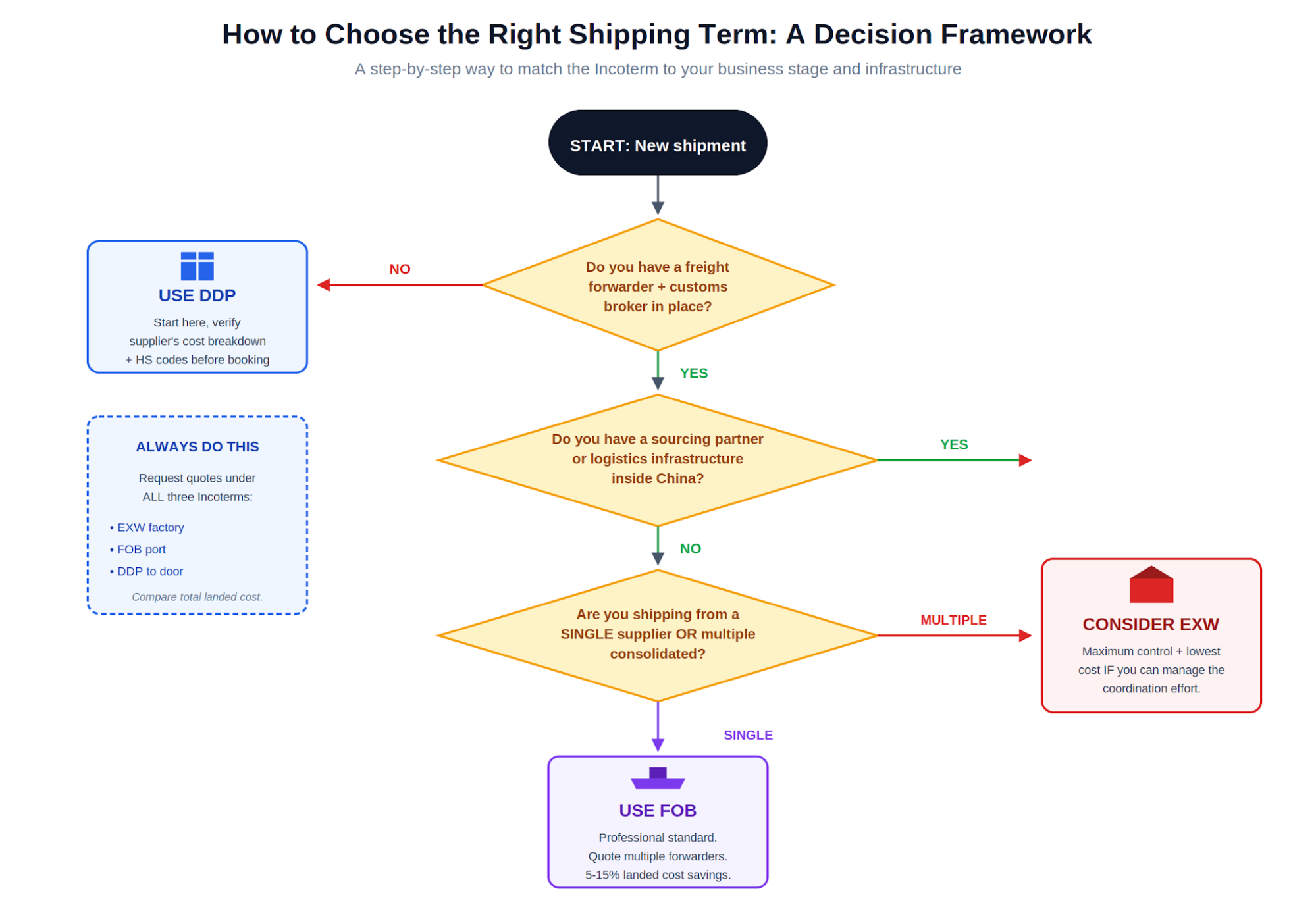
There’s no universally correct answer. The right choice depends on your business stage, infrastructure, and risk tolerance. Use this six-question framework to land on the right Incoterm for any given shipment.How to Choose the Right Shipping Term A Practical Framework
1. Do you have a freight forwarder you trust?
If no, DDP is your most realistic starting point. You can graduate to FOB later, once you’ve built a forwarder relationship through a reliable referral.
2. Do you have a customs broker?
If not, DDP again removes that pain. With FOB, you need a customs broker (or your forwarder may provide one). With EXW, you definitely need one.
3. What is the order value?
Small orders under $5,000 in goods value rarely justify the operational overhead of FOB or EXW. The optimization savings on freight don’t exceed the cost of your time managing the process. Above roughly $10,000 to $15,000 in goods value, FOB often becomes more economical, especially for repeat shipments. Above $50,000, the freight cost difference between forwarders alone justifies running an FOB quote comparison.
4. How many suppliers are you working with?
If you’re ordering from a single supplier, DDP or FOB are both viable. If you’re consolidating multiple suppliers into one container, FOB or EXW with a consolidation partner becomes essential, because each supplier can only ship goods to a single named port under their own quote.
5. Do you have visibility needs?
If you need real-time tracking, vessel ETAs, and customs status updates, FOB gives you that through your forwarder’s portal. DDP usually gives you a tracking number and not much more.
6. What’s your risk tolerance for compliance issues?
DDP shipments where the supplier or their forwarder handles US customs filings carry a hidden risk: if duties are under-declared, you (the buyer of record) can be held liable for the shortfall, plus penalties. FOB shipments where your own broker files the entry are more transparent and easier to defend in an audit.DDP vs FOB vs EXW
Reliable product sourcing starts here
Work with experts who help you evaluate suppliers and reduce risk.
Internal Coordination: Where the Real Savings Come From
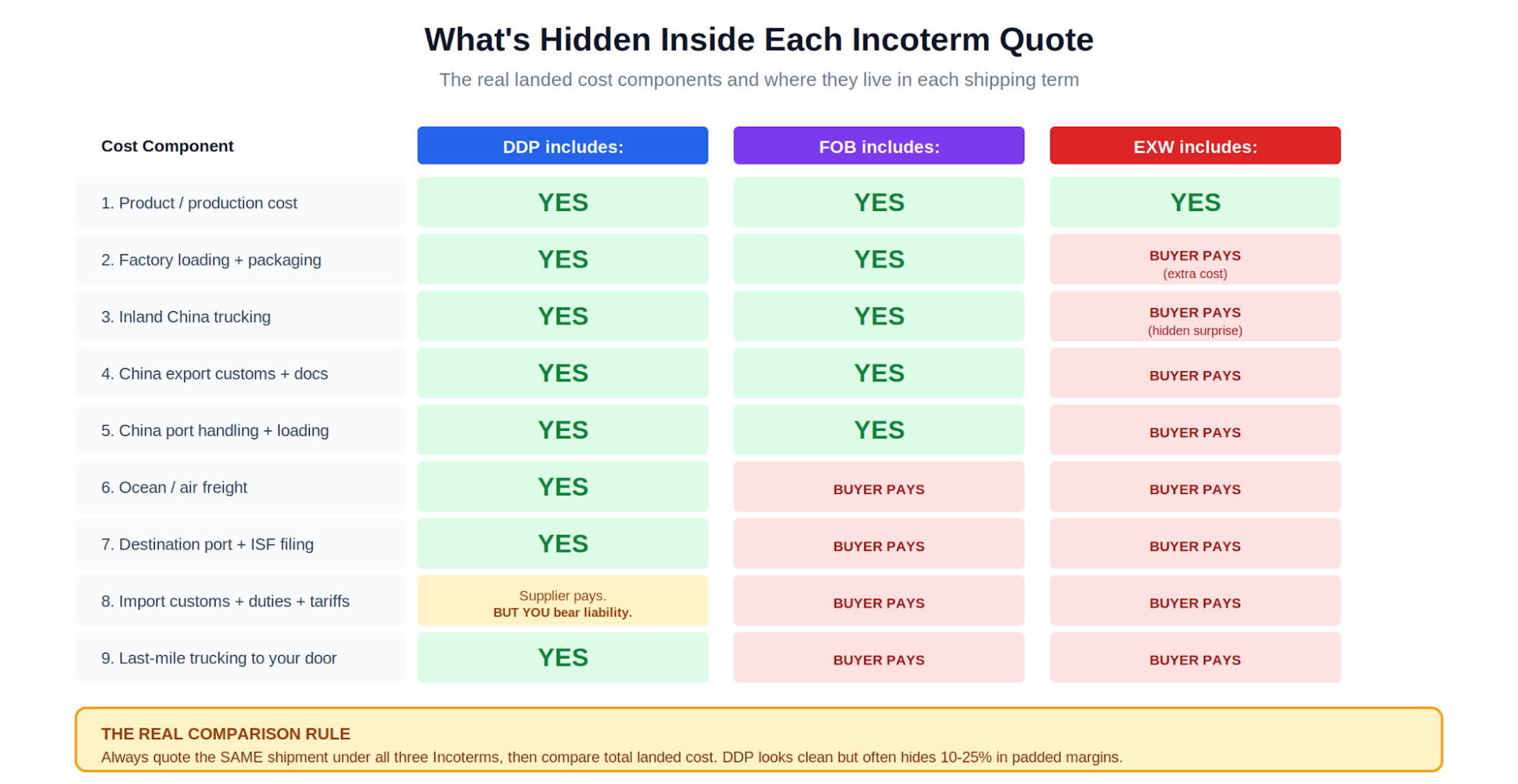
The shipping term you choose only matters in the context of total landed cost. Many buyers make the mistake of comparing only the freight rate, when in reality, the bigger savings come from optimizing the entire chain.What hidden inside each incoterm quoteEvery Incoterm bundles different components. DDP looks like one clean price, but it actually includes the production cost, factory loading, inland China trucking, export customs, port handling, ocean freight, destination port fees, import customs, duties, and last-mile delivery. The question is not which Incoterm has the lowest sticker price. The question is which Incoterm produces the lowest total landed cost for your shipment, with the visibility and control you need.The professional approach is to request quotes from your supplier under all three Incoterms for the same shipment: EXW at the factory, FOB at the port, and DDP to your door. Then compare. Often, you’ll find that DDP is 10 to 25 percent more expensive than FOB plus your own freight forwarder quote, because of the commissions and markups buried inside the DDP rate.
Common Mistakes Importers Make With Shipping Terms
Mistake 1: Accepting the first freight quote without comparison
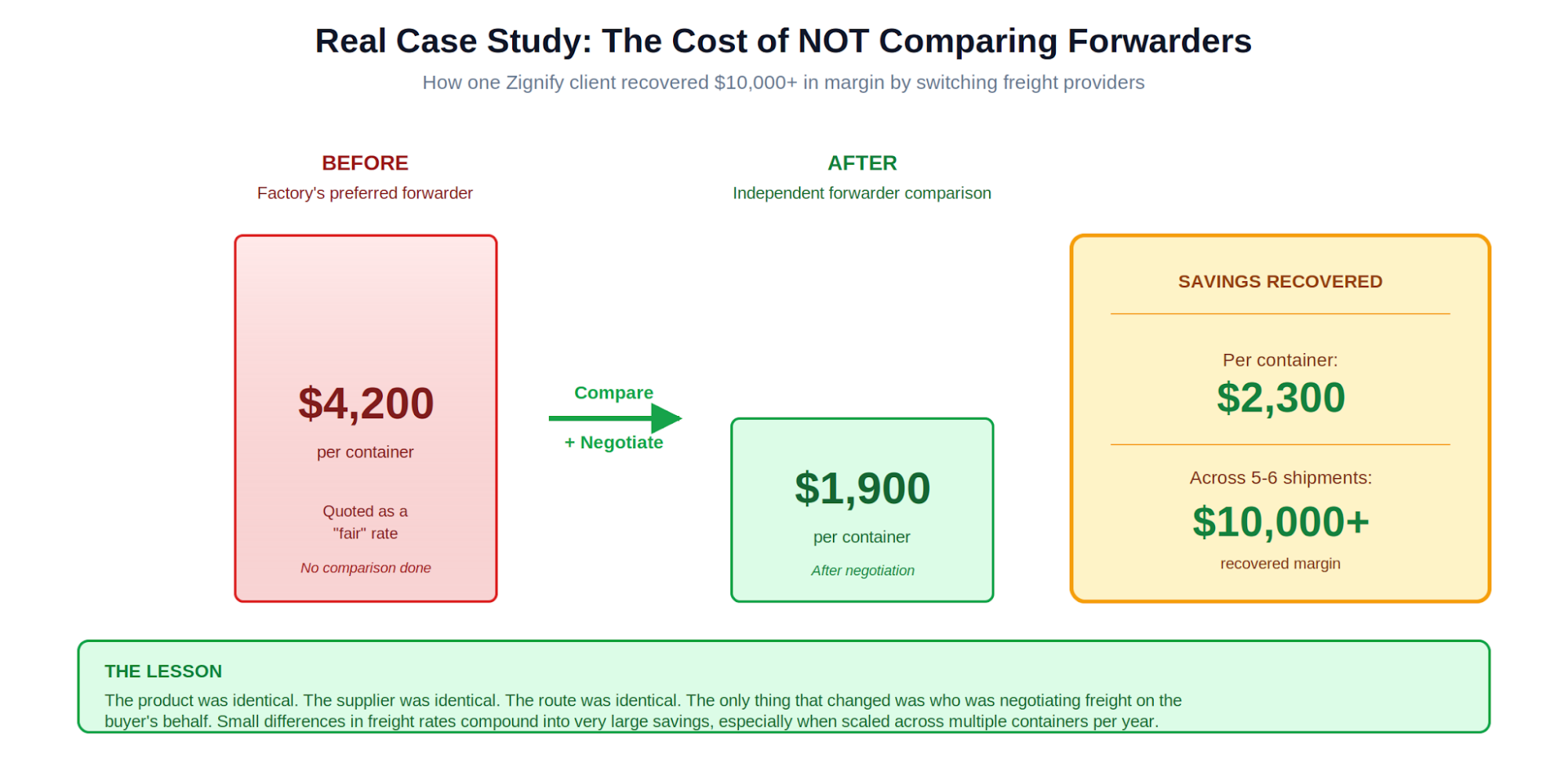
We recently worked with a client who was about to ship a container from Ningbo to Long Beach. The factory’s preferred forwarder quoted $4,200 per container. We pulled three independent forwarder quotes from our network. The winning forwarder came in at $1,900 per container for the same lane, same vessel class, same service level.Real case studyThat saved the client $2,300 per container. Across the five to six containers they ship per year for that SKU, the savings recovered north of $10,000 in margin. The product was identical. The supplier was identical. The route was identical. The only thing that changed was who was negotiating freight on the buyer’s behalf.
Mistake 2: Not factoring in tariff changes
Tariffs change. A category that used to ship duty-free from China can suddenly carry a 25 percent additional tariff overnight. If you’re on DDP, the supplier may quote you a flat rate that does not reflect the new tariff, and either you’ll get a surprise bill at customs or the supplier will absorb the cost by cutting corners on duty declarations. Both outcomes are bad for you.Importers who diversified sourcing from China into Vietnam over the past two years did so largely because anti-dumping duties on certain product categories climbed to 25 to 27 percent. One Zignify client moved part of their production to Vietnam and saved more than $300,000 in tariffs in the first year alone, and projected savings of $500,000 in year two. That kind of strategic move is only visible if you understand exactly what your duty exposure is, and that visibility comes from FOB-level transparency, not DDP black boxes.
Mistake 3: Letting the supplier choose the Incoterm
Suppliers in China naturally prefer terms that maximize their margin and minimize their risk. DDP is often pushed by suppliers because it gives them control of the freight kickback. EXW is sometimes pushed because it removes the seller’s liability the moment goods leave the factory. Neither preference is wrong, but neither is automatically right for you. The Incoterm should serve your business priorities, not the supplier’s.
Mistake 4: Ignoring insurance
None of these three Incoterms automatically includes cargo insurance. DDP buyers often assume they’re covered. They’re not. A separate marine cargo insurance policy is essential, typically costing 0.1 to 0.5 percent of the cargo value. On a $30,000 container of goods, that’s $30 to $150 of insurance that can save you the entire shipment if something goes wrong at sea.
Reliable product sourcing starts here
Work with experts who help you evaluate suppliers and reduce risk.
At Zignify, we treat logistics the same way we treat sourcing: as a category where the best outcome comes from comparison, transparency, and the buyer staying in control. We don’t take commissions from freight forwarders. We don’t mark up freight rates. We compare options on behalf of the buyer and recommend the term and the forwarder that fits the situation.That means for clients who are just starting out, we often recommend DDP to keep operations simple while we audit the supplier’s quote against independent benchmarks. For scaling brands, we usually transition to FOB with a hand-picked forwarder for their lane. For multi-supplier consolidations, we use EXW with a Chinese warehouse partner that handles pickup, consolidation, and export.In every case, the buyer sees the actual freight cost, the actual duty, the actual landed cost, and retains the ability to switch forwarders if performance slips.
Reliable product sourcing starts here
Work with experts who help you evaluate suppliers and reduce risk.
The choice of DDP, FOB, or EXW when importing from China is not a one-time decision. It evolves with your business. New importers benefit from the simplicity of DDP. Scaling brands benefit from the transparency and control of FOB. Mature operators benefit from the optimization potential of EXW. There is no permanent right answer, only a sequence of right answers as your operation matures.Tariff policies will continue to shift. Freight markets will continue to fluctuate. Suppliers will continue to push terms that favor their margins. What stays constant is the buyer’s ability to understand the trade-offs and ask the right questions. That’s what separates buyers who scale efficiently from buyers who quietly leak margin year after year.The right Incoterm is the one that gives you the visibility you need at the operational cost you can absorb. The wrong one is the one you choose without thinking.
Reliable product sourcing starts here
Work with experts who help you evaluate suppliers and reduce risk.
💰 DDP rates from China are quoted with padded margins by default
Most guides treat DDP as the “all-in” price, full stop. What they leave out is that suppliers offering DDP almost always have an arrangement with their preferred forwarder where they earn a commission for routing the freight through that channel. That commission is invisible to you. Across hundreds of buyer shipments, the same DDP rate compared against an independent FOB-plus-forwarder quote came in 10 to 25 percent higher. The fix is to always pull an independent quote, even if you intend to ship DDP, just so you know what the supplier’s markup looks like in real numbers.
⚠️ EXW is not always the cheapest, even though it looks like it on paper
Buyers assume EXW saves money because the unit price excludes logistics. In practice, EXW only saves money when the buyer has actual infrastructure in China, including a forwarder relationship, a customs agent, and ideally a consolidation warehouse. Without those, the cost of arranging inland trucking from a tier-three city in Zhejiang to Ningbo port, plus export customs filings, plus communication overhead, almost always erases the savings. EXW becomes cheaper than FOB only when scale and infrastructure align.
🚩 Customs liability sits with the importer of record, not the freight provider
If your supplier’s DDP service under-declares duties to keep your quote low, US Customs and Border Protection doesn’t go after the Chinese supplier or forwarder. They come after you, the buyer of record on the customs entry. The penalties for under-declaration can include the unpaid duty plus a fine of up to four times that amount, plus interest. That risk is almost never discussed in DDP guides, but it is the single most underrated reason experienced importers eventually move to FOB.Want help applying any of these to your sourcing strategy?Book a free sourcing call →
Frequently Asked Questions
What’s the difference between DDP, FOB, and EXW when shipping from China?
DDP means the supplier ships goods all the way to your door, including paying duties and import customs. FOB means the supplier delivers goods loaded onto a vessel at a Chinese port, and you take over from there. EXW means the supplier makes goods available at their factory, and you handle every step after that, including inland China trucking. DDP is the most hands-off for buyers, EXW is the most hands-on, and FOB sits in the middle.
Which is the best shipping term from China for new importers?
DDP is usually the best starting point for new importers. It removes the need to have a freight forwarder, customs broker, or logistics infrastructure in place. The trade-off is less cost transparency. Most importers start on DDP and graduate to FOB once they have established trusted forwarder and broker relationships, typically after two to five shipments.
Is DDP shipping from China to the USA reliable?
It can be reliable when working with reputable suppliers and verified freight forwarders. The risks are around customs valuation, which can sometimes be optimized in ways that put the buyer at legal exposure as the importer of record, and around hidden margin in the freight component. The fix is to always compare the DDP quote against an independent FOB-plus-forwarder benchmark before booking.
What does DDP mean in shipping from China?
DDP stands for Delivered Duty Paid. It is an Incoterm where the supplier (the seller) is responsible for delivering the goods to a named destination in the buyer’s country, with all transport costs, export customs, import customs, and import duties already paid. The buyer’s only responsibility under DDP is to unload the goods at the agreed destination.
How long does shipping from China to the US take?
Sea freight from China to the US West Coast (Los Angeles, Long Beach, Oakland) typically takes 18 to 25 days port-to-port. To the East Coast (New York, Savannah, Charleston) it takes 30 to 40 days via the Panama Canal. Air freight takes 5 to 10 days but costs 8 to 12 times more per kilogram. Express courier (DHL, FedEx, UPS) is 3 to 7 days for smaller shipments. Add 3 to 7 days for customs clearance and inland delivery on either end.
Which is better for Amazon FBA: FOB or DDP from China?
For most new FBA sellers, DDP is the easier path because Amazon FBA requires goods to be delivered to specific fulfillment centers under tight prep and labeling requirements. A DDP forwarder familiar with FBA can handle that complexity. For larger FBA brands shipping multiple SKUs in significant volumes, FOB combined with a freight forwarder who specializes in FBA prep often delivers a lower landed cost and better visibility into inventory arrival times.
What are the risks of EXW shipping from China?
The main risks are inland China logistics (you arrange trucking from the factory to the port), export customs clearance (you handle the documentation in a country where you likely don’t speak the language), and cargo damage during the inland leg (you carry the loss). EXW is best suited to importers with a Chinese sourcing partner or office, not first-time buyers.
Who pays the import duties under DDP, FOB, and EXW?
Under DDP, the supplier pays the import duties as part of the quote. Under FOB and EXW, the buyer pays the import duties directly to the customs authority in the destination country. Even under DDP, buyers should clearly verify who is acting as the importer of record and how customs declarations are being handled, since liability structures can vary.
Is FOB or EXW cheaper when shipping from China?
On paper, EXW looks cheaper because the unit price excludes logistics. In practice, FOB is usually cheaper for buyers who don’t have logistics infrastructure in China, because the supplier can arrange inland trucking and export customs at lower rates than a foreign buyer can. EXW becomes cheaper only when the buyer has scale, an established forwarder in China, and is consolidating multiple suppliers into one shipment.
Can I switch from DDP to FOB shipping from China mid-relationship?
Yes, and most growing brands do. Once you have a freight forwarder and a customs broker relationship in place, request an FOB quote from your existing supplier alongside their DDP quote. Compare total landed cost. If FOB is cheaper (which it usually is once you have your own freight partner), make the switch on the next shipment. There’s no contractual barrier to changing Incoterms between orders.
How do current China tariffs affect DDP, FOB, and EXW choices?
Tariffs apply to all three shipping terms equally because they’re assessed on the goods themselves at the customs entry point in the destination country. The choice of Incoterm doesn’t change the tariff rate. What it does change is who pays. Under DDP, the supplier pays the tariff and may build it into the quote (or may try to under-declare value to reduce it). Under FOB and EXW, the buyer pays the tariff directly and sees it clearly, which makes tariff exposure easier to plan around when sourcing strategies need to shift to lower-tariff countries.
What’s the difference between Incoterms and shipping terms?
They mean the same thing in practice. Incoterms is the formal name (short for International Commercial Terms), published by the International Chamber of Commerce. “Shipping terms” is the colloquial way buyers and suppliers refer to them. DDP, FOB, EXW, CIF, FCA, and others are all Incoterms, and they’re all shipping terms. The current version in use is Incoterms 2020.