Most importers do not lose money at the negotiation table. They lose it at the border. A wrong digit in an HTS code can quietly add 15, 25, or even 45 percent to your landed cost, eat the margin you spent months negotiating, and trigger penalties that arrive months after the shipment is cleared. Yet HTS classification is still treated by many sellers as something the freight forwarder handles, the broker figures out, or the supplier writes on the invoice. In today’s trade environment, relying on those defaults creates unnecessary risk.
The Harmonized Tariff Schedule of the United States, or HTSUS, is the legal foundation for almost every duty, fee, and trade remedy applied to goods entering the country. If you import for an Amazon brand, run a manufacturing operation, manage procurement, or sell into the U.S. from abroad, your HTS codes are quietly deciding your profitability. This guide explains, in plain business language, how HTS codes actually work, how to use them to estimate duties before you commit to an order, where importers go wrong, and what to do when a single classification could shift your cost structure by tens of thousands of dollars.
Need help with your product sourcing?
Get practical advice tailored to your product, suppliers, and market form Zignify experts
Why HTS Codes Matter More Than Most Importers Realize
An HTS code is not just paperwork. It is the single number that determines how much you pay to bring a product into the United States, whether you qualify for a free trade agreement, and whether your shipment gets flagged, delayed, or audited. CBP treats HTS classification as the importer’s legal responsibility, not the broker’s or the supplier’s.
Here are the practical reasons HTS codes carry so much weight:
Duty calculation: The duty rate, additional Section 301 tariffs, antidumping or countervailing duties, and Section 232 steel and aluminum tariffs are all linked directly to the HTS number.
Trade program eligibility: Whether your shipment qualifies for USMCA, GSP residuals, or other preferential treatment depends on the HTS code and the country of origin.
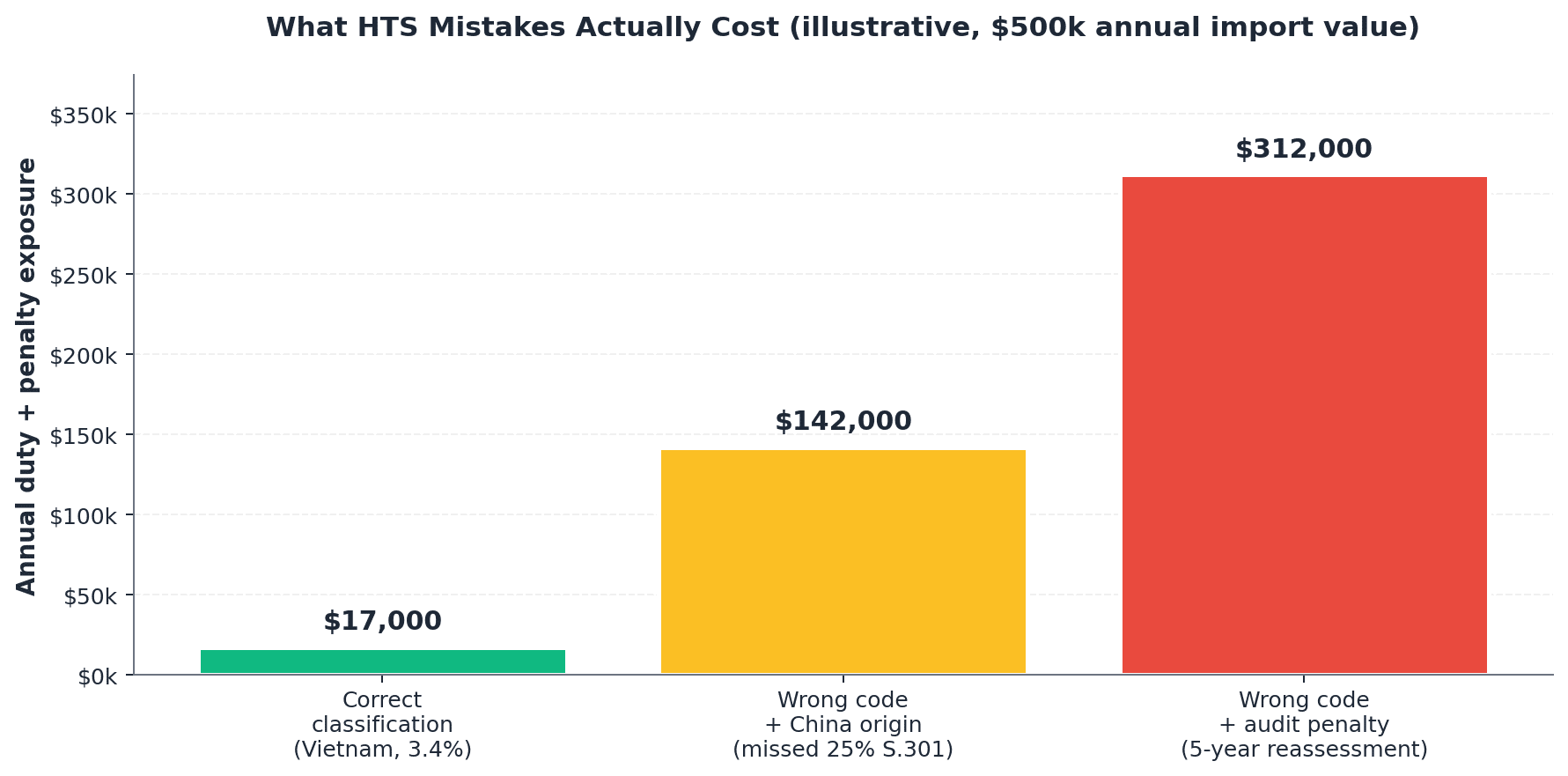
Compliance and audits: U.S. Customs and Border Protection can audit imports up to five years back. Using the wrong code, even unintentionally, can trigger reassessments, interest, and penalties.
Trade remedies and exclusions: When the U.S. adds tariffs on a category, like Chapter 99 tariffs targeting Chinese goods, the codes determine who is hit and who is exempt.
Production and sourcing decisions: A different HTS code under a different country of origin can shift your landed cost dramatically, which means classification is also a sourcing strategy question.
Cash flow impact: Duties are typically paid at entry, long before inventory is sold, which means classification mistakes can create immediate working capital pressure.
If you have ever wondered why two sellers selling almost identical products on Amazon have wildly different margins, HTS classification and country of origin are usually somewhere in the answer.
Figure: Illustrative annual exposure of $500k of imports across three scenarios. Misclassification compounds quickly.
Reliable product sourcing starts here
Work with experts who help you evaluate suppliers and reduce risk.
The Harmonized Tariff Schedule is the U.S. version of the Harmonized System, the global product classification framework used by more than 200 economies and managed by the World Customs Organization. The first six digits are international and identical across all countries that use the Harmonized System. The next four are U.S.-specific.
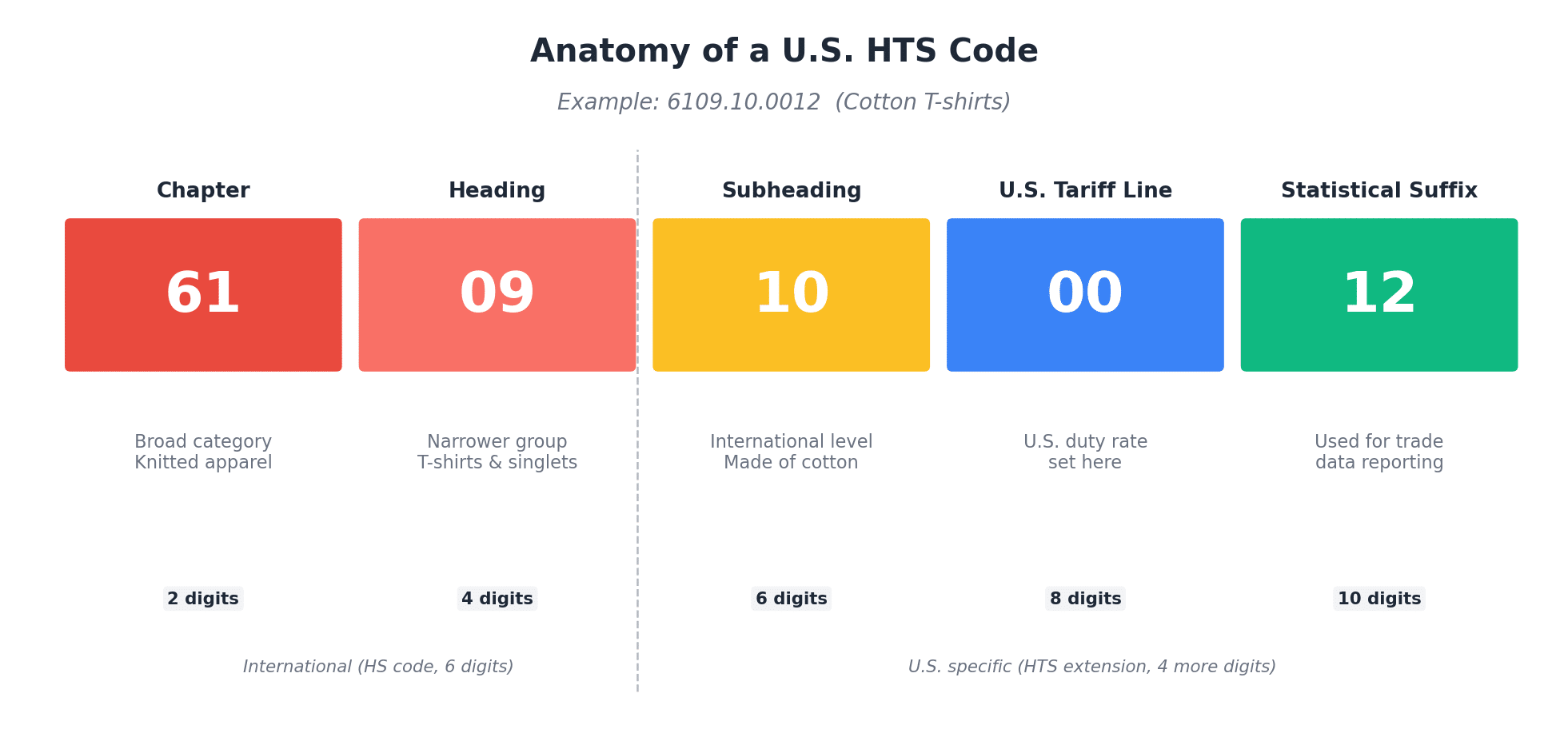
So when you see a 10-digit code like 6109.10.0012, here is what each part is doing:
Figure: Anatomy of a 10-digit HTS code. The first 6 digits are global; the last 4 are U.S.-specific.
Heading (4 digits): A narrower group. Heading 6109 is T-shirts, singlets, tank tops, and similar garments.
Subheading (6 digits): The international level. 6109.10 covers cotton versions.
U.S. tariff line (8 digits): The duty rate is set here.
Statistical suffix (10 digits): Used for trade data and reporting, not for duty.
A few things HTS codes are not, even though people confuse them constantly:
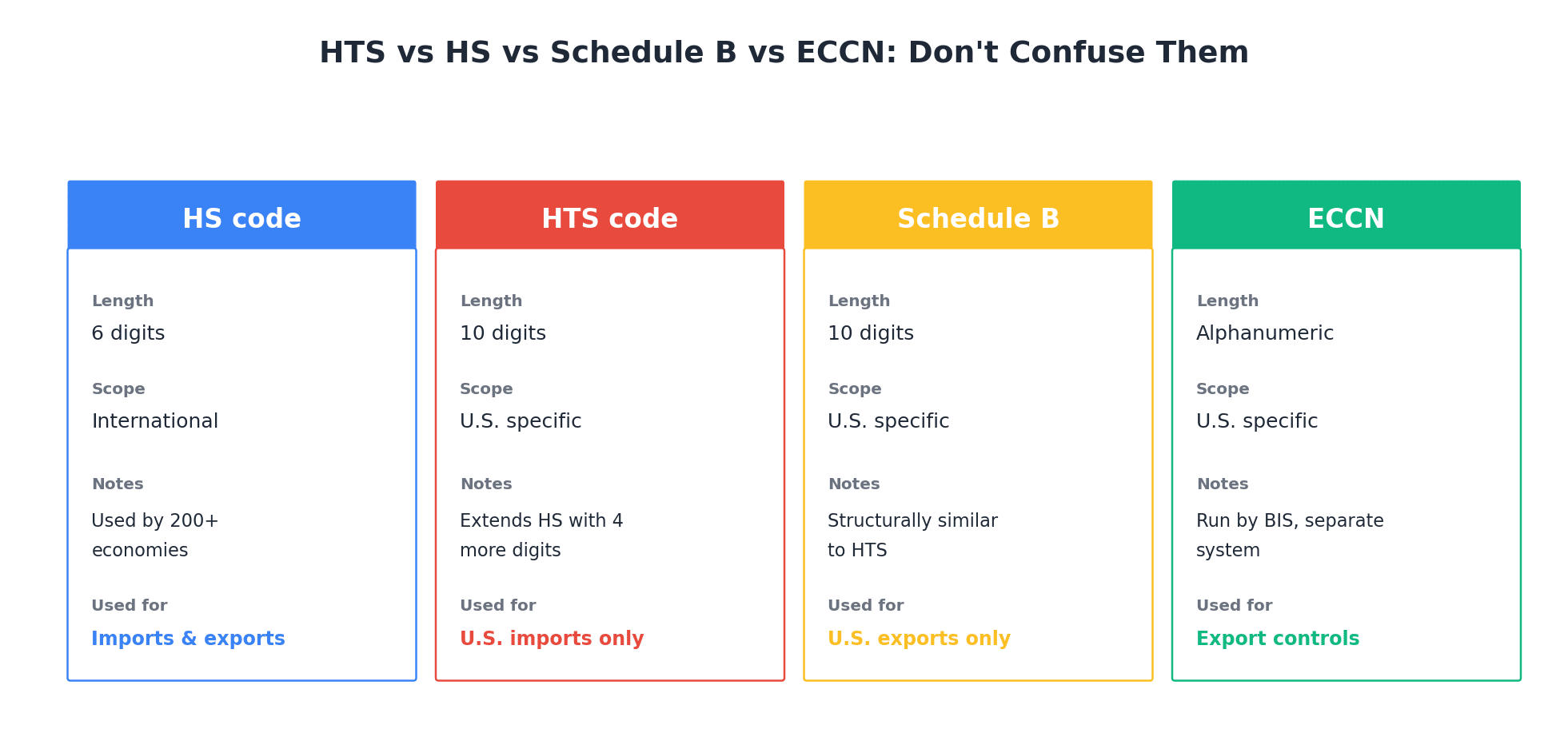
Figure: Four codes importers commonly confuse. Each has a different purpose and authority.
HS code: The 6-digit international root. HTS extends it with 4 more digits specific to the U.S.
Schedule B: The U.S. export classification code, structurally similar to HTS, but used when exporting, not importing.
ECCN: An entirely different system run by the Bureau of Industry and Security for export controls on dual-use and sensitive technology. ECCN has nothing to do with import duties.
Commodity code: A generic term. It can refer to HTS in the U.S., HS internationally, or other systems, depending on the country.
You can search the official tariff schedule at the U.S. International Trade Commission’s HTS database at hts.usitc.gov, which is the authoritative source. Every other lookup tool, paid or free, ultimately derives from this.
Reliable product sourcing starts here
Work with experts who help you evaluate suppliers and reduce risk.
Where Country of Origin Comes In, and Why It Changes Everything
People often think the HTS code alone determines the duty. It does not. Duty is calculated using two things together: the HTS code and the country of origin.
The HTS schedule has three rate columns:
Column 1 General: The standard most-favored-nation duty rate. Applies to most U.S. trading partners.
Column 1 Special: Preferential rates for countries with trade agreements, including USMCA partners, free trade agreement partners, and other programs.
Column 2: A much higher rate that applies to a short list of countries without normal trade relations, currently Cuba, North Korea, Russia, and Belarus.
On top of these, certain HTS subheadings trigger additional tariffs, the most common being Chapter 99 codes that layer Section 301 tariffs onto goods from China. If your product falls under HTS heading 9903.88.xx, you are paying the base rate plus an extra 7.5 percent, 25 percent, or more, depending on the list.
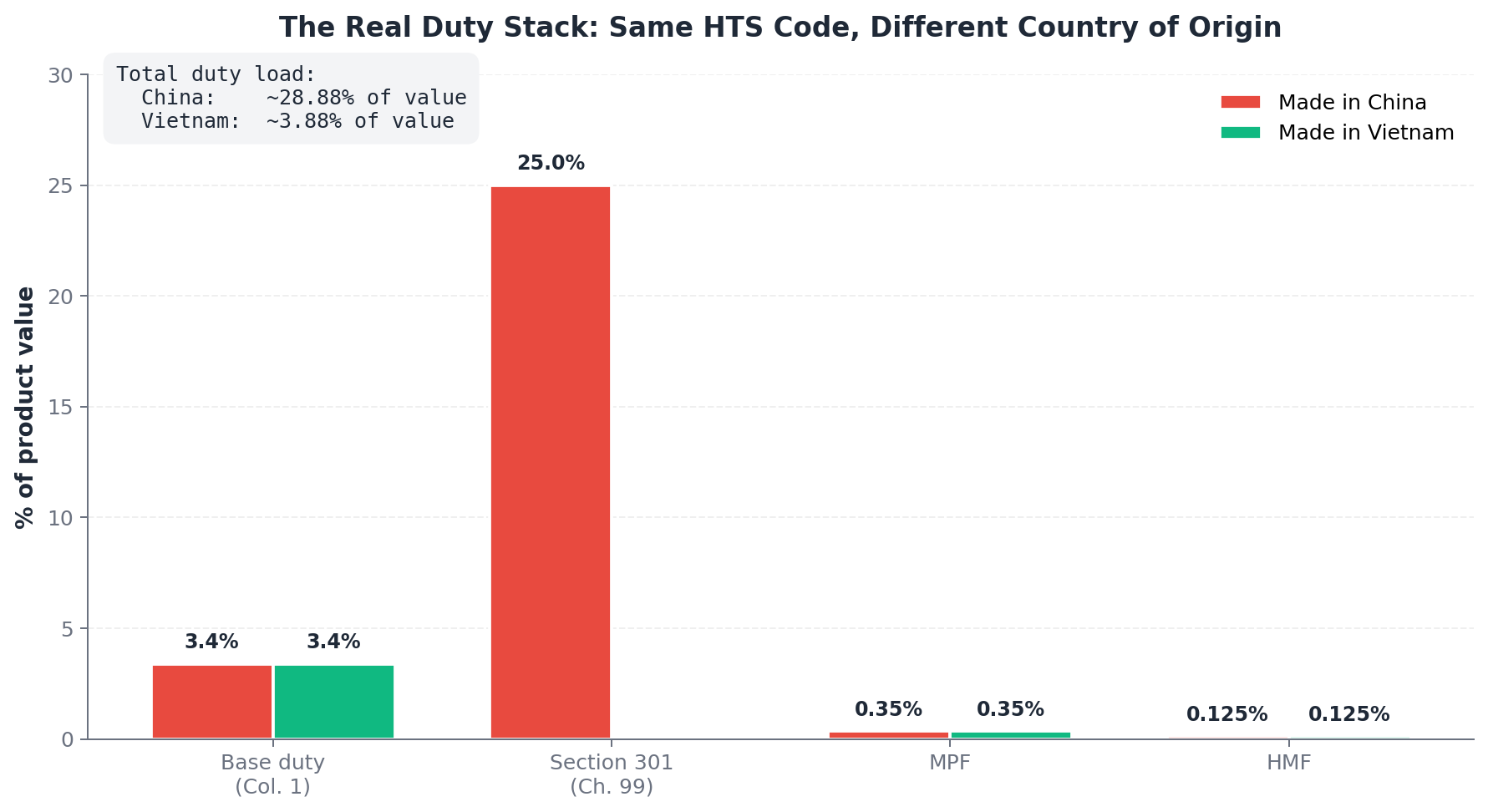
A short example. A houseware item with a base duty of 3.4 percent looks affordable when you only see the HTS lookup. But if it is made in China and falls under a List 3 Chapter 99 line, you are now paying the base 3.4 percent plus 25 percent, plus any additional trade measures or emergency tariffs in effect at the time of import. That same product made in Vietnam or Mexico under USMCA may carry only the base duty, or even 0 percent. The HTS code is the same on paper. The total cost is not.
Figure: Same HTS code, same product, two countries of origin. The duty difference is the whole story.
This is the part that turns HTS lookup into a real business decision. Importers who treat it as a customs detail miss the leverage. Importers who treat it as a sourcing variable build margin.
Reliable product sourcing starts here
Work with experts who help you evaluate suppliers and reduce risk.
Step by Step: How to Use HTS Codes to Estimate U.S. Duties Before You Order
Here is the process serious importers should follow before placing a purchase order, not after the shipment lands. The goal is to estimate your landed cost accurately enough to make a sourcing decision with eyes open.
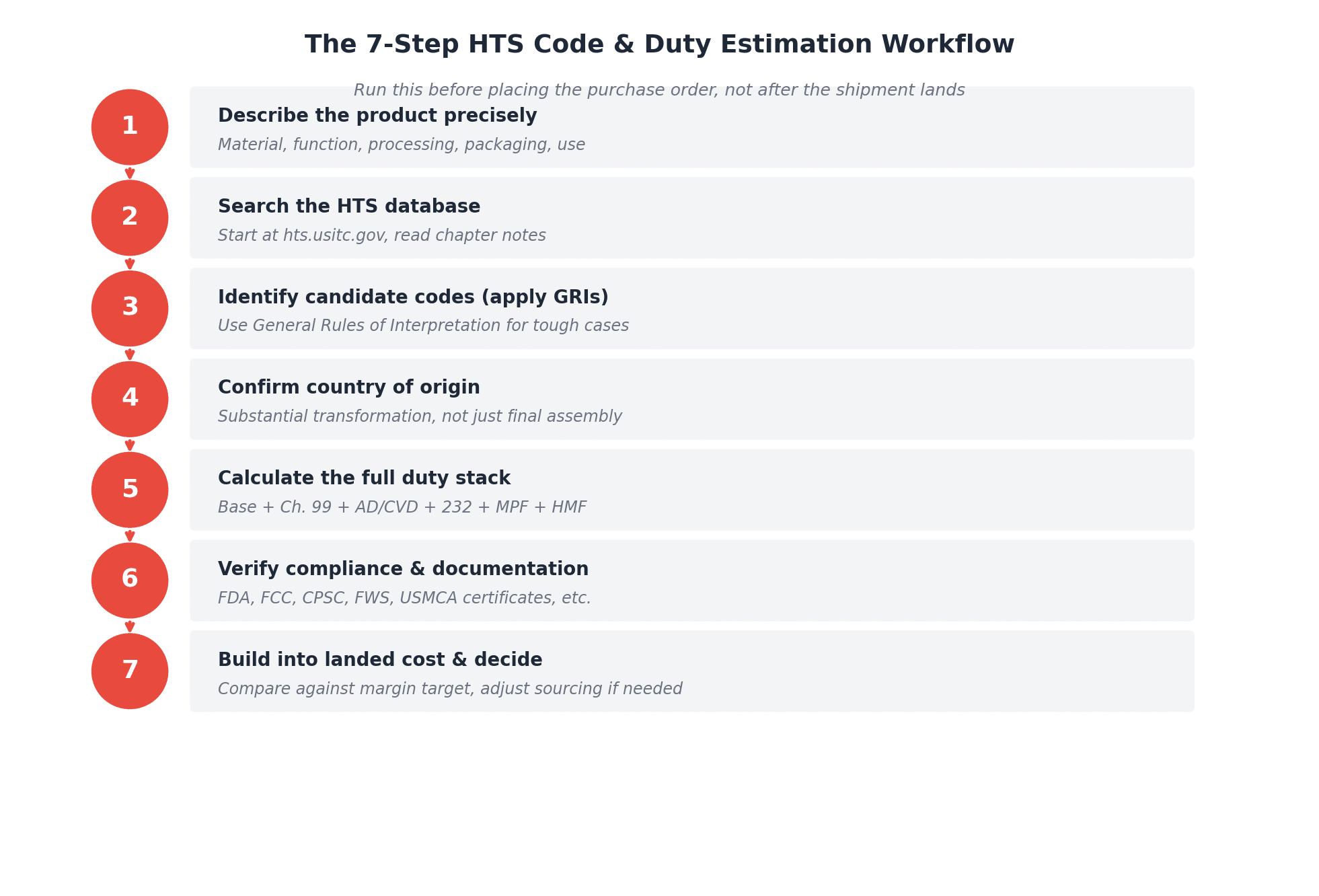
Figure: The 7-step HTS workflow. Run this before you sign the PO.
Step 1: Describe the product precisely
Most HTS classification errors start with vague product descriptions. “Steel parts” or “cosmetic items” tell you nothing useful. You need the material composition, function, processing level, packaging, and intended use. A T-shirt that is 60 percent cotton and 40 percent polyester sits under a different HTS subheading than a 100 percent cotton T-shirt. A finished lithium-ion battery and an unfinished battery cell are classified separately.
If you cannot describe the product to a classification specialist in one paragraph, including materials, function, and how it is sold, you are not ready to classify it.
Step 2: Search the HTS database with the right terms
Open the official HTS schedule at hts.usitc.gov. Search by keyword first to find the relevant chapter, then narrow down by reading the chapter notes and section notes. The chapter notes are not optional reading. They define which products are excluded, which are moved to another chapter, and how borderline cases are decided.
Free third-party tools exist, including those built into many ERP and customs platforms, but always cross-check against the official USITC database. A wrong code from a third-party tool is still your liability.
Step 3: Identify candidate codes and verify with the General Rules of Interpretation
This is where HTS classification stops being a keyword search and becomes a legal interpretation exercise. The Harmonized System operates under six General Rules of Interpretation, or GRIs. These are the legal logic by which a product is assigned a code when more than one looks plausible. GRI 3, for example, governs how to classify a product made of multiple materials. GRI 5 covers packaging and cases.
If you cannot apply the GRIs confidently, this is the moment to bring in either a licensed customs broker or a sourcing consultant who understands tariff engineering. Picking the cheaper duty rate without GRI support is how importers end up with retroactive duty bills.
Step 4: Confirm the country of origin rule of origin
The country of origin is not always where the factory is located. It is determined by where the product underwent a substantial transformation. A product assembled in Vietnam from Chinese components may still be considered of Chinese origin if the transformation was not substantial enough. This is where many importers run into problems after relocating production primarily to reduce tariff exposure.
If you are sourcing under USMCA, the rules of origin can require regional value content thresholds or specific tariff shifts. Documentation matters. A USMCA certificate is the importer’s burden of proof.
Step 5: Calculate the full duty stack
Once you have the HTS code and country of origin confirmed, calculate the full stack. The components and typical ranges are summarized below.
Duty Component
How It Is Calculated
Typical Range
Base duty rate
From HTS Col. 1 General or Col. 1 Special
0% to ~37%
Section 301 (Ch. 99)
Additional tariff on goods from China
7.5% to 25%+
AD / CVD
Antidumping/countervailing duties on specific HTS
Highly variable
Section 232
Steel, aluminum, and derivatives
10% to 25%
Merchandise Processing Fee
0.3464% of entered value (with cap)
~$30 to $578 per entry
Harbor Maintenance Fee
0.125% of value, ocean shipments only
Small but real
Most importers stop at the base duty rate and get blindsided by the additional layers. The MPF and HMF are small, but the Section 301 and Section 232 tariffs are where six-figure surprises live.
Step 6: Verify compliance and documentation requirements
The HTS code triggers more than just duty. It can also flag the need for additional documentation, such as FDA registration for food contact items, FCC approval for electronics, CPSC documentation for children’s products, or FWS permits for wildlife-related goods. Customs holds for missing paperwork are common, expensive, and avoidable.
Step 7: Build the duty estimate into your landed cost
Once the duty is calculated, plug it into your full landed cost: FOB price, freight, insurance, duty, MPF, HMF, port handling, drayage, and last mile. Compare this against the realistic selling price and your target margin. If the math does not work, the answer is rarely “ship anyway and hope”. The answer is usually to source the product differently, classify it more accurately, or shift origin to a country that changes the duty stack entirely.
This is the loop most importers skip. They lock in a supplier on price, then discover at customs clearance that the landed cost has moved by 20 or 30 percent. By then the inventory is in motion and there is no time to renegotiate.
Reliable product sourcing starts here
Work with experts who help you evaluate suppliers and reduce risk.
Common HTS Classification Mistakes That Cost Importers Real Money
After enough sourcing projects, the same classification mistakes show up across industries. None of them looks catastrophic in isolation. They compound into margin destruction over time.
Letting the supplier choose the code: Chinese, Vietnamese, and other overseas suppliers often write whatever HTS code they have used before for similar products. They are not the legal importer, and they do not pay if the code is wrong. You do.
Copying the code from a competitor: Two products that look identical on Amazon can sit under different HTS codes for legitimate reasons, including different material composition, different intended use, or different finishing steps.
Ignoring chapter notes and section notes: These notes are not background reading. They are part of the legal classification logic.
Treating the invoice description as the classification: A commercial invoice description is not a substitute for an HTS code. CBP reads both, but the code is what binds.
Missing Chapter 99 surcharges: Many importers calculate the Column 1 General rate, see a low duty, and forget that Section 301, Section 232, or IEEPA layers may apply. The shock comes at clearance.
Assuming origin shifts on assembly alone: Moving the final assembly to a different country does not automatically change the origin for customs purposes. Substantial transformation rules apply, and they have teeth.
Skipping binding rulings on high-volume products: For products you import in volume, a binding ruling from CBP gives legal certainty. Many importers skip this, then argue about classification later when an audit lands.
Failing to document classification reasoning: When CBP audits, they want to see how you arrived at the code. A paper trail showing the GRIs you applied, the chapter notes you considered, and the rationale for choosing one classification over another is your defense.
Failing to re-evaluate classification after product changes: Small material, packaging, or functional modifications can change HTS classification and duty exposure.
Reliable product sourcing starts here
Work with experts who help you evaluate suppliers and reduce risk.
How Zignify Helps Importers Use HTS Codes as a Sourcing Lever
Zignify is not a customs broker, and we do not file your entries. What we do is help clients make sourcing decisions where HTS classification, country of origin, and total landed cost all line up to actually protect margin. That is a different problem than just looking up a code.
In practice, here is where we typically support importers:
Cross-country duty modeling: When tariffs on Chinese products become too expensive, Zignify helps clients compare sourcing alternatives across countries like Vietnam, Mexico, India, Cambodia, Turkey, and Poland. The goal is not just to lower factory pricing, but to optimize the full landed cost, including duties, freight, and sourcing risk. In some projects, changing sourcing origin has saved clients more than $1 million annually on a single product line.
Pre-order classification review: Before purchase orders are placed, Zignify helps clients review the HTS classifications suggested by suppliers or brokers. While we are not the legal classifier of record, an experienced second review often helps identify costly mistakes before products ship.
Sourcing where origin genuinely changes: Zignify works with supplier networks in countries that qualify for legitimate country-of-origin changes, not simple assembly operations designed to bypass tariffs. This is especially important for companies looking to reduce exposure to Section 301 tariffs without creating compliance or anti-dumping risks.
Compliance flagging: For products that may trigger FDA, FCC, CPSC, or similar regulatory requirements, Zignify helps ensure the necessary certifications and documentation are prepared before shipments leave the factory.
No factory commissions, full transparency: Zignify does not take commissions from factories. Clients see the real factory pricing directly, which helps keep supplier recommendations focused on the buyer’s long-term interests rather than factory incentives.
For the next several years, U.S. trade policy is going to keep moving. New tariffs, new exclusions, new trade agreements, and new compliance enforcement are the new normal. Importers who treat HTS classification as a back-office formality will keep absorbing surprises. Importers who treat it as a strategic input, tied to sourcing country, supplier choice, and total landed cost, will protect margin and keep options open when their competitors get squeezed.
The opportunity is not just to classify correctly. It is to use HTS knowledge to shape sourcing decisions earlier in the cycle. That is the difference between paying tariffs and engineering around them legally.
What Most Guides Get Wrong, Here’s What Our Expert Knows ✅
Most HTS guides treat classification as a lookup exercise. Type the product, get a code, calculate the duty, done. Real importing does not work that way. The expensive mistakes happen where classification, country of origin, and supplier behavior intersect, and standard guides almost never connect those three things.
⚠️ Suppliers will give you whatever HTS code is easiest for them, not the code that protects you.
Factories in China, Vietnam, India, and elsewhere routinely write the HTS code on the commercial invoice that they have used for similar products before. They are not on the hook for misclassification. The importer of record is. The number of clients who arrive at us already in trouble because they accepted the supplier’s code without verification is striking. Always treat the supplier’s suggested code as a starting point, not a conclusion. Verify it against the chapter notes and the General Rules of Interpretation, ideally with a customs broker or a sourcing consultant who understands the product category.
🚩 Moving the final assembly to a new country does not automatically change the country of origin.
This is one of the most expensive misunderstandings in 2026. A lot of sellers have shifted final assembly to Vietnam, Mexico, or Cambodia, thinking it dodges Section 301 tariffs on China. CBP applies a substantial transformation test, and screwing on a lid or repackaging is not a substantial transformation. If the components, the design, and most of the value still come from China, the product is still of Chinese origin for customs purposes. CBP and the Department of Commerce have been actively cracking down on transshipment and minor processing schemes. The right move is to source legitimately from a new country, not to stage origin.
💰 Aggressive classifications that materially reduce duty exposure tend to attract more scrutiny during audits and reviews.
If two HTS codes both look defensible and one has a 2 percent duty while the other has 17 percent, picking the 2 percent code without strong GRI support is asking for an audit. CBP knows the patterns. Importers who self-select into the lowest possible duty without solid classification logic stand out. The right approach is to document the reasoning, apply the General Rules of Interpretation in order, and, where the stakes are high enough, request a binding ruling. A binding ruling is a small upfront investment that locks in your classification legally and gives you something to point to when an audit eventually comes.
If your business depends on accurate landed cost and you are not sure your current setup holds up, this is exactly the kind of pre-order review we help clients with. Book a free sourcing call →
Frequently Asked Questions
1. What is an HTS code, and how is it used in importing goods?
An HTS code, short for Harmonized Tariff Schedule code, is the 10-digit number that U.S. Customs uses to classify imported goods and determine the duty rate. Every product entering the United States must be declared under an HTS code on the entry filing. The code drives the base duty, any additional tariffs, and the documentation requirements for the shipment.
2. What is the difference between HS code and HTS code?
The HS code is the 6-digit international classification managed by the World Customs Organization and used by over 200 economies. The HTS code is the U.S.-specific extension that adds 4 more digits to the HS root. The first 6 digits are the same globally. The last 4 digits are unique to U.S. tariff treatment and statistical reporting.
3. How many digits are in an HTS code?
A full HTS code in the United States is 10 digits. The first 6 are international, the next 2 set the U.S. tariff rate, and the final 2 are a statistical suffix used for trade data reporting. U.S. customs entries generally use the full 10-digit classification.
4. How do I find the correct HTS code for my product?
Start with the official U.S. International Trade Commission HTS database. Search by keyword to find the relevant chapter, then read the chapter notes and section notes carefully. For complex or high-value products, work with a licensed customs broker or a sourcing consultant who can apply the General Rules of Interpretation correctly. Avoid relying only on what the supplier writes on the invoice.
5. Can I use HTS codes to calculate import duties automatically?
Up to a point. Online lookup tools and customs platforms can give you the base duty rate quickly, but they often miss the full picture. The complete duty calculation includes the base rate, any Chapter 99 tariffs like Section 301 on Chinese goods, antidumping or countervailing duties, Section 232 metal tariffs, MPF, and HMF. A reliable estimate requires layering all of these, not just reading the base rate.
6. What is the HTS code 9903?
Chapter 99 of the HTS contains special tariff provisions, including the additional Section 301 tariffs on goods originating in China. If your product falls under heading 9903.88.xx or related subheadings, you pay the standard duty plus an additional tariff on top, typically 7.5 percent or 25 percent, depending on the list. This is the layer where most importers get surprised.
7. What are the penalties for using the wrong HTS code?
Penalties can include duty reassessment, interest on unpaid duties, monetary penalties for negligence or fraud, and, in serious cases, criminal liability. CBP can audit up to five years back. Even unintentional misclassification can result in back duty bills and fines that wipe out years of profit. Documentation of your classification reasoning is your main protection.
8. Is the HTS code the same as Schedule B or ECCN?
No. Schedule B is the U.S. export classification, similar in structure but used when shipping goods out of the country. ECCN is the Export Control Classification Number managed by the Bureau of Industry and Security for export controls on sensitive technology. Neither is interchangeable with HTS, which is used only for U.S. imports.
9. How do U.S. tariffs affect the cost of imported goods?
Tariffs are added on top of the factory price, freight, and other costs. A 25 percent additional tariff on a $5 factory cost adds $1.25 per unit before you even account for freight, MPF, HMF, and last mile. For high-volume imports, this turns into hundreds of thousands of dollars per year. The country of origin and HTS classification together decide the size of that hit.
10. Can I reduce my U.S. import duties legally?
Yes, in several ways. Sourcing from a country with a free trade agreement or lower base duty rate is often the largest lever. Tariff engineering, designing products to fall under a different HTS classification while still meeting the legal definition, can also help. Duty drawback programs allow you to recover duties on goods that are re-exported. Each of these requires careful planning and documentation, ideally before you place the order, not after.