Most product launches do not fail at the idea stage. They fail at the border, on the marketplace listing, or three months after launch when a competitor files a complaint. The reason is almost always the same. The product was technically ready to ship, but it was not legally ready to sell. A proper product compliance check closes that gap before the shipment leaves the factory, and it is one of the most underestimated parts of bringing a product to market. This is especially true for brands sourcing internationally, where production, testing, labeling, and import responsibility are spread across multiple parties.
This guide explains what a product compliance check actually is, why it matters before launch, how it differs from a regular product inspection in China, and what a practical pre-launch process looks like. You will also find checklists you can use directly with your team or your sourcing partner, regardless of whether your product is made in Shenzhen, Vietnam, India, Turkey, or anywhere else.
Need help with your product sourcing?
Get practical advice tailored to your product, suppliers, and market form Zignify experts
Why a Product Compliance Check Matters Before You Launch
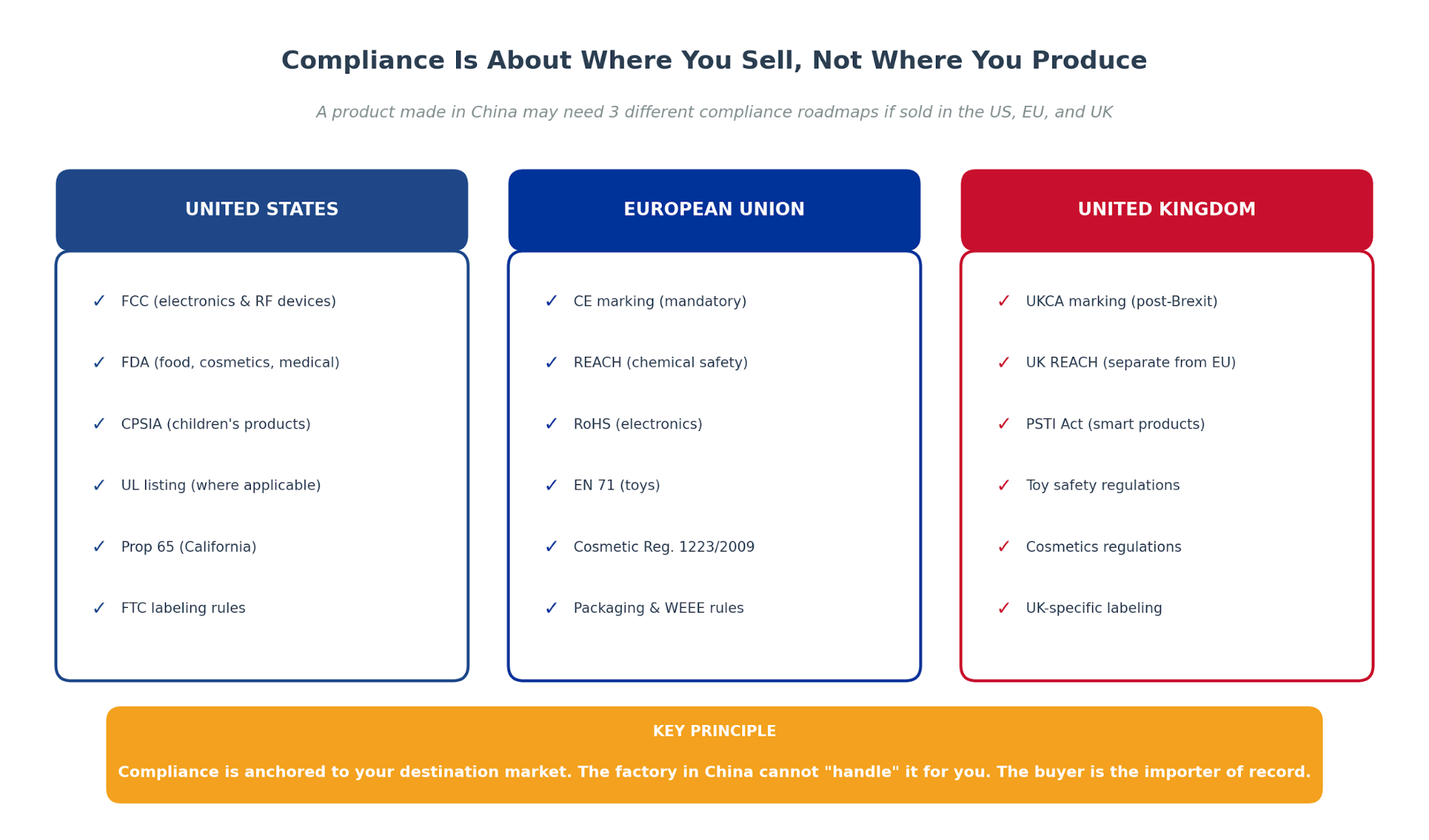
Compliance is not about where your product is produced. It is about where it is sold. A children’s toy made in a perfectly capable factory in Guangdong can still be blocked at a European port if it has not been tested to EN 71. An electronic device assembled in Shenzhen can be listed and then taken down within hours on Amazon US if it lacks FCC documentation. A skincare cream produced in Indonesia can be seized at customs in the EU if it has no Cosmetic Product Safety Report. None of this is theoretical. It happens every week to importers and brands that skipped this step.
The business impact is severe and usually invisible until it is too late. A failed compliance check after the product is on the water can cost a brand its entire first shipment, its launch window, and, in some cases, its marketplace account. Common consequences include:
Customs hold or seizure: Your shipment is blocked at the border and cannot be released without missing certificates or destructive testing.
Marketplace takedown: Amazon, eBay, or Walmart removes your listing because you cannot produce a CE declaration, FCC ID, or required safety report.
Competitor or buyer complaints: A competitor reports your listing for missing labels or certifications, triggering an investigation.
Recall and liability exposure: A safety incident occurred because untested components were used, and your insurance does not cover undocumented products.
Repeat production costs: Goods must be reworked, repackaged, or relabeled at the factory, adding weeks of delay and cutting your margin.
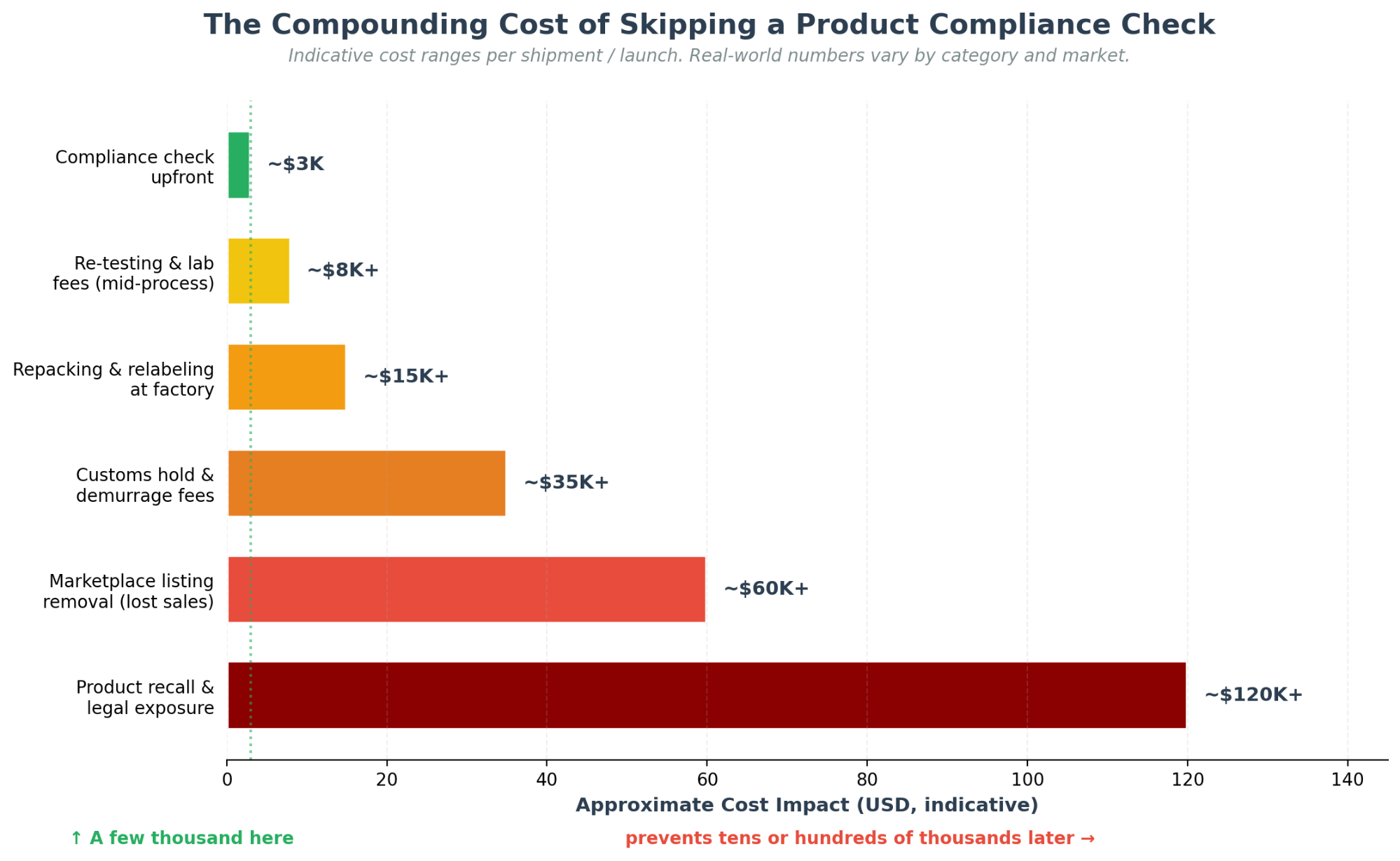
When you compare those costs to what a compliance check actually costs, the math is obvious. A few thousand dollars in advance prevents tens or hundreds of thousands in losses. And yet many first-time importers, and even experienced sellers expanding into a new market, treat it as a final step rather than a planning step.
The earlier these gaps are identified, the cheaper and easier they are to fix.
figure: Indicative cost impact of skipping a compliance check. The earlier the gap is caught, the cheaper it is to fix.
Reliable product sourcing starts here
Work with experts who help you evaluate suppliers and reduce risk.
A product compliance check is the structured process of identifying every regulation, certification, document, label, and test that your specific product needs in order to be legally imported and sold in your target market. It is the bridge between “the factory says it is fine” and “your shipment clears customs and your listing stays up.”
A complete compliance check answers four questions for one specific product going into one specific market:
Which regulations apply: Which laws cover your product category in your target country, including general safety, electrical safety, chemical content, and environmental rules?
Which tests and certifications are needed: Which lab tests, certificates, and conformity declarations are mandatory before import or sale?
Which labels and documents are required: What must appear on the packaging, the product itself, and the technical file you keep on record.
Who is responsible for what: Whether the supplier, the importer of record, or the brand owner must obtain or sign off on each piece of documentation.
The output is a clear, written compliance roadmap. It tells you what to test, where to test it, what to print on the box, what file to keep ready, and what to hand to customs or your marketplace if asked. It is product-specific, market-specific, and time-bound, because regulations change.
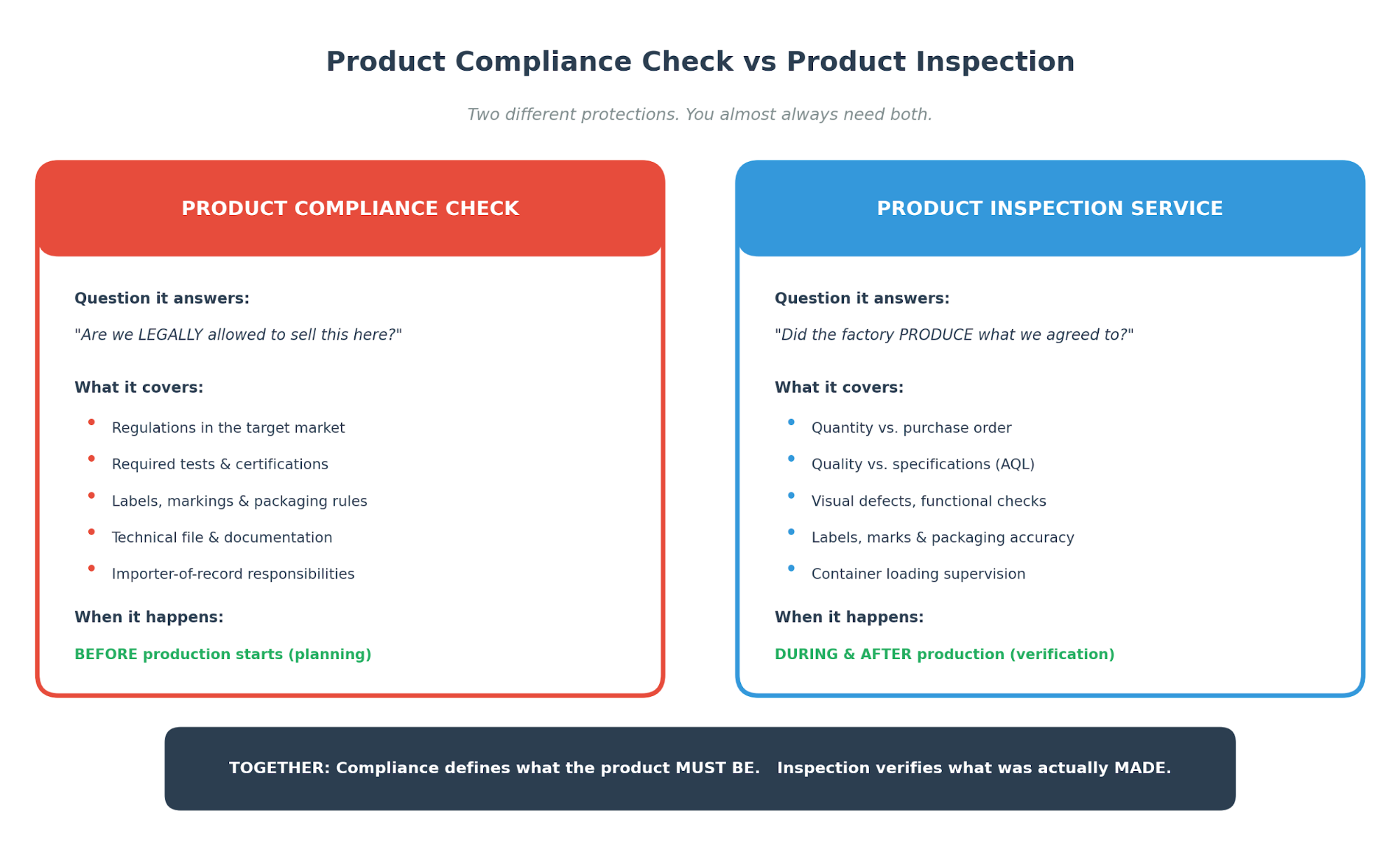
This is different from a generic “product inspection service” or “china inspection company” visit, even though those services are often part of the same workflow. A compliance check is about legal market access. A product inspection in China is about whether the goods produced match the agreed quality, specifications, and quantity. You usually need both, and you need them in the right order.
Figure: Two different protections, working at different stages. A complete pre-launch process uses both.
Quick Reference: Compliance Terms Every Importer Should Know
Use this glossary as a shared vocabulary with your team and suppliers:
Term
What it means
CE marking
A declaration that a product meets EU health, safety, and environmental requirements for sale in the European Economic Area.
FCC certification
A US requirement for devices that emit radio frequency energy, including most electronics.
REACH
EU regulation that restricts hazardous chemical substances in products sold in the EU.
RoHS
EU rules limit hazardous materials such as lead and cadmium in electrical and electronic equipment.
CPSIA
The US Consumer Product Safety Improvement Act sets safety standards for children’s products.
Technical file
The internal documentation package that proves your product complies with applicable rules.
Declaration of Conformity
A signed document, usually by the manufacturer or importer, stating that the product meets specific regulations.
UKCA marking
The UK equivalent of CE marking is required for many product categories sold in Great Britain since Brexit.
Reliable product sourcing starts here
Work with experts who help you evaluate suppliers and reduce risk.
Compliance Is About Where You Sell, Not Where You Produce
One of the most common misunderstandings, especially for first-time importers, is the assumption that compliance is something the Chinese factory will “handle.” It is not. A Chinese factory can produce to any specification you give them, but factories manufacture to specifications. They do not automatically manage your legal obligations in the destination market. If you want CE marking, you need to specify CE marking. If you want a CPSIA-compliant children’s product, you need to specify the standard, the test scope, and the lab.
The same logic applies to factories in Vietnam, India, Bangladesh, Turkey, Mexico, or anywhere else. A skilled manufacturer can build to your spec, but legal responsibility ultimately sits with the importer or brand owner. This is a critical principle because it changes who is responsible when something goes wrong. The importer of record, almost always your company, carries the legal liability in the destination market.
Figure 3: Three of the most common destination markets each with its own compliance roadmap.
Practical Differences by Sourcing Region
A serious compliance check should account for the real differences between origin countries. The destination still drives the rules, but the supplier’s readiness varies:
Sourcing Region
Typical Compliance Profile
China
An enormous range of suppliers and very fast iteration. Export-oriented factories often know CE, FCC, RoHS, REACH, and CPSIA well. However, capability varies wildly. The quality of factory-supplied test reports varies, and forged or copied certificates exist. A China inspection company that knows compliance can identify these gaps in advance.
Southeast Asia (Vietnam, Indonesia, Cambodia)
Increasingly common for textiles, furniture, and some electronics. Compliance literacy is improving, but documentation discipline is generally less developed than in mature Chinese export hubs.
South Asia (India, Bangladesh)
Strong textile and home goods capabilities. Buyers need to be specific about chemical testing standards, such as REACH and AZO dye testing for the EU, and CPSIA phthalate testing for the US.
Turkey & Eastern Europe
Often used for EU buyers who want shorter lead times. Familiarity with CE marking tends to be high, but importer-of-record responsibilities still apply.
Latin America (Mexico, Colombia)
Strong potential for nearshoring into the US. Compliance documentation practices vary by industry, and buyers should not assume parity with mature Asian export ecosystems.
Key Principle
The compliance check is anchored to your target market, not the country of origin. A product made in three countries for sale in the US, EU, and UK needs three compliance roadmaps, not one.
Reliable product sourcing starts here
Work with experts who help you evaluate suppliers and reduce risk.
Step-by-Step: How a Pre-Launch Product Compliance Check Works
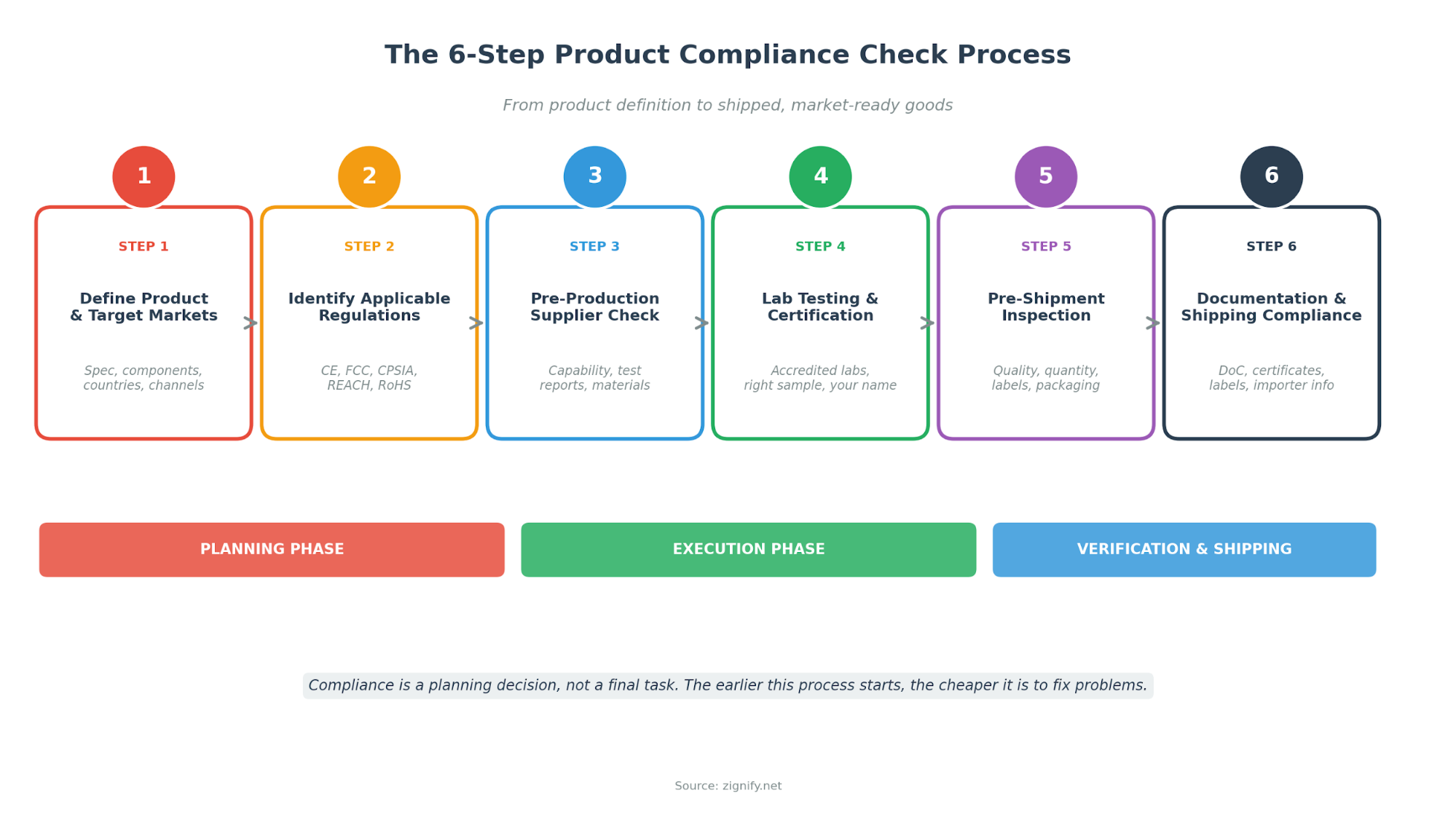
A proper compliance process follows a predictable order. You can use this as a working checklist with your internal team or a sourcing partner. The same flow applies whether your product is made in China or anywhere else.
Figure 4: The six core stages of a complete pre-launch product compliance workflow.
Step 1: Define the Product and Target Markets
Compliance starts with precision. A “phone charger” is not a product description; it is a category. Write down:
The exact product, including materials, components, and any electrical specifications.
All target markets, country by country.
The sales channels such as Amazon US, Amazon EU, your own website, big box retail, or B2B distribution.
Any special claims you plan to make, such as “organic,” “medical grade,” “BPA free,” or “for children under 3.”
Claims drive regulation. A toy “for children under 3” triggers stricter EN 71 and CPSIA requirements than a toy “for ages 14 and up.” A “medical grade” claim activates a completely different regulatory framework than a general consumer device.
Step 2: Identify the Product Category and Applicable Regulations
Once the product is defined, map it to regulatory categories:
EN 71, CPSIA, REACH phthalates, choking hazard rules
Cosmetics & skincare
EU Cosmetic Regulation 1223/2009, FDA cosmetic labeling rules, CPSR, INCI labeling
Food contact materials
FDA food contact regulations, EU 10/2011 plastics regulation, LFGB in Germany
Textiles & apparel
REACH AZO dyes, formaldehyde limits, flammability standards, country of origin labeling
Cleaning products & chemicals
REACH, GHS labeling, CLP regulation in the EU
This mapping step determines nearly every downstream requirement, from testing scope to packaging labels.
For US compliance, the Consumer Product Safety Commission and the FDA publish the requirements relevant to most consumer categories. For the EU, the official CE marking page lists the directives and harmonized standards by product type.
Step 3: Pre-Production Compliance Checklist for Suppliers
Before you place a production order, the supplier needs to confirm what they can deliver against your compliance roadmap. Use this checklist:
Component-level compliance: Have all components been verified against REACH or RoHS, where applicable?
Test reports on file: Does the supplier have recent third-party lab reports, not just internal QC results?
Material declarations: Can the supplier issue a signed Material Declaration?
Capability for required standards: Has this factory ever produced to EN 71, CPSIA, or your specific standard, or is this their first attempt?
Sub-supplier transparency: Do they disclose where critical components, such as chips, batteries, or fabrics, are sourced?
Country-of-origin honesty: Is the product genuinely “Made in China” or “Made in Vietnam,” or is it transshipped?
This is the stage where most compliance failures are born. A supplier who promises certifications they cannot actually produce creates a compounding problem that only surfaces after goods are made.
Step 4: Lab Testing and Certification
Once compliance requirements are identified, the next step is execution. This means selecting accredited labs and managing the actual testing process. Major labs include SGS, Intertek, Bureau Veritas, and TÜV. Local Chinese labs can also be used for some standards, but their reports are not always accepted by all destination markets, so verify in advance.
Practical considerations:
Lab selection: Pick labs accredited for your specific standard, not just “compliance” in general.
Sample preparation: The sample sent to the lab must match the final mass-production version, including suppliers of critical components. Testing a prototype and then changing suppliers makes the report invalid.
Document ownership: Test reports and certificates should be issued in your company’s name, not the factory’s. This is critical for marketplaces and customs.
Cost control: Get quotations from multiple labs. Prices for the same test can vary by a factor of two or three.
Timeline: A single chemical test can take two to six weeks. Build this into your launch timeline.
The output is your technical file. For EU sales, this file must be kept for at least ten years after the last unit is sold under most directives. The International Organization for Standardization maintains many of the underlying technical standards that labs test against.
Step 5: Pre-Shipment Inspection and Quality Verification
Compliance documentation only protects you if the actual goods in the container match the version that was tested and certified. This is where product inspection in China, or in any production country, becomes essential. A standard pre-shipment inspection by a qualified China inspection company covers:
Quantity verification: Confirming that the agreed number of units was actually produced.
Visual and functional checks: Identifying defects across a representative sample, using AQL sampling.
Label and packaging verification: Checking that CE marks, FCC IDs, country of origin, batch numbers, and barcodes are correctly printed.
Compliance documentation match: Confirming that what is in the box matches what is written on the box and in the certificates.
Container loading supervision: Where appropriate, supervising that the goods are loaded correctly and not swapped or short-loaded.
A proper inspection requires physical factory presence, random sampling, documented reporting, and a clear pass or fail verdict. You can read more in our guide to top quality control and inspection services in China, which covers how these inspections work in practice.
Step 6: Documentation, Labels, and Final Shipping Compliance
The last operational step before launch is making sure every required document and label is in place and accessible. A practical pre-shipment compliance checklist includes:
Declaration of Conformity, signed and on file.
Test reports and certificates issued in your company’s name.
Bill of Lading, Commercial Invoice, and Packing List, with HS codes verified for your destination market.
Importer information correctly on the product or packaging, where required.
Country of origin marking that is accurate and permanent.
Marketplace-specific documents, such as Amazon’s requested certificates for restricted categories.
Battery shipping documentation, if applicable, including UN 38.3 test summary and MSDS.
Required EU EORI number, US EIN, or destination-country importer registration.
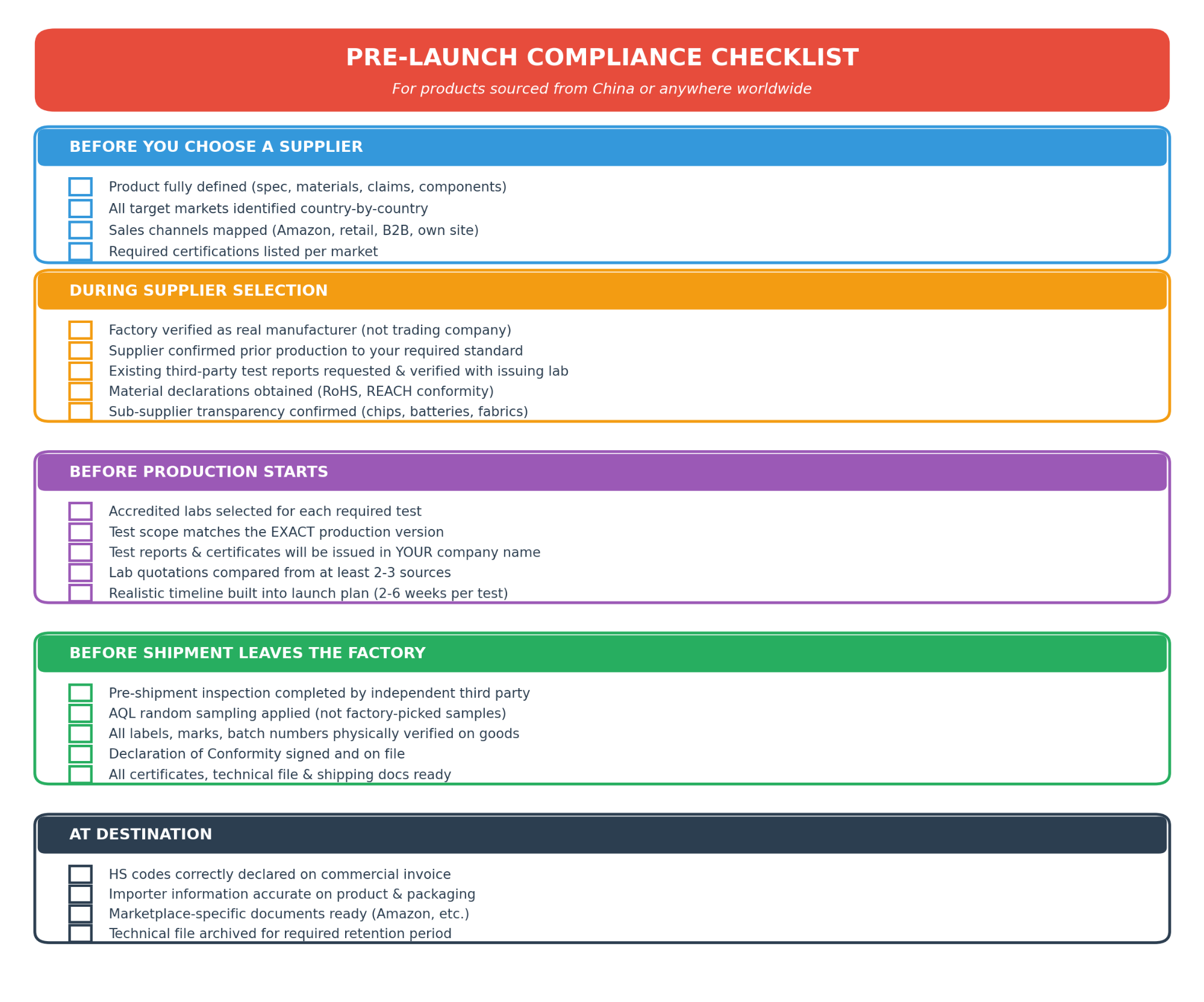
Print this or share with your team and suppliers. Each section corresponds to a critical decision point in the workflow:
Figure 5: The complete pre-launch compliance checklist, organized by stage.
Reliable product sourcing starts here
Work with experts who help you evaluate suppliers and reduce risk.
Compliance Check vs Product Inspection: How They Connect
These two terms get confused constantly, and the distinction matters because they protect against different risks.
Product Compliance Check
Product Inspection Service
Legal and regulatory readiness for the destination market.
Quality and quantity verification at the production stage.
Answers: “Are we allowed to sell this here?”
Answers: “Did the factory produce what we agreed to?”
Happens BEFORE production starts.
Happens DURING and AFTER production.
Output: compliance roadmap, certificates, and technical file.
Output: AQL-based inspection report with photos, measurements, and pass/fail verdict.
Protects against customs holds and marketplace takedowns.
Protects against defective goods and short shipments.
You need both. A product can be fully compliant on paper and still arrive defective. A product can be perfectly produced and still be blocked at customs because nobody filed for CE marking. Treating them as a single process is a common mistake. Treating them as completely separate is also a mistake, because the inspection step is where you actually verify that the compliant version is what got produced.
A well-run pre-launch process integrates the two. Compliance defines what the product must be. Inspection verifies that what was made matches that definition. The same product inspection service global supply chains rely on for quality verification can also be tasked with confirming compliance-related items such as label accuracy, marking placement, and packaging requirements.
Common Mistakes Businesses Make Before Launch
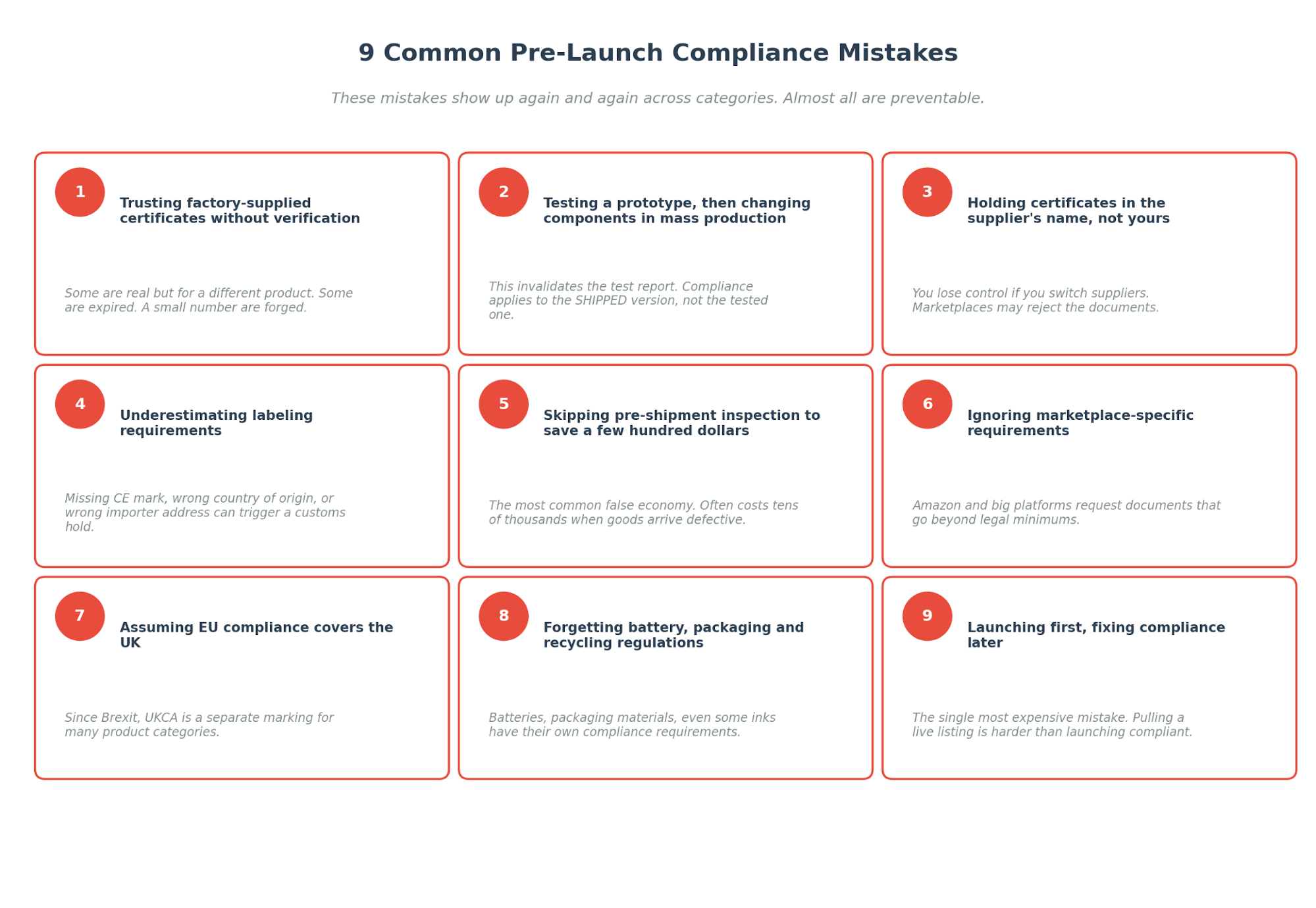
After years of working with importers across categories, the same expensive mistakes show up again and again. Most are avoidable with a small amount of upfront planning.
Figure 6: The nine most common pre-launch compliance mistakes.
Detailed Breakdown of Each Mistake
Trusting factory-supplied certificates without verification. Some test reports are real but apply to a different product version. This is especially common with private-label products. Some others are technically expired. A small number are outright forgeries. Always verify with the issuing lab.
Testing a prototype, then changing components for mass production. This invalidates the report. Compliance applies to the version that is actually shipped.
Holding certificates in the supplier’s name. When the report is in the factory’s name and not yours, you lose control if you switch suppliers, and marketplaces may reject it.
Underestimating labeling requirements. Missing a CE mark, an incorrect country of origin, or a wrong importer address can trigger a customs hold by itself.
Skipping pre-shipment inspection. Saving a few hundred dollars on an inspection often costs tens of thousands when the goods arrive defective or mislabeled.
Ignoring marketplace requirements. Amazon and other large platforms have their own document requests that go beyond legal minimums. Plan for them in advance.
Assuming “EU compliant” covers the UK. Since Brexit, UKCA is a separate marking, and certain product categories require it.
Forgetting battery and packaging regulations. Batteries, packaging materials, and even some inks have their own compliance and recycling registration requirements, especially in the EU.
Launching first, fixing compliance later. This is the single most expensive mistake. Pulling a live listing is harder than launching a compliant one in the first place.
Reliable product sourcing starts here
Work with experts who help you evaluate suppliers and reduce risk.
How Zignify Supports Product Compliance and Inspection
Zignify works on the buyer side, not the factory side. That distinction matters for compliance because the buyer is the party with legal liability in the destination market. A factory has no incentive to over-test or to flag a missing certification. An advisor aligned with the buyer does.
In practice, Zignify helps clients across the full pre-launch process:
Service
What It Covers
Compliance research
Mapping your specific product to the regulations, certifications, and labels required in each target market.
Compliance implementation & lab management
Identifying suitable labs, comparing quotations, organizing sample submissions, and managing the testing process so reports are issued correctly and on time.
Supplier audits
Verifying that the factory you plan to use is real, registered, capable of producing to your required standards, and not hiding red flags such as legal disputes or trading-company markups.
Sample quality inspection
Inspecting samples during sourcing, in China and other regions, so that what the supplier promises is actually what they can produce.
Pre-shipment inspection & mass production QC
On-site inspections by local teams who randomly select goods, follow AQL standards, document with photos and video, and confirm that production matches both your specifications and your compliance documentation.
Logistics & documentation support
Ensuring shipping documents, HS codes, importer information, and required certificates travel with the goods.
The positioning is intentionally not “we offer inspection services.” It is closer to: before you release the balance payment, before your goods leave the country, and before your product hits a marketplace, you should have one independent verification of what is actually in the box and one independent confirmation that the paperwork stands up to scrutiny. That is the value of a buyer-aligned partner with no factory commissions and no incentive to hide problems.
Reliable product sourcing starts here
Work with experts who help you evaluate suppliers and reduce risk.
The brands that win in the next few years will not be the ones with the cheapest factories. They will be the ones with the cleanest supply chains, the most defensible compliance positions, and the fastest, lowest-friction launches. Customs enforcement is tightening in the EU and the US. Marketplaces are demanding more documentation, not less. Competitors are getting better at filing complaints. A well-run product compliance check, combined with disciplined inspection, is not a cost item. It is a competitive advantage that compounds across every product you launch.
What Most Guides Get Wrong, Here’s What Our Expert Knows ✅
Most online guides treat product compliance like a checklist of certificates to collect at the end of production. That framing is exactly why so many launches fail. Compliance is a planning decision, not a final task, and the real risks are almost never in the obvious places. Here is what experienced buyers learn the hard way.
⚠️ A “CE certificate” from a Chinese factory is not the same as a CE compliant product.
Many buyers see a document titled “CE certificate” on a supplier’s website and assume the product is ready for the EU. In reality, CE is a self-declaration by the manufacturer or importer, not a certificate issued by an authority. What matters is the underlying test reports, the technical file, and whether the right harmonized standards were applied. A glossy certificate with a stamp can be worth less than a single accredited lab report. Always verify the lab, the scope of testing, and whether the report covers the exact product version you are buying.
🚩 The version that gets tested is rarely the version that gets shipped, unless someone enforces it.
This is one of the most underestimated risks in the entire process. A supplier sends a sample to a lab, the sample passes, then mass production begins. Somewhere along the way, a component supplier changes, a material grade is downgraded by a few percent, or a connector gets swapped to a cheaper alternative. None of that updates the certificate. Without a pre-shipment inspection that physically checks the produced goods against the certified specification, the paperwork becomes fiction. This is why the inspection step is not separate from compliance, it is the enforcement of compliance.
💰 The expensive mistakes are made in week one, not week ten.
By the time a shipment is sitting at a port and customs is asking for a missing document, the cost of fixing the problem is many times higher than the cost of preventing it. Demurrage fees, return shipping, re-labeling, supplemental testing, and lost launch windows compound quickly. The decisions that determine whether your launch is compliant are made when you choose the target market, when you select the supplier, and when you write the spec sheet. Once production starts, your options narrow fast. A compliance check is most valuable before production, second most valuable during production, and only marginally useful after the container has shipped.
If you are preparing to launch a product made in China or elsewhere, mapping the compliance and inspection workflow upfront is the single highest-leverage decision you can make. Book a free sourcing call →
Frequently Asked Questions
Q1. What is the difference between a product compliance check and a China inspection service?
A product compliance check identifies the regulations, certifications, and documentation your product needs to be legally sold in a target market. A China inspection service, or any product inspection service, verifies that the actual goods produced match the agreed specifications and quality. You usually need both, and they happen at different stages of the process.
Q2. How much does a typical product compliance check cost?
Costs vary widely based on product category and target markets. Compliance research and roadmap mapping are usually a small fixed cost. Lab testing is the larger variable, ranging from a few hundred to several thousand dollars per test, depending on the standard. A child’s toy for the EU may require five or six tests, while a simple non-electronic accessory may require only one or two.
Q3. Do I need a compliance check if I am sourcing from outside China, for example, from Vietnam or India?
Yes. Compliance is determined by your target market, not the country of production. A product made in Vietnam and sold in the EU needs the same CE marking and REACH compliance as one made in China. The country of origin affects tariffs and shipping documents, not your regulatory obligations.
Q4. Can the factory handle compliance for me?
The factory can produce to your specification, but legal responsibility sits with the importer in your destination market. Factories can supply existing test reports and certifications, but those should always be verified independently, and certificates should be issued in your company’s name where possible.
Q5. How long does a full pre-launch compliance process take?
For a straightforward product, four to eight weeks is realistic. For complex categories such as electronics, children’s products, or cosmetics, expect two to four months. The testing phase alone can take several weeks per test, and many tests cannot be run in parallel.
Q6. What certifications does a China inspection company actually verify?
A good inspection company verifies labels, markings, and packaging against the documented requirements, in addition to checking product quality and quantity. They do not replace the lab testing process, but they confirm that the produced goods match the certified specification and that all required marks and documentation are physically present on the goods.
Q7. Are there mobile apps or online services that can do a compliance check for me?
Some platforms offer initial compliance scans, especially for common Amazon categories, but they are limited. Real compliance, particularly for the EU, UK, and regulated categories, requires human judgment, lab work, and a technical file. Treat online tools as a starting point, not a substitute for a proper roadmap.
Q8. What happens if my product fails a compliance check after it has already been shipped?
The shipment can be held at customs, refused entry, returned to the origin, or destroyed at your cost. Marketplace listings can be removed. In severe cases, products already sold must be recalled. Even when the issue is “fixable,” the cost is almost always higher than running the check before production. This is why compliance is a planning step, not a recovery step.
Q9. Do I need a different compliance roadmap for the EU and UK after Brexit?
In most cases, yes. The UK now uses UKCA marking in place of CE marking for many product categories, although CE was accepted in a transitional period. EU certificates are not automatically valid in the UK. If you sell into both markets, plan for both.
Q10. Can Zignify help with both compliance and inspection in one workflow?
Yes. Zignify integrates compliance research, lab management, supplier audits, sample inspection, and pre-shipment quality control as a single buyer-side workflow. The point is that compliance and inspection are connected, and treating them as one process is what protects launches.