
Apple’s new iPhone 17 is making headlines worldwide, but the real story for sourcing professionals lies in how it’s made. Behind the sleek design is a vast global supply chain from advanced chips in Taiwan to OLED displays from South Korea, camera modules from Japan, and final assembly in China and India.
Recently, Apple also announced a $600 billion U.S. investment through its American Manufacturing Program (AMP), aiming to strengthen domestic production and supply chain resilience. This shift shows how even the world’s most successful tech company adapts sourcing strategies to balance cost, quality, and risk.
In this article, we’ll look beyond the iPhone 17’s features to explore the suppliers, sourcing strategies, and lessons behind Apple’s most ambitious product yet.
iPhone 17 Overview: Launch, Features, and Manufacturing Shifts
Apple officially launched the iPhone 17 in September 2025. The release continues its yearly tradition of delivering major flagship upgrades.
The new model brings the A19 Bionic chip, offering faster performance and better efficiency. It also comes with a brighter OLED display and longer battery life. The camera system is a big draw, with AI-powered features that make photography sharper and smarter. Together, these upgrades keep the iPhone on top of consumer wish lists.
But the story goes beyond features. The iPhone 17 is also shaped by manufacturing challenges. Apple still depends on suppliers across Asia, yet tariffs and geopolitical pressures are forcing change.
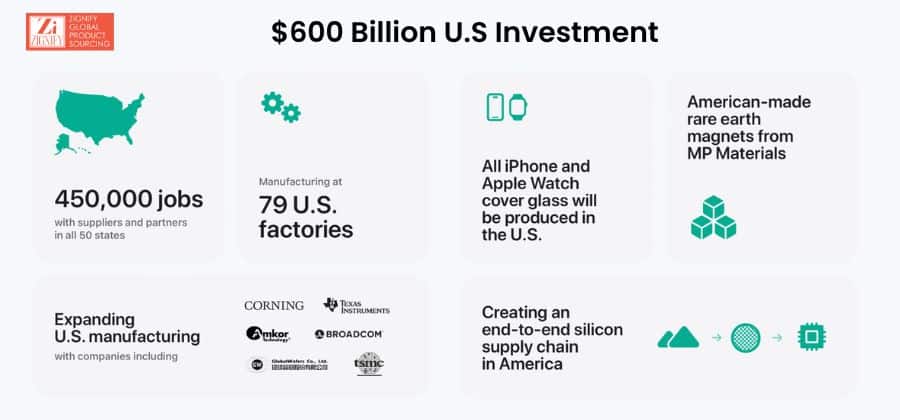
To adapt, Apple launched its $600 billion American Manufacturing Program (AMP). This includes U.S.-based glass production in Kentucky, domestic sourcing of rare earth magnets, and deeper work with American chipmakers.
The result: Apple is gradually shifting from an Asia-heavy supply chain to a more balanced global and U.S. production model. This move shows how Apple is preparing for the future of smartphone manufacturing.

Where Is the iPhone 17 Manufactured?
The iPhone 17 may be designed in California, but its journey to your hands is global. Apple’s manufacturing and assembly strategy spans several regions to balance cost, quality, and risk. With China still central, but increasingly complemented by other countries.
China – Still a Major Hub, But Facing Competition
- China remains Apple’s largest assembly hub, powered by partners such as Foxconn and Pegatron. It retains a huge advantage thanks to mature infrastructure, deep supply chains, and skilled labor.
- However, due to U.S. tariffs and geopolitical risk, Apple is deliberately reducing its reliance on China — especially for units destined for the U.S. market.
India – Rapidly Becoming the New Production Center
- All iPhone 17 models (including the Pro versions) are now being manufactured in India from launch, at five different factories.
- Key Indian partners include Foxconn and Tata Group, especially in plants in Hosur (Tamil Nadu) and Devanahalli (near Bengaluru).
- India is increasingly fulfilling U.S. iPhone demand. Apple is aiming to produce most U.S.-bound iPhone 17 units out of India, partially to avoid tariffs on Chinese-made goods.
- Exports from India are rising sharply: from April–July, Indian plants exported about US$7.5 billion worth of iPhones, nearly half of the previous full fiscal year’s total export figure.
Other Regions (Vietnam, US)
- Vietnam still mostly supplies components (camera modules, etc.) rather than final assembly for now.
- United States is increasing its production of crucial components (glass, lasers, magnets), though full iPhone assembly is still mostly done outside the U.S.
The iPhone 17 isn’t made in just one country anymore; it’s the product of a globally distributed network. China remains central, but Apple is at a major turning point: New production is heavily moving to India, and countries like Vietnam and the U.S. are becoming increasingly more involved. This shift is largely driven by tariff pressures, U.S.-China trade tensions, and the need for more resilient supply chains.
Apple’s Supplier Strategy: detailed breakdown
Apple isn’t only a leader in innovation, but it also excels at building and managing its supply chain. Behind the iPhone 17’s design is a sourcing model shaped by diverse suppliers, rigorous quality checks, and strong sustainability goals. By balancing global partnerships with major U.S. investments, Apple proves its advantage goes beyond technology; it’s also about a smart supplier strategy.
Here’s a summary of Apple’s Supplier Strategy in 2025 — what they’re doing, what’s changing, and why it matters.
What Apple’s Sourcing Strategy Looks Like in 2025
- $600 Billion U.S. Investment via American Manufacturing Program (AMP)
Apple increased its U.S. spending commitment to $600 billion over four years. The goal: bring more of its supply chain and critical component manufacturing into the U.S. through AMP. - Building an End-to-End U.S. Silicon Ecosystem
Apple is partnering with companies like TSMC (in Arizona), GlobalWafers America, Applied Materials, Texas Instruments, etc. to cover everything from wafers to packaging. The target is billions of chips produced in the U.S. for Apple devices (not just for U.S. market) by 2025 - Domestic Production of Key Components
• Glass production (iPhone / Apple Watch cover glass) in Kentucky (Corning).
• Rare earth magnets from MP Materials in the U.S., with expanded recycling capabilities
• VCSEL lasers made in Texas via Coherent. - Diversification of Manufacturing Locations
Beyond the U.S., Apple is increasing production in places like India and Vietnam. These moves help reduce reliance on China and respond to tariff/geopolitical risk. - Stricter Requirements for Suppliers (Quality, Automation, ESG)
• Suppliers are required to meet Apple’s Supplier Code of Conduct: labor rights, health & safety, environment, ethics.
• Apple pushes for clean energy: many suppliers are committed to 100% renewable power for Apple production; large reductions in emissions among display and semiconductor suppliers.
• Automation/robotics are increasingly required for suppliers to win contracts. This helps stabilize quality, reduce labor dependence, and deal with cost pressures. - Sustainability & Circularity
• Goals toward 100% recycled rare earth elements and cobalt by 2025.
• Zero-Waste certification for final-assembly sites. Recycling programs, water stewardship, and minimizing environmental impact.
Why These Sourcing Strategies Matter
- Risk Management: Tariffs, trade tensions, and supply disruptions push Apple to move some production closer to home (U.S.) and spread risk geographically.
- Competitive Advantage: Having domestic capacity for critical components gives Apple more control over cost, lead time, and innovation (e.g. chip design, glass, magnet tech).
- Regulatory & ESG Pressure: Governments increasingly favor local investment; consumers demand ethical sourcing, reduced environmental impact. Apple is responding.
- Supply Chain Resilience: More self-sufficiency in U.S., other countries, cleaner energy, stricter standards = less vulnerable to shocks (pandemics, geopolitical disruptions).
Conclusions on Apple’s Global Product Sourcing Strategy
Apple’s evolving strategy in 2025 shows that excellent tech needs excellent sourcing. With massive U.S. investment (AMP), rapid expansion in India, and moves to shift U.S.-bound iPhones away from China, Apple is building a future where manufacturing resilience equals product competitiveness. For Apple, the message is clear: being great at devices is one thing — being great at supplier strategy is how you stay ahead.
And this isn’t just an Apple story. Every company, no matter its size, needs a strong sourcing strategy. The way you source directly impacts costs, margins, and the ability to respond to risks like tariffs, supply chain disruptions, or changing trade policies. Apple moves fast because it understands that sourcing decisions are financial decisions.
Frequently Asked Questions About Apple’s Global Product Sourcing Strategy
What are the standout features of the iPhone 17?
It introduces the A19 Bionic chip for faster performance, a brighter OLED display, longer battery life, and AI-powered camera features for sharper, smarter photography.
Why is Apple’s supply chain such a big deal with the iPhone 17?
Because the phone’s success relies not just on tech but on a complex global supply chain — from chips in Taiwan and displays in South Korea to cameras from Japan and assembly in China and India.
What is Apple’s American Manufacturing Program (AMP)?
AMP is Apple’s $600 billion U.S. investment over four years to bring more production stateside — covering glass, rare earth magnets, lasers, and an end-to-end silicon ecosystem.
How is Apple diversifying its manufacturing beyond China?
Apple is expanding production in the U.S., India, and Vietnam, reducing over-reliance on China and addressing tariff and geopolitical risks.
What are Apple’s sustainability goals in sourcing?
By 2025, Apple aims to use 100% recycled rare earth elements and cobalt, achieve zero-waste certification at final assembly sites, and push suppliers to adopt renewable energy.
How does Apple ensure supplier quality and compliance?
Suppliers must meet Apple’s Supplier Code of Conduct, covering labor rights, safety, environmental impact, and ethics. Many are also required to increase automation to maintain quality and efficiency.
Why do these sourcing strategies matter for Apple’s competitiveness?
They help Apple manage risk, control costs, meet ESG expectations, and strengthen supply chain resilience — turning sourcing into a real competitive advantage.
What lesson can other companies learn from Apple’s approach?
That sourcing is a financial strategy. Apple adapts quickly to tariffs and global risks, proving that a smart supplier strategy impacts profit margins as much as product design.