
Global supply chains are shifting. In recent years many businesses—especially US and EU-based sellers—have responded to disruptions, rising costs, and quality concerns by rethinking where they source and manufacture goods.
Nearshoring (outsourcing to neighboring countries) is emerging as a powerful strategy alongside traditional offshoring, reshoring, and onshoring. This article explains what these terms mean, compares their advantages, and offers actionable insights for sellers. We’ll cover the core benefits of nearshoring, how it differs from offshoring, reshoring and onshoring, and answer common questions. Reliable partners like Zignify Global Product Sourcing can help sellers navigate these options – schedule a free sourcing call below to learn more about nearshoring strategies for your business.
What Is Nearshoring? Meaning and Benefits
Nearshoring means relocating production or sourcing to nearby countries or regions (often within the same continent or time zone). In other words, it’s a middle ground between distant offshoring and domestic onshoring. For example, a U.S. company may shift some manufacturing to Mexico or Canada instead of Asia. By choosing a nearby supplier, businesses gain geographic proximity, similar work cultures, and easier communication. Key advantages of nearshoring include:
- Lower Transportation & Lead Times: Shorter distances mean faster shipping and delivery. Studies show that shorter supply chains allow quicker response to demand.
- Cost Efficiency: While labor costs may be higher than in traditional offshore hubs (like China), nearshoring can still cut overall expenses. A recent Bain survey found that companies adopting nearshoring can increase gross margins by up to 30% bain.com, thanks to savings in freight, reduced tariffs, and lower risk costs.
- Improved Communication & Quality: Working in similar time zones and cultural settings boosts collaboration. Teams can meet face-to-face more easily, and management can monitor projects directly. This proximity cuts down miscommunication.
- Supply Chain Resilience: Nearshore suppliers are less exposed to distant disruptions (like extreme weather, geopolitical events, or long shipping delays). By diversifying supply chains closer to home, companies lower risk.
- Talent Access: Nearshoring expands the talent pool. For example, Eastern Europe (Poland, Ukraine, Romania) is a growing nearshore hub for IT and engineering, offering highly skilled labor at lower cost than Western Europe.
- Sustainability: Nearshoring reduces the distance goods travel, cutting transportation emissions and creating more efficient supply chains. As consumers and retailers increasingly prioritize eco-friendly practices, this environmental advantage has become a key factor in procurement decisions.
Nearshoring blends lower costs with better speed and flexibility. By moving production closer to major markets, sellers benefit from faster shipping, easier oversight, and often good labor rates. This strategic balance between cost and agility is why 80% of operations executives plan to increase onshoring or nearshoring in the next few years

Nearshoring vs Offshoring vs Reshoring vs Onshoring
It’s useful to distinguish these terms:
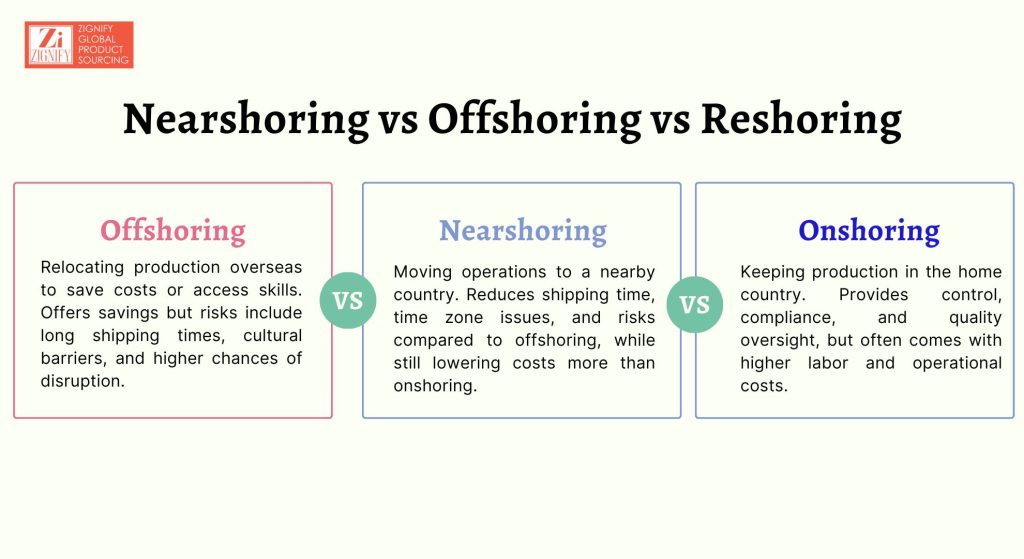
- Offshoring – relocating production or services to a distant country (often overseas, far from the home market). The goal is usually to take advantage of lower labor costs or specialized skills. For example, building a factory in China to serve the US market. Offshoring can yield big cost savings, but comes with challenges: long transit times, cultural/language barriers, and high risk of delays or interruptions.
- Nearshoring – (defined above) moving operations to a nearby country. This reduces many risks of offshoring by keeping suppliers in a friendly time zone and region, while still benefiting from lower costs than onshoring.
- Onshoring (Domestic Sourcing) – keeping production within the company’s home country. This maximizes control and compliance, but can mean higher costs. Thomasnet explains onshoring as “the process of sourcing or relocating a business’ production operations within domestic national borders” thomasnet.com. Onshoring is often chosen for strategic or regulatory reasons, even though local labor can be more expensive.
- Reshoring (Inshoring) – bringing back manufacturing from overseas to the home country. Essentially, reshoring is onshoring applied to facilities that were once offshored. Many companies are now reshoring to boost quality control and avoid foreign risks. According to Thomasnet, reshoring applies to businesses “transferring production back to their domestic nation” thomasnet.com. For sellers, reshoring can mean re-establishing domestic partnerships or factories, often subsidized by government incentives.
Key differences: Offshoring seeks the absolute lowest costs, but at the expense of distance. Onshoring/reshoring minimizes distance but can be costlier. Nearshoring strikes a balance: it offers many of the cost benefits of offshoring (through lower-wage neighbors) while retaining the speed and oversight advantages of proximity.
In practice, many companies adopt a mix — a “split-shoring” or “right-shoring” approach — to balance cost with resilience bain.com. For example, they might source some components locally (onshore), some from a nearby country (nearshore), and some from low-cost distant countries (offshore), depending on the product and market.
Who Should Consider Nearshoring? Industry Use-Cases
Nearshoring is a versatile strategy for many industries, especially where speed and flexibility matter. Sellers of consumer products (apparel, footwear, electronics, home goods, etc.) often benefit, since trends and demand can change quickly. For example, fashion and textile brands can replenish inventory faster by shifting garment production from overseas to Mexico or Eastern Europe, rather than waiting months from Asia. Electronics firms likewise nearshore parts of production to avoid chip shortages or shipping delays
As Protolabs observes, nearshoring and onshoring were once niche, but in 2024 they’re “at the forefront of global supply chain transformation” protolabs.com. U.S. companies are finding that nearshoring to Central American neighbors or Eastern Europe yields significant lead-time cuts and supply stability. In fact, Protolabs notes that moving some operations closer (for example, U.S. firms shifting manufacturing to Mexico) not only cuts transportation costs and lead times, but also “maintain[s] relative proximity to the U.S. market” protolabs.com.
Geographic focus also matters:
- North American sellers: Nearshoring often means Mexico or Canada. Mexico has become a primary nearshore hub – its proximity, favorable trade agreements, and growing manufacturing base have drawn huge investment. Canada also offers high-skill manufacturing for sectors like auto and aerospace.
- European sellers: Nearby Eastern European countries (Poland, Romania, Turkey) are popular for textiles, machinery, and electronics. Western European firms often nearshore to Turkey, Morocco, or Eastern EU for low-cost apparel and automotive parts.
- Other regions: Nearshoring is relative – e.g., companies in Japan might nearshore to Southeast Asia, and Chinese firms to Vietnam. The key is choosing a “close” market, politically and logistically.
Ultimately, if you are a manufacturer, e-commerce seller, or supply chain manager dealing with long lead times or quality issues, nearshoring can be especially appealing. It’s most effective when you need to balance costs against the need for faster iterations, frequent product updates, or just-in-time inventory.
Key Benefits of Nearshoring (Recap)
- Cost savings: Lower freight and tariff expenses. A Bain analysis found that “companies that get nearshoring right can increase gross margins by up to 30%” bain.com.
- Speed to Market: Quicker shipping and production cycles. Suppliers in nearby countries mean goods arrive on faster rail or truck routes, rather than weeks at sea
- Better Communication: Shared language/culture/timezone reduces coordination woes. You can hold regular meetings and site visits with ease.
- Quality Control: Closer oversight leads to better quality. Nearshore factories often match Western standards, and you can respond immediately to issues (adjust designs, fix defects, etc.).
- Risk Reduction: Geographic diversification reduces exposure to global shocks. Local events (hurricanes, port strikes) have less impact when your suppliers are nearer.
- Talent Access: Tap into skilled regional labor pools. For example, Eastern Europe for IT/textiles, or Mexico for automotive and electronics manufacturing.
- Environmental Impact: Shorter shipping routes mean lower emissions. In electronics manufacturing, nearshoring has “sustainability advantages” and helps shrink carbon footprints
- Flexibility: Easier to ramp production up or down. Regional suppliers can often scale faster to meet changing demand, helping you avoid overstock or stockouts.
Nearshoring vs Offshoring: Making the Choice
Choosing nearshoring over offshoring boils down to priorities. If cost is the sole driver, distant offshoring may still win (wages in Asia can be lower). But if agility and control matter, nearshoring is compelling. For many sellers, the extra cost of a nearshore supplier is offset by the savings on expedited freight, inventory financing, and quality rework.
For example, Netsuite notes that offshoring often requires “a significant up-front investment” (new facilities, training, etc.), making it a longer-term strategy. In contrast, nearshoring can sometimes leverage existing capabilities in a closer market with less disruption. And as Bain’s research shows, most leaders today blend models – using a “split-shoring” approach that combines near and offshore sourcing to balance cost and resilience.
Choosing the Right Partner
Once you decide to explore nearshoring, the key step is picking the right partner country or supplier. Consider:
- Cultural fit: Similar business practices and language help.
- Trade agreements: Tariff breaks or trade pacts can make some neighbors more cost-effective.
- Logistics: Look at rail and highway connectivity. For example, Mexico’s manufacturing regions are well-connected to U.S. markets.
- Capabilities: Does the supplier have experience in your industry? Eastern Europe excels at precision engineering; Mexico at auto and appliance manufacturing; Canada and Portugal at textiles.
- Political and Legal Environment: Favor countries with stable policies and strong rule-of-law for contracts and IP.
A good approach is to run a small pilot order first, building a relationship before fully shifting production. Logistics and quality audits are essential. Many companies also use third-party sourcing experts – for instance, Zignify helps businesses identify and qualify nearshore suppliers that fit these criteria, ensuring a smooth transition.
Getting Started with Nearshoring
If you’re convinced of the benefits, the next step is an action plan:
- Supply Chain Assessment: Map your current suppliers, costs, and lead times. Identify products or components that suffer the most from delays or quality issues.
- Research Nearshore Options: Look for countries with the expertise you need. Resources like the U.S. SBA “Make Onshoring Great Again” portal can help identify suitable domestic or regional alternatives. Industry reports and sites (such as those cited above) offer up-to-date analysis of promising nearshore markets.
- Pilot and Evaluate: Start small. Send a sample production or small order to a chosen nearshore partner to test quality, communication, and shipping. Use this to iron out issues before full-scale transfer.
- Risk Management: Plan for contingencies. Even nearshoring isn’t risk-free. Build buffer strategies (like backup suppliers) and maintain some local inventory during the transition.
- Leverage Expertise: Work with sourcing experts (like Zignify) who know the local landscape. They can save time negotiating contracts, ensuring compliance, and solving logistical challenges.
By following these steps, sellers can safely move towards a hybrid supply chain that captures the best of nearshoring and offshoring.
Conclusion on Nearshoring, Offshoring & Reshoring
Nearshoring offers a compelling path for sellers to gain speed, resilience, and often cost advantages in global sourcing. By partnering with nearby countries, businesses align closer to their customers, shorten supply chains, and free up capital. Whether you’re in apparel, electronics, consumer goods or any product-based business, assessing nearshoring options is now a must in strategic planning.
For sellers in the US, Europe or beyond looking to explore nearshoring and broader global sourcing, Zignify Global Product Sourcing is here to help. As a trusted sourcing partner with deep experience in Asia, Latin America, and beyond, we guide companies through every step of the process.
👉 Looking for a reliable partner in product sourcing? Book a call with Zignify and streamline your product sourcing journey across Asia and beyond!
Frequently Asked Questions (FAQ) about Nearshoring vs Offshoring vs Reshoring
1. What exactly is nearshoring?
Nearshoring is when a company relocates part of its sourcing or manufacturing to a nearby country or region, typically sharing a border or time zone. Unlike offshoring (sending work to distant countries), nearshoring keeps operations closer to home. For example, U.S. firms nearshore to Mexico or Canada, and European firms nearshore to Eastern Europe. This proximity brings benefits in cost, speed, and communication.
2. How does nearshoring differ from offshoring?
The difference is distance and trade-off between cost vs control. Offshoring sends work to far-away nations (like factories in Asia) to cut labor costs. Nearshoring sends work to neighboring countries to balance cost savings with lower risk and faster delivery. Offshoring usually offers the lowest wage rates, but nearshoring offers much shorter lead times and easier coordination. For many companies, nearshoring is the middle ground that reduces shipping costs and delays while still taking advantage of lower regional costs.
3. What is reshoring (or onshoring)?
Reshoring (sometimes called onshoring) means bringing manufacturing back to your home country. It applies when you have overseas production and you decide to move it back. Thomasnet explains that reshoring is “transferring production back to [the] domestic nation” Onshoring, by contrast, can also mean simply starting up domestic production when you didn’t have any overseas operations (e.g. building a new factory in the U.S.). Both strategies focus on domestic sourcing for full control, but generally come with higher labor costs.
4. What are the main benefits of nearshoring?
The biggest benefits are faster delivery, better flexibility, and often improved quality. Because suppliers are nearby, shipping times shrink dramatically. It’s easier to visit factories and communicate real-time, cutting down mistakes. Many businesses also save money on inventory – you don’t have to order a year’s supply at once. Nearshoring can also tap lower wages or trade advantages of your neighbors. And importantly, a reliable nearshore supply chain is more robust: local disruptions are less damaging than a storm halfway around the world.
5. Which industries benefit most from nearshoring?
Nearshoring is useful for almost any manufacturing industry, but especially those with fast-moving products or tight quality needs. Apparel and textiles companies, for example, can quickly adapt to fashion trends by nearshoring garment production to Mexico or Eastern Europe. Electronics and automotive parts firms benefit from local parts suppliers to avoid chip shortages. High-tech and custom manufacturing (like CNC machining or complex assemblies) often nearshore for reliability. Essentially, if your products need frequent updates, customization, or rapid restocking, nearshoring can give you the lead time advantage.
6. What are common nearshoring destinations?
It depends on your home market. For U.S. sellers, the top nearshore partner is Mexico (plus Canada). Mexico’s manufacturing sector is mature (autos, appliances, electronics), and it offers free trade via USMCA. The Dominican Republic, Colombia, and other Latin American countries are also growing in tech and apparel. For European companies, Eastern Europe is popular: countries like Poland, Romania, Czech Republic, and Turkey for textiles, machinery and electronics. Even parts of Asia can be nearshore for companies in, say, Japan (e.g. Vietnam or Thailand).
7. Are there downsides to nearshoring?
No strategy is one-size-fits-all. Potential drawbacks include slightly higher labor costs than the cheapest offshore countries, and sometimes limited local supplier options. Regulatory or language differences (even with neighbors) can still pose challenges. Geographic proximity may also mean tariffs if trade deals aren’t in place. However, many companies find these manageable compared to the unpredictable costs of long global supply lines. In fact, industry research shows companies are overcoming these hurdles: 80% of COOs plan to increase nearshoring or onshoring, up from 63% just a few years ago. The key is to choose the right partner country and mitigate any local risks upfront.
8. How can Zignify help with nearshoring?
Zignify Global Product Sourcing specializes in identifying and managing suppliers globally – including nearshore partners. We help sellers vet potential suppliers (ensuring they meet quality and compliance standards), negotiate pricing, and set up supply chains in new regions. For example, we can guide you in exploring nearshore hubs (like Mexico or Eastern Europe) by providing market insights and local connections. This ensures you get the benefits of nearshoring (speed, cost) without the usual headaches of finding and auditing foreign factories. Our team’s on-the-ground experience means faster ramp-up and fewer surprises.