Imagine spending months perfecting a product design, negotiating with a factory in Shenzhen, and investing your life savings into a massive inventory order. The shipping container arrives at your warehouse, but when you open the first box, the stitching is frayed, the electronics won’t power on, or the color is three shades off. This isn’t just a minor inconvenience; it is a catastrophic blow to your brand reputation and your bottom line.
This article explores how a professional quality inspection service China acts as your eyes and ears on the ground, ensuring that what you ordered is exactly what gets loaded onto the ship
Read more about The Importance of Product Quality Checks in Manufacturing
What Is Quality Control?
Quality control (QC) is the process of making sure products meet defined standards before they leave the factory. It covers everything from reviewing product specifications with the supplier, to sampling finished goods to classifying defects and requiring corrective action. For importers sourcing from China, third-party QC is the most practical way to verify that what was agreed upon is actually what gets produced.
It’s worth knowing that QC differs from quality assurance (QA). QA is about setting up the right systems to prevent defects. QC is about checking whether the finished product actually meets the standard. Both matter, but for most importers, QC through independent inspection is the most accessible and actionable layer of protection.
What Is Quality Inspection?
A quality inspection is the hands-on execution of quality control. It means a trained inspector physically visits the factory, evaluates the goods against a pre-approved checklist, and delivers a report, complete with photos and a clear pass/fail result, so the buyer can decide whether to approve the shipment.
What makes inspection so valuable is that it removes the information gap between a buyer overseas and a factory in Guangdong or Zhejiang. Without it, importers are essentially trusting factory-issued quality certificates and those don’t always tell the full story.
Quality Control vs. Quality Inspection: What’s the Difference?
The easiest way to separate these two terms: quality control is the system, and quality inspection is one tool within it.
Quality control covers the full picture, writing product specifications, setting defect criteria, defining AQL sampling standards, and deciding what happens when something fails. It’s the strategy and the process.
Quality inspection is a specific, physical activity within that system. It’s when an inspector walks into a factory, tests actual units, and documents what they find. It’s where the standards on paper meet the reality on the factory floor.
Think of it this way: quality control is the food safety program at a restaurant. Quality inspection is the health inspector’s visit. You need both; the program without the visit is just paperwork, and the visit without the program gives you a result but nothing to build on.
What Does a Quality Inspector Do?
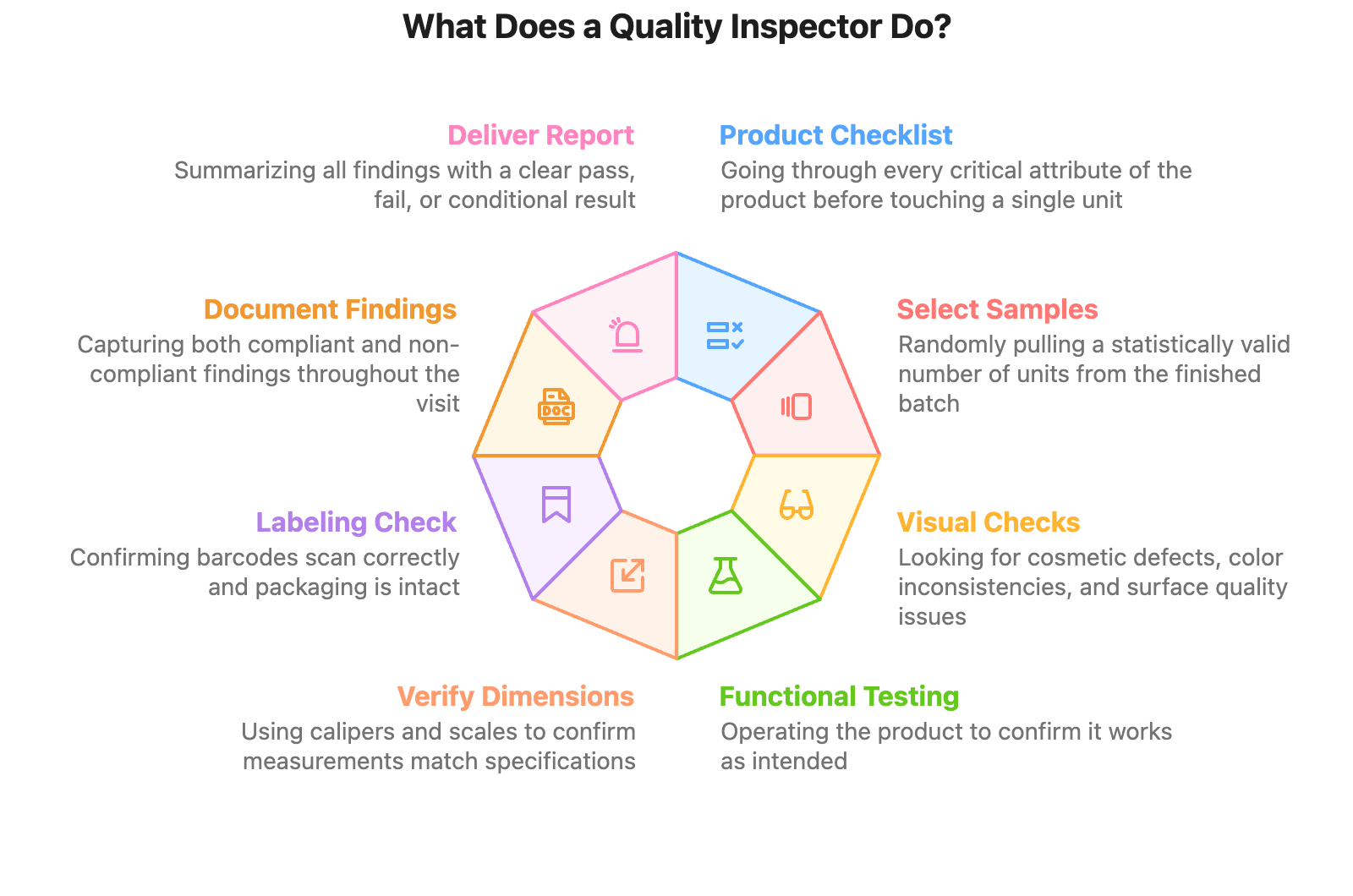
A quality inspector is a trained professional who acts as the buyer’s representative inside the factory. Their job is to observe, measure, test, and document, giving the buyer an objective, evidence-based picture of the goods before payment is released. On a typical assignment, an inspector will:
- Review the product checklist: Going through every critical attribute of the product before touching a single unit, ensuring the product matches approved samples.
- Select samples using Acceptable Quality Limit (AQL) tables: Randomly pulling a statistically valid number of units from the finished batch.
- Perform visual checks: Looking for cosmetic defects, color inconsistencies, surface quality issues, and workmanship problems, detecting visual and functional issues.
- Conduct functional testing: Operating the product to confirm it works as intended — buttons, zippers, mechanisms, electrical functions, and so on.
- Verify dimensions and weight: Using calipers, scales, and tape measures to confirm measurements match the approved specifications.
- Check labeling and packaging: Confirming barcodes scan correctly, compliance markings are present, packaging is intact, verifying labeling, cartons, and protection.
- Document with photographs: Capturing both compliant and non-compliant findings throughout the visit.
- Deliver a report within 24 hours: Summarizing all findings with a clear pass, fail, or conditional result.
Beyond the checklist, a good inspector also brings professional judgment. If something looks unusual or raises a concern that falls outside the standard criteria, they flag it. That human instinct is something no automated process can replicate and it’s why experienced inspectors remain irreplaceable in complex sourcing environments.
Read more about Top Reasons to Choose Zignify for Quality Inspection
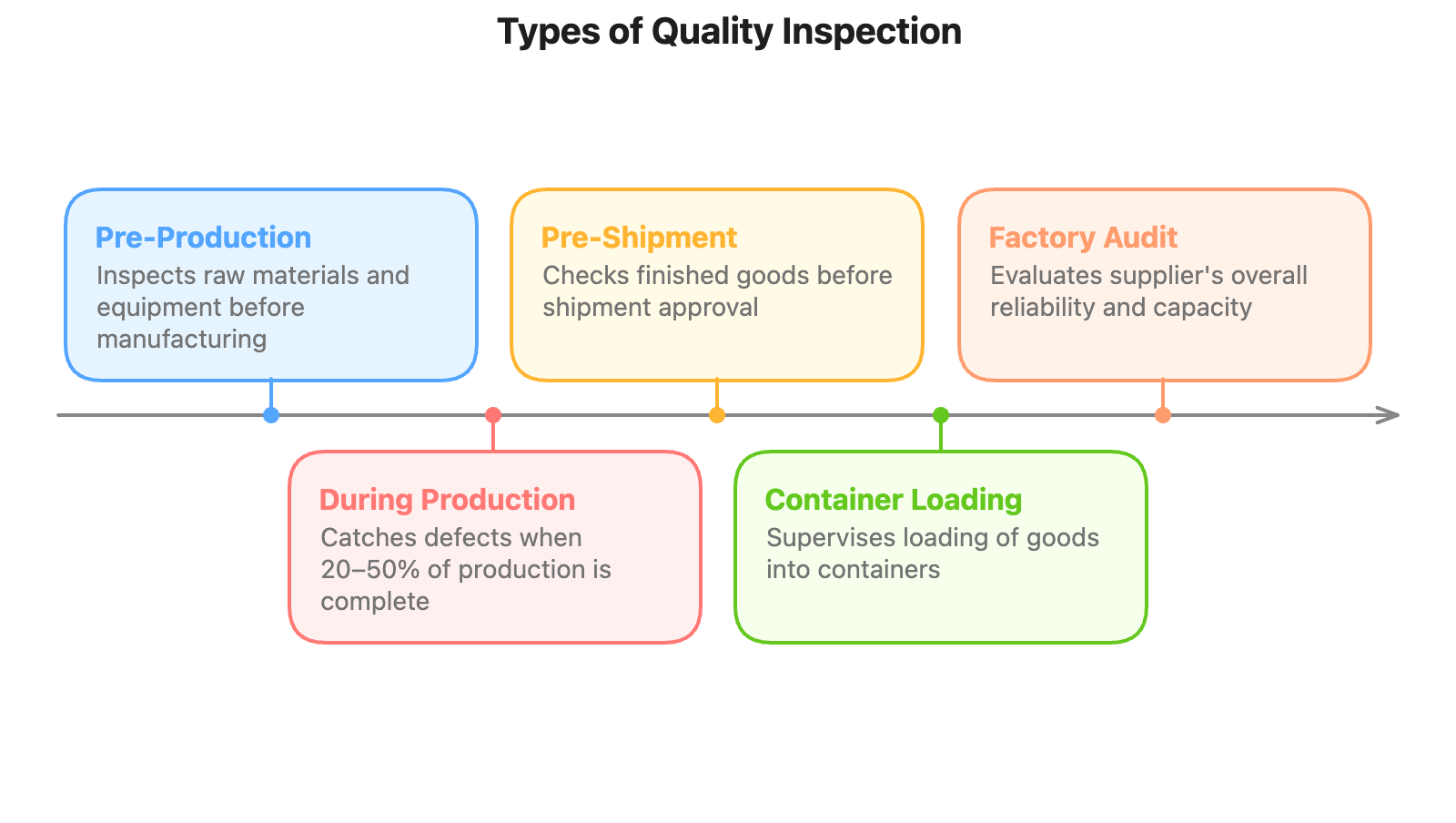
Types of Quality Inspection
Not every inspection happens at the same stage of production. Choosing the right type depends on your product, your supplier relationship, and how much risk you’re comfortable with.
Pre-Production Inspection (PPI)
This inspection happens before manufacturing begins. The inspector confirms that raw materials, components, and equipment are ready and meet your specifications. It’s the earliest opportunity to catch problems, before any production resources are spent.
During Production Inspection (DUPRO)
This takes place when roughly 20–50% of production is complete. The goal is to catch defects early enough that the factory can still fix them without stopping the entire run. It’s particularly useful for large orders where discovering problems late would be costly.
Pre-Shipment Inspection (PSI)
The most common type of inspection. It happens when production is 100% complete and at least 80% of goods are packed. The inspector checks finished goods against your specifications before the shipment is approved and final payment is released. If you only do one inspection, this is the one.
Pre-shipment inspection is the most common, but relying only on it increases risk if issues are found too late.
Container Loading Supervision (CLS)
An inspector is present at the factory during the actual loading of the container. They confirm the right products are loaded, no damaged cartons are included, and the container is properly sealed. It’s the last checkpoint before your goods leave the factory.
Factory Audit
A factory audit evaluates the supplier itself, not just the product. It covers production capacity, management systems, workforce conditions, certifications, and overall reliability. This is the right step before placing a first order with a new factory.
Read more about Supply Chain Optimization 101: Definition, Strategies, and Trends
Common Quality Issues When Sourcing from China:
- Inconsistent materials
- Color variation
- Poor finishing
- Incorrect labeling
- Packaging damage
- Missing components
Most quality issues are not caused by bad suppliers, but by unclear specifications and a lack of production control.
Read more Guide to Find Verified Private Label Manufacturers
How to Choose a Reliable Quality Inspection Service Provider
Choosing the right quality inspection service in China is not simply a matter of finding the most affordable option. The inspection report is only as valuable as the inspector’s skill, independence, and honesty, and those qualities vary significantly across the industry.
The most important criterion is industry experience and product knowledge. A generalist inspector may be adequate for simple goods, but complex or technical products require someone who genuinely understands the category. Ask prospective providers about their track record with your specific product type before committing. Here’s what to look for:
- Industry experience: Ask about their track record with your specific product type — complex products need a specialist, not a generalist.
- Inspector qualifications: Look for training in AQL sampling and relevant safety standards (CE, FCC, ASTM). Salaried inspectors tend to be more accountable than freelancers.
- Reporting quality: Request a sample report upfront. It should include clear pass/fail criteria, high-resolution photos, and be delivered within 24 hours.
- Factory independence: Your provider must have zero financial ties to the factories they inspect. Commissions or referral fees from suppliers are a serious red flag.
- Customizable checklists: A provider who builds checklists around your specific product, not a generic template, is a sign of genuine professionalism.
The right QC partner isn’t just a vendor you book once. They’re an extension of your sourcing operation, and choosing carefully from the start makes every inspection more reliable and every report more actionable.
Choosing the Right Quality Control and Inspection Service in China
China offers a wide range of quality control and inspection service providers, from large international certification bodies to independent inspection agencies. While these options can appear similar on the surface, their capabilities, depth of involvement, and impact on product quality can vary significantly.
For businesses sourcing from China, the key challenge is not simply finding an inspection company, it is ensuring that quality is consistently managed throughout the entire production process, not just checked at the end.
Traditional Inspection Providers
Many inspection companies operate on a task-based model, where inspections are performed at specific stages such as pre-shipment or during production. These services typically include:
- Visual product checks: identifying defects based on predefined criteria
- Quantity verification: confirming order completeness
- Basic functional testing: checking product performance against simple requirements
- Standardized reporting: providing inspection reports with photos and defect lists
While this approach is effective for identifying issues, it is often reactive, meaning problems are detected after they have already occurred.
Limitations of Standalone Inspection Services
Relying solely on third-party inspection companies can leave gaps in the sourcing process, especially when:
- Product specifications are not clearly defined
- Suppliers interpret requirements differently
- Production processes are not actively monitored
- Communication between the buyer and the factory is limited
In these cases, inspections may highlight defects, but do not prevent them, which can lead to delays, rework, or financial loss.
A More Structured Approach to Quality Control
To reduce risk, many businesses are moving beyond isolated inspections toward a more integrated quality control approach that includes:
- Early-stage supplier verification
- Ongoing production monitoring
- Clear quality standards and checkpoints
- Coordination between sourcing, production, and inspection teams
This approach focuses on preventing issues during production, rather than identifying them at the final stage
Zignify’s Approach to Quality Control in China
Zignify operates with a structured quality control model that integrates inspection into the broader sourcing and production process.
Instead of treating inspections as isolated checkpoints, the focus is placed on continuous quality oversight, including:
- Supplier-level verification: ensuring factories meet required standards before production begins
- Production-stage monitoring: identifying and addressing issues early in the manufacturing process
- Detailed inspection reporting: providing clear, actionable insights rather than generic checklists
- Factory visits and on-site verification: validating production capabilities, processes, and working conditions
- Coordination with suppliers: aligning expectations to reduce miscommunication and inconsistencies
This integrated approach allows businesses to maintain better control over product quality, timelines, and overall sourcing performance.
Why Quality control and inspection services with Zignify
With years of experience in product sourcing and quality control across China, Zignify has become a trusted partner for importers worldwide, backed by strong client reviews and a track record of consistent, reliable results.
What sets Zignify apart from standalone inspection agencies is that they bring much more than a checklist to every visit. Because they also operate as a full sourcing company, they already know the supplier, product requirements, and the risks specific to your order. That deeper understanding means their inspectors know exactly what to look for and where problems are most likely to hide. This is why Zignify is the top-rated Quality control and inspection services in China
- Local expertise across China: Inspectors operate across China with hands-on experience in their respective product categories.
- Customized checklists: Zignify builds every checklist around your specific product and destination market requirements, no generic templates.
- Fully independent: No financial ties to factories, no supplier commissions, no referral arrangements. Their only obligation is to you.
- Deep product and supplier knowledge: Because Zignify also handles end-to-end product sourcing, they are familiar with the product category, common production risks, and factory behavior, making inspections more targeted and harder to fool.
- End-to-end sourcing support: Beyond inspection, Zignify supports supplier sourcing, negotiation, factory audits, and logistics, a complete sourcing partner, not just a QC vendor.
- Factory visits and on-site audits: Organizing factory tours and inspections to verify supplier capabilities, production conditions, and compliance standards.
Read more Step-by-Step Guide to Shipping Products from China
Industries Zignify Specializes In for Quality Control and Inspection Services
Zignify works across a broad range of product categories sourced from China. Rather than applying a one-size-fits-all approach, their inspectors are matched to the product types they know best, bringing category-specific expertise to every inspection, so nothing important gets missed. Here are the product categories where Zignify brings the most experience:
- Consumer Electronics and Gadgets: Circuit integrity, battery safety, charging compliance, firmware functionality, and FCC/CE/RoHS certification checks.
- Toys and Baby Products: Small parts hazards, chemical compliance (REACH, phthalates), age labeling, physical safety testing against ASTM F963 and EN71 standards, more.
- Apparel and Textiles: Stitching quality, color fastness, size conformity, fabric composition, and checks for odor, mold, and incorrect care instructions.
- Furniture and Home Goods: Structural integrity, surface finish, hardware functionality, load-bearing capacity, and packaging durability for long-distance shipping.
- Health and Beauty Products: Labeling compliance, ingredient verification, packaging integrity, and expiry date accuracy.
- Sporting Goods and Outdoor Equipment: Material strength, stress testing, weight and dimension accuracy, and sport-specific safety standards.
- Industrial and Hardware Products: Dimensional accuracy, material verification, functional performance, and batch consistency checks.
- Bags and Luggage: Zipper durability, stitching strength, hardware quality, material finish, and correct labeling.
- kitchenware and Home Appliances: Safety certifications, material compliance (food-grade standards), functional testing, and packaging protection.
No matter the product category, the goal is always the same: reducing uncertainty, protecting your investment, and holding suppliers accountable to the standard you agreed on. Inspection requirements vary significantly depending on product complexity and regulatory requirements.
Wrapping Up
Importing from China without quality control is a gamble that gets more expensive the longer it goes on. Defective goods don’t just cause returns, they damage your brand and can trigger regulatory consequences. The solution isn’t to stop sourcing from China. The solution is to inspect intelligently.
A single inspection costing a few hundred dollars can save a shipment worth tens of thousands. Over time, consistent quality control builds supplier accountability that improves defect rates across the board.
Zignify exists to help importers navigate this challenge in quality control and inspection services. With experienced inspectors across China’s major manufacturing hubs, fully customized inspection checklists, rigorous independence from suppliers, and an integrated sourcing model that provides a broader context to every QC engagement, Zignify is built for importers who take product quality seriously
Frequently Asked Questions About Quality Control and Inspection Services
How much does a factory audit cost?
The cost of a factory audit in China typically ranges from $300 to $600 USD, depending on the scope, the provider, and the factory's location. More comprehensive audits covering social compliance, environmental practices, or detailed technical capability assessments may cost more. Always clarify what's included in a thorough audit report, which should cover management systems, production capacity, worker conditions, key certifications, and identified risks.
What are the common quality issues when sourcing from China?
The most frequently reported quality problems include cosmetic defects (scratches, color inconsistencies, poor surface finishing), assembly errors, incorrect dimensions or weights, missing or non-compliant labeling, and packaging damage during transit. Functional failures, products that simply don't work as described, are also common, particularly in electronics. Most of these issues stem from unclear product specifications, inadequate factory communication, or the absence of pre-shipment inspections.
What's included in the inspections service?
A professional inspection includes quantity verification, visual and workmanship checks, functional testing, dimensional and weight measurements, labeling and packaging review, AQL-based sampling, and a full photographic report with a clear pass/fail result.
What are the benefits of product inspection services?
The benefits are both immediate and long-term. In the short term, inspections prevent defective goods from being shipped, saving you from costly returns, replacements, and customer complaints. Over the longer term, consistent inspection programs help identify recurring quality patterns, improve supplier performance, and build a verifiable track record of compliance. They also provide documentation that can support insurance claims, dispute resolution, or regulatory inquiries if problems do arise, making them valuable not just operationally but legally as well.