Most articles about trending products on Amazon focus on what is going viral this week. They show you a list, sprinkle in some screenshots from TikTok, and tell you to “jump on the trend before it dies.” That is not a strategy. It is a way to lose money on a warehouse full of inventory you cannot sell at a profit.
The real question for any serious Amazon FBA seller is not “what is trending?” It is “what is trending, sourceable at a profitable cost, and durable enough to support a real business over the next 12 to 24 months?” This guide takes that view.
We will cover the product categories with strong demand on Amazon in 2026, the sourcing realities behind each one, the mistakes new and existing sellers keep making, and the operational levers that decide whether a trending product becomes a profitable product or just expensive inventory.
Need help with your product sourcing?
Get practical advice tailored to your product, suppliers, and market form Zignify experts
Why Trending Products Matter for Amazon FBA Sellers in 2026
Amazon is the most competitive e-commerce channel in the world. Search for any popular product, and you will see hundreds of listings competing for the same buyer. Trends matter because they signal where demand is concentrated right now. But trends alone do not pay for inventory, FBA fees, advertising, returns, or refunds.
In 2026, three forces are reshaping what counts as a “winning” product on Amazon:
Tariffs and sourcing diversification: Sellers who built China-only supply chains are dealing with squeezed margins. Sellers who diversify earlier protect their pricing power.
Rising FBA fees: bulky, heavy, oversized items are getting more expensive to fulfill. Lightweight, dense products win on unit economics.
Saturation in obvious niches: categories that exploded in 2023 and 2024 are now crowded. Differentiation through packaging, quality, and bundling matters more than ever.
A trending product that ignores these three forces often becomes a margin trap instead of a scalable opportunity.
Reliable product sourcing starts here
Work with experts who help you evaluate suppliers and reduce risk.
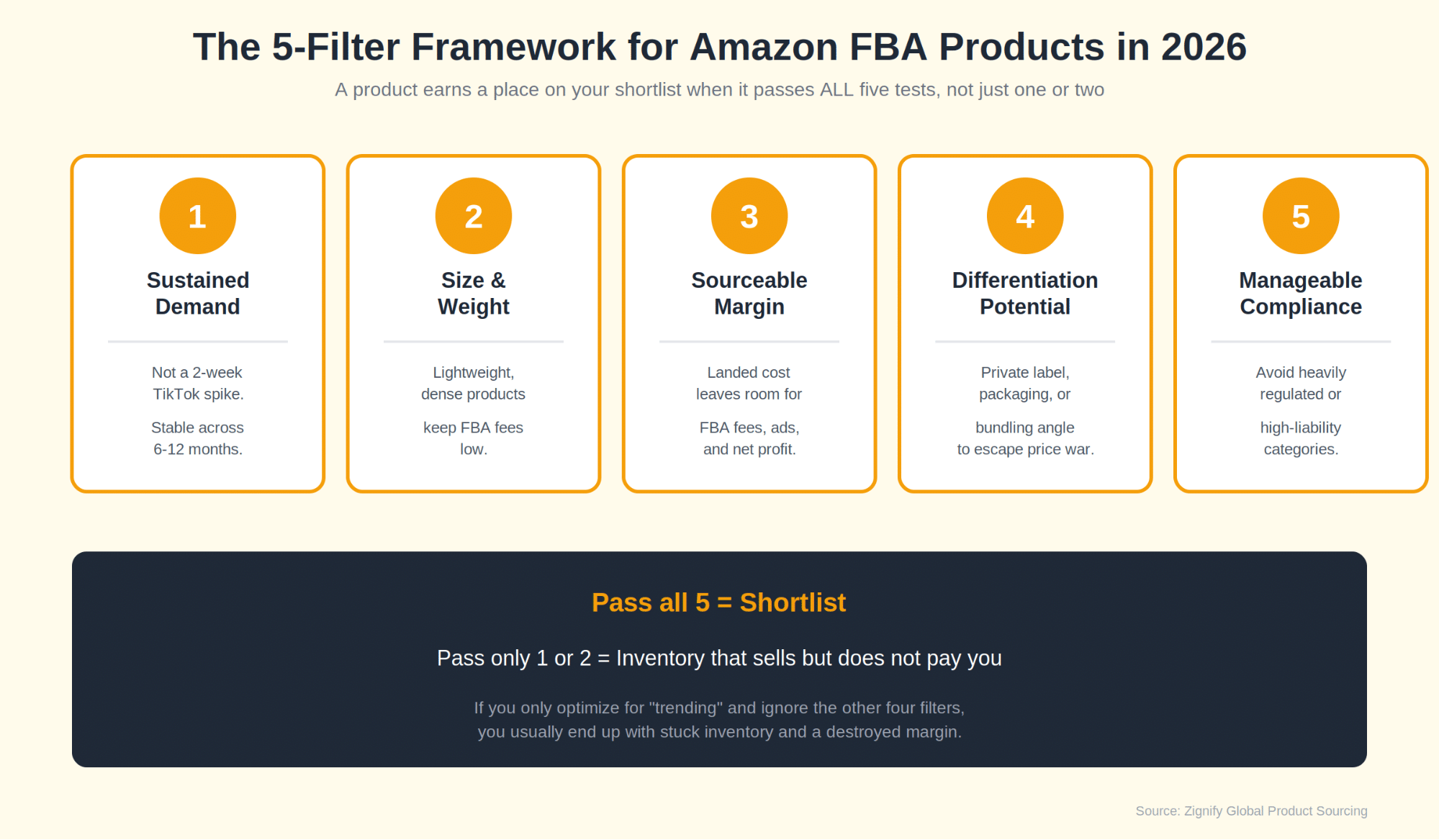
Before we get to the categories, here is the framework that experienced sellers and procurement teams use to filter ideas. A product earns a place on your shortlist when it passes all five of these tests, not just one or two.
Strong, sustained demand: not a 2-week TikTok spike, but consistent search and sales volume across at least 6 to 12 months.
Reasonable size and weight: lightweight, dense products keep FBA fees and shipping costs low and protect your margin.
Sourceable at a real margin: a target landed cost that leaves room for FBA fees, advertising, returns, and a healthy net profit.
Differentiation potential: an angle for private label, packaging upgrades, bundling, or feature improvements, so you are not stuck competing on price alone.
Manageable compliance and liability: avoid heavily regulated categories or products with high return and safety risk if you do not have the resources to manage them properly.
If you only optimize for “trending” and ignore the other four, you usually end up with inventory that sells, but does not pay you.
Figure: The five filters every Amazon FBA product should pass before it earns a place on your shortlist.
Top Trending Product Categories to Sell on Amazon FBA in 2026
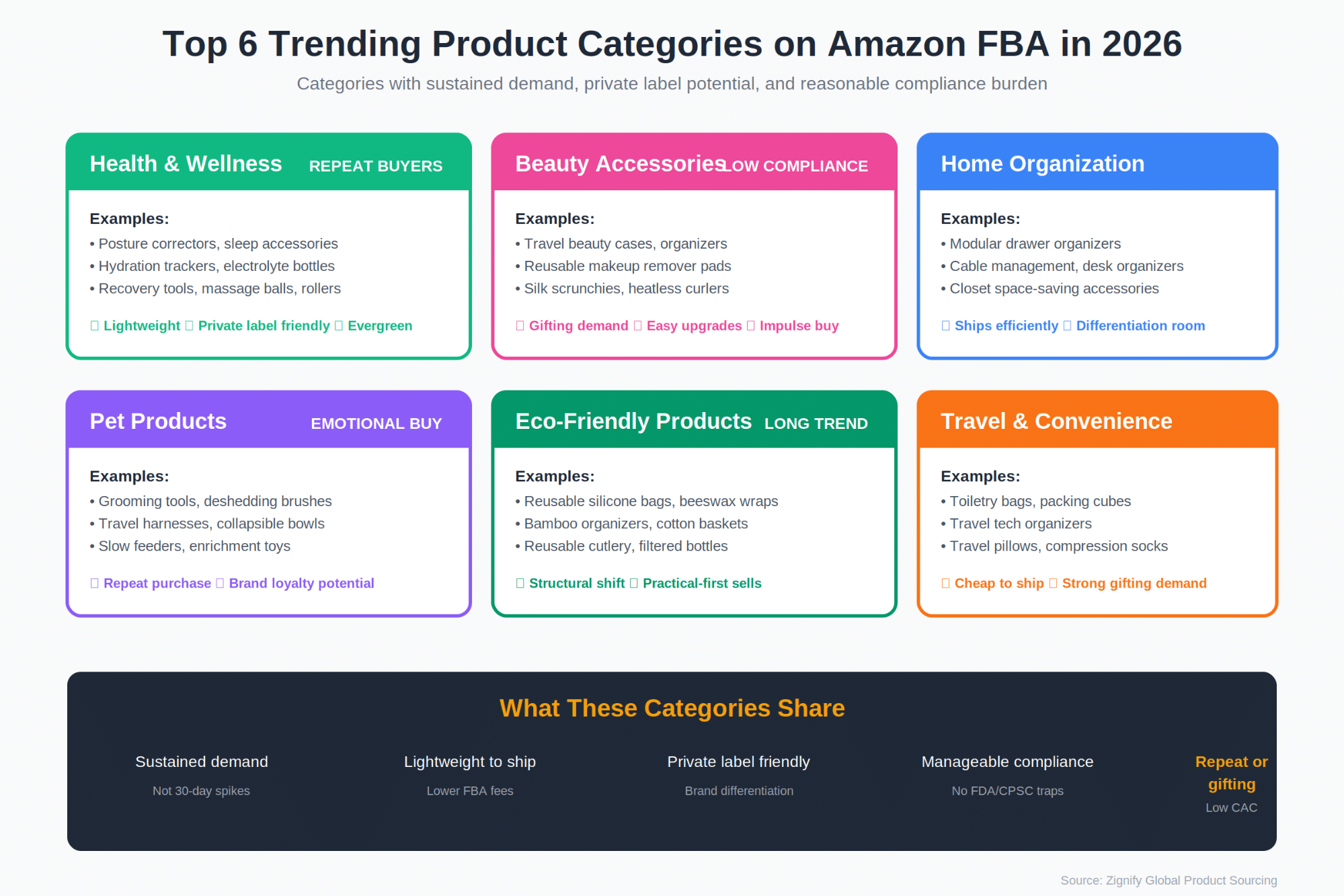
These categories have strong, sustained demand on Amazon in 2026, work well for private labels, and reward sellers who pay attention to sourcing fundamentals. Treat them as starting points, not finished product ideas. The real work happens when you narrow down to a specific SKU, validate the margin, and find the right supplier.
Figure: Top Trending Product Categories to Sell on Amazon FBA in 2026
Health and Wellness Products
Health and wellness is one of the most consistent growth categories on Amazon, and it has been for years. Buyers in this space tend to repurchase, which is exactly the behavior you want.
Strong subcategories in 2026 include:
Posture correctors and back support tools.
Sleep accessories such as eye masks, contoured pillows, and silk sleep covers.
Hydration trackers, electrolyte bottles, and insulated drinkware.
Wellness organizers, pill cases, and supplement caddies.
Recovery tools such as massage balls, fascia rollers, and percussion accessory kits.
Sourcing reality: most of these products are lightweight, easy to private label, and compatible with branded packaging. Be careful with products that move into medical or therapeutic claims territory, because compliance and liability requirements increase significantly.
Beauty and Personal Care Accessories
Beauty is enormous on Amazon, but the smart sourcing play in 2026 is not lipstick or skincare formulations. Those involve formulation development, stricter testing requirements, and category-specific compliance obligations. The smarter play is beauty accessories.
Examples include:
Travel beauty cases and cosmetic organizers.
Reusable makeup remover pads and cleansing tools.
Hair accessories such as silk scrunchies, heatless curlers, and styling tools.
Eco-friendly beauty packaging, like bamboo brushes and refillable containers.
Why it works: lightweight, low compliance burden, strong impulse purchase behavior, and consistent gifting demand. These are also some of the easiest categories for private label upgrades through better packaging or bundling.
Home Organization Products
Home organization remains one of the most reliable sellers on Amazon and is often underestimated by new sellers chasing more “exciting” categories.
Subcategories to look at:
Modular drawer organizers and pantry storage.
Cable management trays, cord wraps, and desk organizers.
Under-sink and bathroom storage solutions.
Closet space-saving accessories.
Strategic angle: these products often ship efficiently, private label well, and can be differentiated through dimensions, material upgrades, and packaging design. The category is competitive, so success in 2026 usually comes from meaningful improvements in quality, functionality, packaging, or bundling rather than copying existing listings.
Pet Products
Pet ecommerce is one of the most emotional and repeat-purchase-driven categories on Amazon. Owners spend, even when they are cutting back elsewhere.
Strong subcategories include:
Grooming accessories such as deshedding tools, nail grinders, and bath gloves.
Travel accessories, seatbelts, harnesses, and collapsible bowls.
Feeding accessories, slow feeders, and storage containers.
Enrichment toys and chew-resistant alternatives.
Sourcing watchpoint: pet safety matters. Cheap suppliers cut corners on materials, and a single batch of weak stitching or toxic dye can cost you your reviews and your account. Quality control is not optional here.
Eco-Friendly and Sustainable Products
Eco-friendliness is no longer a trend. It is a structural shift in how consumers buy, especially in the United States, the EU, and Australia. The products that win in 2026 are the ones that are practical first and sustainable second.
Examples:
Reusable kitchen products such as silicone bags, beeswax wraps, and stainless steel containers.
Sustainable packaging supplies for other e-commerce sellers.
Eco-friendly storage products such as cotton baskets and bamboo organizers.
Travel sustainability products, reusable cutlery sets, and compact filtered bottles.
Strategic note: trend longevity here is excellent. Consumers generally respond better to practical, well-designed products where sustainability supports the value proposition rather than dominating the branding.
Travel and Convenience Products
Travel categories have rebounded hard, and lightweight convenience products consistently perform well on Amazon because they are inexpensive to ship and easy to position as gifts.
Examples include:
Compact toiletry bags and packing cubes.
Travel tech organizers for cables and small electronics.
Portable storage solutions such as foldable laundry bags and shoe pouches.
Lightweight convenience products such as travel pillows and compression socks.
Why this category rewards good sourcing: shipping economics are favorable, customization options through fabric, color, and packaging are wide open, and it is one of the best categories for differentiation through small, smart product improvements.
Reliable product sourcing starts here
Work with experts who help you evaluate suppliers and reduce risk.
Where to Source Trending Amazon FBA Products in 2026
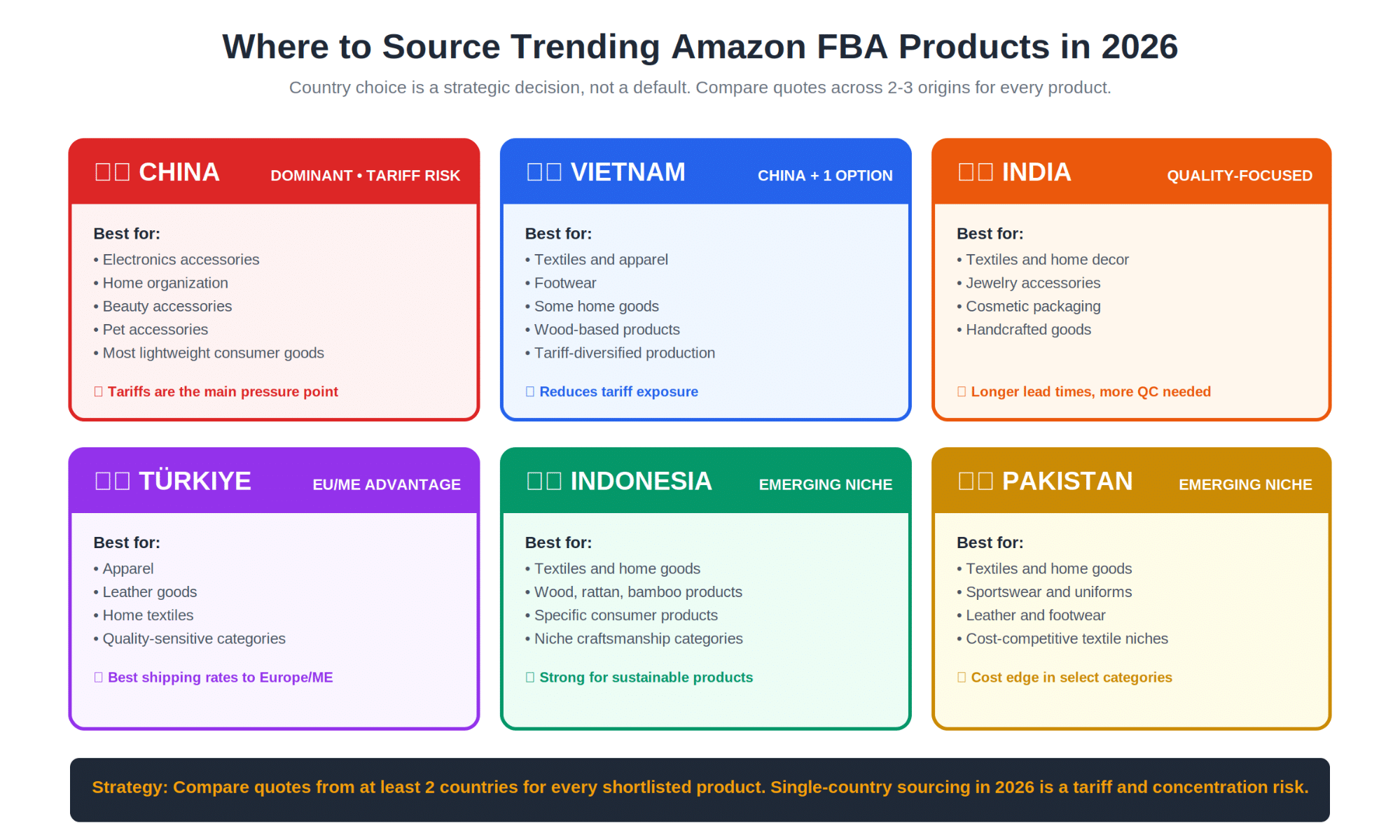
Country choice is a strategic decision in 2026, not a default. Picking the right origin can mean the difference between a workable margin and a product that loses money on every unit. Here is a brief overview of where each category tends to source best, based on our experience.
Figure: Where to source which categories in 2026, and the strategic strengths of each country.
China remains dominant for: electronics accessories, home organization, beauty accessories, pet accessories, and most lightweight consumer goods. The supplier base is enormous, and unit costs are usually the lowest. Tariffs are the main pressure point.
Vietnam is increasingly competitive for: textiles, apparel, footwear, some home goods, and certain wood-based products. It is a strong “China plus one” option to reduce tariff exposure.
India works well for: textiles, home decor, jewelry accessories, and certain cosmetic packaging. Lead times can be longer, and quality control needs more attention than in China.
Türkiye is strong for: apparel, leather goods, and some home textiles, especially for sellers in Europe and the Middle East, where shipping costs are favorable.
Indonesia and Pakistan are emerging in specific niches, particularly textiles, home goods, and certain consumer products.
How to Source a Trending Product the Right Way: Step by Step
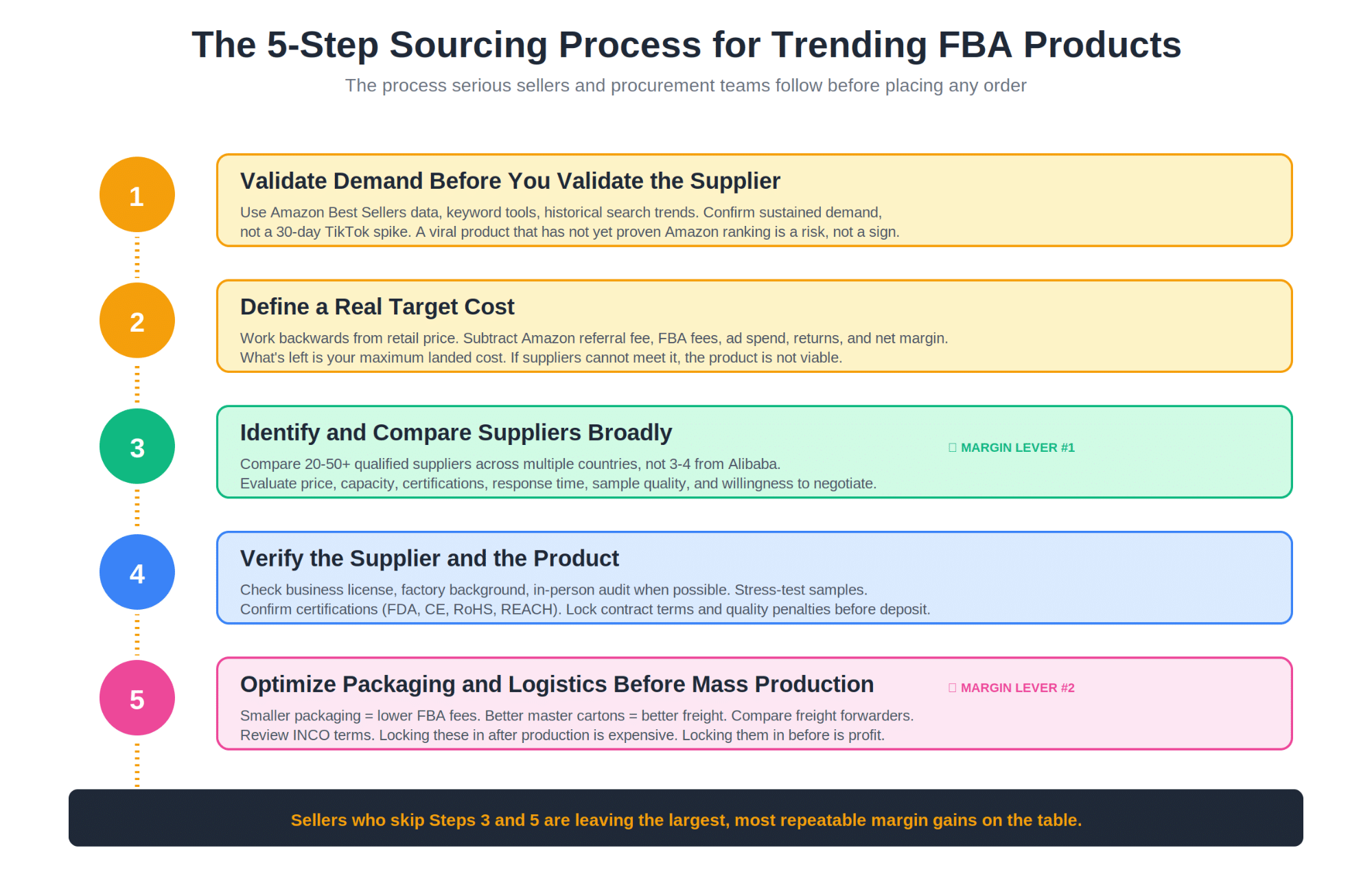
This is where most “trending products” articles fall apart. They tell you what to sell, then leave you to figure out how to actually source it. Here is the process experienced sellers and serious procurement teams follow.
Figure 4: The 5-step sourcing process. Steps 3 and 5 are where the largest, most repeatable margin gains live.
Step 1: Validate Demand Before You Validate the Supplier
Before you message a single factory, confirm the product has real, sustained demand. Use Amazon’s Best Sellers data, keyword tools, and historical search trends to confirm the product is not a 30 day spike. A product trending only on TikTok or Instagram has not yet proven it can sustain Amazon ranking.
Step 2: Define a Real Target Cost
Calculate what you can pay per unit and still make a profit. Work backwards from your target retail price and subtract Amazon referral fees, FBA fees, advertising spend, returns, and your desired net margin. The number you are left with is your maximum target purchasing price. If suppliers cannot meet that price, the product is not viable, no matter how trendy it is.
Step 3: Identify and Compare Suppliers Broadly
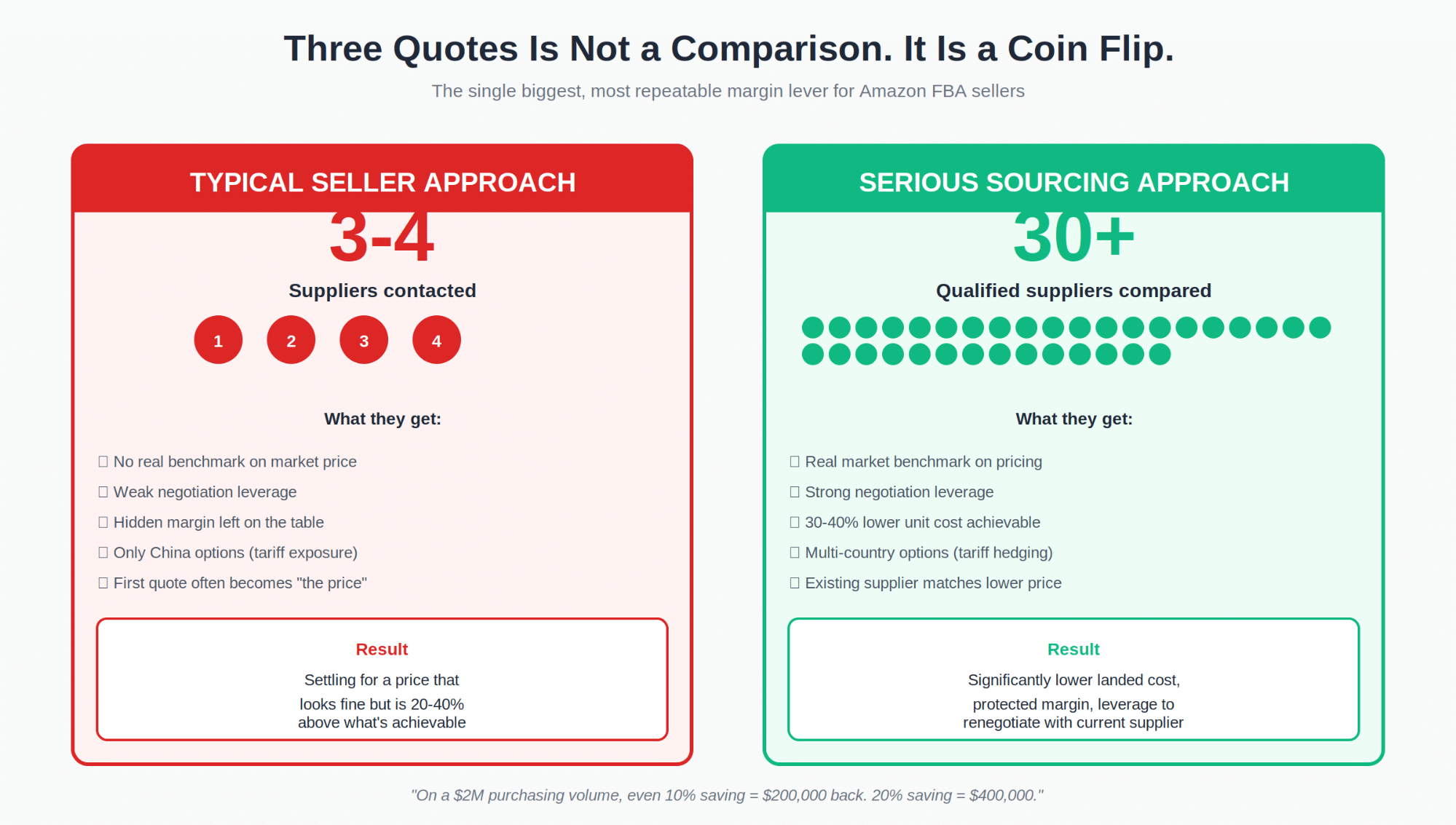
This is where most sellers cut their own margins. They contact 3 or 4 suppliers from Alibaba, take the best quote of those few, and call the job done. Serious sourcing teams compare 20 to 50+ qualified suppliers across multiple countries before negotiating, because more options always create more leverage.
A real comparison should evaluate not only price, but also factory size, production capacity, certifications, response time, sample quality, and willingness to negotiate.
Figure: The difference between contacting a few suppliers and running a serious comparison
Step 4: Verify the Supplier and the Product
Cheap quotes are easy to find. Reliable, compliant suppliers are not. Before placing any meaningful order:
Verify the supplier’s legitimacy with business license checks, factory background research, and, where possible, an in-person audit.
Order samples and stress test them against your specifications.
Confirm the supplier can meet relevant certifications for your category and target country, such as FDA, CE, RoHS, REACH, or category-specific safety standards.
Review the contract, payment terms, and penalties for delays or quality failures.
Sellers who skip this step are the ones who post angry reviews about Alibaba scams and “ghost factories” six months later.
Step 5: Optimize Packaging and Logistics Before Mass Production
This is the step that separates serious sellers from amateurs. Packaging and logistics are not afterthoughts. They are profit levers.
Packaging design affects FBA dimensional weight and storage fees. A small reduction in box size can cut your fulfillment costs significantly across thousands of units. Even small dimensional improvements can materially reduce FBA fulfillment fees and freight costs across high-volume SKUs.
Master carton size and pallet efficiency affect freight cost, container utilization, and warehouse fees.
Shipping method, INCO terms, and freight forwarder choice can swing your landed cost dramatically. In one of our cases, comparing logistics providers reduced container shipping cost from around 4,200 USD to around 1,900 USD per container. Across multiple containers per year, that is real money.
If you skip this step, you are leaving a margin on the table that you will not get back later.
Reliable product sourcing starts here
Work with experts who help you evaluate suppliers and reduce risk.
The Biggest Mistakes Sellers Make With Trending Products
In our work helping Amazon sellers source products, we see the same mistakes repeatedly. Avoid these, and you remove most of the risk.
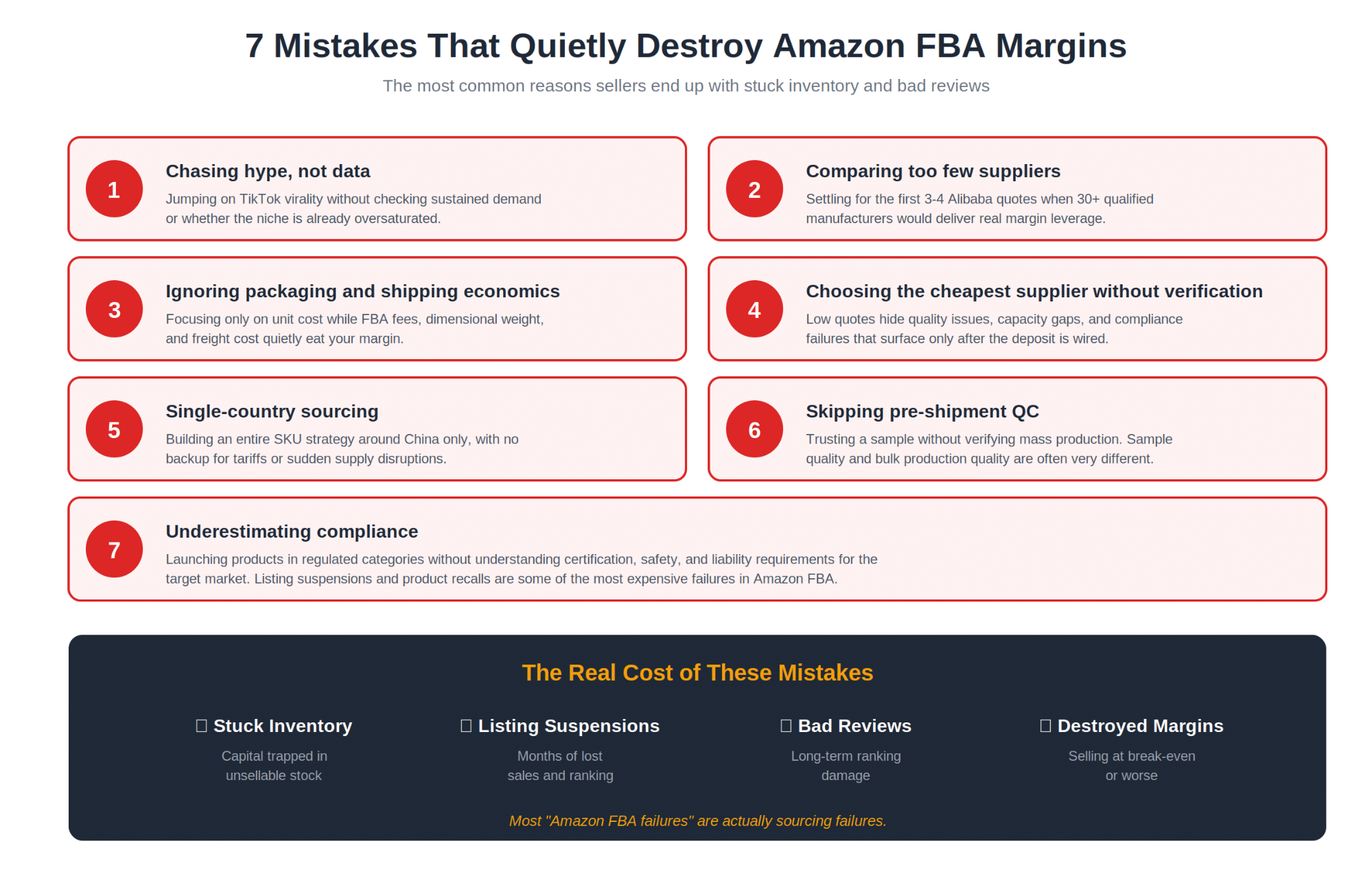
Figure: The seven sourcing mistakes that most often reduce Amazon FBA profitability.
Chasing hype, not data: jumping into a product because it went viral on TikTok last week, without validating sustained demand or checking whether the niche is already saturated.
Comparing too few suppliers: settling for the first 3 or 4 Alibaba quotes when there are dozens of qualified manufacturers worth comparing.
Ignoring packaging and shipping economics: focusing only on unit cost and forgetting that FBA fees, dimensional weight, and freight cost can quietly destroy your margin.
Choosing the cheapest supplier without verification: low quotes often hide quality problems, capacity issues, or compliance gaps that surface only after you have wired the deposit.
Single-country sourcing: building an entire SKU strategy around China only, with no backup plan for tariffs, supply disruptions, or sudden price increases.
Skipping pre-shipment QC: trusting a sample without verifying mass production quality. Sample quality and bulk production quality are often very different.
Underestimating compliance: launching products in regulated categories without understanding certification, safety, and liability requirements for your target market.
These are not theoretical. These are the most common reasons Amazon sellers end up with stuck inventory, suspended listings, and bad reviews that they cannot recover from.
For a deeper look at this topic, you may want to read our step-by-step guide to sourcing products for Amazon FBA.
Reliable product sourcing starts here
Work with experts who help you evaluate suppliers and reduce risk.
Why Sourcing Strategy Matters More Than the Product Trend Itself
Here is the harder truth: most “trending products” articles will not tell you. Two sellers can pick exactly the same product on the same day. Twelve months later, one is doing seven figures with healthy margins, and the other has quietly shut down. The difference is rarely the product. It is the sourcing strategy behind it.
A real sourcing strategy in 2026 does the following:
Compares many qualified suppliers, not three. The leverage you get from comparison is the single biggest source of margin improvement available to most sellers.
Sources from multiple countries when it makes sense. Pure China sourcing is now a tariff and concentration risk for many categories.
Treats packaging as a profit lever. Smarter packaging means lower FBA fees, better unit economics, and stronger shelf appeal.
Treats logistics as a profit lever. Multiple freight quotes, better INCO terms, and consolidation can shift thousands of dollars back to your bottom line per shipment.
Builds in quality control and compliance from day one, not as an afterthought after a return spike.
If you ignore the sourcing strategy and only focus on the product trend, you are competing on price in a saturated category, and competing only on price becomes increasingly difficult as categories mature and advertising costs rise.
How Zignify Helps Amazon FBA Sellers Source Trending Products in 2026
Zignify is a global product sourcing partner for Amazon sellers, manufacturers, and procurement teams. We are not a manufacturer. We are not a trading company. We do not earn factory commissions or supplier-side kickbacks. Our entire model is buyer-aligned.
Here is how we typically support Amazon FBA sellers working on trending products:
Product hunting and trend validation: helping you separate sustainable trends from short-term hype, with honest input on saturation, margins, and category competition.
Broad supplier search: comparing many qualified suppliers across China and beyond, not just the same few names you would find on your own.
Multi-country sourcing: actively evaluating Vietnam, India, Türkiye, Indonesia, Pakistan, and other origins where they make sense for your category.
Direct supplier access: you communicate with the supplier, you pay the supplier directly, and there are no hidden trading margins on top of factory prices.
Quality control and compliance: pre-production checks, in-line inspections, and pre-shipment QC, plus support on certifications and documentation.
Packaging and logistics optimization: practical input on packaging design, master carton sizing, freight comparisons, and INCO terms.
Mass production management: keeping production on schedule, on quality, and on cost.
The model is simple. Our clients pay us for research, supplier qualification, and project management. They keep the savings.
On larger purchasing volumes, even modest sourcing improvements can translate into significant savings over time. And these savings often come from straightforward work: comparing more suppliers, asking better questions, and negotiating from facts.
Read more about How to Choose the Best Amazon Product Sourcing Service & FBA Agent.
Reliable product sourcing starts here
Work with experts who help you evaluate suppliers and reduce risk.
Amazon in 2026 rewards sellers who treat sourcing as a competitive advantage, not an afterthought. The categories above offer real opportunities, but only for sellers who source intelligently. Trends will keep changing. The principles will not. Pick a product with sustained demand, source it through a structured comparison process, optimize your packaging and logistics, and protect your margin from the start.
That is what serious Amazon FBA businesses look like in 2026.
What Most Guides Get Wrong, Here’s What Our Expert Knows ✅
Most “trending products on Amazon” articles miss the part that actually decides whether you make money. They focus on what is hot and ignore the sourcing economics underneath. Here are three things experienced sourcing teams know that most guides will not tell you.
⚠️ Chasing TikTok virality is one of the fastest ways to end up with stuck inventory.
A product going viral on TikTok or Instagram does not mean it has a healthy margin or a sustainable Amazon presence. By the time most sellers act on the trend, the early movers have flooded the category, ad costs have spiked, and the product is being sold at break-even or worse. The right validation is not “is it viral right now?” but “has search volume and sales velocity held up over the last 6 to 12 months, and is the niche still penetrable?” Without that filter, you are buying inventory at the worst possible point in the cycle.
💰 Comparing 3 suppliers is not sourcing. It is settling.
The single biggest, most repeatable margin lever for Amazon FBA sellers is comparing more suppliers, not better ad copy and not a fancier landing page. We have seen sellers shave 30 to 40 percent off unit cost simply by comparing 30 or 40 qualified factories instead of the 3 or 4 they would have contacted on their own. Even if you stay with your existing supplier, the leverage from a real comparison usually unlocks a better price or better terms. Most sellers leave that money on the table because they do not know what is possible until they see the data side by side.
🚢 Packaging and logistics quietly decide whether your product is profitable on Amazon.
Two sellers with the same product, same supplier, and same retail price can have very different net margins, and the reason is almost always packaging dimensions, master carton efficiency, freight forwarder choice, and INCO terms. A packaging redesign that shrinks dimensional weight by 15 percent can cut FBA fulfillment fees materially across thousands of units. A better freight quote can save thousands of dollars per container. These are not optimizations to do “later.” They should be locked in before mass production starts, because once your packaging is printed and your forwarder is chosen, switching is expensive and slow.
If you are evaluating a trending product for 2026 and want a clear view on whether the sourcing actually works, talk to a sourcing partner before you place the order. Book a free sourcing call →
Frequently Asked Questions
1. What are the top trending products to sell on Amazon FBA in 2026?
The strongest categories are health and wellness, beauty and personal care accessories, home organization, pet products, eco-friendly and sustainable products, and travel and convenience products. The reason these categories work is not that they are exciting, but that they offer sustained demand, lightweight shipping, private label potential, and reasonable compliance burden.
2. How do I identify viral product trends on Amazon before they become saturated?
Look for products where search volume and sales velocity have been climbing steadily for 6 to 12 months, not products that spiked in the last 30 days. Combine Amazon Best Sellers data, keyword tools, and category-level sales trends. If a product is already heavily promoted across TikTok and dozens of new Amazon listings, you are usually too late to enter without a strong differentiation angle.
3. How do I validate a viral product idea before launching it on Amazon?
Run three checks before you commit. First, confirm sustained demand using historical search and sales data, not just social media. Second, calculate your full landed cost, FBA fees, advertising estimate, and target margin to make sure the unit economics work. Third, check the competitive landscape on Amazon to see how many strong listings already exist and whether you have a real angle to differentiate.
4. What product categories have the highest potential for sustainable success on Amazon in 2026?
Categories with repeat purchase behavior and low to moderate compliance burden tend to perform best. Pet products, health and wellness accessories, home organization, and beauty accessories all fit this profile. They reward sellers who invest in branding, packaging, and quality, rather than competing only on price.
5. How do I calculate potential profit margins for a trending Amazon product?
Start with your planned retail price, subtract Amazon’s referral fee, FBA fulfillment fees, expected returns, advertising spend, and your target net margin. The number left is your maximum landed cost. Compare that against supplier quotes including freight, duties, and any tariffs. If your landed cost is higher than your maximum, the product does not work, regardless of how trending it is.
6. Should I source trending products from China or look at Vietnam, India, or Türkiye?
It depends on the product category and your tariff exposure. China still wins on cost and supplier base for most consumer goods. Vietnam is increasingly competitive for textiles, apparel, and certain home goods. India works well for textiles, home decor, and some packaging. Türkiye is strong for apparel and leather goods, especially for European buyers. The smartest approach in 2026 is to compare quotes from at least two countries before committing.
7. What are common sourcing mistakes new Amazon sellers make in 2026?
The biggest mistakes are: comparing too few suppliers, choosing the cheapest quote without verification, ignoring packaging and shipping economics, building a single-country supply chain, skipping pre-shipment quality control, and underestimating compliance requirements for their target market. Each of these can quietly destroy a launch.
8. How can a sourcing partner like Zignify actually help me find a profitable Amazon FBA product?
Zignify supports product hunting and trend validation, broad supplier search across multiple countries, supplier verification, quality control, packaging optimization, and logistics negotiation. The point is not to “do it for you” as a black box, but to give you direct access to a much larger pool of qualified suppliers, side-by-side comparisons, and experienced negotiation. Clients pay suppliers directly, and Zignify does not earn supplier-side commissions, helping keep incentives aligned with the buyer.