For most brands and procurement teams, supplier diversification stopped being a theoretical conversation somewhere between the first round of tariffs, the first factory shutdown, and the first quarter where freight rates doubled overnight. It became a survival question. The challenge is that “diversification” has been reduced to a single phrase in most boardrooms, namely “we need to move out of China,” and that framing has caused a wave of expensive, reactive sourcing decisions that often increase risk instead of reducing it.
From what we’ve seen, the companies that rushed to “leave China” without running the numbers usually ended up paying more somewhere else, either in quality problems, delays, or hidden logistics costs. Diversification should make your supply chain stronger, not just different
This guide walks through what supplier diversification actually means when it is done well. You will see why it is a profitability strategy as much as a risk strategy, where companies usually go wrong, how to build a diversified supplier base that holds up operationally, and how the math works out in real cases where buyers compared more suppliers, restructured production, and protected their margins in the process.
Reliable product sourcing starts here
Work with experts who help you evaluate suppliers and reduce risk.
Why Companies Are Diversifying Their Supply Chains
The push toward supplier diversification is not driven by one trend. It is the result of several pressures arriving at the same time, and most procurement teams are trying to manage them with sourcing networks built for a much more stable era. A lot of sourcing structures were built for a world where freight was predictable, tariffs were stable, and factories always had capacity. That world is gone.
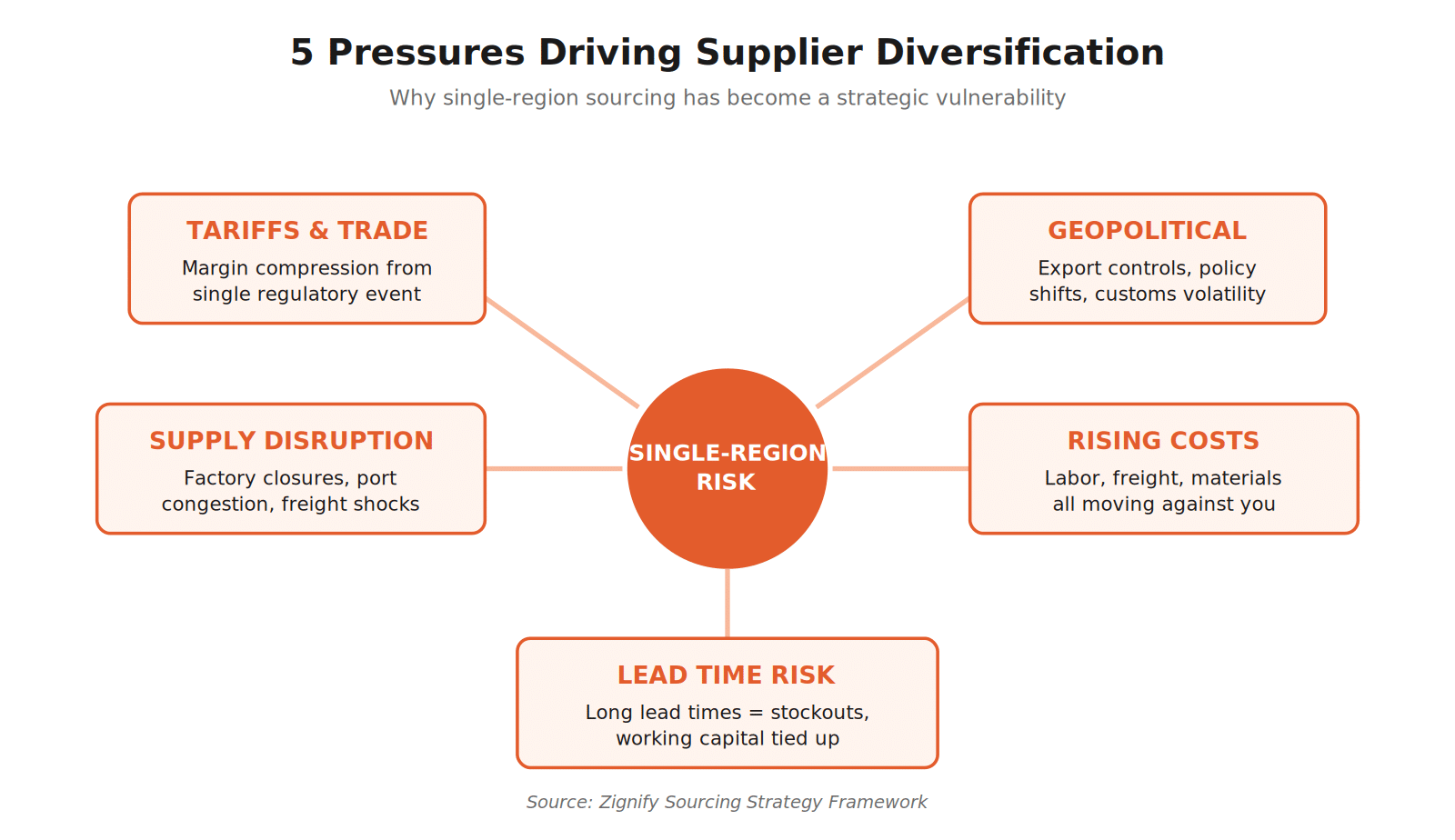
Five concurrent pressures making single-region sourcing a strategic vulnerability
Tariffs and Trade Tensions
Tariffs can quickly destroy margins and make single-country sourcing risky. Diversifying suppliers across multiple regions helps protect businesses from sudden regulatory and import cost changes.
Geopolitical and Policy Uncertainty
Export controls, trade policies, and customs changes can disrupt sourcing overnight. Multi-country sourcing reduces dependency and creates stronger negotiation leverage.
Pandemic-Era Supply Chain Lessons
COVID exposed the risks of relying on one sourcing region. Companies with diversified supplier networks were able to adapt faster when factories, ports, and logistics systems faced disruptions. COVID was basically a stress test for global procurement. The companies with backup suppliers survived. The ones without them spent months firefighting.
Rising Manufacturing and Logistics Costs
Labor, freight, and material costs continue to fluctuate globally. A diversified supplier base allows companies to compare sourcing options instead of accepting constant cost increases from one supplier.
Lead Time as a Competitive Advantage
Long lead times create inventory pressure and lost sales. Diversifying suppliers can improve production flexibility, shorten lead times, and reduce reliance on large safety stock levels.
Why Diversification Is Not the Same as Leaving China
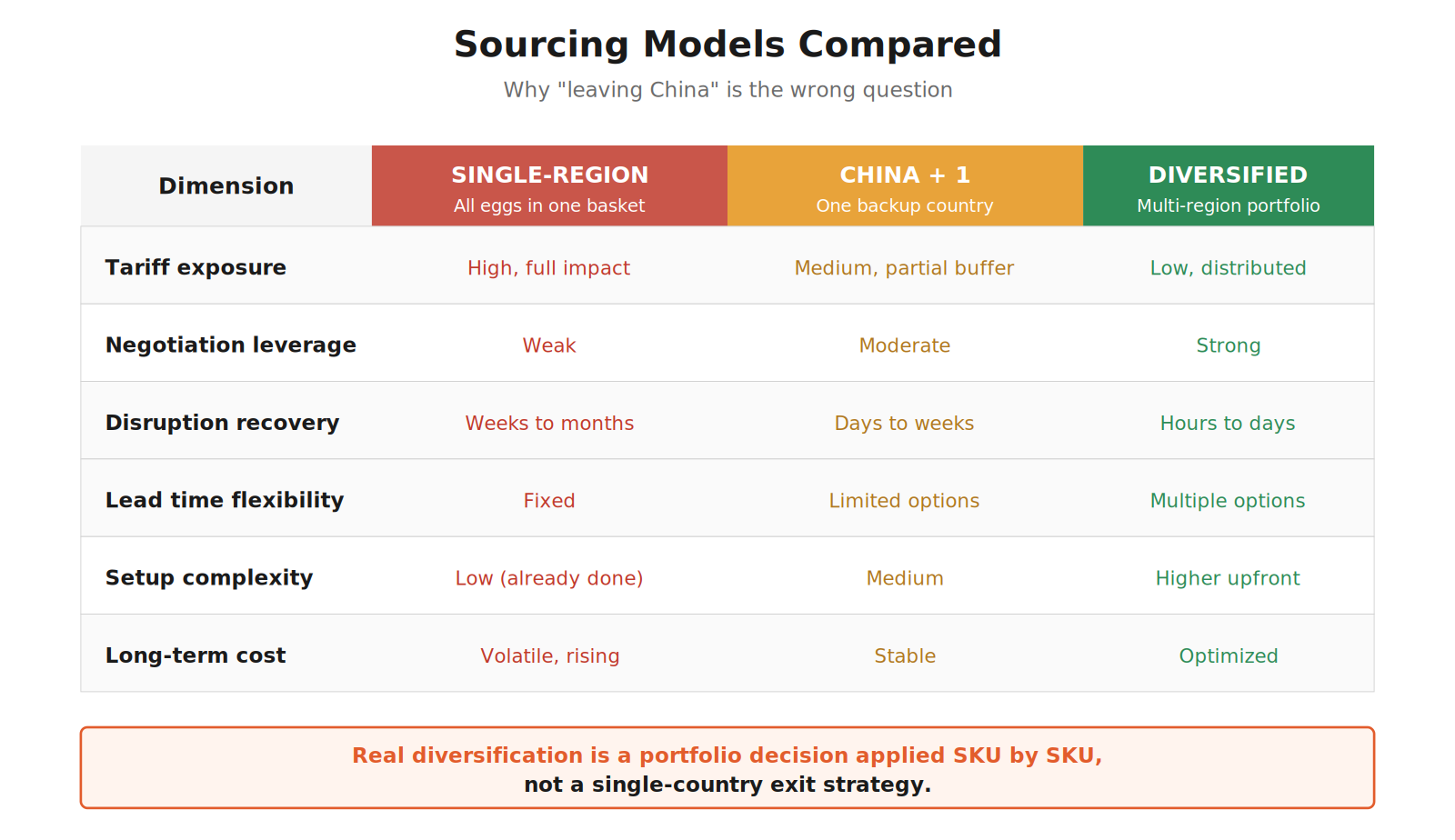
This is one of the most important distinctions in modern sourcing strategy, and it is where most reactive decisions go wrong. Smart supplier diversification is not replacing China entirely. It is reducing dependency on any single sourcing region while improving flexibility, cost control, and operational resilience.
How single-region, China plus one, and diversified sourcing models compare across the dimensions that actually move the P&L.
China still offers genuine advantages for many product categories: deep manufacturing ecosystems, mature component supply chains, scale, technical capability, and competitive unit costs that newer hubs cannot yet match. Walking away from those advantages without a clear strategy can damage product quality and inflate costs more than tariffs ever did.
A balanced approach looks more like this:
Keep China where it genuinely outperforms on cost, quality, or capability.
Add a qualified alternative in another country for the categories most exposed to tariffs or disruption.
Build redundancy for high-risk SKUs so that no single event takes a product line offline.
Continuously evaluate the trade-off between unit cost, lead time, tariff exposure, and quality consistency.
This is what “China plus one” actually means in practice. It is not a slogan. It is a portfolio decision applied SKU by SKU. The best sourcing strategies are rarely ideological. They’re practical. Keep what works, reduce what’s risky, and build flexibility into the system.
Reliable product sourcing starts here
Work with experts who help you evaluate suppliers and reduce risk.
The Biggest Mistakes Companies Make When Diversifying Suppliers
After watching enough diversification projects up close, the same mistakes repeat. Most are not about the chosen country. They are about how the decision was made.
Reacting to Headlines Instead of Numbers
Many companies shift sourcing strategies based on headlines rather than real cost analysis. Without evaluating landed cost, lead times, quality risk, and supplier capacity, diversification decisions often create new problems instead of solving old ones. If your sourcing strategy changes every time the news cycle changes, you don’t really have a sourcing strategy.
Comparing Far Too Few Suppliers
Comparing only a few suppliers does not provide a real market view. Broader supplier comparisons create stronger pricing benchmarks, better negotiation leverage, and access to higher-quality manufacturers.
Weak Supplier Vetting
New sourcing regions bring new risks, including hidden subcontracting, inconsistent quality, and unreliable production capacity. Proper supplier verification is critical before scaling production.
No Backup Manufacturing Capacity
Using only one supplier in a new country is not true diversification. Real resilience requires backup manufacturing options so production can continue if one supplier fails.
Switching Countries Without Calculating Landed Cost
Many companies focus only on factory pricing and ignore freight, duties, packaging, certifications, and lead-time costs. Diversification decisions should always be based on total landed cost, not unit price alone.
Underestimating Supplier Onboarding Complexity
New supplier onboarding takes time and includes sampling, compliance checks, tooling, contract negotiation, and production testing. Rushing the process often creates expensive problems later. The first production order tells you more about a supplier than ten sales calls ever will. That onboarding phase is where most hidden issues surface.
Reliable product sourcing starts here
Work with experts who help you evaluate suppliers and reduce risk.
How to Build a Diversified Supplier Base That Actually Works
A practical diversification strategy is built in stages. The goal is not to move everything, it is to remove fragility from the parts of the business that cannot afford to be fragile.
This is where a lot of companies go wrong. They try to rebuild the whole supply chain at once instead of focusing on the SKUs and suppliers that would hurt the business the most if they failed.
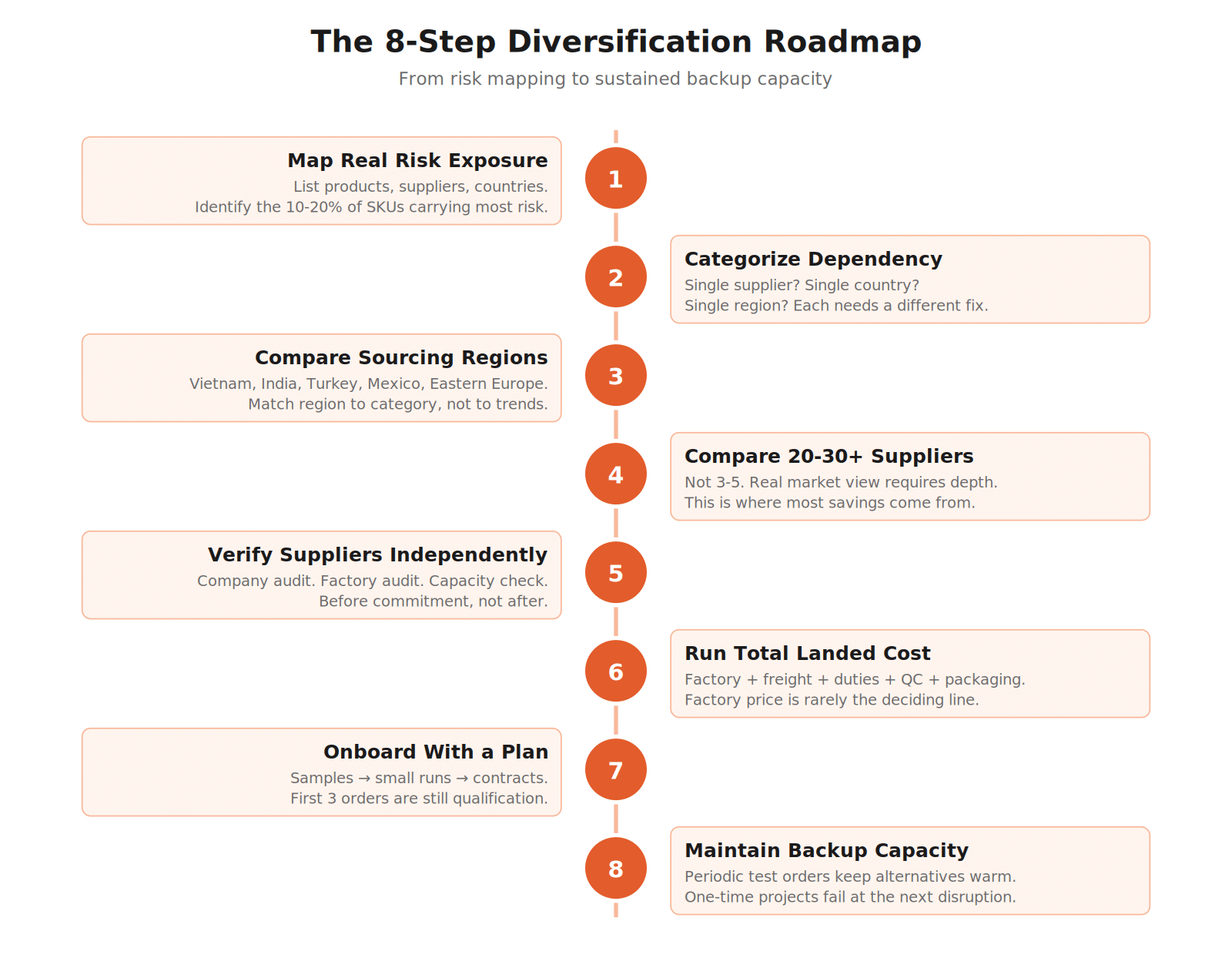
The 8-step roadmap, from mapping risk exposure to maintaining backup capacity over time.
Step 1: Map Your Real Supply Chain Risk
Start by identifying your key SKUs, suppliers, sourcing countries, and how much revenue depends on each one. Most companies discover that a small number of products create the majority of their supply chain risk, which helps prioritize where diversification matters most.
Step 2: Categorize Supplier Dependency
Understand whether your risk comes from relying on a single supplier, a single country, or an entire region. Each type of dependency requires a different strategy, from adding backup factories to expanding into completely new sourcing regions.
Step 3: Compare Sourcing Regions Strategically
Different countries have strengths in different product categories. The right sourcing region depends on factors like manufacturing expertise, lead times, trade advantages, tariffs, and logistics efficiency — not simply what is currently trending.
Step 4: Compare More Suppliers Than You Think You Need
Strong supplier diversification requires broad supplier comparison. Looking at significantly more manufacturers gives better pricing benchmarks, stronger negotiation leverage, and access to suppliers you would not find through a limited search. This is honestly one of the biggest hidden advantages in sourcing. The more supplier data you collect, the harder it becomes for weak pricing or weak factories to hide.
Step 5: Verify Suppliers Before Committing
Supplier verification is critical when entering new sourcing regions. Confirm the factory’s legitimacy, production capacity, compliance standards, and operational stability before moving forward with production.
Step 6: Evaluate Total Landed Cost
Do not focus only on unit pricing. Compare the full landed cost, including freight, duties, packaging, certifications, lead times, and quality control costs. A cheaper factory price does not always create a lower total cost. Read more about Total Landed Cost
Step 7: Onboard Suppliers With a Structured Plan
Use phased onboarding with product samples, trial production runs, inspections, and clear contracts covering quality standards, lead times, and payment terms. The first few orders should be treated as part of supplier qualification. That’s where you learn how the supplier performs when real pressure hits timelines and quality targets.
Step 8: Maintain Backup Manufacturing Capacity
Supplier diversification is an ongoing process, not a one-time project. Keep alternative suppliers active for critical SKUs so your business can respond quickly when disruptions, pricing changes, or supply issues occur.
Reliable product sourcing starts here
Work with experts who help you evaluate suppliers and reduce risk.
Best Countries for Supply Chain Diversification by Category
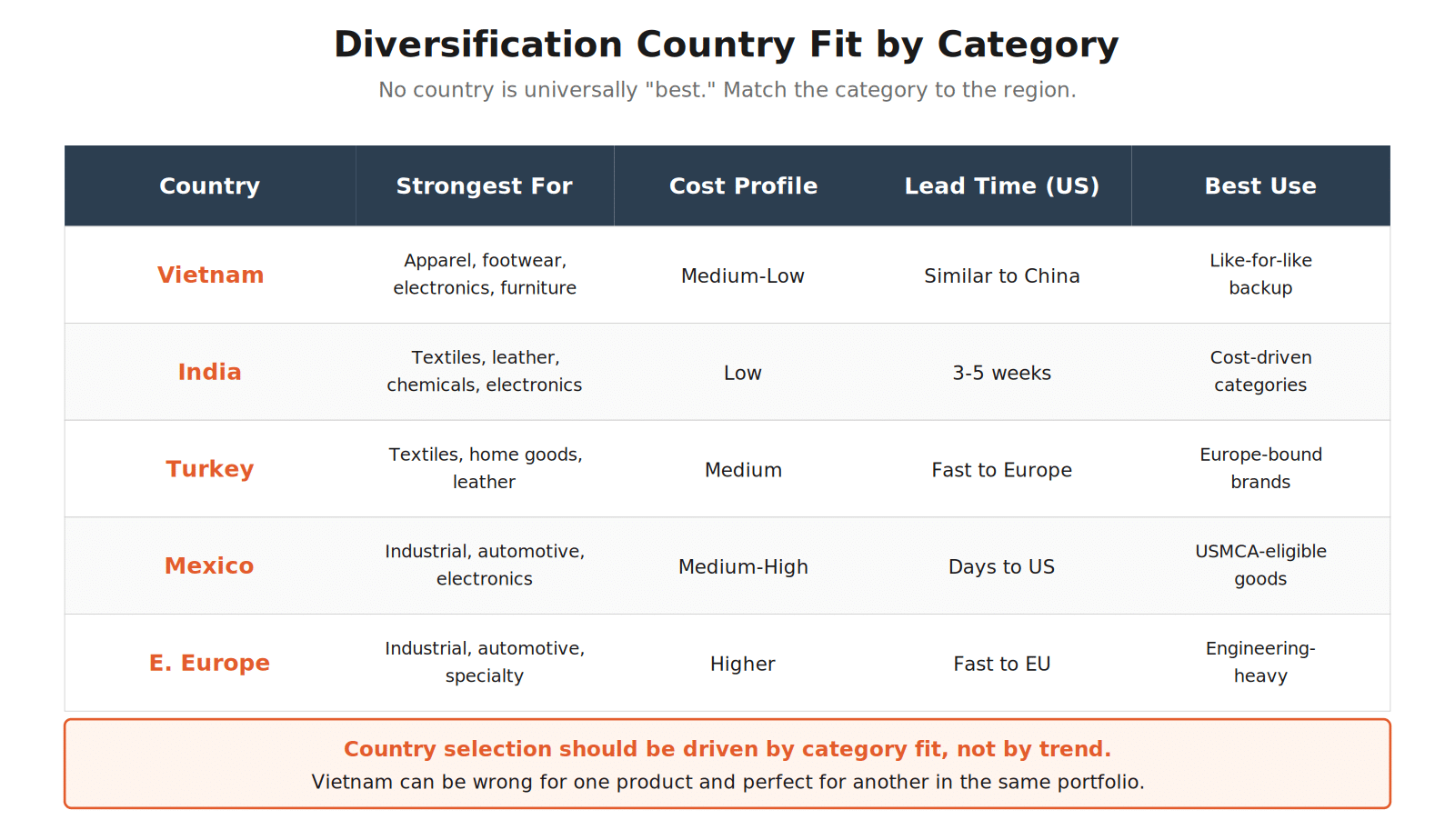
There is no universal “best” alternative to China. Different categories find their best fit in different countries, and the right answer depends on cost, capability, lead time to your end market, and trade access. The right sourcing country depends on the product, not the trend cycle.
Sourcing country fit by category, lead time, and best-use case. Pick by category, not by trend.
Vietnam
Strong in apparel, footwear, furniture, electronics assembly, and consumer goods. Vietnam is one of the closest alternatives to China for many product categories, with mature manufacturing infrastructure and favorable trade access. Read more about Guide to Sourcing Products in Vietnam
India
Well known for textiles, garments, leather goods, chemicals, and growing electronics production. Costs can be competitive, but supplier quality and consistency vary widely, making supplier vetting especially important. India can be extremely competitive, but the supplier quality spread is wide. Proper vetting there is not optional. Read more about Guide to Source Product from India
Turkey
A strong option for textiles, home goods, and leather products, especially for European markets. Its location helps reduce lead times and freight costs compared to Asian sourcing routes. For European buyers especially, Turkey can solve both lead time and freight pressure at the same time. Read more about Guide to Source Product from Turkey
Mexico
Increasingly attractive for North American supply chains thanks to shorter lead times and USMCA trade benefits. Strong in industrial products, automotive, electronics, and selected consumer goods. Mexico is powerful for the right categories. Read more about Guide to Source Product from Mexico
Countries like Indonesia, Thailand, Bangladesh, Cambodia, and Malaysia each offer strengths in specific industries, from textiles and consumer goods to electronics and automotive manufacturing. Smaller sourcing hubs are getting stronger every year. Some of the best opportunities right now are in countries buyers are still overlooking.
Reliable product sourcing starts here
Work with experts who help you evaluate suppliers and reduce risk.
This part rarely makes it into the marketing decks, but it is one of the largest financial benefits of diversification. When a supplier knows they are your only realistic option, they price accordingly. Lead times slip and quality issues take longer to resolve, because they know you cannot easily walk away. The relationship is structurally tilted in their favor.
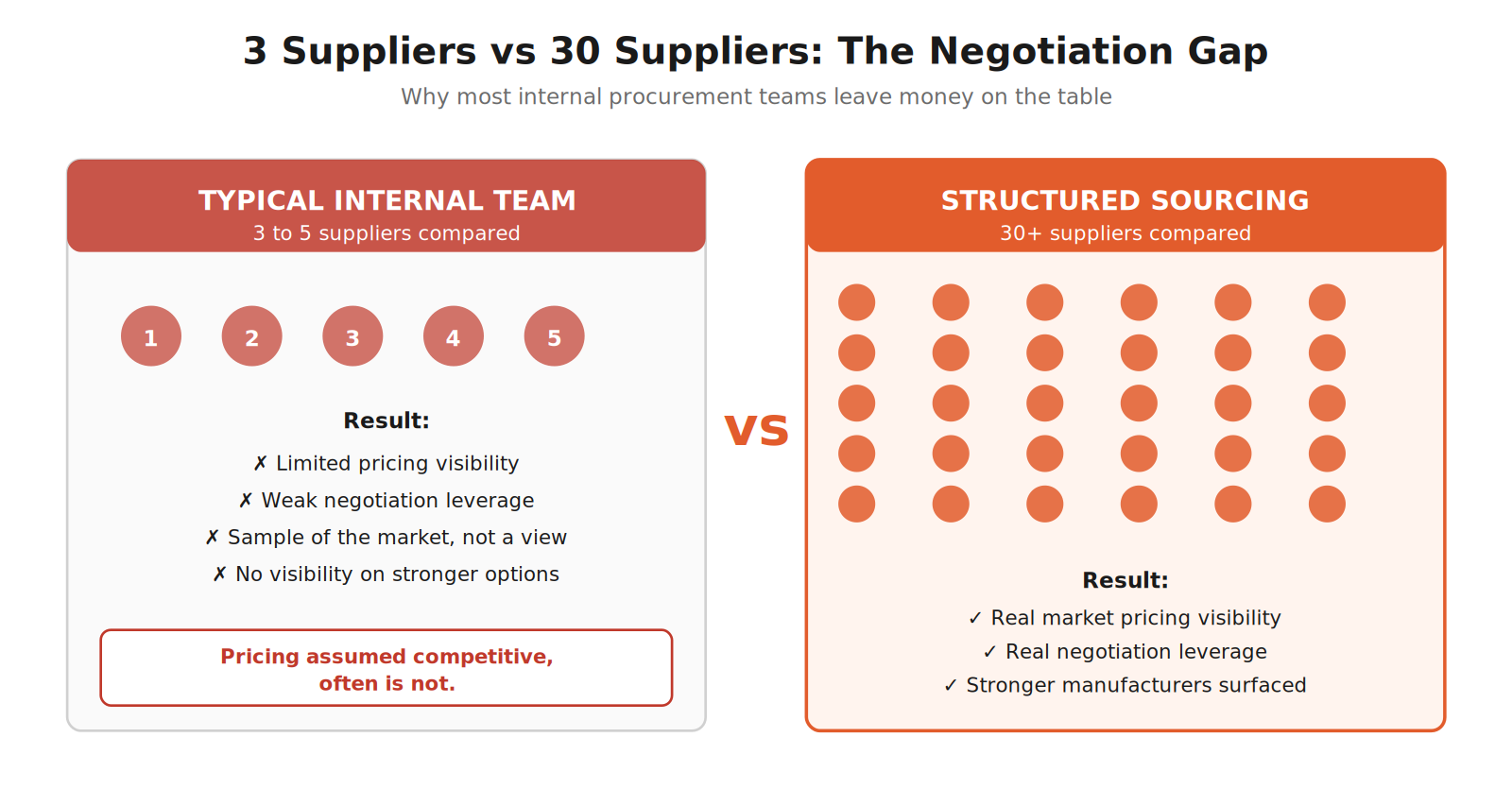
Comparing 3 to 5 suppliers vs 30+ suppliers, and what the depth of comparison actually changes for negotiation.
When a supplier knows they are being compared against real alternatives, the conversation changes. Pricing tightens. Service levels improve. Issue resolution speeds up. Even if you never actually move volume to the alternative, the existence of the alternative protects your margin and your operational position. This is one of the most underrated returns on a diversification project.
The same logic applies in the other direction. A supplier you have never given a meaningful order to is unlikely to prioritize you when capacity is tight. Diversification works best when alternatives are kept genuinely warm with periodic test orders, real communication, and active relationship management. Factories prioritize active customers. If you disappear for a year and come back during a crisis, you’re not getting top priority production slots.
Why Companies Work With Zignify on Supplier Diversification
Most companies do not lack the will to diversify. They lack the bandwidth, the supplier reach, and the procurement infrastructure to do it well. This is the gap Zignify fills, and the role we play is deliberately on the buyer’s side.
A few things shape how Zignify approaches diversification projects:
Country agnostic sourcing. We source inside China, outside China, and across multiple regions. The recommendation is driven by where your category performs best, not by a fixed narrative about any country.
Broad supplier comparison. We typically approach 30 or more potential producers per category instead of three to five. More comparisons produce better pricing, stronger negotiation leverage, and a clearer view of which suppliers are genuinely capable.
Direct supplier access for the client. You pay the factory directly. You hold the relationship. You can verify everything. There is no hidden margin embedded in the supplier price.
No factory commissions, no bribes. Zignify does not take commissions or kickbacks from factories. The team is paid by you, which keeps incentives aligned. We are sometimes proudly kicked out of factories that expect bribes, which is a feature, not a bug.
Structured supplier verification. Company audits, factory audits, and capacity checks happen before commitments, not after. This is where most reactive diversification projects go wrong, and where most savings are protected or lost.
Total landed cost focus. Decisions are evaluated across factory price, packaging, freight, duties, compliance, and quality cost. Not just the unit price line.
Quality control built into production, not just samples. Mass production quality is verified before final payment, which protects both the cost saving and the reputation of the brand. Sample quality means nothing if mass production collapses later. Production QC is where brand protection actually happens.
Transparent process, not a black box. Regular updates, full visibility, and pricing tracked to the work delivered.
Reliable product sourcing starts here
Work with experts who help you evaluate suppliers and reduce risk.
Zignify Real Case Studies on Supplier Diversification
The following sourcing projects show what strategic supplier diversification can achieve when companies compare more suppliers, evaluate total landed cost properly, and restructure sourcing based on long-term operational goals instead of reacting to short-term goal.
Diversification is not “finding another factory.” It is restructuring risk, pricing power, and operational flexibility at the same time. When done properly, it usually improves margin and resilience together, not one at the expense of the other
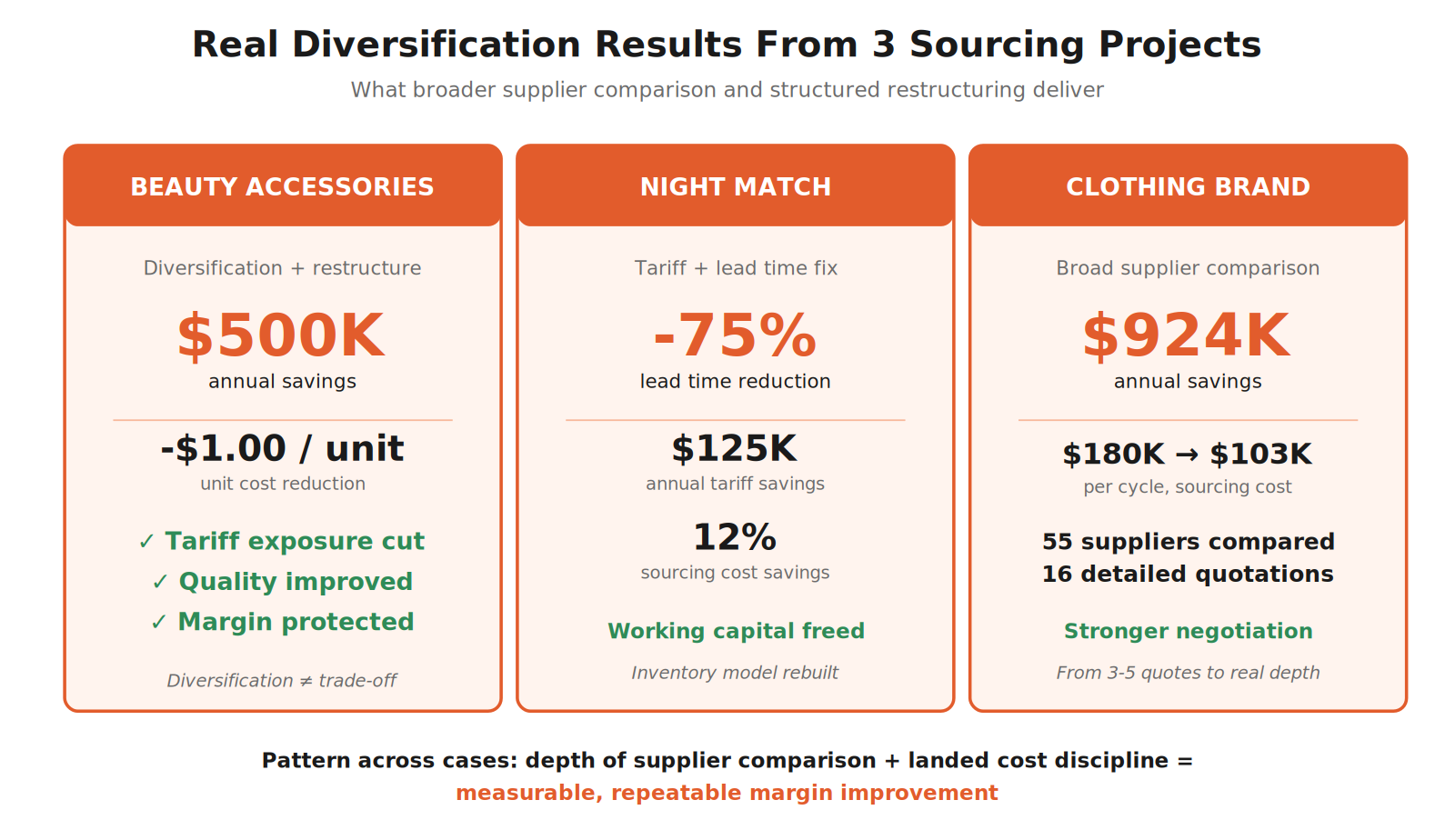
Three real diversification projects and the financial results they delivered.
Case Study 1: Beauty Accessories Brand
The brand was facing rising tariff exposure on a category produced entirely in one region. Production was restructured across new suppliers, partly outside the original country, cutting unit cost by around one US dollar and delivering roughly 500,000 US dollars in annual savings while improving quality. The takeaway: diversification was not about leaving a region, it was about building a setup that was cheaper, more resilient, and better quality at the same time.
Case Study 2: Night Match
A consumer brand with concentrated tariff exposure and long lead times went through a structured diversification process. The result was a 75 percent lead time reduction, roughly 12 percent in sourcing savings, and around 125,000 US dollars in annual tariff savings. The shorter lead time alone freed significant working capital, and the project paid for itself many times over inside the first year.
Case Study 3: Clothing Brand
The brand was working with a small supplier set and assumed pricing was already competitive. A structured process evaluated 55 suppliers and gathered 16 detailed quotations. Sourcing cost per cycle dropped from 180,000 to 103,000 US dollars, with around 924,000 US dollars in annual savings. No magic, just broader supplier comparison and disciplined negotiation.
What These Case Studies Have in Common
Across all three, the same pattern shows up. Real diversification value comes from comparing more suppliers, modeling landed cost properly, and building a balanced footprint, not from reacting to a single tariff headline. The savings are not theoretical and the framework is repeatable.
The Opportunity Ahead
Companies that take supplier diversification seriously over the next two years are setting themselves up for a structural advantage. Margins protected from tariff swings. Supply continuity through disruptions that competitors cannot absorb. Stronger negotiation positions in every category. Faster lead times where it matters. The companies that do this well rarely talk about it, because they are too busy compounding the advantage.
The companies that delay are betting that the next disruption will be smaller than the last. That bet has not aged well in any of the past several years. The biggest mistake we see is waiting until a disruption is already underway. Once factories are overloaded or tariffs hit, every buyer suddenly starts looking for alternatives at the exact same time. Diversification works best when you build it before you desperately need it.
What Most Guides Get Wrong, Here’s What Our Expert Knows ✅
Most diversification guides talk about countries, frameworks, and acronyms. They rarely talk about the operational details that determine whether the project actually saves money or quietly costs more. These are the points buyers usually only learn after a painful first attempt.
⚠️ Diversification numbers usually fall apart on the landed cost line, not the factory price line.
Buyers compare factory prices, see a lower number in another country, and approve the move. Then freight, duties, certifications, longer lead times, and quality cost quietly add back what they thought they saved. The honest evaluation always runs on total landed cost, including working capital tied up in longer lead time inventory. Skip that math and the project looks great in slide three and disappointing in the financials.
🚩 A backup supplier with no real orders is not a backup, it is a placeholder.
Buyers often qualify a second supplier, place one small test order, then forget about them for a year. When the actual disruption happens, that supplier has reassigned capacity, lost interest, or quietly drifted on quality. Real backup capacity requires periodic small orders, active communication, and treating the relationship as ongoing rather than dormant. The cost of keeping a backup warm is small. The cost of discovering at the wrong moment that it was never really warm is much larger. This is extremely true in practice. Factories prioritize active customers. If you disappear for 12 months and suddenly come back during a supply chain crisis asking for urgent capacity, you are not going to the front of the line.
💡 The biggest savings in diversification rarely come from the country switch.
They come from comparing many more suppliers than the previous procurement process did, and from negotiating from a position of real alternatives. Companies that move from comparing three suppliers to comparing thirty almost always find double-digit cost reductions, regardless of whether they end up moving country at all. The country decision matters, but the supplier comparison process matters more, and most internal teams are not set up to run comparisons at that depth. Deep supplier comparison takes time, follow-up, negotiation, verification, and a lot of filtering. But this is usually where the real savings are hiding.
If your business is exposed to a single supplier or single country and you want to know what real diversification would look like for your specific categories, Book a free sourcing call →
Frequently Asked Questions
1. What is supplier diversification?
Supplier diversification is the practice of building production and sourcing capacity across multiple suppliers, regions, or countries to reduce concentration risk and improve commercial flexibility. The goal is not to move away from any one country, but to make sure no single disruption can stop your business or compress your margin.
2. What are the benefits of supplier diversification for small to mid-size companies?
The main benefits are stronger negotiation leverage, lower concentration risk, and protection from tariff or freight shocks. Smaller companies often feel disruptions harder than large enterprises because they have less inventory cushion, which makes diversification a meaningful operational and financial advantage even at modest scale.
3. How do I start a supplier diversification initiative?
Start by mapping which SKUs and product lines carry the most risk if disrupted, then categorize whether the dependency is on a single supplier, single country, or single region. Each level requires a different fix. Once you know where the real risk sits, you can prioritize a small number of high-impact categories instead of trying to diversify everything at once.
4. What are the biggest risks of not diversifying my supplier base?
Single-source dependency creates supply continuity risk, weak negotiation leverage, and direct exposure to tariffs, freight volatility, and policy changes. The cost is rarely visible until something breaks, but when it breaks the impact usually shows up in lost sales, emergency air freight, and compressed margin all at once.
5. What are the best practices for evaluating new suppliers when diversifying?
Compare significantly more suppliers than your team usually does, verify each one independently rather than relying on websites or marketing materials, and evaluate them on total landed cost rather than factory price alone. Run small test orders before committing to volume, and treat the first three orders as part of qualification, not routine business.
6. How does supplier diversification affect contract negotiations?
Diversification improves negotiation in two ways. Suppliers who know they are being compared against real alternatives tend to price tighter and respond faster on issues. The presence of a credible second source also makes pricing pressure structural rather than situational, because the supplier knows volume can move if needed.
7. Is supplier diversification just “moving out of China”?
No, and treating it that way usually leads to worse outcomes. Smart diversification keeps China where it genuinely outperforms on cost, quality, or capability, and adds qualified alternatives in other regions for categories most exposed to tariffs or disruption. It is a portfolio decision applied SKU by SKU, not a single country exit.
8. What are the cost implications of supplier diversification?
In well-run projects, total landed cost typically goes down because broader supplier comparisons unlock better pricing and tariff exposure is reduced. In poorly run projects, costs can go up if companies move on factory price alone without modeling freight, duties, certifications, and lead time impact. The difference is almost always in the depth of the analysis, not the country chosen.
9. How many suppliers should I compare for each product category?
Most internal procurement teams compare three to five suppliers, which is usually too few to find the real market price or the strongest manufacturers. Comparing 20 to 30 or more suppliers per category gives a much more reliable view, exposes pricing extremes, and produces stronger negotiation leverage. The depth of comparison is one of the highest-value parts of any diversification project.
10. How do I measure if my supplier diversification strategy is working?
Track concentration metrics, such as the share of revenue dependent on any single supplier or country, total landed cost per category, lead time stability, quality consistency, and tariff exposure as a percentage of cost of goods. A working diversification strategy reduces concentration over time, holds or improves quality, and produces measurable improvements in landed cost or operational resilience, ideally both.