Most Amazon and e-commerce sellers do not struggle to find suppliers. They struggle to find the right suppliers at the right long-term cost. Many sellers open Alibaba, Faire, or DHgate, contact a few vendors, accept the first reasonable quote, and stop there. Months later, margins tighten, packaging costs climb, and competitors somehow land at significantly lower landed costs on the same product category.
This guide is for sellers who want to do better. It walks through the best wholesale websites for Amazon FBA and eCommerce sellers in 2026, what each one is actually useful for, where their limitations start to bite, and when it is time to move beyond marketplace sourcing into direct factory relationships. The goal is simple: help you understand the full landscape so you can build a sourcing strategy that protects your margins for years, not just for your first order.
Need help with your product sourcing?
Get practical advice tailored to your product, suppliers, and market form Zignify experts
Why Wholesale Sourcing Strategy Matters More in 2026 Than Ever Before
Wholesale sourcing in 2026 is not the same game it was three years ago. Tariffs have shifted. Freight costs have moved. Supplier reliability has become unpredictable. And the gap between sellers who source well and sellers who source casually has widened to the point where it decides who stays in business.
Several structural shifts changed wholesale sourcing over the last few years:
Tariff exposure: Sellers relying entirely on China-based sourcing are increasingly exposed to tariff volatility, geopolitical risk, and changing freight economics.
Marketplace saturation: Faire, Alibaba, and DHgate are flooded with sellers buying the exact same products. Differentiation is harder, and resale margins are thinner.
Supplier quality variance: Many “verified” suppliers on wholesale marketplaces are trading companies rather than actual manufacturers. Pricing carries hidden intermediary margins.
Logistics complexity: Shipping, customs, and packaging now make up a larger percentage of landed cost than most sellers track.
Sellers who treat wholesale websites as the entire sourcing strategy are competing in the most crowded part of the market. Sellers who use those websites as a starting point, then graduate into direct supplier relationships, are the ones improving their margins year over year. The difference between the two groups is not the budget. It is a process.
Reliable product sourcing starts here
Work with experts who help you evaluate suppliers and reduce risk.
What Makes a Good Wholesale Website for Amazon and eCommerce Sellers
Before we get into specific platforms, it is worth defining what actually matters. Not all wholesale websites are built for the same buyer, and the wrong fit costs more than just money. It costs time, inventory mistakes, and sometimes account suspensions on Amazon if a supplier turns out to be selling counterfeits.
Strong wholesale platforms generally offer:
Supplier transparency: You can see who you are actually buying from, not just a storefront name.
Verified manufacturer status: The platform distinguishes between factories, trading companies, and resellers.
MOQ flexibility: Minimum order quantities that match where you are in your business, not where the seller wishes you were.
Clear shipping options: Predictable lead times, freight pricing visibility, and customs documentation.
Communication infrastructure: Built-in messaging, contracts, and dispute resolution.
Product category depth: Enough supplier coverage in your niche that you can compare offers, not just take the first one.
A wholesale website that scores well on these factors is a useful tool. A platform that scores poorly is a fast way to lose money on inventory you cannot resell or cannot import.
The Best Wholesale Websites for Amazon FBA and eCommerce Sellers in 2026
This is not a ranked list. Different platforms serve different sellers at different stages. What matters is matching the platform to your actual sourcing situation.
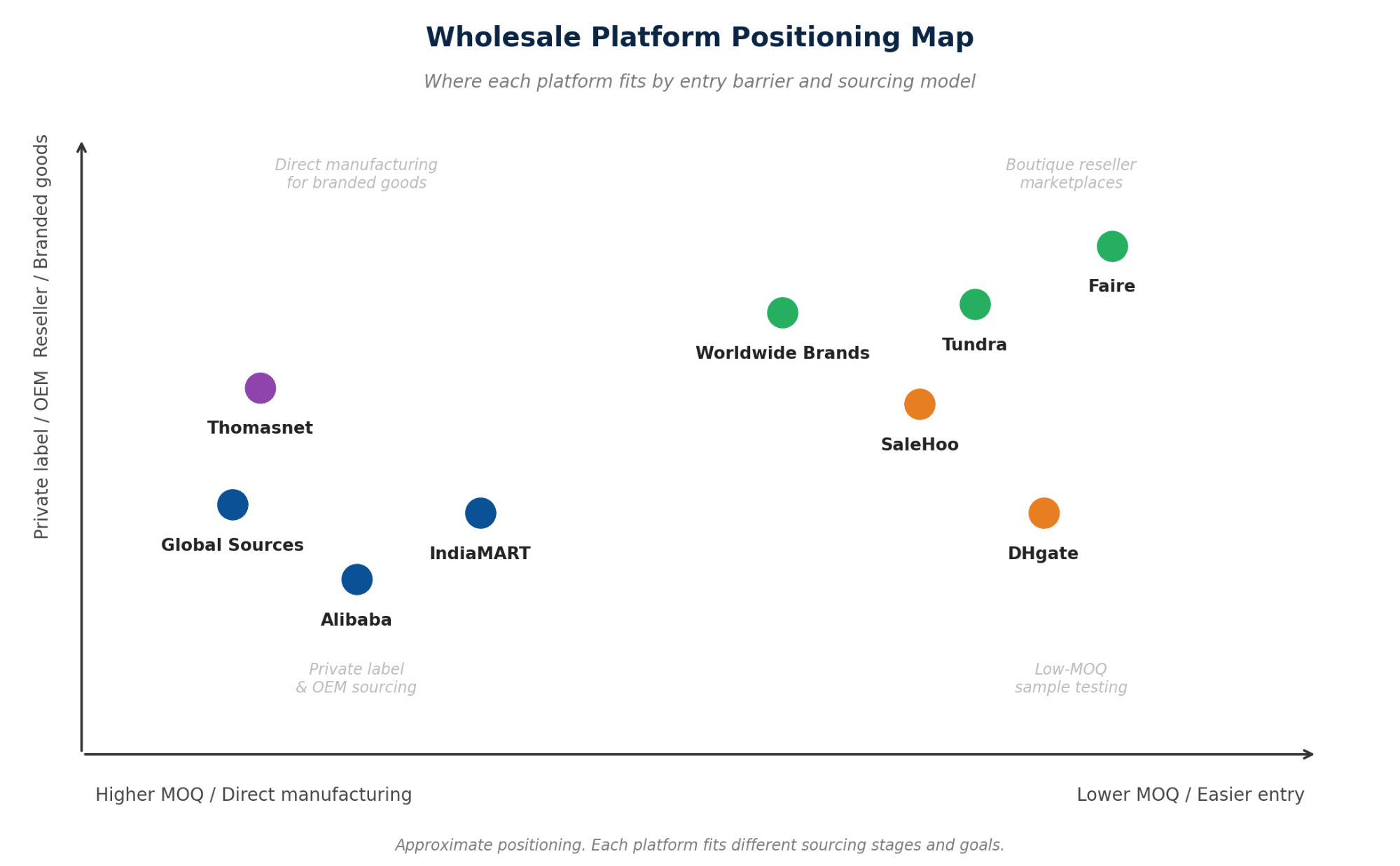
Each platform below serves a different sourcing model. Some are better for private label manufacturing, others for branded resale or domestic sourcing.
Figure: Where each major wholesale platform sits by entry barrier and sourcing model
Faire is one of the most searched wholesale platforms for boutique and lifestyle sellers, and the reason is straightforward. It curates suppliers, focuses on smaller independent brands, and offers low minimums with net 60 payment terms for qualified retailers.
Best for: Boutique eCommerce, Etsy sellers, gift shops, and small lifestyle brands.
Strengths: Curated supplier base, low MOQ entry, attractive credit terms, strong design-led inventory.
Limitations: Limited customization, you are buying finished, branded goods rather than building your own. Margins are constrained because you are reselling someone else’s brand. Other retailers on Faire are buying the same SKUs, so differentiation is difficult.
Reality check: Faire is excellent for getting started or for brands that intentionally curate other brands. It is not ideal for sellers building custom private-label products or aiming for deep manufacturing control.
Alibaba remains the largest B2B sourcing platform in the world. For Amazon FBA sellers, it is often the first point of contact with manufacturers in China and increasingly in Vietnam, India, and Pakistan.
Best for: Private label sellers, FBA sellers needing OEM manufacturing, and brands testing new product categories.
Strengths: Enormous supplier pool, broad product categories, MOQ flexibility on many items, Trade Assurance protection.
Limitations: A significant portion of the “manufacturers” listed are actually trading companies adding a 5 to 20 percent margin. Verification is inconsistent. Pricing on the platform is not the floor; it is the starting point for negotiation. Sellers who accept initial quotations without broader comparison often pay more than necessary.
Reality check: Alibaba is a discovery tool, not an optimized sourcing channel. The platform shows you suppliers. It does not show you the right supplier or the right price.
Global Sources is Hong Kong-based and skews toward verified manufacturers, particularly in electronics, fashion accessories, and home products. It is more selective than Alibaba and runs major trade shows that connect buyers with factory teams directly.
Best for: Electronics sellers, established Amazon brands, buyers who want fewer trading companies in their results.
Strengths: Higher concentration of actual factories, strong electronics depth, good supplier verification.
Limitations: Fewer suppliers overall than Alibaba. Less coverage outside of China. MOQs tend to be higher.
Thomasnet is a North American manufacturer directory used heavily by industrial buyers. It is not a marketplace in the traditional sense, more a directory for finding US and Canadian suppliers.
Best for: Brands that want US-made products, industrial components, and made-in-America positioning.
Strengths: Verified North American manufacturers, strong industrial categories, useful for compliance-sensitive products.
Limitations: Higher unit costs than Asian sourcing. Smaller selection. Not ideal for general consumer goods at scale.
IndiaMART is India’s largest B2B marketplace and has become more relevant as sellers diversify away from China-only sourcing.
Best for: Textiles, apparel, leather goods, jewelry, home textiles, and agricultural products.
Strengths: Strong textile and apparel base, competitive pricing for India-strong categories, growing English language support.
Limitations: Communication can be inconsistent. Quality verification on the platform is weaker than that of Alibaba. Logistics infrastructure from India is generally less mature than China’s for many product categories.
SaleHoo is a paid supplier directory aimed at beginner eCommerce and Amazon sellers. It vets suppliers and provides a curated list rather than open access.
Best for: New sellers learning the basics of sourcing, dropshippers, and hobby-scale resellers.
Strengths: Vetted suppliers, beginner-friendly tools, low entry barrier.
Limitations: Margins are typically thinner because most listed suppliers are distributors rather than manufacturers. Not built for scale.
DHgate is a China-based B2B and B2C marketplace that allows much smaller orders than Alibaba, sometimes single units.
Best for: Sample testing, very low MOQ buying, trend testing, and dropshippers.
Strengths: Tiny MOQs, fast onboarding, broad product variety.
Limitations: Quality is highly variable. Pricing is rarely competitive at scale because most sellers are middlemen. Not appropriate for serious Amazon FBA inventory at volume.
Worldwide Brands is a directory of certified wholesale suppliers and dropshippers, mainly in the United States.
Best for: US-based dropshippers, small Shopify stores, sellers who want US-domestic suppliers.
Strengths: Verified suppliers, US-based, dropship-friendly.
Limitations: One-time fee model. Margins are constrained because most suppliers are distributors.
Tundra positions itself as a no-fee wholesale marketplace for retailers, with a focus on smaller US brands and boutique inventory.
Best for: Boutique retailers, gift shops, and smaller eCommerce brands looking for branded inventory.
Strengths: No commission fees for buyers, curated suppliers, strong US brand focus.
Limitations: Smaller catalog than Faire. Limited international scaling.
Reliable product sourcing starts here
Work with experts who help you evaluate suppliers and reduce risk.
Where Most Wholesale Websites Source From: Geography Matters More Than You Think
Geography is one of the most overlooked variables in wholesale sourcing. Two suppliers selling the same product on the same platform can have completely different cost structures, lead times, and tariff exposures depending on where they actually manufacture.
Here is the rough geographic reality of where wholesale platforms source from:
Alibaba and Global Sources: Predominantly China, with growing supplier bases in Vietnam, Pakistan, Bangladesh, India, and Turkey.
Faire, Tundra, Worldwide Brands: Predominantly the United States and Europe, with smaller suppliers of branded finished goods.
IndiaMART: India, with strength in textiles, leather, jewelry, and home goods.
DHgate: Predominantly China, including a high volume of resellers.
Thomasnet: North America, primarily the United States and Canada.
Why does this matter? Because in 2026, single-country sourcing is a vulnerability. A seller who sources only from China is one tariff change away from a margin crisis. A seller who sources only domestically is paying a premium that may not be sustainable as competitors diversify.
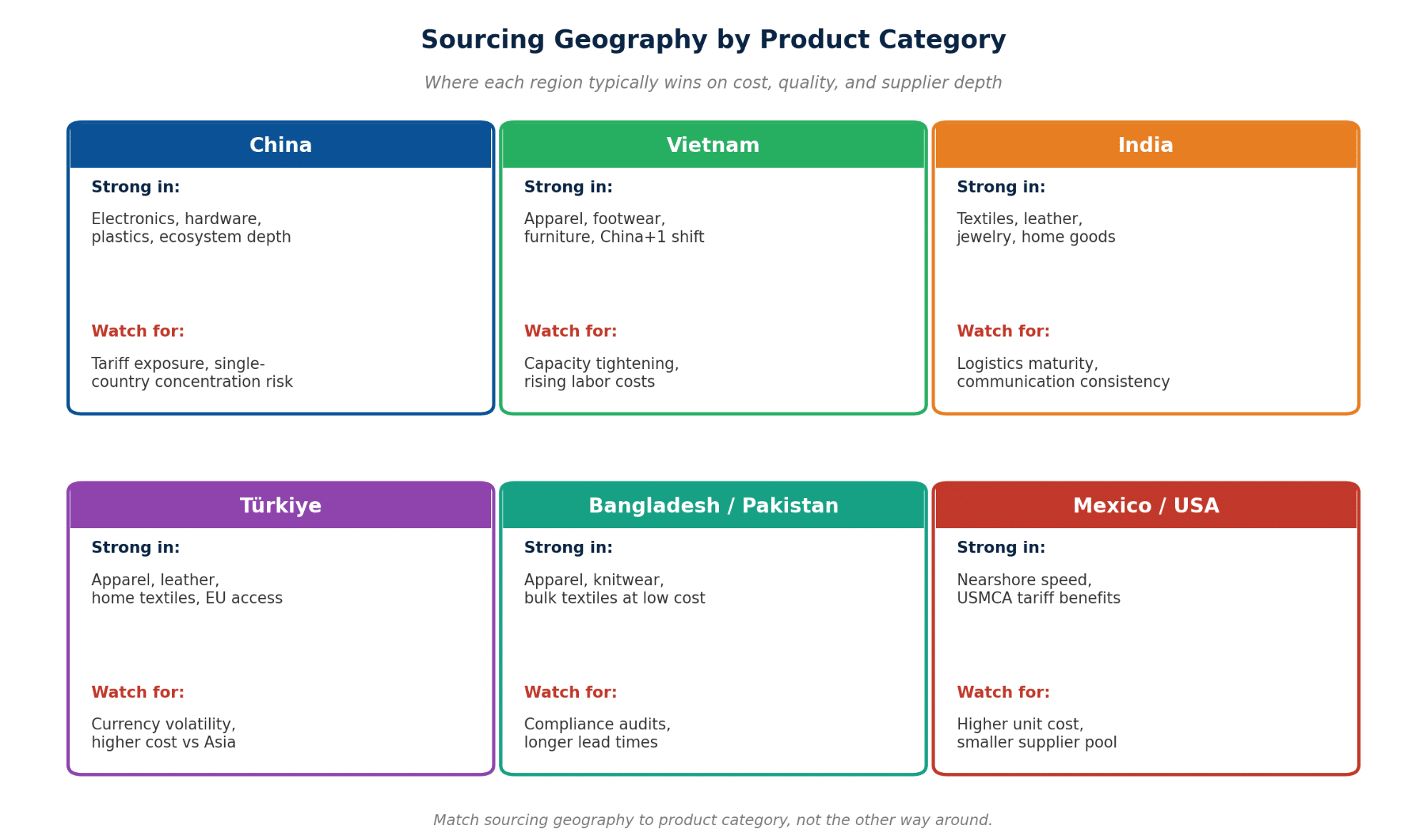
Figure: Where each major sourcing region wins on cost, quality, and supplier depth, and what to watch for.
The smartest sourcing strategies match the country to the product category. Vietnam, Bangladesh, and India are strong for apparel, China remains dominant for electronics, and India and Turkey are increasingly competitive for textiles and leather goods. The best results come from balancing cost, quality, and supply chain risk across the right sourcing regions.
Read more about Top 10 Alternatives to China for Sourcing and Manufacturing
Reliable product sourcing starts here
Work with experts who help you evaluate suppliers and reduce risk.
How Smart Sourcing Actually Works: A Step-by-Step Process
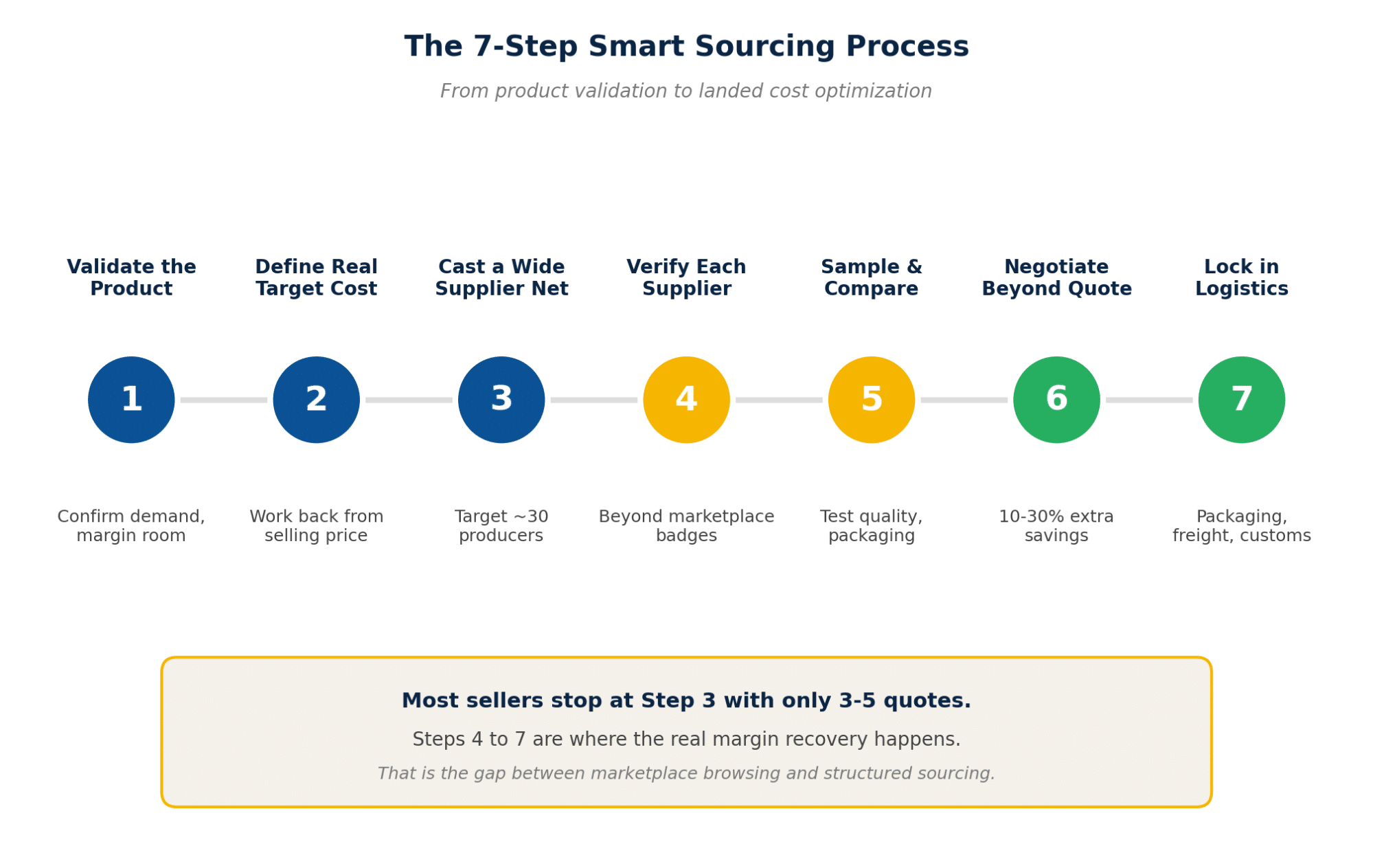
Finding wholesale suppliers is the easy part. Building a profitable sourcing operation requires structure. Here is the process that serious Amazon and eCommerce sellers follow when they want to source well, not just source fast.
Figure: The 7-step smart sourcing process. Most sellers stop at Step 3.
Step 1: Validate the Product Before You Source It
Before contacting suppliers, make sure the product actually has demand, healthy margins, and room to compete. Check Amazon Best Sellers rankings, competitor pricing, reviews, and estimated advertising costs. If the numbers do not work at the retail level, sourcing alone will not fix the business model.
Step 2: Define Your Real Target Landed Cost
Work backward from your target selling price after subtracting Amazon fees, shipping, advertising, returns, and desired profit margin. This gives you the landed cost suppliers need to meet for the product to remain profitable.
Step 3: Benchmark a Wider Supplier Pool
Most Amazon sellers contact only a few suppliers and stop there. Strong sourcing requires broader supplier comparison across multiple factories and countries. The more competitive quotes you gather, the stronger your pricing visibility and negotiation leverage become.
Step 4: Verify Suppliers Independently
Supplier verification goes beyond checking marketplace profiles. Review business licenses, export history, production capabilities, and factory legitimacy before placing large orders. Proper verification helps reduce quality, fraud, and fulfillment risks later.
Step 5: Sample, Test, and Compare Carefully
Order samples from multiple suppliers and compare them side by side for quality, packaging, consistency, and durability. Strong sampling helps identify problems before they become expensive inventory issues on Amazon.
Step 6: Negotiate Beyond the Initial Quote
The first supplier quote is rarely the best possible price or structure. Better negotiation can improve unit costs, MOQs, payment terms, packaging options, and lead times — often creating major margin improvements without changing the product itself.
Step 7: Optimize Logistics, Packaging, and Documentation
Freight, packaging dimensions, customs, and compliance documents all affect Amazon FBA profitability. Small improvements in packaging efficiency and logistics planning can create significant long-term savings across multiple shipments.
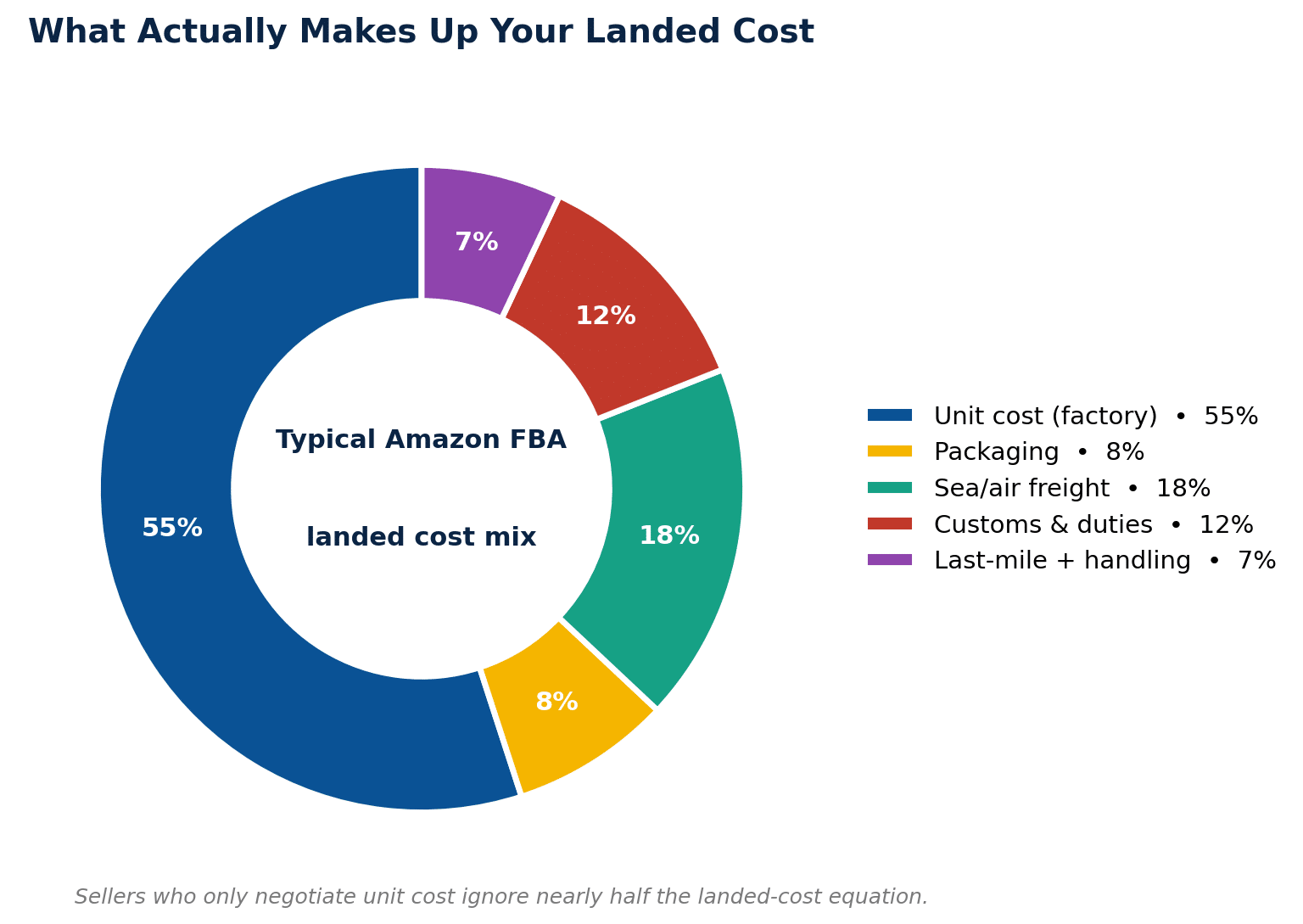
Figure: Typical landed cost mix for an Amazon FBA product. Unit cost is roughly half the equation.
Reliable product sourcing starts here
Work with experts who help you evaluate suppliers and reduce risk.
The Biggest Mistakes Amazon and eCommerce Sellers Make on Wholesale Websites
Most sourcing failures fall into a small set of repeating patterns. If you recognize yourself in any of these, you are not alone, but you are leaving money on the table.
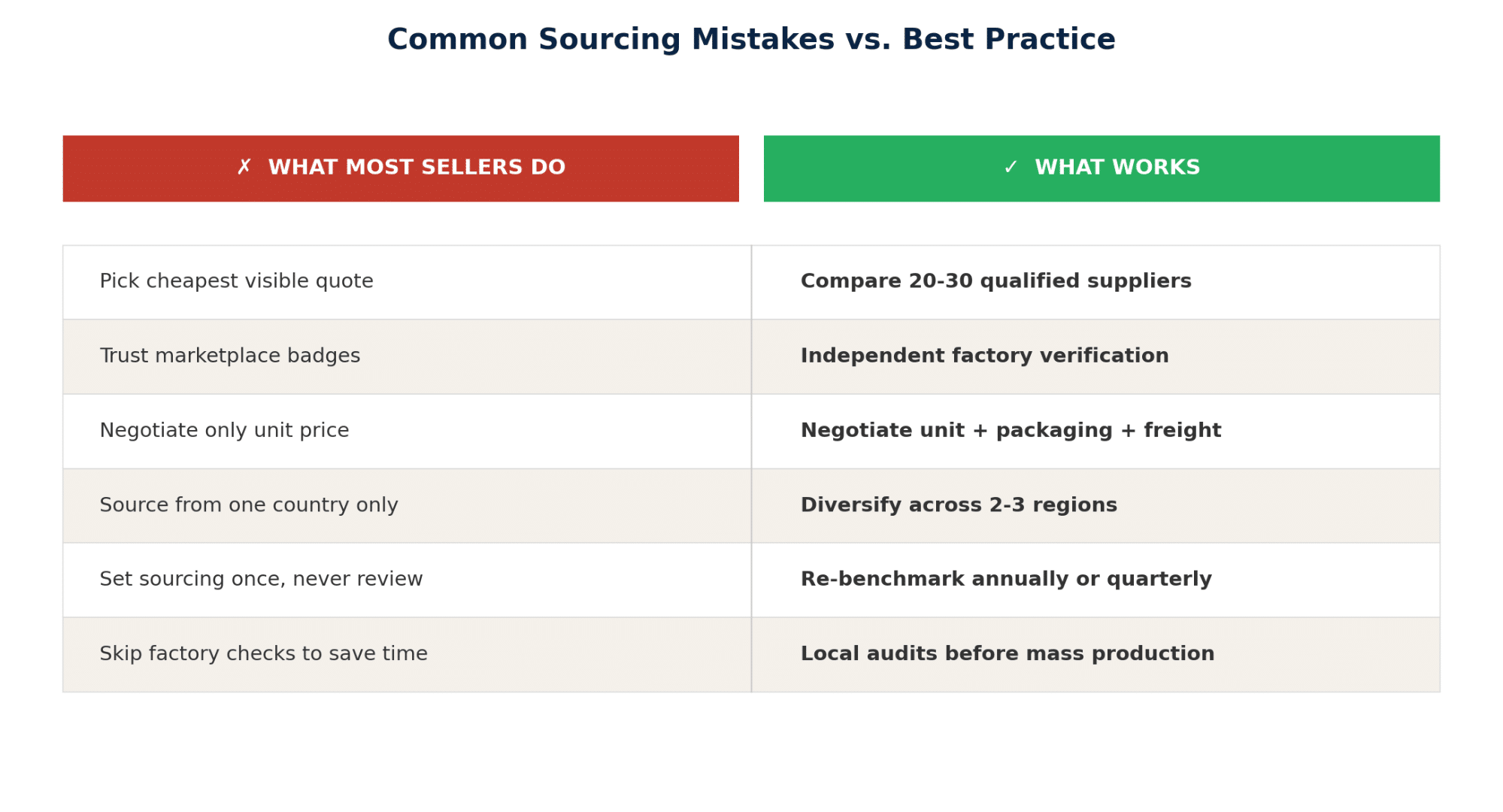
Figure: The six most common sourcing mistakes and what successful sellers do instead.
Picking the cheapest supplier on the first page: The cheapest visible quote is rarely the cheapest available quote. It is just the cheapest one you saw before you stopped looking.
Comparing too few suppliers: Three quotes are not a comparison. Thirty quotes is a comparison.
Trusting verified badges as proof of quality: Badges check basic legitimacy. They do not check whether the factory can actually deliver consistent quality at your volume.
Ignoring packaging in cost calculations: Packaging is part of landed cost. Sellers who only negotiate unit price miss 5 to 15 percent of recoverable savings.
Never visit a factory or send a third party: Photos and videos can be misleading without independent verification. The only reliable verification happens on the ground.
Treating sourcing as a one-time event: Sourcing is a continuous process. Costs shift, suppliers underperform, and new factories enter the market. The seller who reviews sourcing annually wins against the seller who sets it up once and forgets.
Sourcing only from one country: Single-country sourcing is single-point-of-failure sourcing. Diversification is no longer optional in 2026.
Reliable product sourcing starts here
Work with experts who help you evaluate suppliers and reduce risk.
When to Move Beyond Wholesale Websites: Direct Sourcing and Why It Wins
There comes a point where wholesale platforms stop being enough. Margins shrink, competitors sell the same products, and suppliers treat you like another small marketplace buyer.
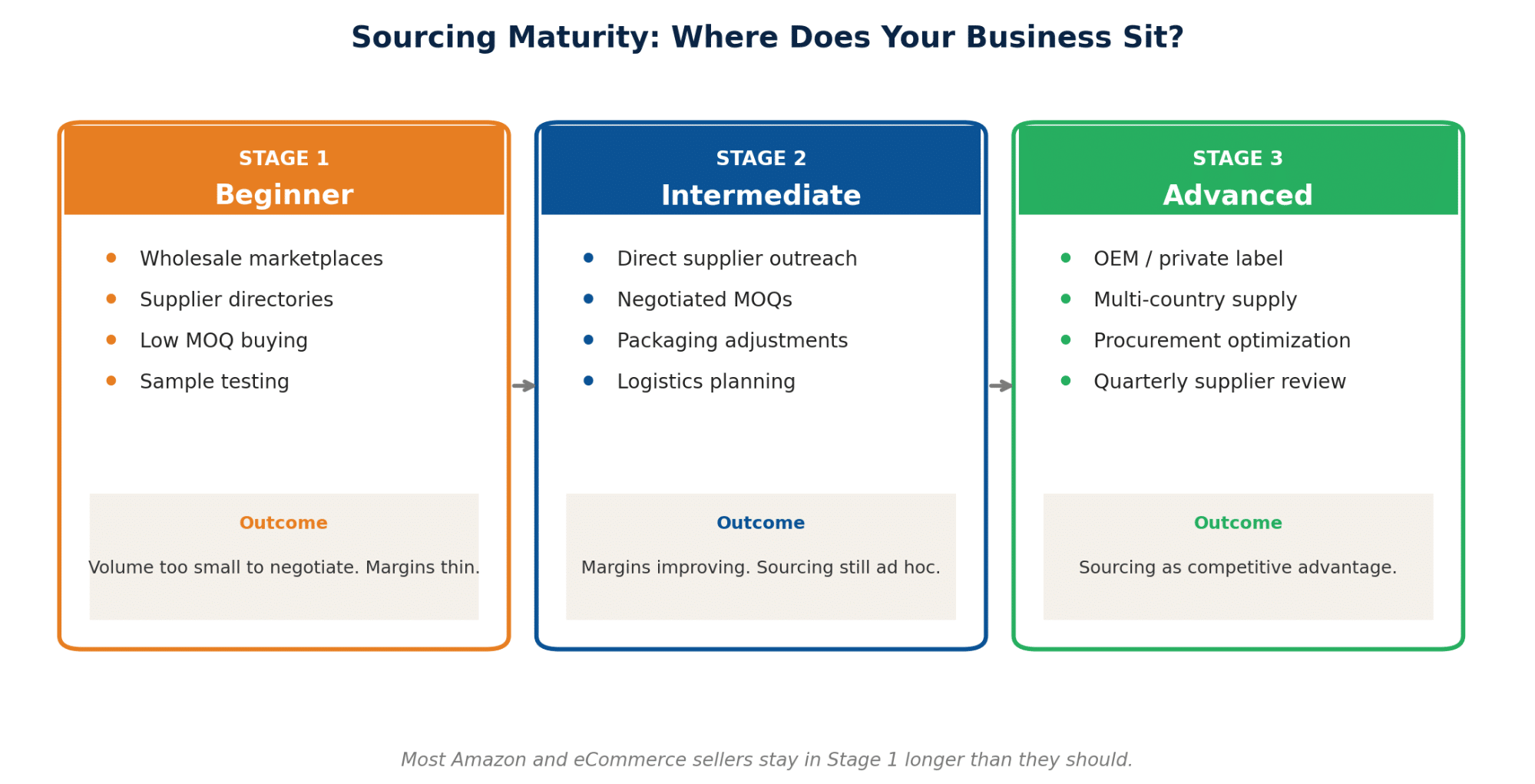
Figure: The three stages of sourcing maturity. Most sellers stay in Stage 1 longer than they should.
That is when direct sourcing becomes important. Direct sourcing means working with actual factories, negotiating better pricing and MOQs, and building products around your brand instead of generic marketplace inventory.
In one beauty accessories diversification project, broader direct supplier sourcing and country diversification reduced annual sourcing costs by roughly $500,000 while improving quality consistency and reducing tariff exposure.
This is where Zignify supports ecommerce brands and Amazon sellers, through deep supplier comparison, direct factory negotiation, independent quality control, and logistics optimization. Clients work directly with factories, with full supplier transparency and no hidden sourcing margins.
How Zignify Supports Amazon and eCommerce Sellers Beyond Wholesale Websites
Wholesale websites are good for discovery. They are not built for ongoing supplier optimization. That is the gap Zignify fills.
Here is what working with us actually looks like:
Broad supplier identification: We target around 30 qualified manufacturers per project, often across multiple countries. The wider the comparison, the better the negotiation leverage.
Direct supplier introduction: Clients pay factories directly. We never take factory commissions, hidden markups, or kickbacks. The supplier identity is fully transparent.
Independent verification: Local checks, factory visits where useful, and quality control during mass production.
Negotiation support: We negotiate in the supplier’s language and on the buyer’s behalf, which routinely produces 10 to 30 percent unit cost reductions and sometimes much more.
Packaging and logistics optimization: Unit cost is only part of the equation. We audit packaging, freight, and customs to recover landed cost.
Multi-country sourcing strategy: For sellers diversifying away from China-only supply, we help structure a sourcing portfolio across China, Vietnam, India, Turkey, Pakistan, Bangladesh, and Mexico based on what works best for each product category.
The result is sourcing that gets sharper over time, not sloppier. Margins improve. Risk drops. And you stop competing on price with sellers who never moved beyond a marketplace search bar.
Reliable product sourcing starts here
Work with experts who help you evaluate suppliers and reduce risk.
The Opportunity Ahead: Building a Sourcing Operation That Compounds
The eCommerce sellers who will dominate the next few years are not just the ones with strong ads or attractive storefronts. They are the ones with stronger sourcing operations, lower unit costs, more reliable suppliers, diversified manufacturing regions, and packaging optimized for freight efficiency. These advantages compound over time and directly protect margins as competition increases.
Wholesale websites are a useful starting point, especially for new sellers, but they are not a complete sourcing strategy. The brands that grow long-term are the ones that move beyond marketplace sourcing into deeper supplier comparison, direct factory relationships, and structured sourcing optimization. That is where Zignify helps, supporting brands with supplier sourcing, negotiation, quality control, and long-term supply chain improvement.
What Most Guides Get Wrong, Here’s What Our Expert Knows ✅
Most articles about wholesale websites stop at the listicle. They tell you which platforms exist and assume your job is done. After running supplier optimization projects across dozens of product categories, here is what we see buyers consistently miss when they treat marketplace sourcing as a finished strategy.
💡 The “verified manufacturer” badge on wholesale sites is the lowest possible bar, not a quality signal.
Verification on Alibaba, Global Sources, and similar platforms typically confirms that a business license exists. It does not confirm that the entity is a factory rather than a trading company, that it can produce at your volume, or that quality will hold across multiple production runs. We have audited “verified” suppliers and found warehouses with no production capacity, just a sales team forwarding orders to actual factories elsewhere with a 10 to 20 percent margin layered on top. Real verification requires independent factory visits, social audit checks, and reviewing export records, none of which marketplace badges measure.
⚠️ Most sellers compare too few suppliers, and they pay for it forever.
The standard FBA approach is to message five suppliers, pick the cheapest acceptable one, and move on. That is not sourcing. It is gambling with your unit cost. In one clothing brand project, we contacted 55 suppliers and gathered 16 competitive offers. The same factory the client had been using for years agreed to drop pricing from $5.51 per unit to $3.85 per unit, a 30 percent cut, simply because we showed up with leverage they could see. Three quotes do not produce that outcome. Thirty quotes do. The cost of casting a wide net is days of work. The cost of not casting one is hundreds of thousands of dollars over the life of the product.
💰 Packaging is your hidden second-largest sourcing cost, and almost nobody negotiates it.
Sellers obsess over unit price and ignore packaging. That is a mistake. Packaging affects freight volume, customs cost, Amazon’s dimensional weight fees, and warehouse efficiency. On one project, optimizing packaging dimensions on a single product line recovered approximately $11,900 in annual landed cost savings without changing the product itself. The factory was happy to adjust because nobody had asked. If your supplier sized your packaging with a default carton from their catalog, you are almost certainly paying for empty space that ships across an ocean every month. That is a recoverable margin, and it should be on every sourcing review checklist.
If you are scaling on Amazon or in e-commerce in 2026 and you have not had your sourcing audited in the last 12 months, the savings are likely larger than you think. Book a free sourcing call →
Frequently Asked Questions
1. What are the best wholesale websites for Amazon FBA sellers in 2026?
For private label and OEM, Alibaba and Global Sources remain the largest discovery platforms. For boutique reselling, Faire and Tundra are stronger. For US-domestic sourcing, Thomasnet and Worldwide Brands are useful. The right platform depends entirely on your product category, target margin, and whether you are building a brand or reselling other brands.
2. How do I verify the legitimacy of a wholesale supplier?
Marketplace verification badges are a starting point, not a conclusion. Real verification means checking business licenses with local authorities, requesting export history and recent invoices, ordering samples from multiple production runs, and ideally arranging an on-the-ground factory inspection. If a supplier resists basic verification, treat that as a serious warning sign and move on.
3. What is the minimum order quantity I should expect on wholesale websites?
MOQs vary widely. DHgate and Faire often allow very low MOQs, sometimes single units. Alibaba MOQs typically start at 100 to 500 units for many categories, though many factories will negotiate lower for first orders. Direct factories usually want higher MOQs, often 1,000 units or more, but pricing improves significantly at that volume.
4. Are wholesale websites cheaper than going directly to a factory?
Usually not. Marketplace pricing often includes intermediary margins from trading companies. Direct factory pricing can often outperform marketplace pricing by meaningful margins, especially after broader supplier comparison and negotiation. The catch is that direct sourcing requires more work upfront, which is why many sellers either stay on platforms or use a sourcing partner to handle the heavy lifting.
5. How is Faire different from Alibaba?
Faire curates US and European boutique brands selling finished, branded products with low MOQs and credit terms. You buy someone else’s brand to resell. Alibaba is a global B2B marketplace where you mostly work with manufacturers to produce private label or OEM products under your own brand. Different platforms, different business models, different margin profiles.
6. Can I source from multiple countries through wholesale websites?
Yes, especially through Alibaba, which has growing supplier bases in Vietnam, India, Turkey, Pakistan, and Bangladesh. IndiaMART covers India specifically. For serious diversification, however, marketplace browsing is rarely enough. You usually need a sourcing partner with an on-the-ground presence in each country to verify suppliers and manage the additional logistics complexity.
7. How much can I really save by comparing more suppliers?
Realistic savings from broader supplier comparison typically range from 10 to 30 percent on unit cost, sometimes more. In one of our clothing brand projects, deeper supplier comparison and structured negotiation produced substantial savings on the same supplier relationship through broader supplier comparison and renegotiation. The wider your comparison and the better your negotiation leverage, the larger the gap.
8. Do I need a sourcing agent if I am already using wholesale websites?
Not necessarily for low volume or early-stage sourcing. Wholesale websites are perfectly fine when you are testing products and learning the basics. You start needing structured sourcing support when your volume reaches a level where 10 to 20 percent on unit cost becomes meaningful money, when you want to diversify across countries, or when quality issues start affecting your Amazon account health.
9. What is the biggest mistake new Amazon sellers make with wholesale sourcing?
Stopping the supplier search too early. The cheapest supplier on page one of Alibaba is rarely the cheapest available supplier. New sellers tend to contact a few suppliers, pick a reasonable quote, and move on, then wonder why competitors on the same listing are cheaper. Wider supplier comparison and tighter negotiation are the single biggest unlocked margin opportunity for most early-stage sellers.
10. How does Zignify make money if not from factory commissions?
Clients pay us directly for our research, supplier identification, negotiation, and quality control work. Factories pay us nothing. Clients pay factories directly for their goods. This structure is unusual in sourcing and intentional. It removes any incentive for us to push you toward a particular factory and aligns us fully with the buyer side. The savings we generate for clients are typically several times larger than our fees.