The US tariff environment has made a lot of importers seriously rethink their supply chains. Buyers who built their margins around China-only sourcing are watching landed costs jump, and many are now searching for US manufacturers, US supplier lists, and made-in-USA producers as a way to protect their numbers. Some are succeeding. Many are running into surprises they did not expect, like rigid minimum order quantities, longer lead times than promised, or “Made in USA” labels that fall apart under closer inspection.
This guide is a practical look at how to find manufacturers in the US, what you can actually source domestically, where US production is concentrated, how to vet suppliers properly, and when US manufacturing genuinely beats nearshoring to Mexico or sourcing from countries like Vietnam, Indonesia, or India. The goal is not to sell you on the idea of domestic sourcing. It is to give you a clear framework for deciding when it makes business sense and when it does not.
Need help with your product sourcing?
Get practical advice tailored to your product, suppliers, and market form Zignify experts
Why US Manufacturers Suddenly Matter More to Importers
For decades, China was the default choice for manufacturing because the cost advantage outweighed tariffs and shipping expenses. But that equation has changed. Rising tariffs, anti-dumping duties, freight costs, and stricter compliance requirements have made US manufacturing more competitive in certain categories. Here are the real business drivers pushing buyers toward US manufacturers:
Tariff exposure: products coming from China can face cumulative duty rates that crush margins on lower-cost items. Domestic production removes that risk entirely.
Shorter lead times: a 4 to 6 week production run domestically can replace a 90 to 120 day cycle when you count factory time and ocean freight. That matters for inventory planning, especially during Q4.
Lower freight risk: ocean freight has become unpredictable. Domestic trucking is more controllable.
IP protection: certain product categories with sensitive designs benefit from domestic production where IP enforcement is straightforward.
Marketing leverage: in categories like supplements, baby products, premium apparel, and food, “Made in USA” carries real consumer value and can support higher price points.
Smaller production runs: some US manufacturers will run smaller batches than overseas factories that want 5,000 to 10,000 pieces minimums.
Driver
What changes
Best for
Tariff exposure
Removes import-duty risk entirely on tariff-hit goods
Categories facing 25%+ duties
Lead times
4-6 weeks domestic vs 90-120 days from Asia
Seasonal goods, fast turnover
Freight risk
Controllable trucking vs unpredictable ocean freight
Just-in-time inventory models
IP protection
Easier domestic enforcement of designs and tooling
Patented or proprietary products
Marketing leverage
“Made in USA” premium pricing
Supplements, baby, premium apparel, food
Smaller batches
MOQs of 100-500 vs 5,000-10,000 in Asia
Startups, niche products, testing
Reliable product sourcing starts here
Work with experts who help you evaluate suppliers and reduce risk.
What You Can Actually Source from US Manufacturers
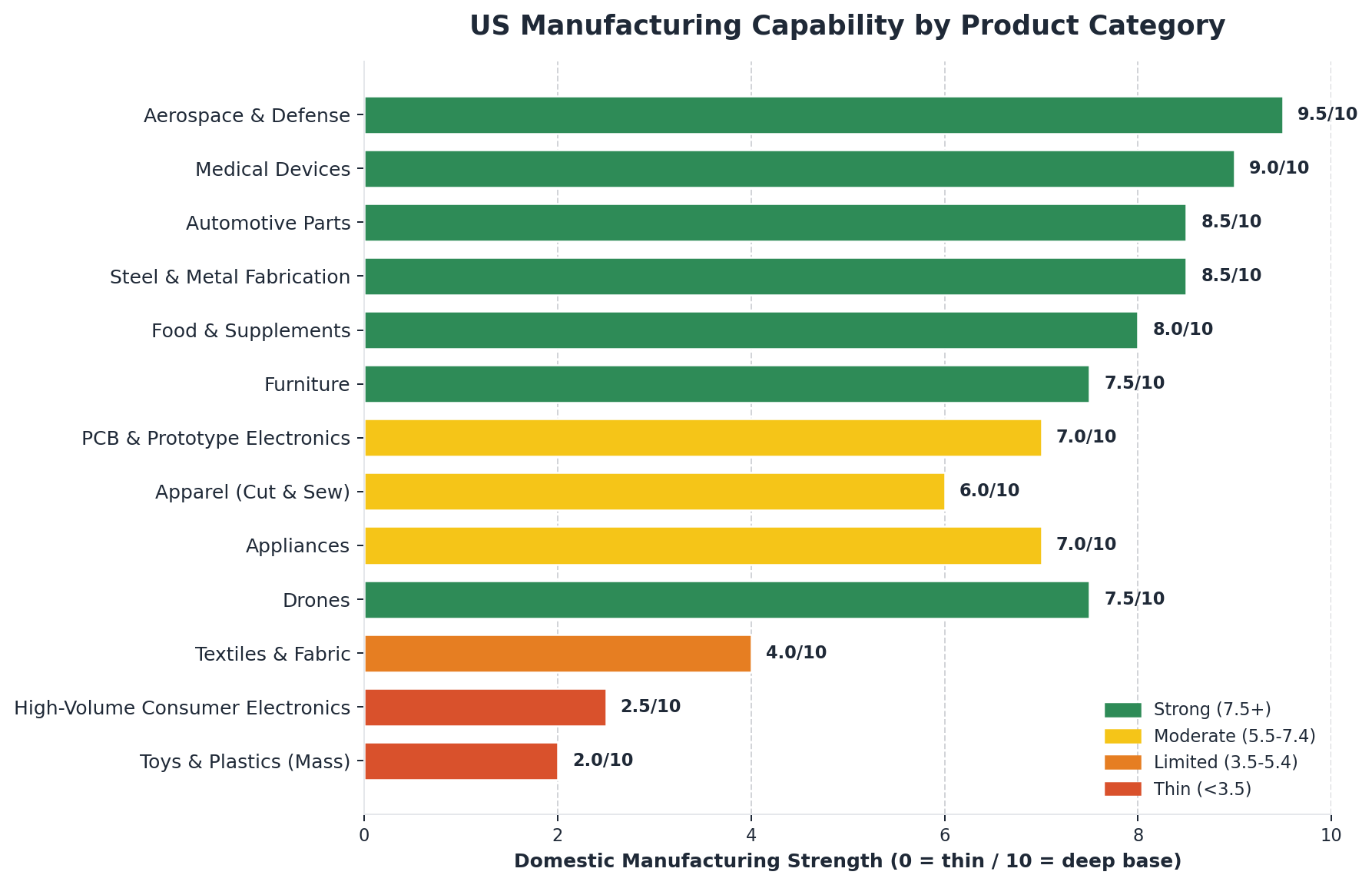
US manufacturing is not evenly distributed across product categories. Some industries have a much thinner domestic supplier base after decades of offshoring. Knowing the difference saves you weeks of pointless searching.
Figure: Where the US has a strong manufacturing base, and where it does not.
Clothing, garment, and textile manufacturers in the US
Concentrated in Los Angeles, North Carolina, and parts of the Northeast. Strong for cut-and-sew apparel, athletic wear, denim, knitwear, and basic woven garments. The catch: the domestic fabric supply chain is thin, so even US cut-and-sew factories often rely on imported textiles, which affects both your cost and your ability to claim a clean “Made in USA” label.
Automotive manufacturers and parts producers
Large and well-developed. Includes the Big Three, foreign brands like Toyota, Hyundai, and BMW with US plants, plus a deep tier-2 and tier-3 supplier network for parts and accessories. Concentrated in the Midwest, with Michigan, Ohio, and Indiana as the anchor states.
Steel, metal fabrication, and industrial materials
Globally significant. Steel manufacturing is concentrated in the Great Lakes region, with major plants in Indiana, Ohio, and Pennsylvania. Custom CNC machining, metal stamping, and precision fabrication shops exist in every industrial state.
Electronics, PCB, and semiconductor manufacturers
Strong PCB base for low-to-mid volume, prototyping, and defense-grade work. Semiconductor capacity is being rebuilt with new fabs in Arizona, Ohio, and Texas, though most consumer chip volume still comes from Asia. Best for prototypes and small batches, weaker for high-volume consumer electronics.
Drones, aircraft, and defense components
Well-developed, partly because defense procurement rules favor domestic production. Washington State, Texas, and California anchor this category.
Furniture, appliances, and home goods
Furniture is concentrated in North Carolina, Michigan, and the Midwest. Major appliance plants run in Ohio, Kentucky, Tennessee, and Iowa. Both categories have specialty mid-volume producers handling private label work.
Food, supplements, and personal care
One of the deepest US contract manufacturing categories, with strong clusters in California, Utah, Florida, and the Midwest. Especially easy to find producers for private label and co-packing work, partly because FDA compliance is location-sensitive.
Medical devices
Large and well-developed, driven by FDA regulatory advantages and the desire of medical buyers to stay close to their producers. Massachusetts, Minnesota, California, and Indiana are the key clusters.
Reliable product sourcing starts here
Work with experts who help you evaluate suppliers and reduce risk.
Where to Find US Manufacturers: Directories, Associations, and Trade Shows
If you want to build a real US supplier list, there are legitimate places to start. The internet is flooded with low-quality directories that mix brokers, dropshippers, and resellers with actual factories. Many online directories are SEO lead farms filled with brokers, importers, and recycled supplier profiles rather than real factories.
The resources below filter for legitimacy and give you a real starting point. Treat them as the top of your funnel, not the end of the process. None of them replaces the verification steps later.
General industrial directories
These cover broad product categories across most US industries:
Thomasnet. The closest thing to a comprehensive industrial supplier database. Strong for industrial, OEM, and B2B categories. Free to search.
IQS Directory. Curated directory focused on US industrial suppliers. Useful for CNC, metal fabrication, plastics, packaging, and machinery.
MFG.com. RFQ-style marketplace where you post requirements, and US shops bid. Good for custom fabrication, machining, and prototype work.
Maker’s Row. Focused on US factories for consumer products, especially apparel, accessories, beauty, home goods, and small-batch makers.
Government and industry associations
These resources are funded or backed by trade groups, so the listed manufacturers are typically verified members:
NIST Manufacturing Extension Partnership (MEP). Federal network with state-level offices in every state. Connects buyers to local manufacturers and offers free supplier-matching support.
National Association of Manufacturers (NAM). Industry advocacy group with a member directory across all major manufacturing sectors. Useful for verifying that a producer is a real, established business.
Manufacturing USA. Network of public-private institutes focused on advanced manufacturing. Best for specialty technologies, robotics, and emerging materials.
Made in USA Certified. Third-party certification body. Listed companies have been verified against the FTC “all or virtually all” standard.
Category-specific directories
If you have a clear product category, vertical directories outperform general ones:
American Apparel Producers’ Network (AAPN). Member directory for US-based apparel, textile, and accessories manufacturers. Strong for cut-and-sew, knit, and woven categories.
Printed Circuits Association (IPC). Trade body for the electronics manufacturing industry. Their member directory is useful for PCB, EMS, and contract assembly work.
Natural Products Association. For supplements, personal care, and natural-product contract manufacturers. Member screening filters out questionable operators.
Trade shows where you actually meet US producers
Directories give you contact information. Trade shows let you see samples, walk supplier booths, and qualify multiple producers in a few days. For most categories, this is worth more than any directory search:
MAGIC Las Vegas. The largest US apparel and accessories trade show. Many domestic cut-and-sew producers exhibit alongside importers, so you can compare directly.
ASD Market Week. Wholesale and consumer products trade show in Las Vegas. Mixed domestic and imported, but a useful first-pass survey of categories like home, gift, beauty, and general merchandise.
IMTS (International Manufacturing Technology Show). Chicago-based, held every two years. The largest manufacturing technology show in the Americas. Critical for CNC, machining, automation, and industrial fabrication.
SupplySide West. Las Vegas show for ingredient and contract manufacturing in supplements, food, beverage, and personal care. Almost all major US co-packers exhibit here.
NAMM Show (for music and audio gear). Specialty trade show with most US instrument and audio equipment manufacturers represented. Useful for niche electronics and prosumer hardware sourcing.
A practical workflow: pick one or two general directories to build your long list, cross-reference against the relevant association directory to filter for verified members, then plan to attend the right trade show within the next 6 months to qualify your top candidates in person. This combination consistently produces better suppliers than relying on any single source.
Reliable product sourcing starts here
Work with experts who help you evaluate suppliers and reduce risk.
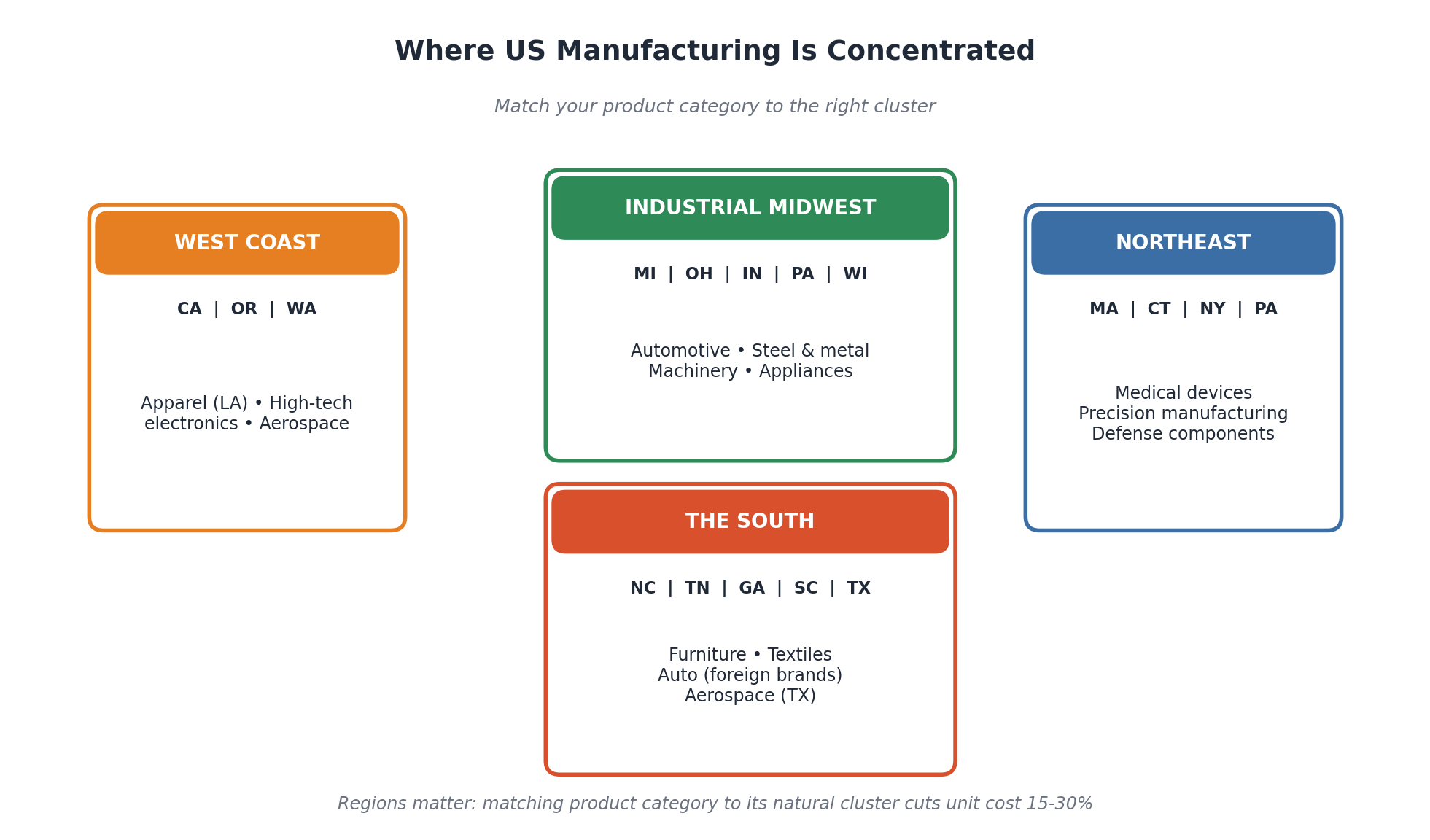
If you are building a US supplier list, geography matters more than most buyers realize. Manufacturing in the USA is not spread evenly. Cost of labor, available skill base, port access, and state-level incentives create real concentration patterns that affect your unit cost.
Figure: Major US manufacturing regions and their specialties.
The Industrial Midwest
Michigan, Ohio, Indiana, Wisconsin, and Pennsylvania carry the bulk of heavy industry. Automotive, machinery, steel, appliances, and industrial equipment dominate here. Labor is more expensive than in the South, but the skill base is deep. This region is the right starting point for auto components, machinery, metal fabrication, and large appliances.
The South
North Carolina, Tennessee, Georgia, South Carolina, and Texas have become the new manufacturing belt. Furniture, textiles, automotive (especially foreign-brand US plants), and increasingly electronics are concentrated here. Labor costs are typically lower than the Midwest, right-to-work laws are more common, and several states actively recruit foreign manufacturers with tax incentives. Texas alone has become a major hub for semiconductors, oil and gas equipment, and aerospace.
The West Coast
California remains the apparel capital of the US, with Los Angeles holding the largest cut-and-sew base in the country. The Bay Area dominates high-tech contract manufacturing for prototypes and specialty electronics. Costs are high, but specialty capabilities exist here that you will not find elsewhere.
The Northeast
Massachusetts, Connecticut, and parts of New York and Pennsylvania specialize in precision manufacturing, medical devices, aerospace components, and high-value specialty production. Volume is lower, but capability is high.
When you build a US supplier list, you want to match your product category to its natural region. Hunting for clothing manufacturers in Michigan or PCB shops in rural Mississippi wastes time. The right region usually has clusters of suppliers competing with each other, which keeps pricing honest.
Reliable product sourcing starts here
Work with experts who help you evaluate suppliers and reduce risk.
How to Find Manufacturers in the USA: A Step-by-Step Approach
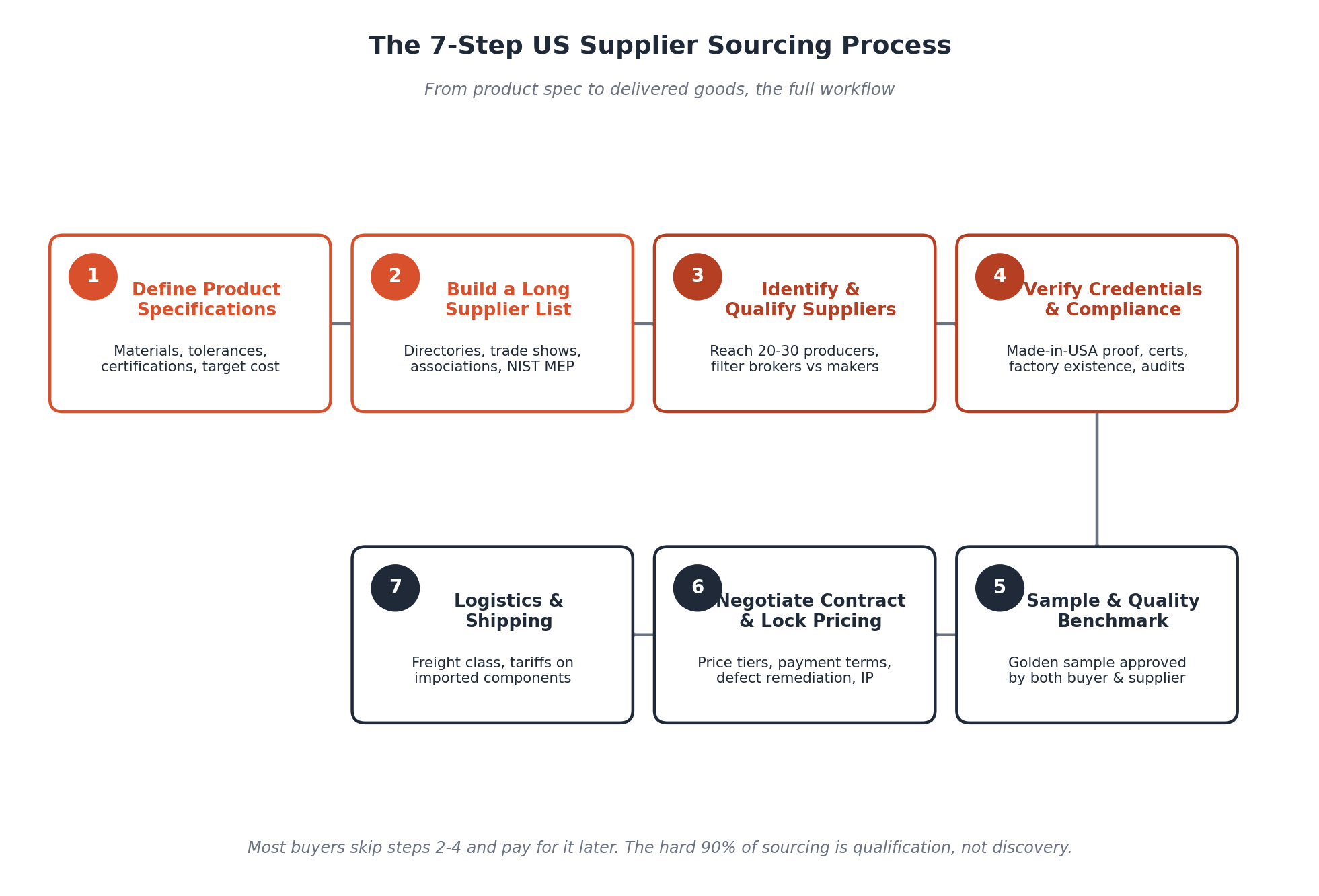
Most “how to find a manufacturer in the USA” guides give you a list of directories and stop there. That is the easy 10% of the work. The hard 90% is qualifying, verifying, and negotiating. Here is the full process at a glance, then a breakdown of each step.
Figure: The seven steps from spec to shipment.
Step 1: Define your product specifications clearly
Before contacting any supplier, you need a clear product specification document. This includes materials, dimensions, tolerances, finish requirements, regulatory certifications needed, packaging requirements, and target unit cost. Without this, every supplier conversation turns into a guessing game, and quotes become impossible to compare.
Step 2: Build a long list using directories and trade associations
There are legitimate places to find US manufacturers. The Thomasnet directory is the closest thing to a comprehensive industrial supplier database. State and regional manufacturing associations (the NIST Manufacturing Extension Partnership network has state offices in every state and is a useful starting point at nist.gov/mep) often maintain member lists. Trade shows like ASD Market Week, Magic, Coverings, IMTS, and category-specific events are where you actually meet US producers. Industry-specific directories, like the American Apparel Producers’ Network for garment manufacturers, are far more useful than generic listings.
Step 3: Identify and qualify potential suppliers
This is where most buyers cut the work short. Contacting 3 to 5 suppliers and choosing the best one is not a real selection process. You want a wider top-of-funnel. Reaching out to 20 or 30 producers in a category gives you genuine price benchmarks, exposes who is a real manufacturer versus a broker, and gives you real negotiating leverage. The first quote a US manufacturer gives you is almost never the best price they can offer, but you need data points to push back with.
One reality many buyers discover late is that strong US manufacturers are often capacity-constrained and selective about clients. Unlike many overseas factories competing aggressively for export orders, domestic producers may prioritize long-term or high-volume accounts, especially in regulated or industrial sectors.
Step 4: Verify credentials, “Made in USA” claims, and certifications
This step matters more than buyers think, even with domestic suppliers. The Federal Trade Commission has a specific Made in USA standard that requires “all or virtually all” of a product to be domestic in materials and labor. Many manufacturers calling themselves US-based actually assemble or finish imported components, which means you cannot legally market the final product as “Made in USA” unqualified. If that label is part of your value proposition, you need to verify component origin, not just where the box was sealed.
You also want to verify:
That the company is actually a manufacturer, not a trading company or a broker reselling someone else’s production.
That their stated facility exists, is operational, and matches what they claim about capacity.
That they hold the certifications they list (ISO 9001, FDA registration, GMP, UL listing, or whatever applies to your category).
That their references check out with actual buyers, not testimonials handed to you by the supplier.
For higher-value contracts, a physical factory visit or a third-party audit is worth the money. This is true even in the US. The risk profile of domestic sourcing is different from China sourcing, but it is not zero. Our guide on how to choose reliable manufacturers walks through the full verification framework we use on client projects.
Reliable product sourcing starts here
Work with experts who help you evaluate suppliers and reduce risk.
Step 5: Sample production and quality benchmarking
Order paid samples from your top three or four candidates and benchmark them against each other and against your existing supplier if you have one. A “golden sample” approved by both you and the supplier becomes the quality reference for the production run. Without it, every quality dispute later becomes a he-said-she-said argument.
Step 6: Negotiate contracts and lock in pricing
US manufacturers tend to expect more formal purchase agreements than overseas suppliers, which is actually good for you. The contract should cover unit pricing tiers by volume, payment terms, lead time commitments, quality acceptance criteria, defect remediation responsibility, IP ownership for tooling and designs, and termination clauses. Skip none of these. Verbal agreements in US manufacturing get expensive when something goes wrong.
Step 7: Logistics, documentation, and shipping
Domestic logistics are simpler than international, but they are not free of complexity. You still need to plan freight class, palletization, accessorials, dock requirements, and freight insurance. For larger volume buyers, negotiating annual freight contracts with regional carriers can take 5 to 10% off your shipping costs. If you are using a US manufacturer to bypass tariffs but still importing materials, you also need to understand the substantial transformation rules that determine country of origin for customs purposes.
Reliable product sourcing starts here
Work with experts who help you evaluate suppliers and reduce risk.
USA vs Mexico vs Asia: How to Think About the Tradeoffs
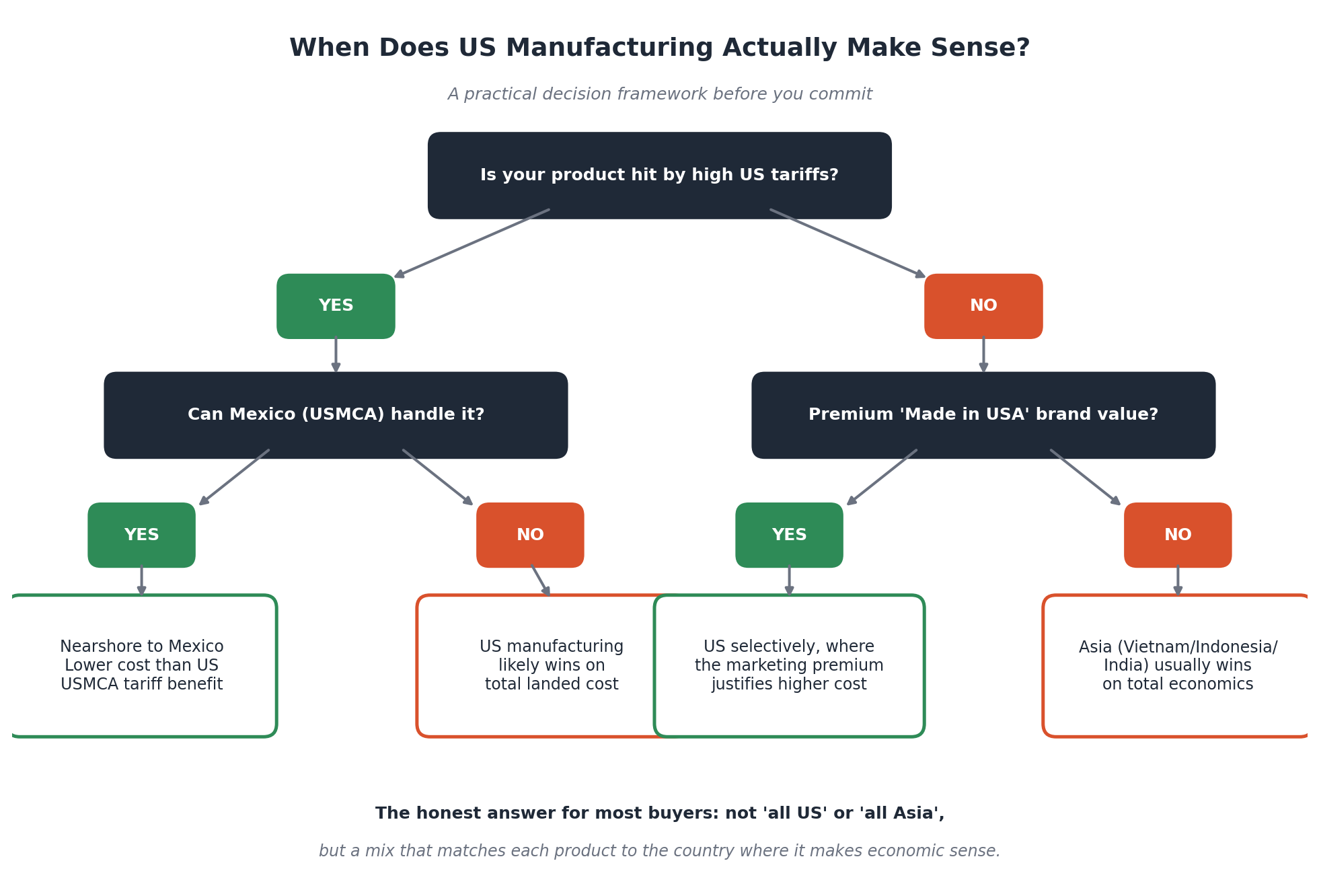
The honest comparison is not US vs China. It is US vs Mexico vs your Asia options, each evaluated factor by factor for your specific product.
No single country wins on every factor. Asia still dominates on unit cost and MOQ flexibility, especially for high-volume consumer goods. The US wins on tariff exposure, IP protection, and logistics simplicity. Mexico sits in the middle and often produces the best total economics for tariff-exposed goods that do not require deep specialized capability. The right answer for your product is rarely a single-country answer.
Figure: A practical decision framework for choosing your sourcing country.
Common Mistakes When Sourcing from US Manufacturers
After years of helping buyers evaluate US sourcing decisions, the same mistakes show up over and over. Most of them are expensive but avoidable.
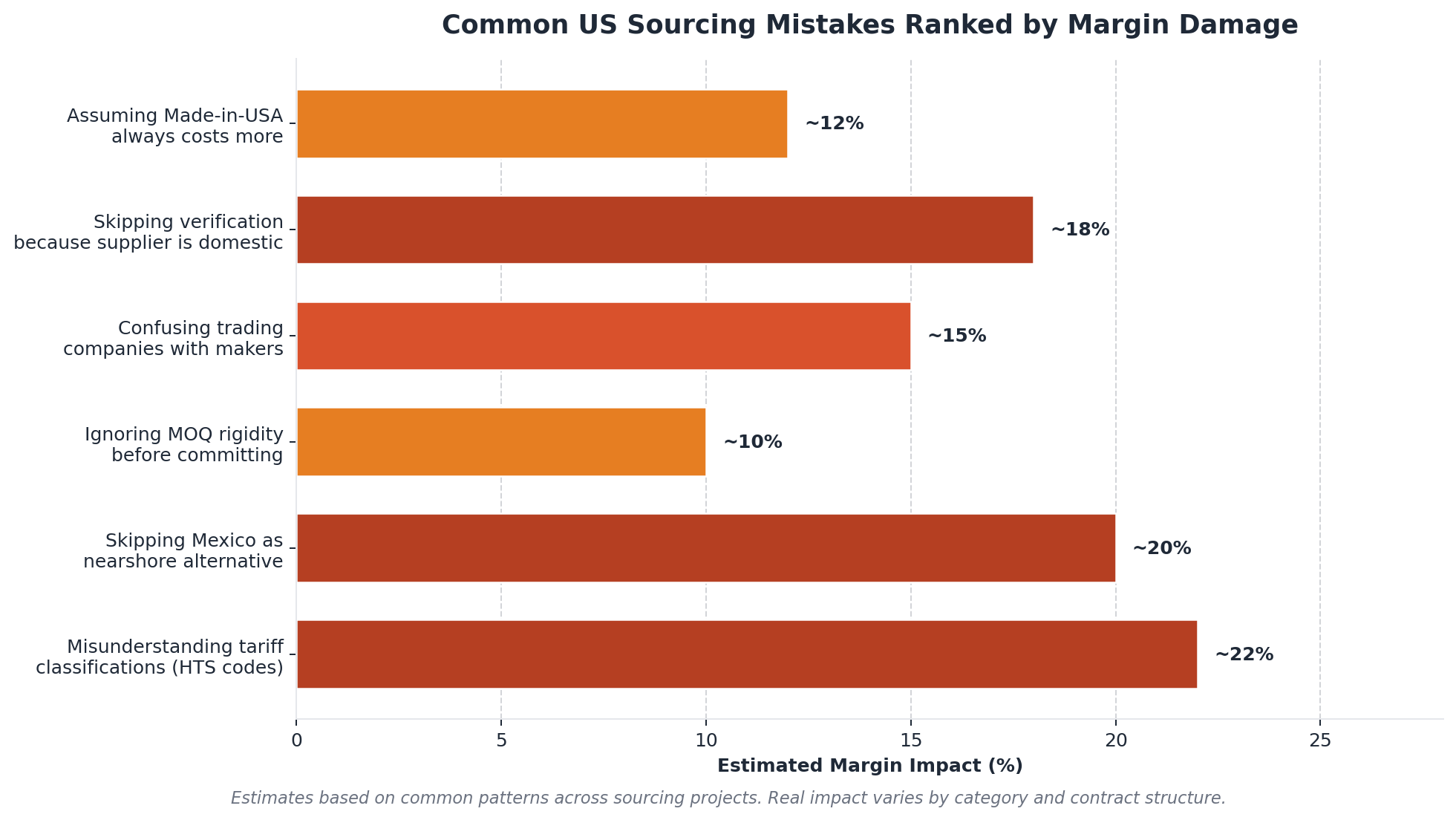
Figure: The six most expensive mistakes buyers make when moving to US suppliers.
Assuming “Made in USA” automatically means more expensive. For some categories, yes. For others, especially when you fully load tariffs, freight, financing costs of long shipping cycles, and quality control overhead, US production is competitive or cheaper. Run the real numbers before you assume.
Skipping verification because the supplier is domestic. Domestic does not equal honest. US suppliers can misrepresent capacity, fake certifications, or quietly relabel imported products as domestic. The legal exposure on false “Made in USA” claims is real, especially if you market the product with that label.
Confusing trading companies with manufacturers. Many “US manufacturers” you find online are actually distributors or trading companies that resell imported products or subcontract production. You pay a markup without getting the benefits of direct manufacturer access. Always ask to see the actual production floor. Our breakdown of the different types of manufacturers (OEM, ODM, contract manufacturers, trading companies) covers what to ask to tell them apart.
Not accounting for MOQ rigidity. Some US manufacturers, especially in apparel and food, have rigid MOQs that are higher than expected. You can negotiate down, but only with real volume commitments or by working with smaller specialty producers, which often cost more per unit.
Ignoring Mexico as a nearshore alternative. For buyers fixated on “made in USA” because of tariffs, Mexico often delivers similar landed cost with lower unit price, plus USMCA preferential treatment for most goods. Read more about the full Mexico sourcing picture in our complete guide to sourcing products from Mexico.
Misunderstanding tariff classifications. Tariffs apply to specific HTS codes. A small change in product specification, materials, or country of substantial transformation can shift the tariff calculation entirely. Some buyers move production to the US when a simple component change or country swap would have solved the tariff problem at a fraction of the cost.
Reliable product sourcing starts here
Work with experts who help you evaluate suppliers and reduce risk.
How Zignify Supports Buyers Evaluating US and Alternative Sourcing Options
Here is the honest part. Zignify is not a US-only sourcing firm. We are a global product sourcing partner that helps clients make better sourcing decisions across multiple countries, including the US, Mexico, Vietnam, Indonesia, India, Turkey, and many others. Our value for buyers thinking about US manufacturing is not “we have a magic list of American factories.” It is that we can help you decide whether US production is actually the right answer for your specific product and situation, and then execute the sourcing properly wherever that turns out to be.
What we do for buyers in this scenario:
Run a real cost comparison across the US, Mexico, and Asia for your specific product, including landed cost, tariffs, MOQs, lead times, and the operational implications of each option.
Approach a wide pool of qualified suppliers, typically 30 or more producers per project rather than 3 to 5, which gives you real price benchmarks and negotiating power.
Verify suppliers properly. We are on the buyer’s side, never on the supplier’s side. We do not take commissions or referral fees from factories, which means our recommendations are not biased by who pays us.
Support sample evaluation, contract negotiation, mass production oversight, quality control, and logistics across whatever countries your final supply chain involves.
Give you direct contact and pricing transparency with the suppliers we recommend. You see the real prices and you can talk to the factory directly. No black box.
The buyers we work best with are not looking for someone to push them toward a particular country. They are looking for someone to help them think through the tradeoffs honestly and execute well. If US manufacturing is the right answer for you, we will tell you. If it is not, we will tell you that too, and show you the math behind it.
Reliable product sourcing starts here
Work with experts who help you evaluate suppliers and reduce risk.
The Real Opportunity: A Smarter, Diversified Sourcing Strategy
The buyers who will come out of this tariff era in the strongest position are not the ones who panicked and moved everything to one country. They are the ones who built flexible, multi-country supply chains that can shift as policy and cost dynamics change. US manufacturing is one tool in that toolkit. Mexico is another. Vietnam, Indonesia, India, and Turkey are others. The right answer for any given product depends on the cost structure, the regulatory environment, the marketing positioning, and the operational complexity you can manage.
Tariff policy will continue to change. The buyers who treat sourcing as a strategic capability, not a one-time decision, will keep their margins intact regardless of what happens next. Building that capability starts with running honest comparisons, vetting suppliers properly, and not falling for the marketing version of any single country’s manufacturing story. Our article on reshoring and supply chain resilience covers how to build that kind of flexibility into your operations.
What Most Guides Get Wrong, Here’s What Our Expert Knows ✅
Most articles about US manufacturers stop at “here are some directories” and skip the parts that actually decide whether your sourcing project succeeds or fails. After running supplier searches across the US, Mexico, and Asia for hundreds of buyers, certain patterns show up that the generic guides never warn you about.
⚠️ A “Made in USA” label is a legal claim, not a marketing line, and the FTC enforces it harder than buyers expect.
The FTC requires “all or virtually all” of the product to be of US origin to make an unqualified “Made in USA” claim. That means materials, components, and processing. A surprising number of US-based assemblers and finishers tell their buyers the product is “Made in USA” when, under the actual standard, it is not. If you build your marketing around that claim and the FTC investigates, the penalties and rebrand costs will swallow any tariff savings you got from moving production. Verify component origin in writing before you let marketing touch the label.
💰 The cost comparison most buyers run between US and overseas suppliers leaves out the numbers that matter most.
Buyers usually compare unit cost FOB China to unit cost ex-factory USA and call it a day. That ignores tariffs, anti-dumping duties, ocean freight volatility, ground transportation, financing costs on 90 to 120 day shipping cycles, MOQ-driven inventory risk, and customs broker fees. When you load the full landed cost properly, the spread between US and overseas often looks completely different. For some product categories, US manufacturing actually wins on total economics once you stop comparing apples to oranges.
🎯 The smartest tariff response is rarely “move everything to the US.”
For most product categories under most tariff scenarios, the right answer is a combination of nearshoring to Mexico, diversifying across two or three countries, and selectively domesticating only the products where it makes real economic sense. Mexico under USMCA gets preferential treatment for a wide range of goods at lower unit cost than the US for most labor-driven categories. Vietnam, India, and Indonesia keep working for categories that face less aggressive tariffs. A blanket move to the US looks safe, but it usually costs more than necessary and reduces flexibility for the next round of trade policy shifts.
If you are weighing US manufacturing against other options, the honest answer almost always involves a real cost model. Book a free sourcing call →
Frequently Asked Questions About US Manufacturers and Supplier Lists
1. How do I find a manufacturer in the USA for my product?
Start by defining a clear product specification, then build a long list using directories like Thomasnet, industry-specific trade associations, the NIST Manufacturing Extension Partnership network, and category-relevant trade shows. Contact 20 or more suppliers, not just 3 to 5, to get real price benchmarks and to filter out trading companies pretending to be manufacturers.
2. How do I verify a “Made in USA” claim from a supplier?
Ask for documentation of component origin, not just final assembly location. The FTC requires “all or virtually all” of the product to be US-origin for an unqualified claim. Verify this with the supplier in writing before relying on it for marketing. A factory visit or third-party audit is appropriate for any meaningful contract.
3. What products are commonly manufactured in the US?
Strong domestic manufacturing exists for automotive parts, steel and metal fabrication, aerospace components, drones and defense equipment, medical devices, furniture, food and supplements, certain apparel and textiles, PCBs and prototype electronics, and home appliances. Other categories, especially high-volume consumer electronics and many fashion textiles, have a much thinner US base.
4. Is it cheaper to manufacture in the US or overseas?
It depends on the product, the volume, the tariff exposure, and how you calculate cost. For simple, labor-intensive consumer goods at high volume, overseas usually wins on unit cost even after tariffs. For complex products, low-to-mid volumes, or products facing high tariffs, US manufacturing can be cheaper on total landed cost. Run the real numbers, including freight, financing, and tariff exposure, before you assume.
5. How do I find US manufacturers for custom clothing or private label production?
Los Angeles is the largest cut-and-sew apparel cluster in the US, followed by North Carolina. The American Apparel Producers’ Network, Maker’s Row, and Magic trade show in Las Vegas are useful starting points. Be ready for higher MOQs than Asian factories in some cases, and verify whether the fabric is also domestic if “Made in USA” matters to your brand.
6. Where can I find verified US supplier lists?
Thomasnet remains the most comprehensive industrial directory. Industry-specific trade associations maintain member directories that filter for legitimacy. State-level Manufacturing Extension Partnerships keep regional supplier databases. Paid databases like IQS Directory and MFG can help for specific categories. No directory replaces direct verification of a supplier’s claims, capacity, and credentials.
7. What are the advantages of using a US manufacturer for prototypes?
Faster turnaround, easier communication, better IP protection, and the ability to visit the facility quickly during development. For prototyping work specifically, US suppliers often beat overseas options on total cost when you factor in the development time saved.
8. How does US sourcing help with tariffs, and is it always the right answer?
US manufacturing eliminates import tariff exposure entirely for products fully produced domestically. It is not always the right answer because unit cost is typically higher, MOQs can be rigid, and certain components may still need to be imported. For many buyers, a mix of US production for tariff-exposed products and nearshoring to Mexico or sourcing from Vietnam or Indonesia for less-exposed categories produces better total economics than a full domestic shift.