If you sell a physical product and you have not registered your brand in the countries where you manufacture and sell, you are operating on borrowed time. Counterfeit listings, hijacked ASINs, blocked shipments at Chinese customs, and surprise cease and desist letters from someone who registered “your” brand before you did are not edge cases. They often happen at the exact moment when sales are starting to scale, never early, always when volume starts becoming meaningful and your brand is finally worth copying
This guide explains how trademark registration actually works for product businesses in 2026. It covers Brand Registry requirements (the Amazon term most sellers ask about), the basic US trademark process at the USPTO, and the trickier and more urgent topic of trademark registration in China. It is written for founders, importers, Amazon sellers, and product brands who need to understand the business case for filing early and the practical sequence for getting it done.
Need help with your product sourcing?
Get practical advice tailored to your product, suppliers, and market form Zignify experts
Why Trademark Registration Matters Before You Scale
A trademark is the legal anchor for your brand name, logo, and product identity in a specific country. Without it, three risks build quietly in the background while you focus on sales: someone else can register your brand in your manufacturing country, knock-off versions of your product can list freely on marketplaces, and platforms like Amazon will not give you the tools to fight back. This is the silent risk stage, it rarely announces itself, and most founders only discover it once the problem has already taken hold.
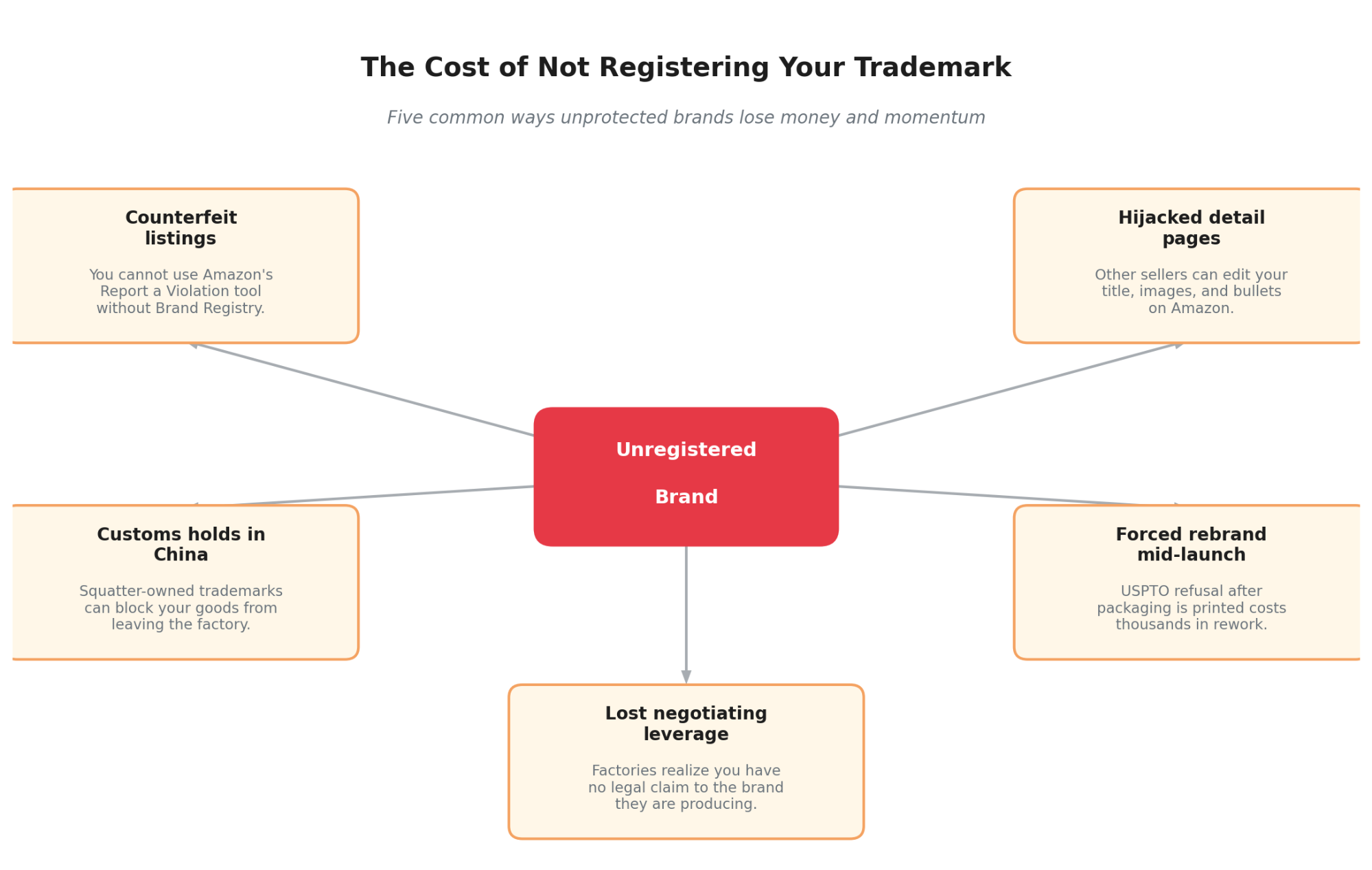
The cost of doing nothing is not theoretical. It usually shows up in one of these forms: counterfeit listings on Amazon that you cannot remove because you have no Brand Registry access, hijacked product detail pages where another seller edits your title, images, or bullets, shipments held at the port of origin because someone else owns “your” trademark in that country, lost negotiating power with factories who realize you have no legal claim to the brand they are producing, and forced rebrands mid-launch because the USPTO refuses your application after you have already printed packaging.
Figure: Five common ways unprotected brands lose money and momentum.
For a brand doing six or seven figures a year, any one of these can cost more than years of trademark filing fees combined. This is exactly why most experienced sourcing consultants treat trademark filing as part of the sourcing setup, not a “later” task.
Reliable product sourcing starts here
Work with experts who help you evaluate suppliers and reduce risk.
People often use these terms interchangeably, but they are not the same thing.
A trademark is a legal right granted by a national trademark office (the USPTO in the US, CNIPA in China, EUIPO in the EU, and so on). It gives you exclusive rights to use a specific name, logo, slogan, or design in connection with specific goods and services in that country.
Amazon Brand Registry is a private program run by Amazon. It is not a legal right. It is a verification layer that unlocks tools inside Amazon’s ecosystem. To enroll, Amazon checks that you actually own a trademark and that the brand on your packaging matches the trademark on file.
The key terms to understand:
Trademark office: the government body that examines and grants trademarks (USPTO, CNIPA, EUIPO, JPO, etc.).
Word mark: protection for the brand name in standard characters, regardless of font or color.
Design mark: protection for a logo or stylized version of the brand.
Nice class: the international classification of 45 categories that defines which goods or services your mark covers.
Specimen: proof that you are actually using the mark in commerce.
Office action: a formal objection from the examining attorney that you must respond to.
Pending vs registered: a pending mark has been filed but not yet approved. A registered mark has passed examination and publication, and is the one that carries full legal weight. This distinction matters more than most people realize. Even experienced sellers sometimes assume that filing with Amazon or enrolling in Brand Registry confers legal rights — it does not. Amazon Brand Registry is a private verification program. The legal right comes from the trademark office, not from Amazon.
Brand Registry Requirements in Plain English
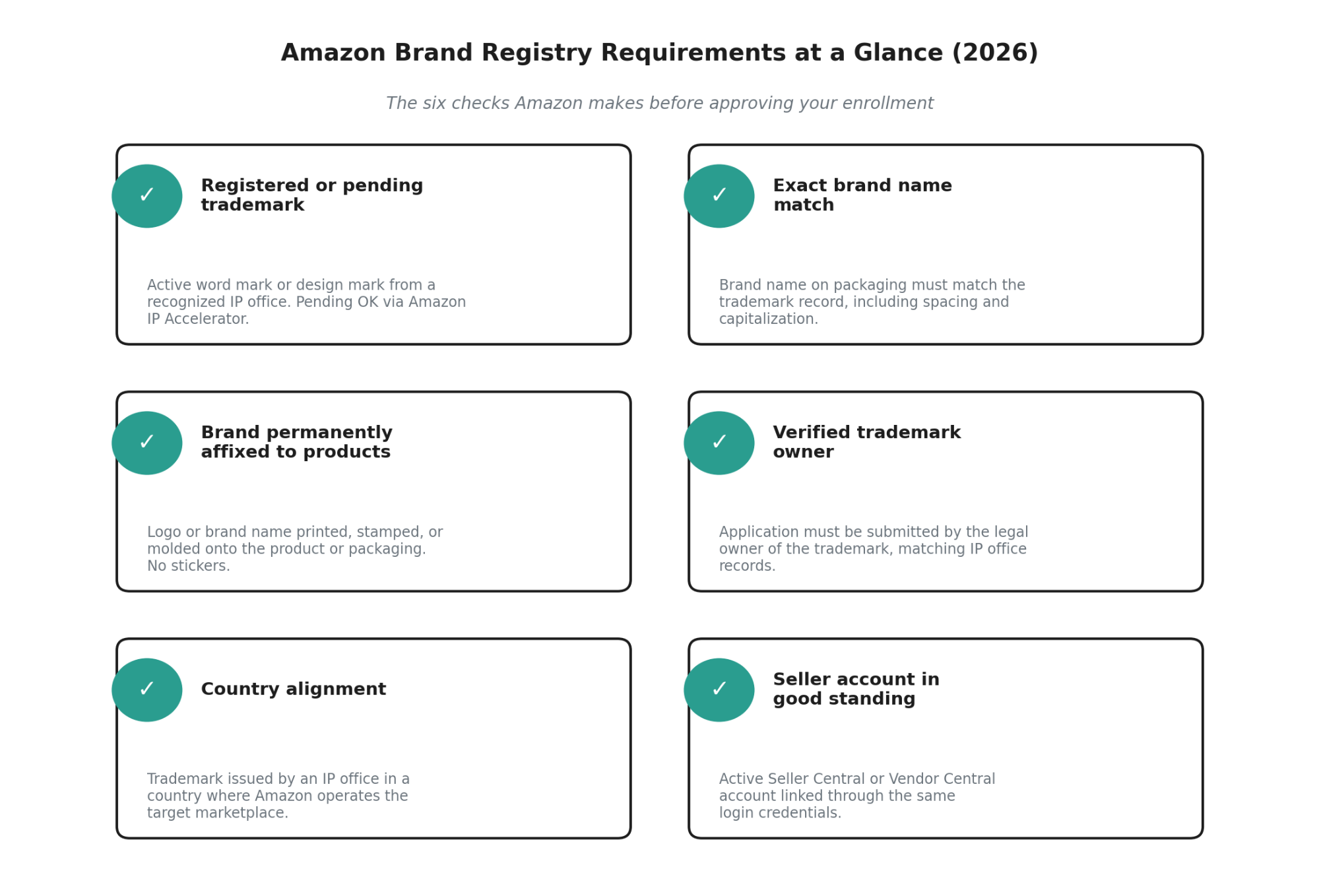
To enroll in Amazon Brand Registry, you need an active registered trademark (or a pending application through Amazon’s IP Accelerator), a word mark or design mark with words/letters/numbers, and product photos showing the brand permanently affixed to your packaging. The brand name on your packaging must match the trademark record exactly, including spacing and capitalization. This exact-match rule is where most brands underestimate the risk. Tiny branding decisions made early on — a dropped word, a stylized ampersand, a lowercase letter, can lock you out of Brand Registry entirely if they weren’t aligned with your trademark filing from the start.
Figure: The six checks Amazon makes before approving your enrollment.
The most common reason Brand Registry applications fail is not lack of a trademark. It is a mismatch between the trademark record, the packaging, and the Amazon listing. These small inconsistencies can delay enrollment by weeks. The table below lists the rejections that experienced sellers see most often.
Common Brand Registry rejection reasons
The most common reason Brand Registry applications fail is not lack of a trademark, it is a mismatch between the trademark record, the packaging, and the Amazon listing. The table below is essentially a checklist of avoidable pain. Almost every rejection on this list happens because someone rushed the filing or finalized packaging before the trademark was confirmed, treating them as separate workstreams instead of one coordinated process.
Rejection Reason
What Actually Happens
Brand name mismatch
Trademark says “BlueWave Audio” but the packaging says “BlueWave”, even one missing space triggers rejection.
Mark type mismatch
Image-based mark uploaded as word mark, or vice versa, the trademark type must match the IP office record.
Logo not on packaging
Stickers, digital overlays, or temporary labels are rejected, the brand must be permanently affixed.
Trademark owner mismatch
Trademark filed under personal name while seller account is under a company entity, ownership must align.
Verification code not returned
Code sent to trademark attorney on file is missed or expires, applications close in 10 days without it.
Trademark class misalignment
Mark registered in a class that does not match the products being sold, limits enforcement scope on Amazon.
Reliable product sourcing starts here
Work with experts who help you evaluate suppliers and reduce risk.
Where to File: US, China, and Your Other Priority Markets
Trademark rights are territorial. A US registration only protects you in the US. A Chinese registration only protects you in China. There is no global trademark. Even the Madrid Protocol, which lets you file in multiple countries through a single application, still requires you to designate each country and pay for protection there.
For most product brands sourcing from Asia and selling in Western markets, the priority filing map is fairly consistent. The table below summarizes how experienced sourcing teams usually prioritize trademark filings by market category.
Trademark filing priorities by market type
Market Type
Typical Countries
Why It Matters
Primary selling markets
US, EU, UK, Canada, Australia, Japan
Revenue, listings, ad protection
Manufacturing and exit risk
China, Vietnam, India, Turkey, Indonesia
Prevent squatting and customs holds
Strategic expansion
Mexico, Brazil, Singapore, UAE, Saudi Arabia
Cheaper to file early than rebrand later
Transit and warehousing hubs
Singapore, Netherlands, Hong Kong
Reduce risk of customs seizure in transit
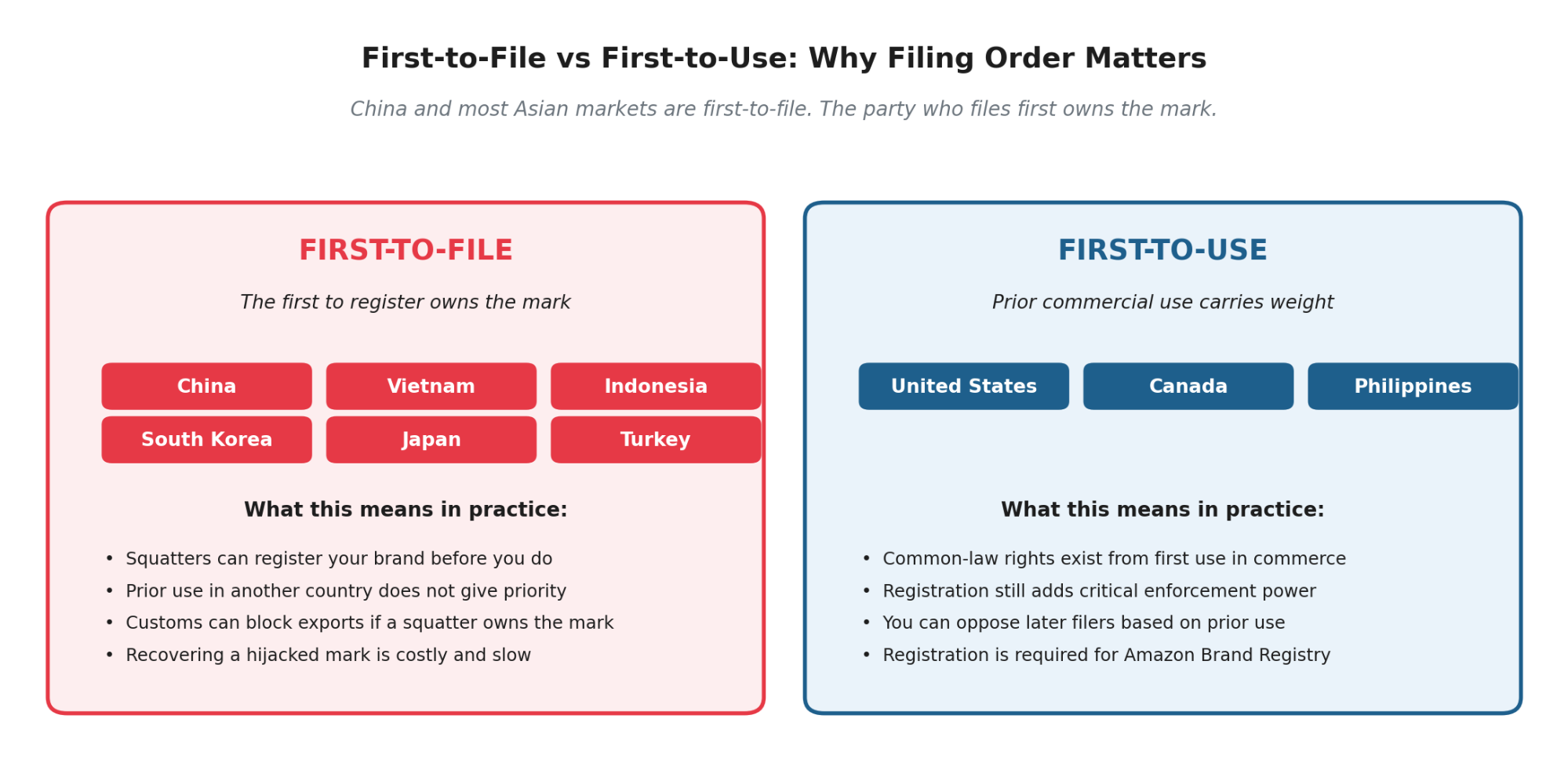
The question of where to register a trademark is not really about covering all countries. It is about identifying which countries carry actual risk or revenue for your business. Most brands instinctively think about their selling markets, the US, EU, UK, and stop there. But manufacturing countries matter just as much. A squatter who registers your brand at CNIPA in China does not need to sell a single product to cause real damage. They can block your shipments at the port of origin. Your trademark strategy needs to follow your entire supply chain, not just your storefront.
Figure: China is a first-to-file jurisdiction. Filing order, not first use, decides ownership.
Reliable product sourcing starts here
Work with experts who help you evaluate suppliers and reduce risk.
How to Trademark Your Product: A Practical Step-by-Step Guide
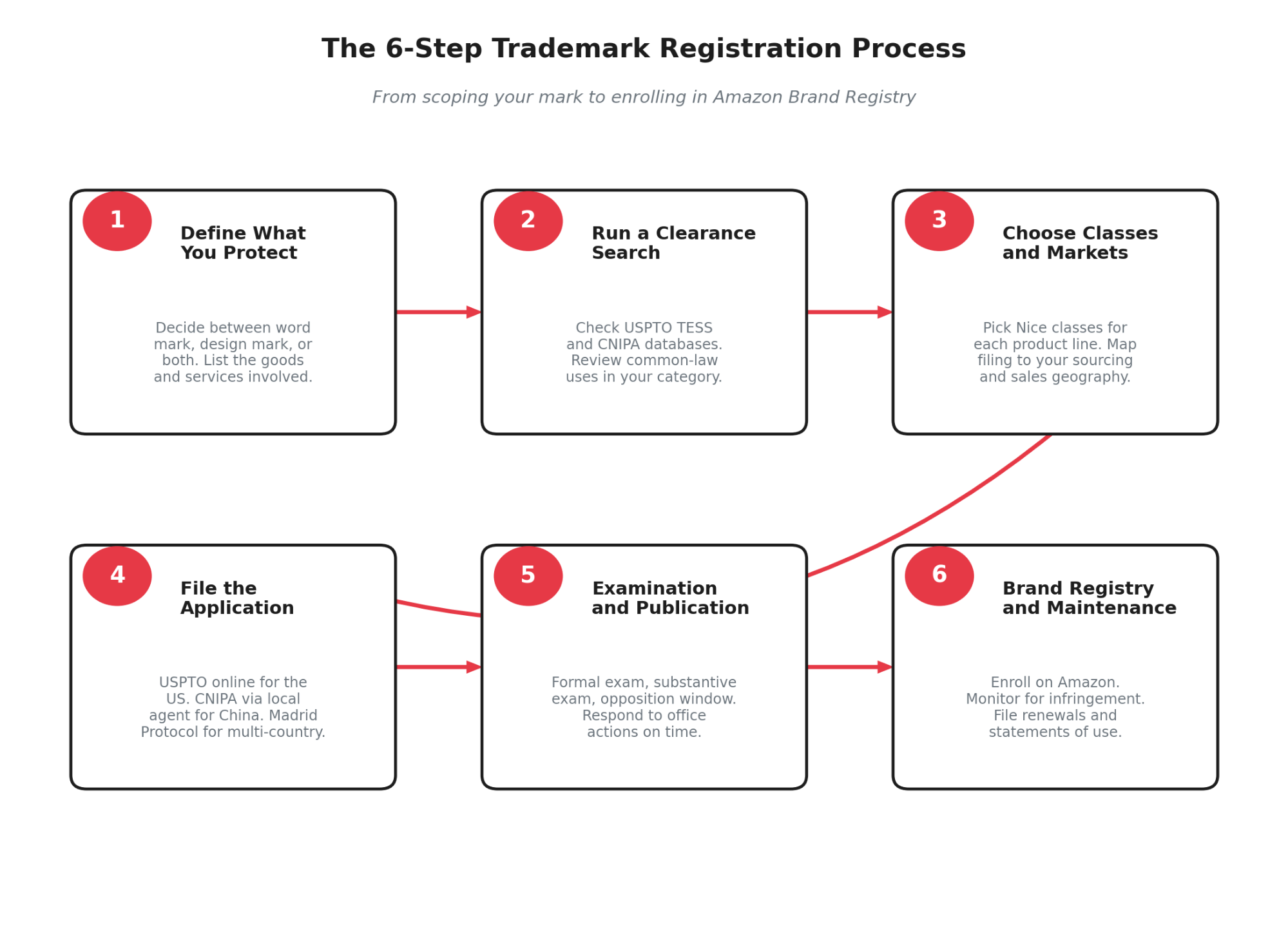
This is the general sequence for trademark registration, with the most important nuances for both the US and China explained at each step. Understanding the steps intellectually is the easy part. What actually protects your brand is executing them in the right order at the right time, before you send branded mockups to a factory, before you finalize packaging, and before you launch. Timing is everything here, and most of the costly mistakes in trademark practice are sequencing mistakes, not legal ones.
Figure: The six steps move from defining what you protect to enrolling in Brand Registry and maintaining your rights over time.
Step 1: Decide Exactly What You Are Protecting
Before you file anything, write down what your trademark actually is. Is it the brand name as a word? The logo as a design? Both? A slogan? A distinctive product shape? Most people rush this step and end up filing the wrong thing first, usually the logo, because it feels more “official.” But for most product brands, the word mark should come first. It is stronger, more flexible, and makes Brand Registry enrollment cleaner. The logo can follow as a second filing once the name is protected.
For most product brands, the order of priority is usually:
A word mark for the brand name. This is the strongest and most flexible protection because it covers the name regardless of how it is styled.
A design mark for the logo, especially if the logo carries significant brand recognition.
Optional later filings for slogans, packaging trade dress, or product shape if relevant.
If you sell on Amazon, the word mark is usually the better first filing because it makes Brand Registry enrollment cleaner and gives you broader enforcement options.
Step 2: Run a Clearance Search
Filing without searching first is one of the most expensive mistakes in trademark practice. If a similar mark already exists in your category, your application will be refused and your filing fees will not be refunded.
A proper clearance search looks at the official trademark database in each country you plan to file in (the USPTO TESS system in the US, the CNIPA database in China), then checks for similar marks that could create a “likelihood of confusion” with yours. It also looks for unregistered or common-law uses that might create conflicts.
For products sold under crowded categories such as apparel (Class 25), electronics (Class 9), and cosmetics (Class 3), the risk of refusal is significantly higher and a thorough search is essential.
Step 3: Identify the Right Classes and Markets
You have to file separately for each class of goods and separately in each country. A water bottle brand that also sells branded apparel and a fitness app might need Class 21 (containers), Class 25 (clothing), and Class 9 (software). Filing only in Class 21 leaves the apparel and app side completely exposed. This is the step where most brands underestimate both the cost and the complexity. It is tempting to file in just one class to save money upfront, but the cost of adding classes later, through new applications that restart the clock, is almost always higher than getting the filing right the first time.
In China, there is an extra layer that catches foreign filers off guard. CNIPA uses a sub-class system inside each Nice class. This means that two products that look like they are in the same category (for example, “athletic wear” and “swimwear”) can be in different sub-classes, and a trademark in one sub-class does not necessarily block someone from registering the same name in the other. A specialist with experience in Chinese trademark practice will recommend a sub-class strategy that closes these gaps.
Reliable product sourcing starts here
Work with experts who help you evaluate suppliers and reduce risk.
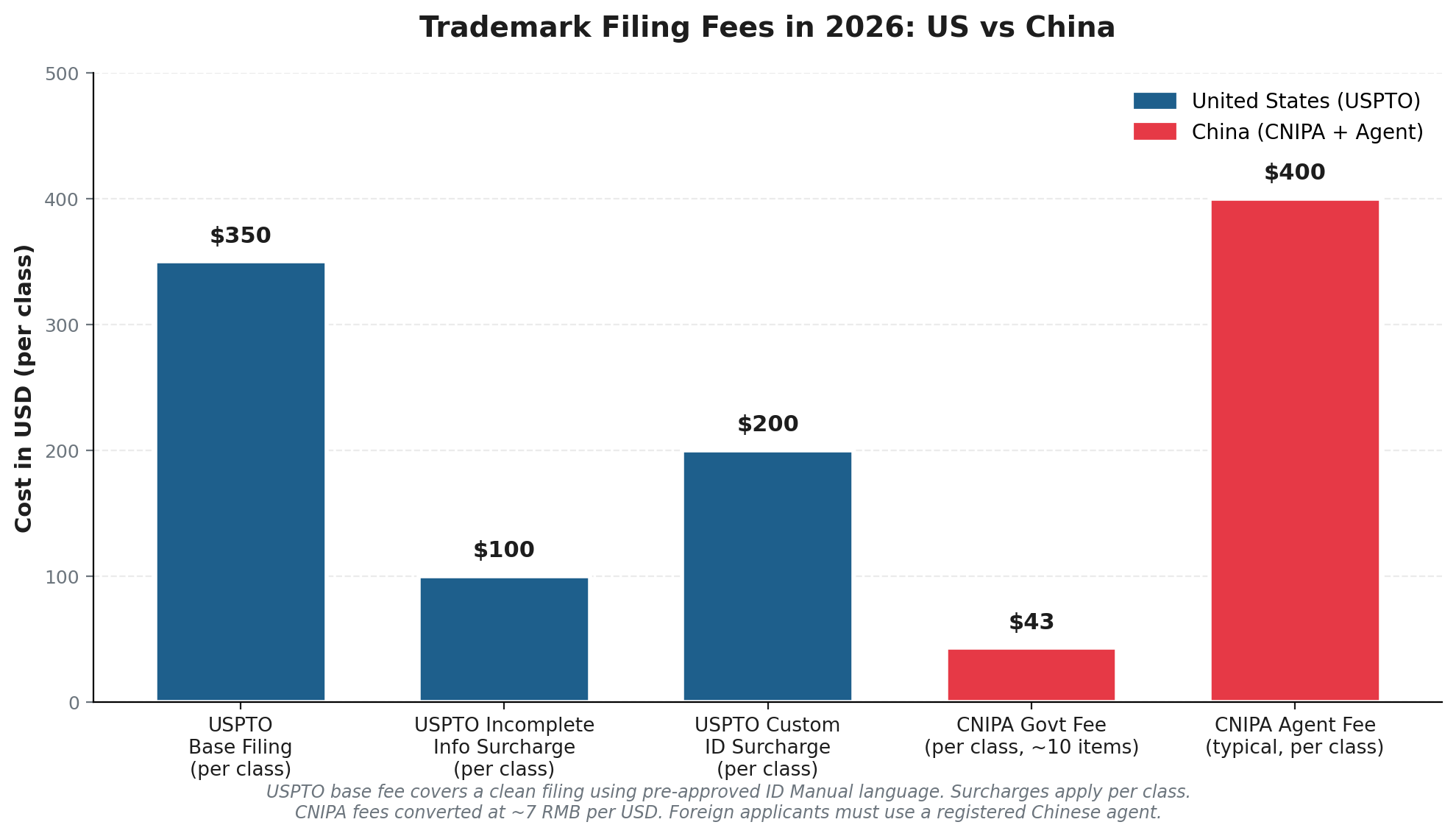
In the US, you file directly with the USPTO through the TEAS system. As of 2026, the base fee is $350 per class, with surcharges for incomplete applications or custom goods descriptions. In China, foreign applicants cannot file directly with CNIPA, you are legally required to use a registered Chinese trademark agent under Article 18 of the Chinese Trademark Law. Agent fees add several hundred USD per class on top of government fees. This China agent dependency is one of the most commonly underbudgeted costs in sourcing plans. Brands that budget only for US filing fees are often caught off guard when the China filing comes due, particularly if the supply chain is already in motion.
You can read the official fee structure on the USPTO trademark fee information page.
In China, foreign applicants cannot file directly with CNIPA. Under Article 18 of the Chinese Trademark Law, you must use a registered Chinese trademark agent. Government fees are roughly RMB 300 per class for up to 10 items, with RMB 30 for each additional item. Agent fees vary widely but typically add several hundred USD per class. You can find the official body and its English resources at the China National Intellectual Property Administration.
For multiple countries, the Madrid Protocol managed by the World Intellectual Property Organization lets you file one application that designates several member countries. This can simplify filing but does not change the fact that each country still examines the application under its own rules. More details are available at WIPO’s Madrid System.
Figure: USPTO fees can rise quickly if applications are incomplete. China requires a local agent on top of government fees.
Step 5: Examination, Publication, and Verification
After filing, your application goes through formal examination (do you have the right documents), substantive examination (is the mark distinctive and free of conflicts), and publication for opposition (does anyone object).
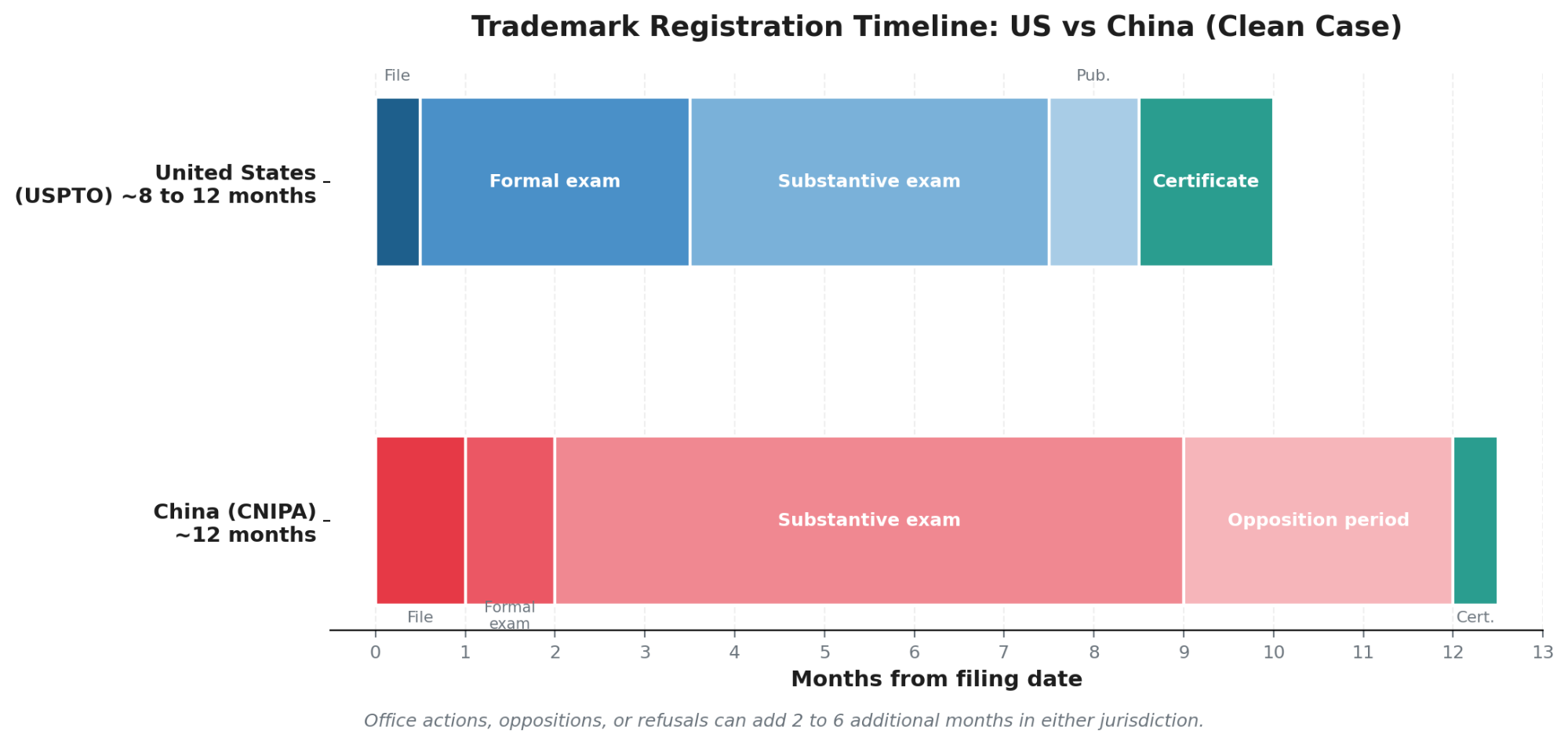
In the US, this takes roughly 8 to 12 months in a clean case. Office actions, oppositions, or specimen problems can add 2 to 6 months.
In China, examinations take about 9 months, followed by a 3-month publication period. Total time from filing to certificate is typically 12 months for a clean application. CNIPA stopped issuing paper certificates in 2022 and now issues electronic certificates only.
Figure: Typical timeline for a clean trademark application from filing to certificate.
If an office action is issued in either jurisdiction, you have a strict deadline to respond. Missing it abandons the application and you lose the filing fees.
Reliable product sourcing starts here
Work with experts who help you evaluate suppliers and reduce risk.
Step 6: Enroll in Brand Registry and Compliance Programs
Once you have a registered or pending trademark, you can enroll in Amazon Brand Registry for free. After enrollment, you unlock A+ Content, Brand Analytics, Sponsored Brands advertising, the Report a Violation tool, and listing protection. But this is also where many brands make the mistake of thinking the job is done. Brand Registry gives you tools inside Amazon’s ecosystem, it does not automatically protect you on other marketplaces, at Chinese customs, or in supplier disputes. Enforcement outside of Amazon still requires active effort: customs recordation, sub-class strategy, and supplier-side contracts are the next layer.
If you sell on other marketplaces, most also have their own brand-protection programs that require trademark registration as a baseline. Walmart Brand Portal, eBay’s Verified Rights Owner program, and Alibaba’s AliProtect all require evidence of trademark ownership.
For Chinese customs protection specifically, you can also file your registered trademark with the General Administration of Customs of the People’s Republic of China. This adds a layer of customs-level enforcement that can help block counterfeit exports before they leave the country.
Reliable product sourcing starts here
Work with experts who help you evaluate suppliers and reduce risk.
Trademark, Patent, or Copyright: Which One Do You Actually Need?
Many product brands waste money filing the wrong type of IP protection. The table below compares the three main options. For most physical product brands, especially those sourcing from Asia and selling on marketplaces, the right answer is almost always trademarks first. Roughly 90% of ecommerce brands only need trademark protection in the early stages. Patents are expensive, slow, and only worth pursuing if your product has a genuinely novel technical mechanism that meets the legal bar for protection. Copyright attaches automatically to creative works and is generally the lowest-priority filing unless your packaging artwork or content is a core part of your brand identity.
How the three main IP rights compare for product brands
Aspect
Trademark
Patent
Copyright
Protects
Brand identity (name, logo, slogan)
Inventions and technical solutions
Creative works (text, design, code)
Duration
10 years, renewable indefinitely
20 years (utility), 14 to 15 (design)
Life of author plus 70 years
US filing fee
$350 base per class
$1,600 to $4,000+ per filing
$45 to $65 per work
China filing
Via local agent, ~RMB 300 per class
Via local agent, complex review
Automatic, optional registration
Best for product brands
Almost always required
If product has novel mechanism
Packaging artwork, manuals
For most physical product brands, the priority filing is a trademark for the brand name and logo, followed by copyright for distinctive packaging artwork or manuals. Patents are only worth filing if your product has a genuinely novel technical mechanism that meets the bar for protection in your target markets.
If you want a deeper breakdown, the Zignify blog has a related guide on trademark vs patent vs copyright differences that walks through how each one applies in real sourcing scenarios.
Common Pitfalls and Mistakes to Avoid
Most trademark problems are not legal problems. They are sequencing and communication problems that show up at the worst possible moment. These are the patterns that come up repeatedly with product brands.
Filing Only in the US When You Manufacture in China
This is the single most common mistake. The US trademark gives you enforcement in the US, but it does not stop a Chinese company from registering your brand at CNIPA and then blocking your goods at the port. Because China is first-to-file, the squatter who registered the name first wins, regardless of your prior use elsewhere.
Sending Branded Mockups to Factories Before Filing in China
If you send packaging files with your brand name and logo to a Chinese factory before filing your CNIPA application, you are giving anyone in that supply chain the information they need to register your brand themselves. File first, then send branded documents to suppliers.
Choosing a Brand Name Without Clearance Search
Falling in love with a name before checking if it is available in your target markets leads to refusals, rebrands, and wasted packaging runs. A 30-minute search before committing to a name can save months of cleanup. This is where emotional decision-making costs real money. Brand naming should be treated like sourcing, with the same due diligence, market research, and risk assessment, not as a creative branding exercise that happens in isolation before any legal checks are done.
Underestimating the Class Count
Many product brands file in only one class to save money, then realize later that they need protection for accessories, packaging, or related services that fall in different classes. Adding classes after the fact requires a new application and starts the clock over.
Ignoring Renewal and Maintenance Deadlines
A trademark is not a one-time filing. In the US, you must file a Declaration of Use between years 5 and 6, and then renew every 10 years. In China, registrations are valid for 10 years and must be renewed within 12 months before expiry or during a 6-month grace period. Missing these deadlines cancels your registration and reopens the door to squatters.
Reliable product sourcing starts here
Work with experts who help you evaluate suppliers and reduce risk.
How Zignify Supports Trademark and Brand Protection in Sourcing
Zignify is a sourcing partner, not a law firm. Trademark filings are handled by licensed attorneys and trademark agents, while Zignify helps integrate brand protection into the sourcing process from the start.
This includes identifying where trademark protection is actually needed based on manufacturing and sales markets, coordinating filings before supplier outreach and packaging development, and connecting clients with trusted trademark specialists in China and other key markets.
Over the years, Zignify has seen many sourcing problems tied directly to missing or delayed trademark protection, from Chinese trademark squatting and Brand Registry issues to customs delays caused by incorrect trademark ownership. The common pattern is simple: trademark protection should be part of the sourcing strategy before production begins, not an afterthought.
Reliable product sourcing starts here
Work with experts who help you evaluate suppliers and reduce risk.
The Opportunity Ahead With a Properly Protected Brand
A brand with proper trademark protection does more than stop counterfeits, it becomes a stronger and more valuable business asset. Investors value protected brands higher, marketplaces provide better enforcement tools, and suppliers take businesses more seriously when brand ownership is clearly and legally secured. IP is not just a defensive shield. It is also leveraged in negotiations, with factories, distributors, and acquirers. A registered trademark in your manufacturing country tells a supplier that you own the brand, you have legal standing, and walking away from the relationship does not give them rights to use your name.
But this only works when trademarks are filed in the right countries, under the right classes, and aligned with packaging, listings, and supplier operations. Most brand-protection issues happen because these steps are delayed or disconnected from the sourcing process.
The brands that scale successfully in 2026 will treat trademark registration as part of supplier and sourcing strategy from day one, not as a legal task to handle later. The earlier protection is in place, the easier it becomes to build a secure and defensible supply chain around the brand.
What Most Guides Get Wrong, Here’s What Our Expert Knows ✅
Most articles about trademark registration in China and Brand Registry repeat the same surface-level advice. After working with hundreds of product brands sourcing from Asia, three issues come up over and over that almost no general guide covers. Here is what experienced sourcing teams actually warn buyers about.
🚩 Your Chinese factory may already know your brand name better than you think.
When you send product specs, packaging mockups, or sample orders to a factory in China, you are handing over your brand name months before it is legally yours in that country. Most bad-faith trademark filings in China come from someone connected to the supply chain, a sales rep, a former employee, or a competitor who shares the same factory. The CNIPA database is public, and squatters watch it carefully. The fix is filing your Chinese trademark before you send your first formal RFQ that includes branded packaging, not after your goods are ready to ship.
⚠️ Brand Registry approval depends on details no one tells you about until you fail.
Amazon does a character-for-character comparison between your trademark record, your packaging photos, and your listing. A single space, a capital letter, a stylized ampersand, any of these can break enrollment. The most painful version of this is when packaging has already been printed before the trademark application is finalized, so the seller is locked into a name that does not match. Reviewing trademark, packaging, and listing copy together before any of them are final is the cheap way to avoid an expensive rebuild later.
💰 China sub-class strategy is where most foreign trademarks quietly lose protection.
CNIPA divides each Nice class into sub-classes, and a trademark registered in one sub-class does not automatically block someone from registering the same name in an adjacent sub-class. A pet products brand might register in the obvious sub-class for pet accessories but leave the sub-class for pet food unprotected, then watch a competitor register the same brand name there. A specialist who understands the CNIPA sub-class structure will recommend a defensive filing strategy that closes these gaps before they become disputes.
If you are sourcing in China and have not filed your trademark there yet, this is the kind of gap that can stop a shipment before it leaves the factory. Book a free sourcing call →
Frequently Asked Questions
1. How much does it cost to trademark a product in the US in 2026?
The USPTO base filing fee is $350 per class as of 2026, with additional surcharges of $100 per class for incomplete applications and $200 per class for custom descriptions of goods. Most single-class filings cost between $350 and $750 in government fees, and attorney fees typically add $500 to $2,000 more depending on complexity and clearance search depth.
2. How long does trademark registration take in the US and China?
A clean US trademark application typically takes 8 to 12 months from filing to registration. In China, the process usually takes around 12 months, with examination running about 9 months followed by a 3-month publication period. Office actions, oppositions, or refusals can add 2 to 6 months in either jurisdiction.
3. Can I trademark my product name without a lawyer?
In the US, individual applicants can file directly with the USPTO without a lawyer, though attorney involvement reduces the risk of refusals and office actions. In China, foreign applicants are legally required to use a registered Chinese trademark agent under Article 18 of the Chinese Trademark Law. They cannot file directly with CNIPA.
4. What are the Brand Registry requirements on Amazon?
Amazon requires an active registered trademark or a pending trademark application filed through Amazon’s IP Accelerator program. The trademark must be a word mark or a design mark with words, letters, or numbers from a recognized IP office. Your brand name on packaging must exactly match the trademark record, and the logo must be permanently affixed to your products or packaging.
5. Why is trademark registration in China so important even if I do not sell there?
China operates a first-to-file trademark system, which means whoever registers the trademark first owns it, regardless of who used it earlier elsewhere. If a third party registers your brand at CNIPA before you do, they can legally block your goods from leaving Chinese ports through customs. Filing in China is about protecting your supply chain, not just your sales territory.
6. Can a US company register a trademark in China remotely?
Yes, but not directly. A US company must engage a CNIPA-registered Chinese trademark agent to file the application on its behalf. The entire process can be handled remotely through the agent, including responding to office actions and receiving the electronic registration certificate. CNIPA stopped issuing paper certificates in 2022.
7. What is bad-faith trademark registration in China?
Bad-faith registration is when someone files for a trademark with no genuine intention to use it, usually to extract money from the legitimate owner or block their business. Chinese law has tightened against bad-faith filings in recent years, and CNIPA now rejects more of them at examination, but the safest defense is still to file your trademark in China before your brand appears in the Chinese supply chain.
8. How do I check if my product name is already trademarked?
In the US, search the USPTO’s Trademark Electronic Search System (TESS) at uspto.gov. In China, search the CNIPA trademark database. Both are public. For a thorough clearance check, also look for similar marks that could be considered confusingly similar, not just identical matches, and check common-law uses through web searches and marketplace listings.
9. What is the difference between a trademark and a copyright?
A trademark protects brand identity, such as names, logos, slogans, and packaging trade dress. A copyright protects creative works, such as written content, artwork, software code, and photographs. Most product brands need both: a trademark for the brand name and logo, and copyright for the packaging artwork, manuals, and website content.
10. Do I need to renew my trademark registration?
Yes. In the US, you must file a Declaration of Use between years 5 and 6, and then renew every 10 years. In China, registrations are valid for 10 years and must be renewed within 12 months before expiry or during a 6-month grace period after expiry. Missing these deadlines cancels your registration and opens the door for someone else to register the same mark.