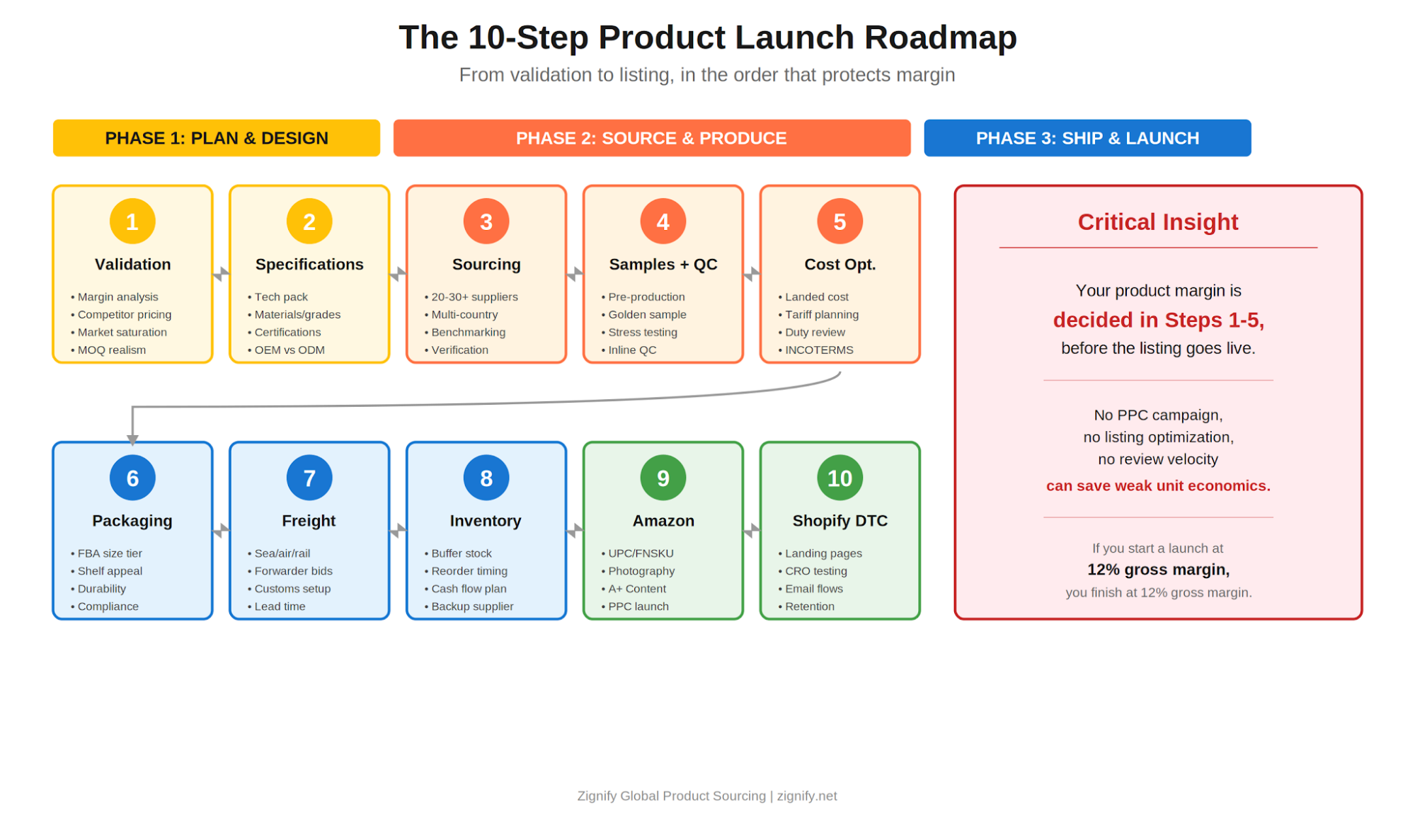
Most product launches fail before the listing goes live. Not because of bad marketing, weak photography, or a slow PPC ramp-up. They fail because the supply chain behind the product was never built to support a real launch. The seller picked the first supplier who answered, skipped the packaging math, underestimated tariffs, and discovered the real cost only after the first shipment arrived.This new product launch checklist walks through the supply-chain side of a launch in the order it actually matters. It covers product validation, specs, sourcing, samples, cost optimization, packaging, freight, inventory planning, and the final listing prep for Amazon FBA and Shopify DTC. If you are launching private label products in 2026, this is the operational map most guides leave out.
Need help with your product sourcing?
Get practical advice tailored to your product, suppliers, and market form Zignify experts
Why Most Product Launches Fail Before the Listing Goes Live
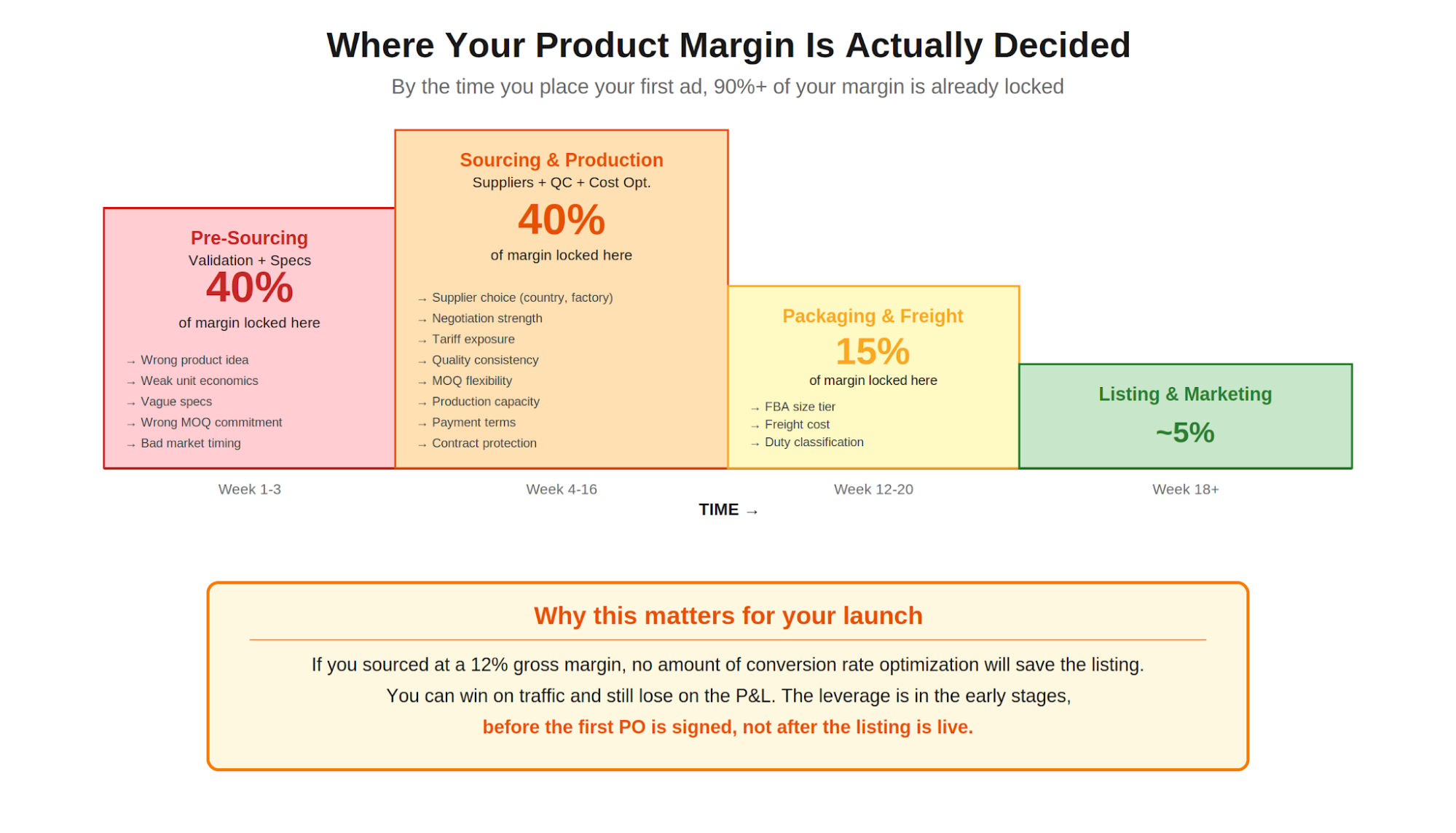
Sellers love to talk about launch strategy in terms of keywords, reviews, and PPC budgets. Those things matter, but they are the visible layer. The deeper layer is the supply chain decisions you locked in weeks earlier: which supplier, which country, which packaging spec, which freight route, which MOQ. Once those are set, your margin is mostly set with them.Here is the uncomfortable truth most launch content avoids. Your product margin is determined before your first sale. If you sourced at a 12 percent gross margin, no amount of conversion rate optimization will save the listing. You can win on traffic and still lose on the P&L.This is why launch readiness is a sourcing problem first and a marketing problem second. The sellers who launch profitably do three things differently. They benchmark suppliers globally instead of accepting the first three Alibaba quotes. They plan packaging and freight before they sign a PI. And they treat the first production run as the start of a supply chain, not a one-off transaction.
Reliable product sourcing starts here
Work with experts who help you evaluate suppliers and reduce risk.
Step 1: Product Validation Before You Touch a Supplier
Validation is the cheapest part of a launch and the most skipped. Sellers fall in love with a product idea, jump straight to Alibaba, and only later discover that the unit economics never worked. By then, they have paid for samples, signed an NDA, and lost two months.A serious validation step looks before samples, supplier negotiations, or tooling costs begin at:
Margin analysis: full landed cost including duty, freight, FBA fees, returns, and ad spend, not just the FOB quote.
Competitor pricing: where your product would sit in the listing pool, and whether you can hold that price after Amazon fees.
Shipping feasibility: oversize items, hazmat, batteries, and liquids all carry surcharges that quietly destroy margin.
Market saturation: review counts, daily search volume, and how many sellers already own the top of the page.
MOQ realism: whether the minimum order quantity matches your launch capital, or forces you to overcommit before you have proof.
If the numbers do not work on paper, walking away early is usually cheaper than trying to rescue the product later. The opportunity cost of launching the wrong product is much higher than the cost of saying no.
Reliable product sourcing starts here
Work with experts who help you evaluate suppliers and reduce risk.
Once the product clears validation, you need a specification document that a factory cannot misinterpret. This is where private label sellers lose the most quality on their first run. Two suppliers quoting “the same product” almost never quote the same product. One uses thinner material, one uses a cheaper zipper, and one ships with no inner foam. The quotes look comparable on paper. The products are not.A usable spec sheet covers:
Dimensions and tolerances: exact measurements with acceptable variance, not “approximately.”
Materials: grade, weight, thickness, fabric composition, plastic resin type, and metal alloy.
Certifications required: CE, FCC, CPSC, FDA, REACH, Prop 65, depending on your market.
Barcode requirements: UPC, EAN, FNSKU for Amazon FBA, label placement, and scannability test.
Amazon compliance: hazmat documentation, lithium battery declarations, and child safety where relevant.
This is also where you decide whether you want OEM or ODM production. OEM means the factory builds to your spec from scratch. ODM means you customize an existing factory product. ODM is faster and cheaper. OEM gives you more differentiation. Neither is wrong. They just produce different launch timelines.
Reliable product sourcing starts here
Work with experts who help you evaluate suppliers and reduce risk.
Step 3: Supplier Sourcing That Goes Beyond Alibaba
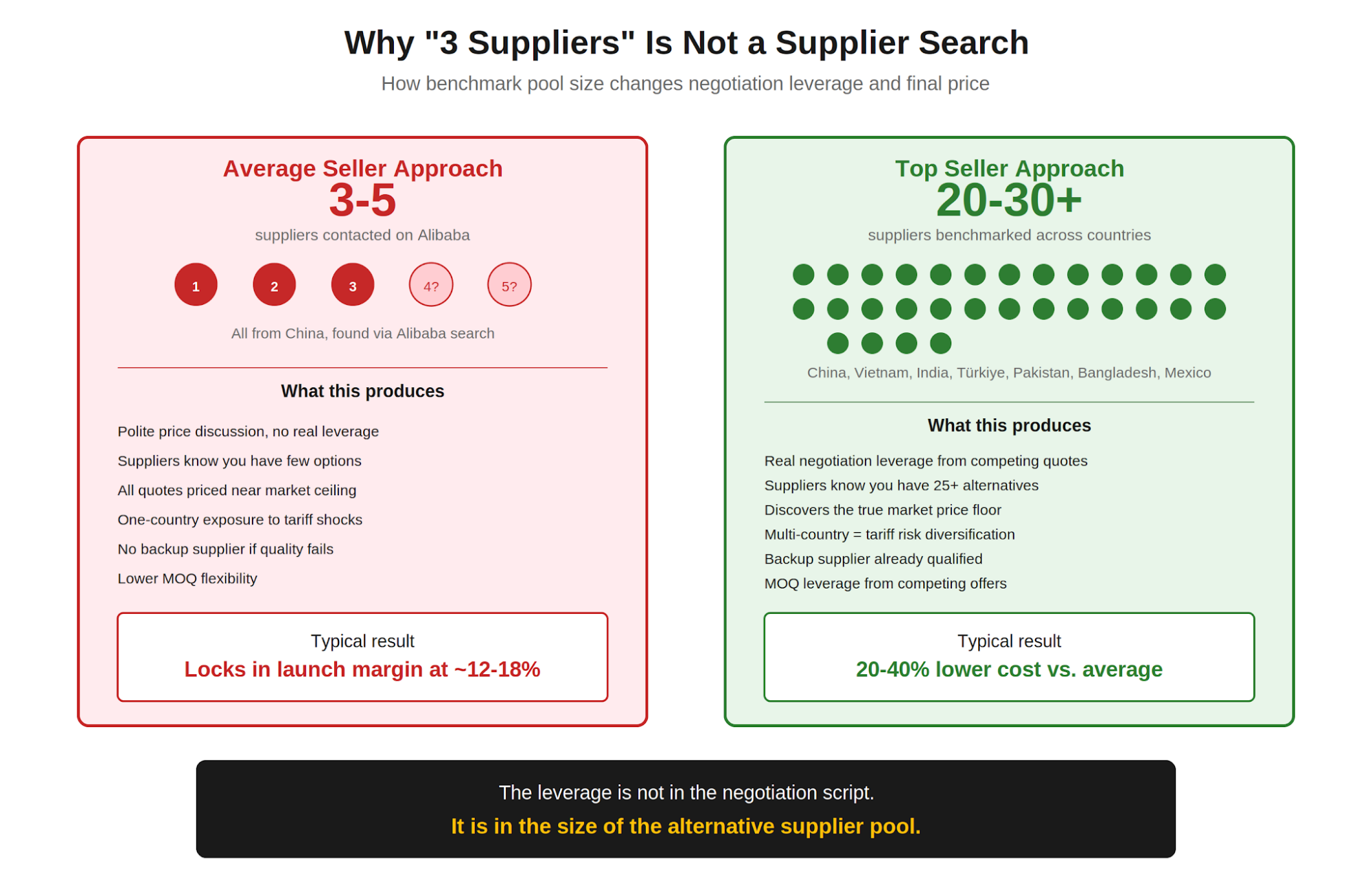
Most sellers approach sourcing by opening Alibaba, contacting three to five suppliers, picking the most responsive one, and calling it a day. This is the single biggest reason launch margins are weak. You cannot negotiate from a position of strength when your alternative pool has five names in it.Top sellers benchmark differently. They do not stop at “best price from the suppliers I happened to find.” They start there. The goal is 20 to 30 qualified producers minimum, across multiple countries, with comparable quotes against the same spec.Why does this matter so much? Because the second-best supplier is also your leverage with the first. If your top supplier knows you have many other quotes on file, the negotiation conversation changes completely. If they think you have three, they hold the price.
Where to source: country matters more than ever
China is still the dominant manufacturing country for most categories, but it is no longer the automatic answer. For sellers shipping into the United States, China-origin tariffs have shifted the math on entire product categories. Vietnam, India, Türkiye, Pakistan, Bangladesh, Mexico, and Indonesia all matter now, depending on the product. A serious supplier search for a 2026 launch looks across multiple countries by default.
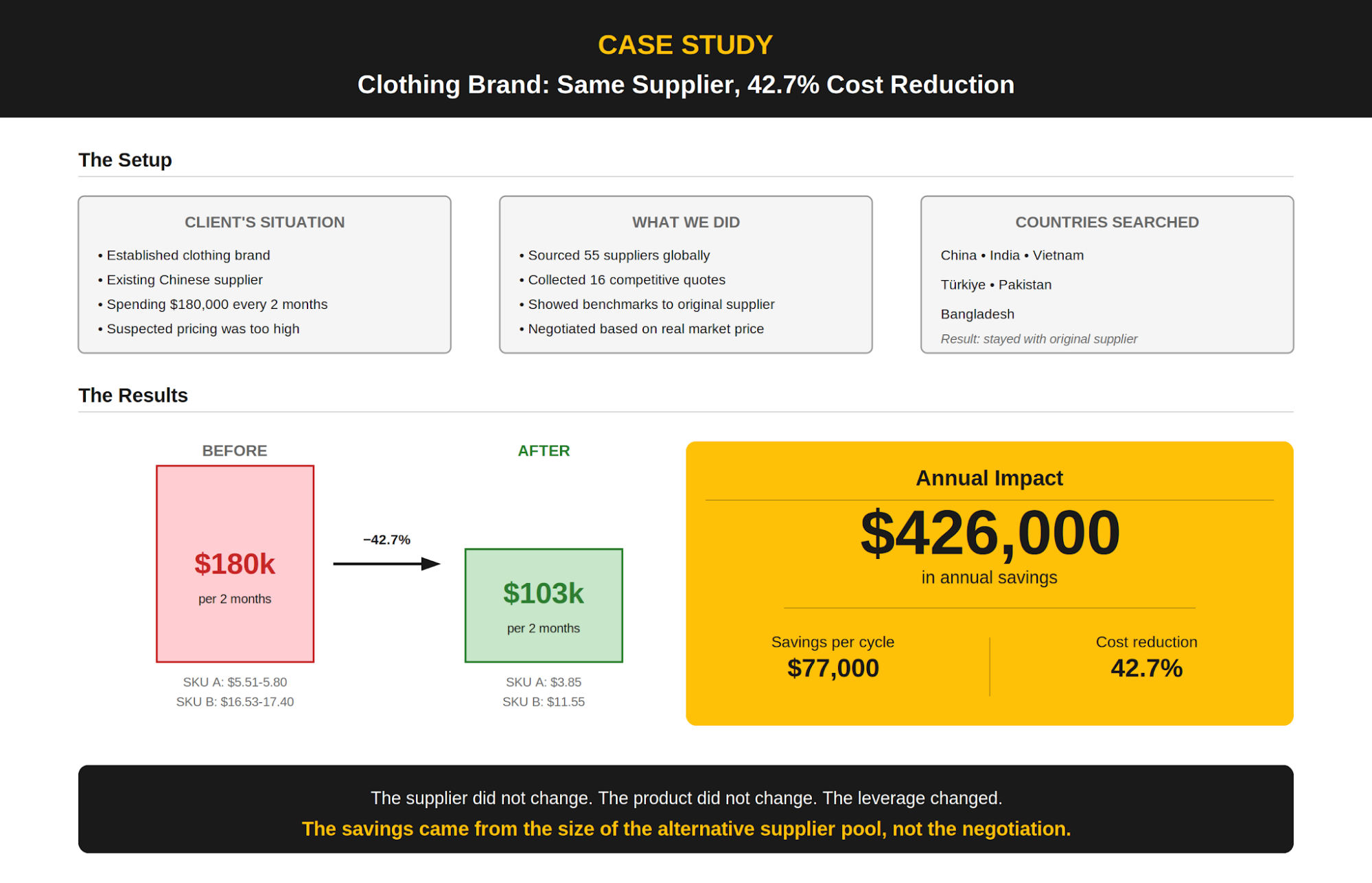
REAL CLIENT EXAMPLE: CLOTHING BRANDWe sourced 55 suppliers across China, India, Vietnam, Türkiye, Pakistan, and Bangladesh for an established clothing brand. We received 16 competitive offers. The interesting result: the original Chinese supplier matched the better pricing once they saw the benchmark. Per cycle, production cost dropped from $180,000 to $103,000. That is 42.7 percent savings, roughly $426,000 a year, with the same factory. The leverage came from the supplier pool, not the negotiation script.
Step 4: Sample Testing and Pre-Production Quality Control
Samples are where launches go wrong silently. A factory sends you a beautiful pre-production sample, you approve it, you pay the deposit, and three months later, mass production looks nothing like the sample. The factory swapped components, downgraded the fabric, or rushed the assembly to hit the deadline.A serious sample stage includes:
Pre-production sample: confirms the factory can build to your spec at all.
Golden sample: the locked reference sample that mass production must match. Keep one copy for yourself, send one to the factory, photograph and document everything.
Stress testing: drop tests, tensile tests, abrasion tests, and electrical testing, if applicable. Many sellers ship to FBA without ever testing whether the product survives Amazon warehouse handling.
Packaging drop tests: simulate the actual journey from factory to FBA bin. Most damaged-on-arrival returns trace back to packaging that was never tested under realistic conditions.
QC inspection during mass production: not at the end, but during. By the time goods are crated, fixing defects becomes a return-to-factory negotiation. During production, it is a same-day correction.
Quality control is the difference between a launch and a recall. The standard practice in serious sourcing is to inspect a statistically valid sample of the production run, in person, at the factory, before payment is released. Relying exclusively on the factory’s own QC team creates an obvious conflict of incentives.
Step 5: Cost Optimization Before You Place the Production Order
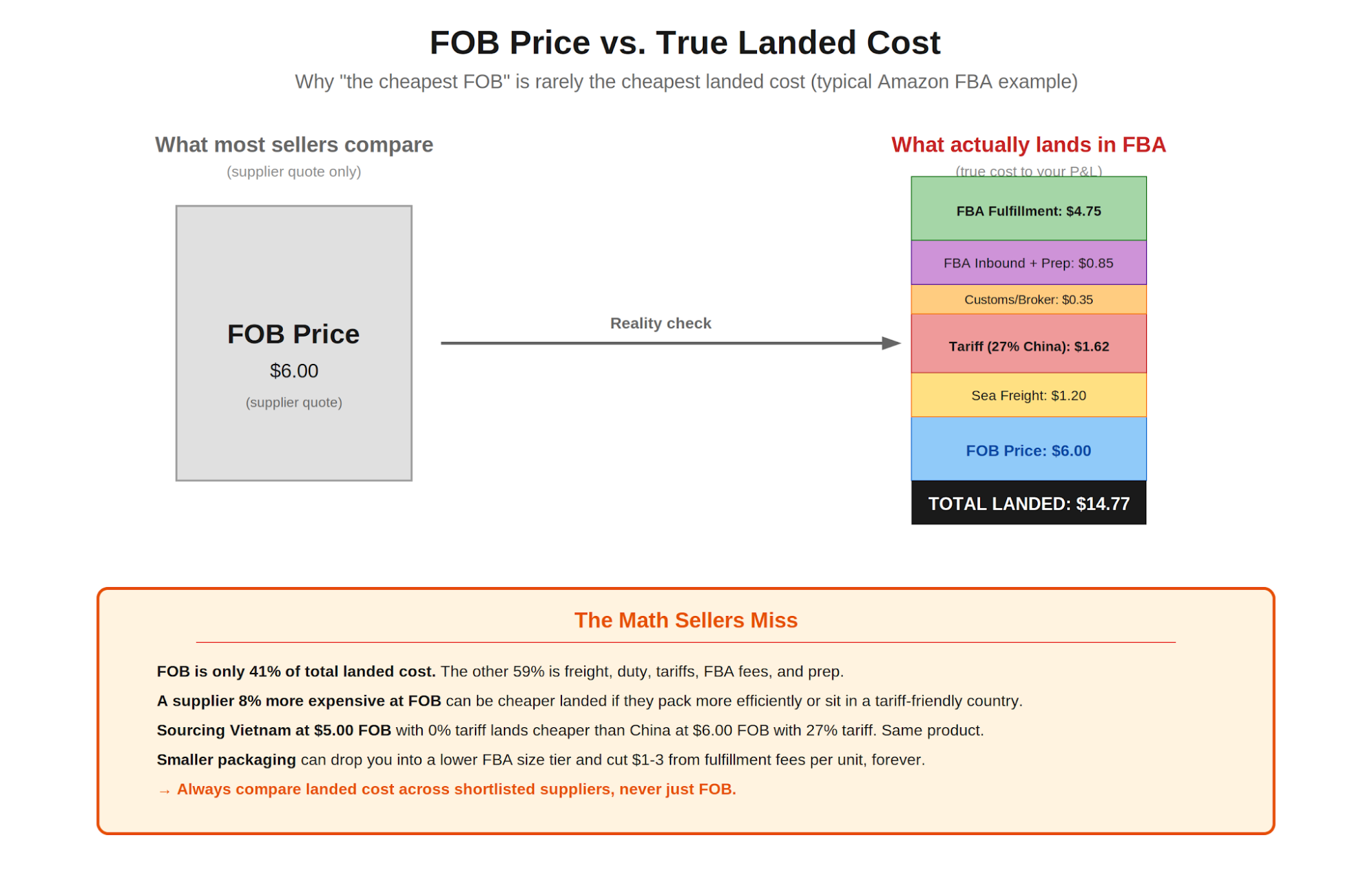
This is the section most launch checklists skip entirely, which is why so many launches start with weak margins; they spend the next 18 months trying to claw back.Landed cost is not the FOB quote. It is the FOB quote plus freight, plus duty, plus tariffs, plus customs broker fees, plus storage, plus inland transport, plus FBA prep, plus FBA inbound fees. By the time you finish adding those up, the supplier’s FOB price is often 50 to 70 percent of your true landed cost. Optimizing only the FOB price and ignoring the rest is the most common margin mistake we see.Figure 5. Why FOB price alone is misleading. Sellers comparing only the supplier quote miss the 59 percent of cost that lands on top of it.
Tariff planning: the largest single lever for US sellers
For sellers shipping into the US, tariffs have become the dominant cost variable. China-origin goods carry tariff layers that have changed several times in the last two years. Many sellers built supply chains when tariffs were lower and have not re-run the math since.
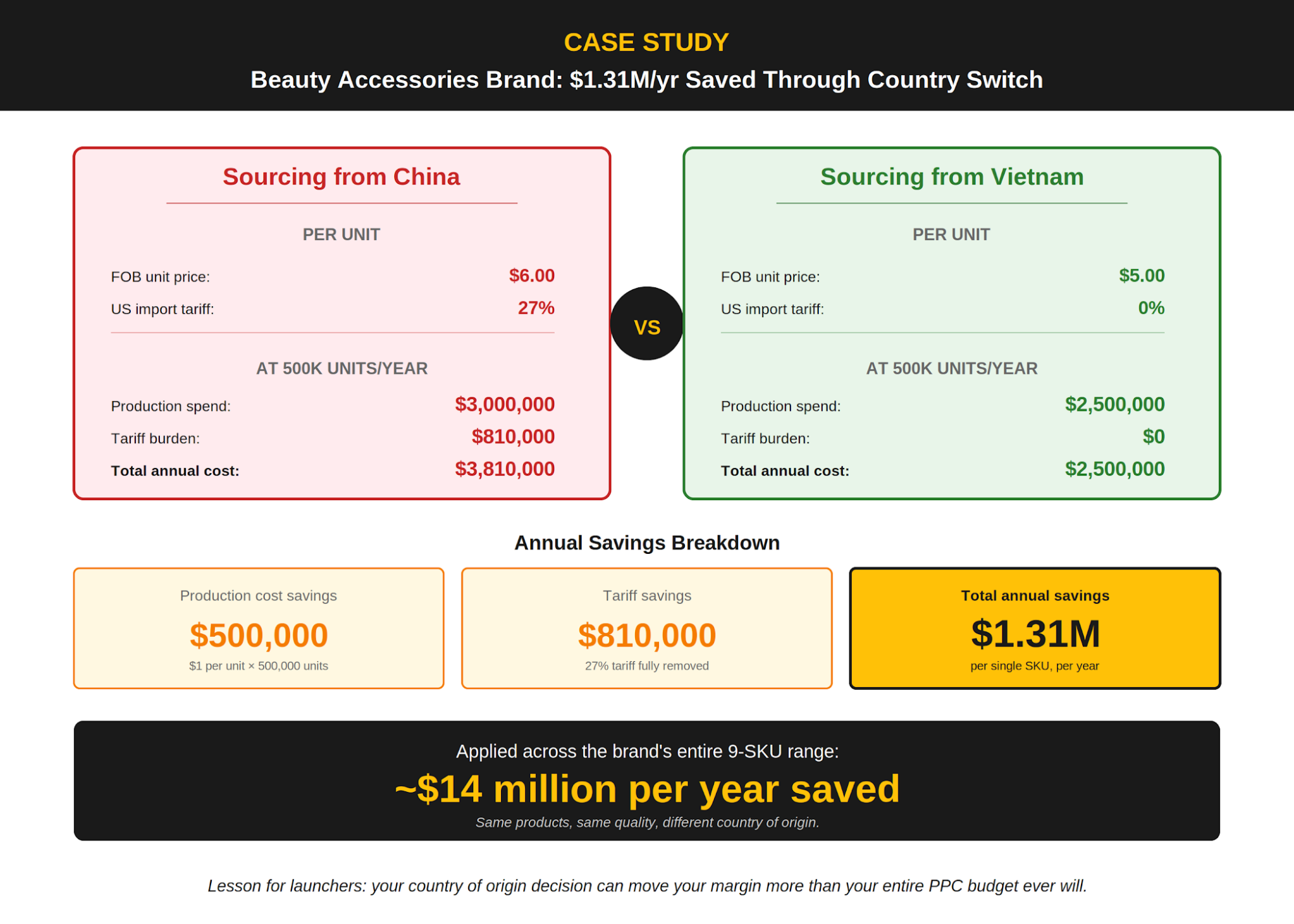
REAL CLIENT EXAMPLE: BEAUTY ACCESSORIES BRANDA beauty accessories brand selling heavily in the US was paying about $6 per unit in China, with a 27 percent import tariff layered on top. We sourced the same product from Vietnam at $5 per unit, with zero tariff exposure. At 500,000 units per year, that produced about $500,000 in product cost savings and another $810,000 in tariff savings. About $1.31 million per year, on one product. Across their 9-SKU range, full diversification produced roughly $14 million in annual savings.
Figure 6. Beauty accessories tariff case study. Switching country of origin removed the 27% tariff burden entirely and reduced per-unit cost.This is the launch lesson that does not appear in any marketing playbook. Your product margin is determined before your first sale, and the country of origin is one of the largest levers you have.
Reliable product sourcing starts here
Work with experts who help you evaluate suppliers and reduce risk.
Packaging size: A smaller carton can drop your product into a lower FBA size tier and reduce per-unit fulfillment cost.
Master carton optimization: Cube efficiency directly affects container utilization and freight cost per unit.
Duty classification: Many products are classified under the wrong HTS code, which sometimes means the importer is paying a higher duty rate than the law requires. A correct classification review is rarely expensive and sometimes saves significant money on every shipment forever.
INCOTERMS choice: FOB, EXW, CIF, DDP, each shift costs and risks differently. Many sellers default to whatever the factory offers, which is rarely the cheapest option.
Step 6: Packaging Development That Sells and Survives
Packaging is one of the most underrated margin levers in private label. The reason is simple: small packaging decisions multiply across every unit you sell.A serious packaging stage covers:
Branding and unboxing: the visible part. Important for retention, repeat purchase, and DTC perception.
Inserts and instructions: regulatory in some categories, brand-building in others.
Sustainability: matters for both consumer perception and for some retailer compliance requirements.
Shipping durability: protects margin by reducing damaged returns. This is where most cheap packaging fails.
Shelf appeal: only relevant if you sell off-Amazon or in retail, but critical when you do.
The cost-optimization question to ask at this stage: can you make the packaging smaller without losing brand quality? A 10 percent reduction in package dimensions can change your FBA size tier and cut per-unit fulfillment costs for the lifetime of the product. The math compounds on every unit sold.
Reliable product sourcing starts here
Work with experts who help you evaluate suppliers and reduce risk.
Freight is one of the most overlooked sections of a launch checklist, but it is also one of the easiest places to save real money. Most sellers accept the factory’s shipping offer because it feels convenient. Factories often work with preferred forwarders, which may include commercial incentives or long-standing routing relationships.A real freight plan covers:
Sea vs. air vs. rail: each has different cost, speed, and reliability tradeoffs. The right answer changes by season, by container availability, and by your inventory position.
Lead time: sea freight from China to the US runs 25 to 45 days port-to-port, plus customs clearance, plus inland to FBA. Plan accordingly.
Buffer stock: at least one production cycle of safety stock, more if your supplier’s lead time is long.
Customs and broker setup: get your customs broker in place before your first shipment, not during.
Freight forwarder benchmarking: Comparing two or three forwarders against each other regularly is the simplest way to keep shipping costs honest.
Reliable product sourcing starts here
Work with experts who help you evaluate suppliers and reduce risk.
This is where fast-growing sellers crash hardest. The launch goes well, ranking improves, sales accelerate, and the seller runs out of stock six weeks in. The next reorder takes 90 days to land. By the time inventory returns, ranking has collapsed, PPC has burned through cash trying to defend the listing, and the launch has effectively restarted from scratch.A real inventory launch plan considers:
Reorder timing: When do you place the next order to avoid a stockout, given your lead time and current sell-through rate?
Cash flow: Do you have the working capital to reorder before the first batch is fully sold? Most growing sellers do not, and that is the gap that needs solving before launch, not during.
Stockout cost: An Amazon stockout costs more than lost sales. It costs ranking, review velocity, and PPC efficiency for months afterward.
Scaling production: Can your supplier handle 2x your current volume in the next cycle? If not, you need a backup supplier qualified before you need them, not after.
Production capacity validation: The factory said they can make 50,000 units a month. Have you verified that? Touring the factory, or having someone do it for you, is the only honest answer.
A common pattern we see: sellers underestimate how quickly inventory turns once a launch starts working. They place a conservative first order, the product sells through faster than expected, and the reorder window becomes the bottleneck on the entire business. Planning inventory with the assumption that the launch might actually succeed is a habit that separates the brands that scale from the ones that stall.
Step 9: Amazon Listing Preparation
Once the supply chain is sound, the listing layer matters. This is where most launch content focuses, so we will keep this section short and operational.
UPC and EAN codes: registered, valid, and matched to your FNSKU.
Product photography: main image on white background, lifestyle shots, infographic overlays, scale shots, packaging shots, A+ content visuals.
A+ Content or Brand Story: required for brand-registered sellers, and one of the highest-ROI listing investments.
SEO keywords: backend search terms, title structure, bullet point keyword placement, all tied to actual search volume rather than guesses.
Listing optimization: conversion-rate testing, especially on the main image and price point.
Launch review velocity: opt into Vine, plan for follow-up email sequences, and set the review request automation correctly.
PPC launch plan: budget per day, sponsored product structure, defensive bidding on your own brand terms, and broad-match harvesting for new keywords.
The listing layer can lift a strong product. It cannot save a weak supply chain. A great listing on a 12 percent margin product just loses money faster.
Step 10: Shopify and DTC Launch Preparation
If you are launching on Shopify rather than or alongside Amazon, the playbook shifts. You own more of the customer experience, but you also carry more of the conversion burden.
Conversion-rate optimization: the entire economics of DTC depend on cost-per-acquisition versus average order value versus lifetime value. The product page itself becomes the listing.
Landing page design: dedicated pages for paid traffic, not just the default product page.
Product bundles: a strong way to lift average order value on day one.
Email and SMS flows: welcome, abandoned cart, post-purchase, review request, repeat-purchase nudge. These should all be live before the first ad dollar runs.
Retention strategy: subscription, repeat purchase incentives, or simply great packaging and a reason to come back.
The DTC version of this checklist is even more dependent on margin, because you are paying for every customer twice. Once in CAC, and again in operational costs. If your sourcing is weak, your DTC launch will quietly bleed cash even when the marketing dashboard looks healthy.
Reliable product sourcing starts here
Work with experts who help you evaluate suppliers and reduce risk.
A few patterns repeat across every weak launch we have seen.
Choosing the wrong supplier: usually because the seller talked to three suppliers, not 30.
Skipping packaging optimization: shipping in oversized cartons that bump up the FBA size tier and inflate fulfillment cost on every single unit, forever.
Underestimating tariffs: especially for sellers who built supply chains pre-2023 and have not re-run the math since.
Failing QC: relying on factory self-inspection, which is a structural conflict of interest.
Not negotiating MOQs: accepting the supplier’s first MOQ as if it were fixed, when most are negotiable in exchange for slightly higher unit pricing or a deposit adjustment.
Overpaying for production: not benchmarking widely enough to know what the real market price is.
Unable to scale inventory: launching with one supplier and no backup, which becomes a problem the moment things go well.
Unstable supply chains: assuming one factory, one country, one forwarder will hold together for the next three years. They will not.
Zignify works on the buyer’s side. We do not sell products. We are not a trading company, and we do not take commissions from factories. Our role is to help sellers build a launch supply chain that holds up to scrutiny, scale, and tariffs.In a typical launch project, we cover:
Product validation and target price testing: telling you early whether the numbers can work at all.
Supplier search across multiple countries: typically 20 to 30 qualified producers, not three.
Negotiation: pushing pricing down while protecting quality, using the full benchmark pool as leverage.
Sampling and golden sample management: making sure the product you approve is the product you receive in mass production.
Quality control in the factory, during mass production: not just at the end.
Packaging optimization: where most sellers leave money on the table.
Logistics benchmarking: comparing forwarders the way we compare suppliers.
Compliance and documentation: certificates, hazmat, labeling, country-specific requirements.
Contracts: clear terms that protect the buyer on quality, delivery, and exclusivity where relevant.
You pay us for the work. You pay the supplier directly. Supplier ownership remains with the buyer. There are no hidden product margins, no factory commissions, no setup fees. You have direct access to the supplier from day one and can verify everything we do.The point is not to outsource the launch. It is to remove the supply-chain weaknesses that quietly kill it.
Reliable product sourcing starts here
Work with experts who help you evaluate suppliers and reduce risk.
A new product launch in 2026 is a different exercise than it was three years ago. Tariffs are higher and more variable. Supplier markets outside China are more credible. Amazon’s fee structure is more punishing for oversized packaging. DTC ad costs have climbed. The margin for error on sourcing has shrunk.But the opportunity has also widened. Sellers who plan the supply chain seriously now have access to better suppliers in more countries, cleaner freight benchmarking, and tighter QC processes than were realistic a few years ago. The launches that go well in the next 24 months will not be the ones with the loudest marketing. They will be the ones with the strongest sourcing foundation behind a normal marketing plan.The work happens before the listing goes live. The checklist above is where that work lives.
What Most Guides Get Wrong, Here’s What Our Expert Knows
Most product launch checklists treat sourcing as one bullet point in a marketing plan. That framing is what causes launches to fail at the cost layer. The supply-chain decisions you make in weeks one to four lock in margin for the life of the product, and almost no public checklist explains the traps that show up later.
Your landed cost is not your FOB price, and the gap is where launches die.
Sellers compare supplier quotes on FOB and pick the cheapest one. Then they add freight, duty, tariffs, broker fees, FBA inbound, and prep, and discover the cheapest FOB quote was not actually the cheapest landed cost. A supplier 8 percent more expensive at FOB can be 15 percent cheaper landed if they pack more efficiently or ship from a tariff-friendly country. Run the full landed-cost math on every shortlisted supplier before you negotiate, not after.
The factory’s own QC report is a structural conflict of interest.
The people inspecting the goods report to the people who made them. That is not how quality control is supposed to work in any other industry. For a real launch, you need a third party in the factory during mass production, not at the end. By the time goods are crated, fixing defects becomes a return-to-factory negotiation that the supplier almost always wins. Catching the problem mid-production turns it into a same-day correction with no leverage lost.
The “best price” you negotiated is rarely the best price available.
Most sellers stop benchmarking the moment a supplier agrees to their target price. That is the exact moment top sellers keep going. The reason is simple: suppliers know what most buyers will accept, and they price to that ceiling. The only way to know the real market price is to benchmark across 20 to 30 suppliers in multiple countries against an identical spec. We have seen the same product quoted from $5.51-$5.80 down to $3.85 by the same factory once they saw the wider benchmark. The leverage was not in the negotiation. It was in the supplier pool size.If you are within 90 days of launching a new product and have not yet stress-tested your sourcing assumptions, the cheapest version of that conversation is the one that happens now. Book a free sourcing call →
Frequently Asked Questions
What is the most important step in a new product launch checklist?
Validation and target-price testing, before any supplier is contacted. If the unit economics do not work on paper at a realistic landed cost, no amount of sourcing or marketing later will save the product. The cheapest decision in a launch is saying no to the wrong product early.
How many suppliers should I contact before placing a production order?
Top sellers benchmark 20 to 30 suppliers minimum across multiple countries on the same spec. Three to five suppliers is not a supplier search; it is a polite negotiation with no leverage. The wider the pool, the stronger the negotiation position with whichever supplier you eventually choose.
Should I source from China or Vietnam for an Amazon FBA launch?
It depends on the product, the tariff exposure for your target market, and the production complexity. For many categories selling into the US, Vietnam has become competitive or cheaper than China once tariffs are included. For some categories, China is still the only credible option. The right answer is to run quotes from both before deciding, not to assume one is correct.
How long does a typical product launch take from sourcing to first sale?
Allow three to six months as a realistic range. Validation and sourcing take 4 to 8 weeks, samples take 2 to 4 weeks, mass production takes 30 to 60 days, depending on category and country, freight adds 25 to 45 days for sea, and FBA inbound takes another 1 to 3 weeks. Compressed timelines almost always sacrifice quality control or freight cost.
What is the difference between OEM and ODM sourcing?
OEM means the factory builds entirely to your spec from scratch, which gives maximum differentiation but takes longer and costs more upfront. ODM means you customize an existing factory product, which is faster, cheaper, and lower-risk for first-time sellers. Most successful private label launches start ODM and move to OEM as the brand matures.
How do I avoid getting stuck with a bad supplier after launch?
Three things help. First, qualify a backup supplier before you need one, not after a quality failure. Second, do not pay 100 percent upfront. Standard terms are 30 percent deposit and 70 percent against pre-shipment inspection. Third, never lose direct supplier access. If you work with a sourcing partner, make sure you have the supplier’s contact details from day one and can communicate independently.
Are tariffs on Chinese goods going to keep changing?
The short answer is yes. Tariff policy on China-origin goods has shifted several times in the last 18 months and the structure remains politically active. Sellers who built supply chains assuming static tariffs are exposed. Multi-country sourcing is not just a cost play; it is a risk management play. Having qualified suppliers in two countries means a tariff change is not an existential event for your brand.