Most supplement brands do not fail because their formula was wrong. They fail because they chose the wrong manufacturer, missed a compliance requirement, or built a packaging setup that quietly ate their margin on every single order. By the time those problems show up, money has already been spent, inventory is already on the water, and fixing them is far more expensive than getting them right the first time.If you are planning to source private label supplements, the early decisions matter more than almost anything you will do later. This guide walks through how to find the right manufacturer, which certifications actually protect your business, how packaging affects your real landed cost, and where the biggest risks hide. The goal is simple: help you make sourcing decisions that hold up once real orders, real customers, and real customs inspections are involved.
Need help with your product sourcing?
Get practical advice tailored to your product, suppliers, and market form Zignify experts
Why Sourcing Decisions Decide Whether a Supplement Brand Survives
Supplements are an attractive category for a reason. Demand is recurring, margins can be strong, and private labels give you a branded product without owning a factory. But the same things that make the category attractive also make it unforgiving. You are selling something people put into their bodies, in a market where platforms, customs authorities, and regulators all care deeply about what is inside the bottle and what is printed on the label. We’ve seen brands spend months perfecting marketing only to get stuck on compliance basics. In supplements, sourcing mistakes tend to show up much later, when they’re expensive to fix.That changes the stakes. In many product categories, a sourcing mistake means a lower margin or a slow reorder. In supplements, a sourcing mistake can mean a blocked shipment, a delisted product, a failed lab test, or an account suspension that takes your whole business offline. The cost of getting it wrong is not just financial, it is existential for a young brand.Here is the part most new brands underestimate. The manufacturer matters more than the formula spreadsheet. Two factories can quote you the same ingredient list at a similar price and still deliver completely different products, because the real differences live in the parts you cannot see on a quote.
Raw material sourcing: where the actual ingredients come from and how consistent they are batch to batch.
Testing standards: whether the factory verifies potency, purity, and contamination, or simply assumes it.
Filling precision: how accurately each capsule, scoop, or gummy is dosed.
Stability processes: whether the product holds up over its shelf life instead of degrading early.
Packaging quality: whether seals, caps, and labels survive shipping and storage. This is exactly why we rarely compare suppliers on price alone. The hidden differences usually sit in testing, sourcing, and process control.
None of those show up on a price comparison. All of them show up in your reviews, your return rate, and your compliance record. This is why serious sourcing starts with manufacturer capability, not with the recipe.
Reliable product sourcing starts here
Work with experts who help you evaluate suppliers and reduce risk.
What You Are Really Choosing When You Source Private Label Supplements
Private label supplements cover a wide range of product types, and each one carries a different level of manufacturing difficulty. Knowing where your product sits helps you set realistic expectations on cost, minimum order quantity, and how hard you need to vet the factory.
Common private label supplement formats
Capsules and tablets: the most established format, generally the easiest to produce consistently.
Powders: common for protein and greens, where blending uniformity and scoop accuracy matter.
Gummies: high consumer demand but technically one of the hardest formats to get right.
Stick packs and sachets: convenient and premium feeling, but often tied to higher minimum orders.
Liquids and tinctures: where stability, dosing, and packaging integrity become critical.
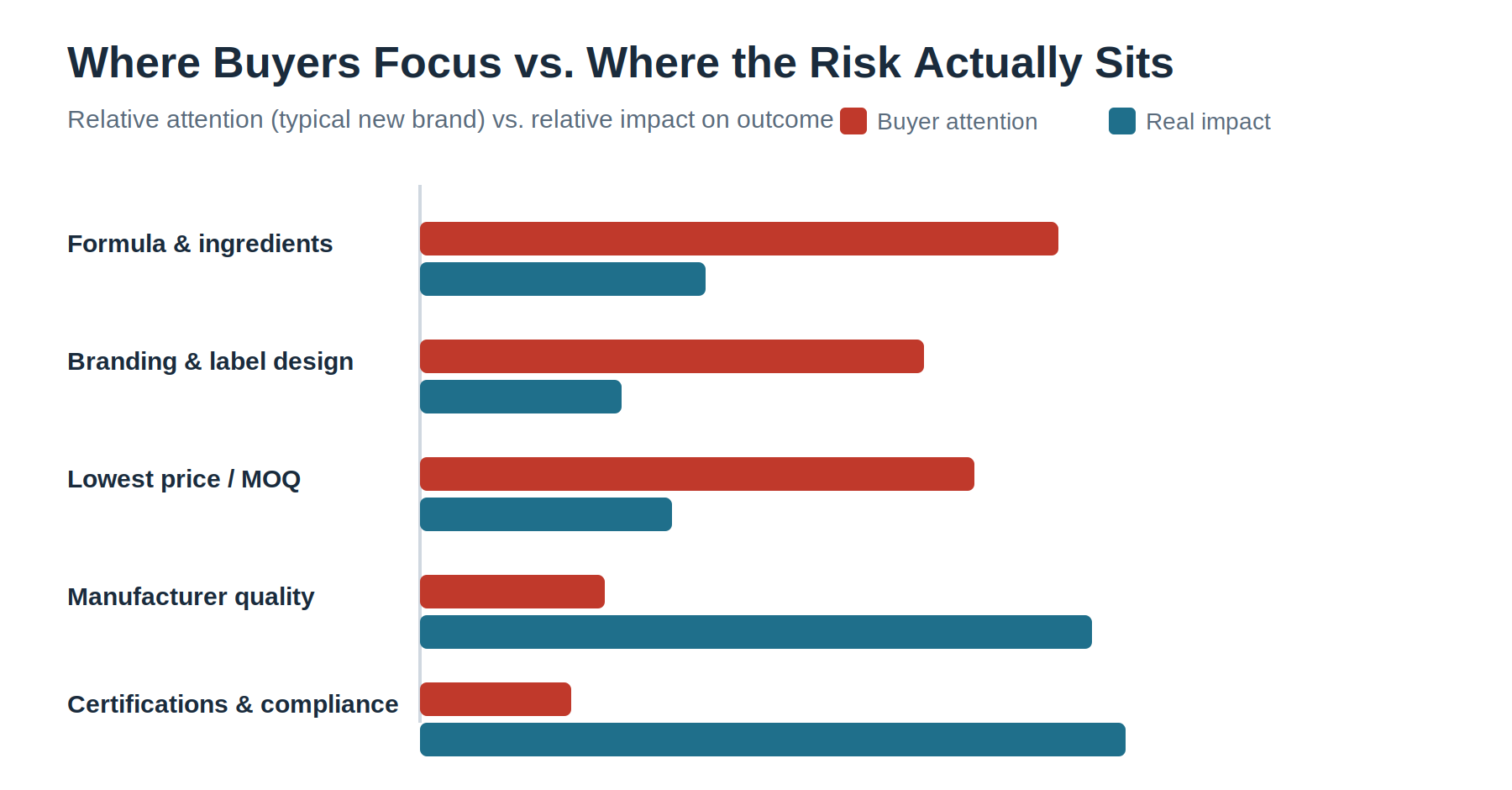
The chart below shows a pattern worth internalizing before you start. New brands tend to pour their attention into formula and branding, while the factors that actually decide the outcome, manufacturer quality and compliance, get the least attention.Figure 1. Where buyers focus is rarely where the real risk sits.A quick word on gummies, because they trap a lot of first time brands. Demand is enormous, so people assume production is straightforward. It is not. Gummy production is technically difficult, with common issues around stability, melting during shipping, flavor consistency, sugar ratios, and shelf life. Gummies generate a surprising number of complaints related to melting, texture changes, and shelf-life issues. They’re one of the formats where factory selection really matters.A gummy manufacturer should be vetted far more aggressively than a standard capsule supplier. If a factory cannot clearly explain how they handle heat in transit and stability over time, that is a signal, not a detail.
Reliable product sourcing starts here
Work with experts who help you evaluate suppliers and reduce risk.
India vs China vs USA: Where to Source Supplements
There is no single best country to source private label supplements. Each origin has real strengths and real weaknesses, and the right answer depends on your product, your target market, and how much compliance confidence you need to show. Many of the strongest brands do not pick one country at all. They use a hybrid approach.
Origin
Strengths
Trade-offs
China
Strong on raw ingredients, packaging, and cost efficiency. Deep supplier base and fast iteration.
Perception concerns in some markets, and quality varies widely between factories.
India
Strong for nutraceutical and herbal ingredients, Ayurvedic products, and aggressive pricing.
Supplier quality varies significantly, so vetting becomes even more important.
USA
Strong on compliance confidence, FDA familiarity, premium positioning, and fast domestic fulfillment.
Much higher pricing, which can be hard to absorb on price sensitive products.
The advanced move is to separate the decision by component. A brand might take ingredients from India, packaging from China, and filling or final production in the USA, matching each origin to its strength. This is harder to manage, but it can give you the ingredient access, cost structure, and compliance credibility that no single country offers on its own.This is also where a buyer side sourcing partner earns its place. Comparing factories across several countries, in one product category, is slow and easy to get wrong when you are doing it alone from inbox replies.
Reliable product sourcing starts here
Work with experts who help you evaluate suppliers and reduce risk.
Certifications Are Often More Important Than Price
Supplement manufacturing is trust based. Buyers chasing the lowest capsule price or the smallest minimum order often skip past the question that actually protects the business: can this factory prove what it produces? Cheap factories without proper certification can damage a brand very quickly, especially once Amazon compliance, retailer approvals, and customs inspections enter the picture.These are the certifications buyers care about most, and why each one matters. Not every certification is necessary for every product, but the factory should be able to clearly explain which ones apply and provide supporting documentation.
Certification
Why it matters
GMP
Good Manufacturing Practice, the baseline for consistent and controlled production.
FDA Registration
Builds confidence for selling into the U.S. market.
ISO
Signals process quality and structured management systems.
HACCP
Food safety control, important for ingestible products.
Organic
Supports premium positioning when claims are backed properly.
NSF
Credibility for sports and performance supplements.
Halal
Opens Middle East and Muslim majority markets.
Vegan
Meets growing direct to consumer demand.
Certifications also tie directly into legal selling. For the U.S. market, dietary supplements sit under specific FDA rules, and it is worth understanding the basics of FDA dietary supplement regulation before you commit to a manufacturer. A factory that cannot support the documentation you need is a factory that can cost you a listing later.
Reliable product sourcing starts here
Work with experts who help you evaluate suppliers and reduce risk.
A Step by Step Process to Source Private Label Supplements
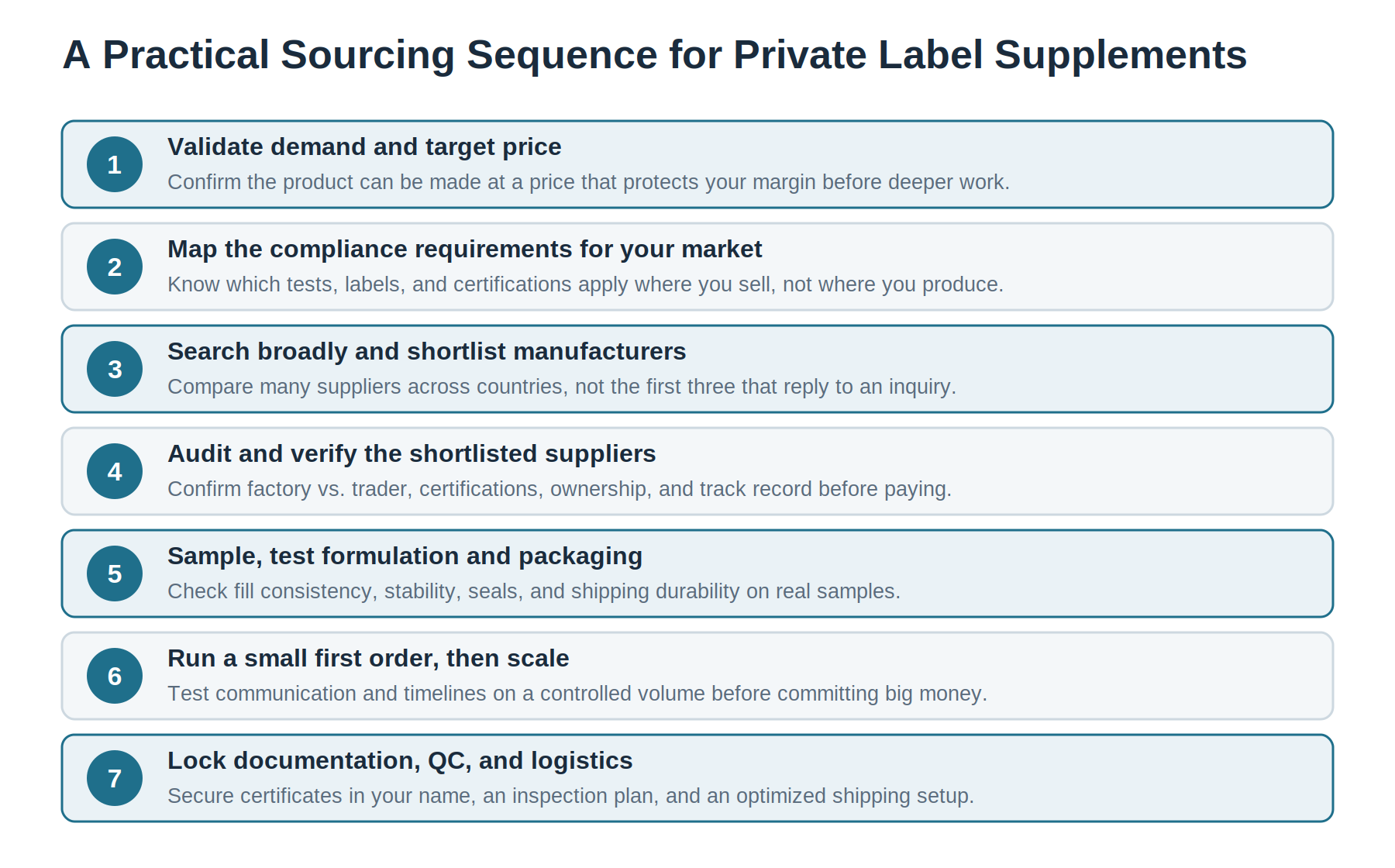
Sourcing works best as a sequence, not a scramble. Doing things in the wrong order is how brands end up paying for samples of products they should never have pursued, or signing with a factory they never verified. The sequence below keeps risk low and decisions cheap until you have real evidence.Figure 2. A practical sourcing sequence that keeps risk and cost low early.
Step 1: Validate demand and target price
Before sourcing, confirm the product is worth pursuing. A quick market and price check tells you whether your target purchasing price is realistic, so you do not invest in a product that cannot carry a healthy margin. This validation step is lightweight compared to full sourcing, and it filters a long idea list down to the few products actually worth deeper work.
Step 2: Map compliance for your selling market
Compliance is about where you sell, not where you produce. A children’s product, a skin contact product, anything used with food, and anything with electronics or batteries each carry different requirements. Mapping this early tells you which tests, labels, and certifications you need, so you can rule out factories that cannot support them.
Step 3: Search broadly and shortlist manufacturers
Do not stop at the first three suppliers who reply. A broad search across multiple factories, and often multiple countries, is what gives you real leverage on price and real options on quality. The aim is a shortlist of credible manufacturers, not a single default supplier you happened to find first. Not every certification is necessary for every product, but the factory should be able to clearly explain which ones apply and provide supporting documentation.
Step 4: Audit and verify before you pay
At this point you are about to send money to a company you have never worked with. A supplier audit confirms whether the supplier is a real factory or a trading company in between, how long they have operated, who the owners are, and whether there are legal or reputational red flags. This is the step that separates working on verified facts from working on trust alone.
Step 5: Sample, then test formulation and packaging
Order samples and check the things that fail in the real world: fill consistency, stability, seal integrity, and whether the packaging survives shipping. Packaging quality control matters just as much as formulation quality control. A perfect capsule inside a bottle that leaks or whose label peels is still a returned product.
Step 6: Run a small first order, then scale
Instead of placing a huge first order, test the relationship at a controlled volume. Test communication, sample to production consistency, packaging quality, and whether they hit timelines. Smart brands prove a supplier on a small order before scaling, because responsiveness under real pressure is hard to fake.
Step 7: Lock documentation, QC, and logistics
Finally, secure the paperwork and the flow. That means test reports and certificates issued in your company name, a clear inspection plan, and a shipping setup that does not quietly inflate your landed cost. Getting documentation and logistics right at the end is what makes the whole thing repeatable on reorders. Documentation tends to feel boring until somebody asks for it. Then it suddenly becomes the most important part of the project.
Reliable product sourcing starts here
Work with experts who help you evaluate suppliers and reduce risk.
Packaging Is One of the Most Underrated Profit Drivers
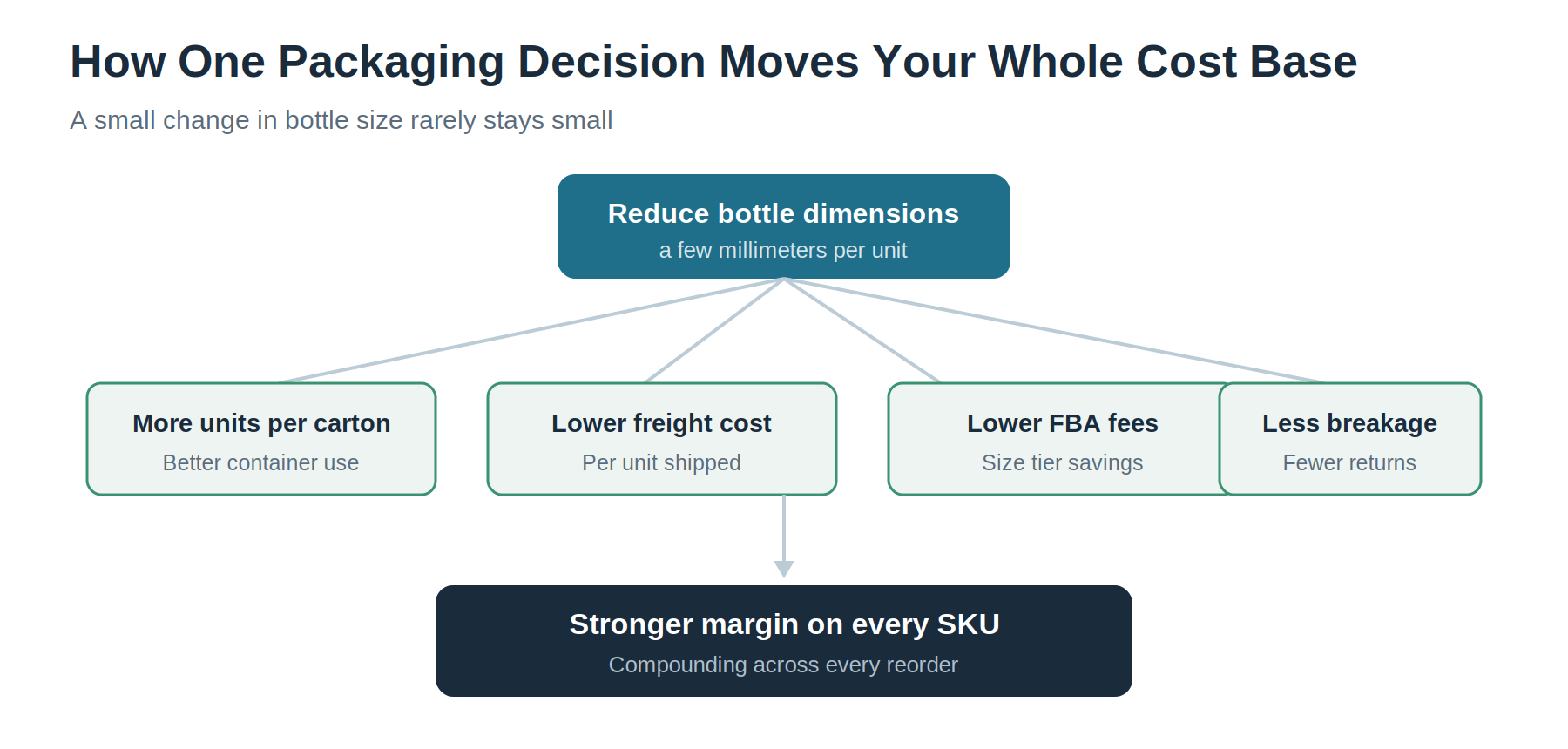
Most supplement brands treat packaging as a design choice: pick a bottle, design a label, done. In reality, packaging quietly drives landed cost, shipping cost, shelf appeal, breakage rate, and how customers perceive the quality of what they bought. Small packaging optimizations can save thousands per SKU, free up container space, and cut both freight and fulfillment costs.Here is a concrete example most brands never calculate. Reducing a bottle’s dimensions by even a few millimeters can let you fit more units per carton, reduce freight cost per unit, lower Amazon FBA fees by staying in a better size tier, and reduce breakage. Each of those is small on its own. Together, across every reorder, they reshape your margin.Figure 3. A small packaging change rarely stays small.Packaging is also where preventable quality failures live. The common ones are familiar to anyone who has read enough supplement reviews.
Seal and moisture failures: weak induction seals or caps that let moisture into the bottle.
Label problems: peeling labels, fading print, or labels that fail compliance requirements.
Wrong components: incorrect or missing scoops, poor caps, leaking pouches.
These create returns, bad reviews, lost trust, and in some cases platform penalties. Treating packaging as an afterthought is one of the most expensive habits in the category, which is why it deserves the same scrutiny as the formula itself.
Common Mistakes That Sink New Supplement Brands
Most failures in this category are not exotic. They are the same handful of mistakes repeated by brand after brand. Knowing them in advance is the cheapest insurance you can buy. Almost all of these mistakes are avoidable if they’re identified early enough.
Chasing the formula before the factory: locking the recipe first and then hunting for the cheapest maker, instead of starting from manufacturer capability.
Treating compliance as a later problem: assuming you can fix labeling, testing, and claims after launch, when the real risk is a blocked shipment or a suspended listing.
Letting MOQ pick the supplier: many factories require 5,000, 10,000, or even 50,000 units, especially for custom formulations, gummies, and stick packs, and a brand chasing the lowest MOQ can end up with the wrong partner.
Skipping the audit: sending money to a trading company that presents itself as a factory, with no verification of ownership or track record.
Underestimating packaging: ignoring how dimensions, seals, and labels affect both cost and returns.
There is a related truth worth stating plainly. The best supplement manufacturers usually do not compete on price. Top tier factories often reject very small clients, enforce stricter minimums, and hold their pricing, because compliance risk is high and quality systems are expensive to run. If a factory is unusually cheap and unusually flexible, ask why. Sometimes it is a genuine startup friendly partner. Sometimes it is a sign of standards you do not want to inherit.The real risk in supplement sourcing is not manufacturing, it is compliance. Failed testing, incorrect labeling, unsupported health claims, banned ingredients, customs issues, and platform suspensions cause more damage than a slightly higher unit cost ever will. If you want to go deeper on platform specific risk, read more about avoiding tariff and compliance traps in Amazon FBA sourcing before you scale.
Reliable product sourcing starts here
Work with experts who help you evaluate suppliers and reduce risk.
How Zignify Supports Private Label Supplement Sourcing
Sourcing private label supplements well is really four jobs at once: supplier verification, quality control, compliance management, and cost optimization. That is exactly the work Zignify is built around, and importantly, on the buyer’s side. Zignify does not take factory commissions or bribes, which means the supplier we recommend is the one that fits your product, not the one paying for placement.In practice, that support shows up across the same sequence you just read.
Target price validation: a fast, lightweight check on whether your top product ideas can be produced at a price that protects your margin, before committing to full sourcing.
Broad supplier search: comparing many manufacturers across countries in your specific category, so you choose from real options rather than inbound replies.
Supplier audit: verifying whether a supplier is a factory or a trader, checking ownership, history, and red flags before you pay.
Compliance check and lab management: identifying which regulations and tests apply to your market, then coordinating the labs so certificates are issued in your company name.
Quality control and packaging optimization: inspecting production and helping redesign packaging to cut freight, fulfillment, and breakage costs.
The underlying principle is transparency. You get direct supplier access, a clear view of the process, and decisions grounded in verified information instead of sales pressure. That is the difference between a black box service and a partner that helps you make better sourcing calls.
Reliable product sourcing starts here
Work with experts who help you evaluate suppliers and reduce risk.
The supplement market rewards brands that take sourcing seriously. Recurring demand and strong margins are real, but they only reach your bottom line if your manufacturer is reliable, your compliance is solid, and your packaging is working for you instead of against you. The brands that win are not the ones with the cleverest formula. They are the ones whose supply chain holds up quietly, order after order.Get the foundations right early, and scaling becomes a matter of repeating a process you trust. Get them wrong, and every growth step multiplies a problem you never fixed. The good news is that the right foundations are knowable, and they are exactly what a careful, buyer side sourcing process is designed to deliver.
What Most Guides Get Wrong, Here’s What Our Expert Knows
Most supplement sourcing guides stop at find a GMP factory and pick a nice bottle. The expensive lessons live in the details those guides skip, the ones you only learn after a shipment is held or a listing disappears.Certifications on a website are claims, not proof, until you verify them.A logo on a supplier’s homepage means very little on its own. Certificates expire, get borrowed, or apply to a different production line than the one making your product. The factories that look most polished online are sometimes traders presenting someone else’s credentials. Before any payment, the certificate should be checked against the issuing body and tied to the exact facility and product type you are ordering. Skipping this is how brands discover, at customs, that their proof does not hold.Gummies and stick packs hide their real cost in stability and shipping, not unit price.The quote on a gummy looks great until summer freight melts a container or a batch separates before its date. These formats carry stability, heat, and shelf life risks that capsules simply do not. A low price from a factory that cannot explain its stability testing or its shipping protections is not a saving, it is a deferred loss. The cheapest gummy supplier is frequently the most expensive one once returns and write offs are counted. We’ve seen products that looked profitable on paper become expensive after factoring in spoilage, heat exposure, and returns.A few millimeters of packaging can outweigh months of price negotiation.Brands spend weeks fighting a supplier for a small per unit discount, then ignore a packaging change that would save far more. Bottle dimensions drive units per carton, freight per unit, and Amazon size tiers all at once. Running the packaging math before the final order often reveals more margin than the entire price negotiation did. The factory will not raise this for you, because it is your cost to find, not theirs.If you are about to source private label supplements, get a second set of eyes on the factory, the certs, and the packaging before you commit. Book a free sourcing call →
Frequently Asked Questions
What does it mean to source private label supplements?
It means having a manufacturer produce a supplement to your specification and sell it under your own brand, rather than reselling someone else’s product. You control the branding, packaging, and often the formulation, while the factory handles production. The hard part is choosing a manufacturer that can meet quality and compliance standards consistently.
Is the formula or the manufacturer more important?
The manufacturer is more important. Two factories can quote the same ingredient list and deliver very different products because of raw material sourcing, testing, filling precision, and quality controls. A strong manufacturer protects your reviews, return rate, and compliance record in ways a formula spreadsheet cannot.
Which certifications do I actually need for supplements?
It depends on your market and product, but GMP is a baseline most serious buyers expect. Selling into the U.S. often involves FDA registration, while NSF matters for sports supplements, and Halal or Vegan certifications open specific markets. The key is that your factory can genuinely support and document the certifications your market requires.
What is a realistic minimum order quantity for private label supplements?
It varies widely by format. Capsules can have relatively accessible minimums, while custom formulations, gummies, and stick packs often require thousands of units or more. Rather than chasing the lowest MOQ, look for a supplier whose minimums match your stage and whose quality you have verified.
Where should I source supplements, China, India, or the USA?
Each has trade-offs. China is strong on ingredients, packaging, and cost. India is strong on nutraceutical and herbal ingredients with aggressive pricing. The USA offers compliance confidence and premium positioning at higher cost. Many brands use a hybrid setup, matching each origin to its strength.
What is the biggest hidden risk in supplement sourcing?
Compliance, not manufacturing. Failed lab tests, incorrect labeling, unsupported health claims, banned ingredients, and customs or platform issues cause far more damage than a slightly higher unit cost. Mapping compliance for your selling market early is the cheapest way to avoid these problems.