Most buyers ask one question when they start working with a sourcing partner: What does a sourcing agent cost? It is an important question, but the visible fee is only one part of the real sourcing cost. The agent fee is the number that sits on the surface, easy to see and easy to compare. The cost that decides whether your sourcing project makes or loses money sits much lower down, in the supplier price you negotiate, the suppliers you never compared, and the defects you discover after the goods have shipped.This guide breaks down how sourcing agents actually charge, the four main pricing models, the hidden margin trap that catches importers who believe they are buying factory direct, and how to evaluate a sourcing company on the things that move your total purchasing cost. It also explains where a transparent, buyer-side partner like Zignify fits, and why the cheapest sourcing agent is often the most expensive sourcing decision you can make.
Need help with your product sourcing?
Get practical advice tailored to your product, suppliers, and market form Zignify experts
Why Sourcing Agent Cost Is the Most Misunderstood Number in Importing
A sourcing agent helps you find suppliers, negotiate pricing, check quality, and move goods from a factory to your warehouse. The fee they charge for that work is real, but it is rarely the highest cost in the transaction. When buyers shop for the lowest fee, they often end up paying far more in places they were not looking.Think about where money is actually won or lost on a sourcing project:
Supplier price: the unit cost you negotiate, which usually dwarfs the agent fee on any real order.
Supplier selection: whether you compared five factories or fifty before deciding.
Quality outcomes: the cost of defects, returns, rework, and lost customers.
Logistics and duties: the landed cost after shipping, tariffs, and documentation.
A low-cost sourcing structure with limited supplier comparison or weak quality control can easily erase any savings gained on the fee itself. That is why the smart framing is not how cheap the agent is, but does this sourcing structure lower or raise my total cost over time?
Reliable product sourcing starts here
Work with experts who help you evaluate suppliers and reduce risk.
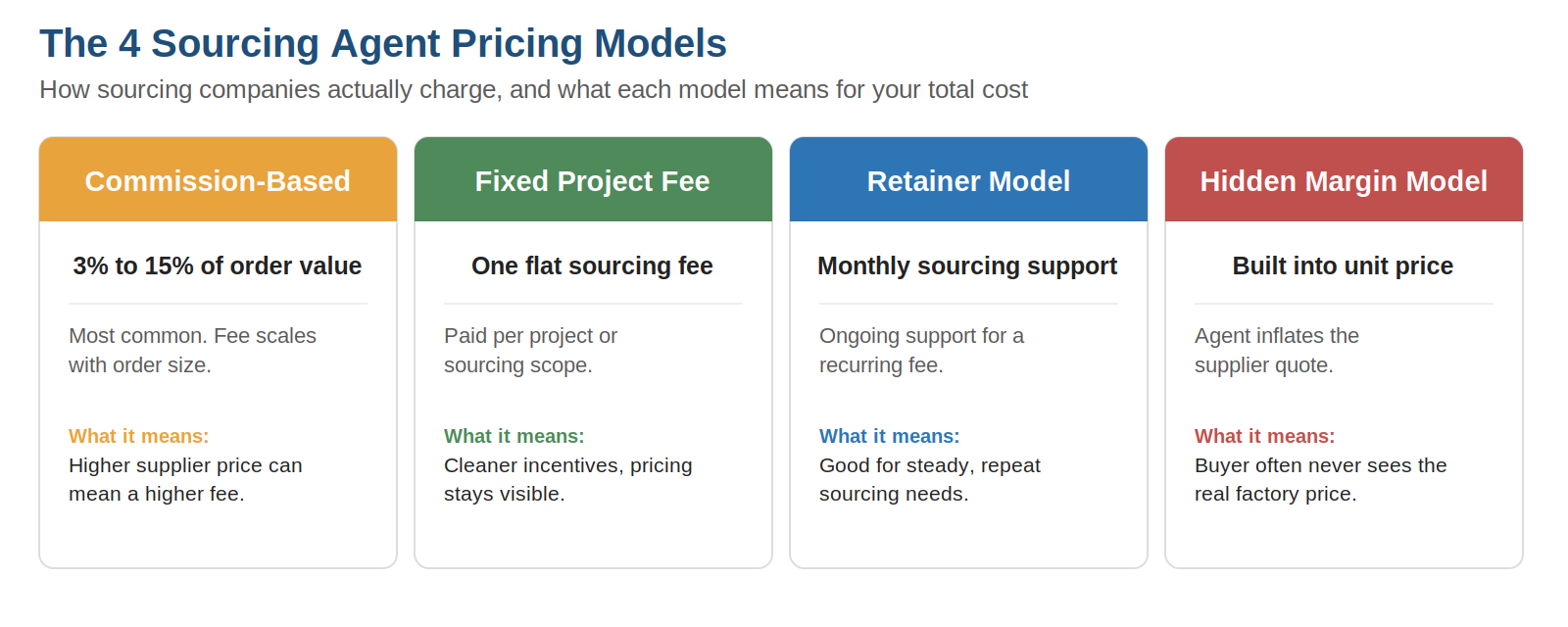
Before you can judge whether a fee is fair, you need to know which model you are being charged under. Most sourcing agents use one of four structures, and each one changes your economics and the incentives behind the advice you receive.The four pricing models most sourcing agents use, and what each one means for your cost.
Pricing Model
How It Works
What It Means for You
Commission-Based
A percentage of the order value, usually 3% to 15%.
Most common. The fee grows with your order, and higher supplier pricing can mean a higher fee.
Fixed Project Fee
A flat sourcing or supplier search fee per project.
Cleaner incentives. Supplier pricing stays visible and easier to analyze.
Retainer Model
A recurring monthly fee for ongoing sourcing support.
Useful for steady, repeat sourcing needs and long-term supplier management.
Hidden Margin Model
The agent inflates the supplier quote and keeps the difference.
You often never see the real factory price. Feels like factory direct, but is not.
1. Commission-Based Sourcing Fees
This is the most common model. The agent charges a percentage of your order value, typically somewhere between 3% and 15%. It is simple to understand and easy to compare, which is why so many buyers default to it.The catch is the incentive. When the fee is a percentage of the order, a higher supplier price can produce a higher commission. That does not mean every commission-based agent inflates pricing, but it does mean the structure can create incentive misalignment around supplier pricing.
2. The Hidden Margin Model
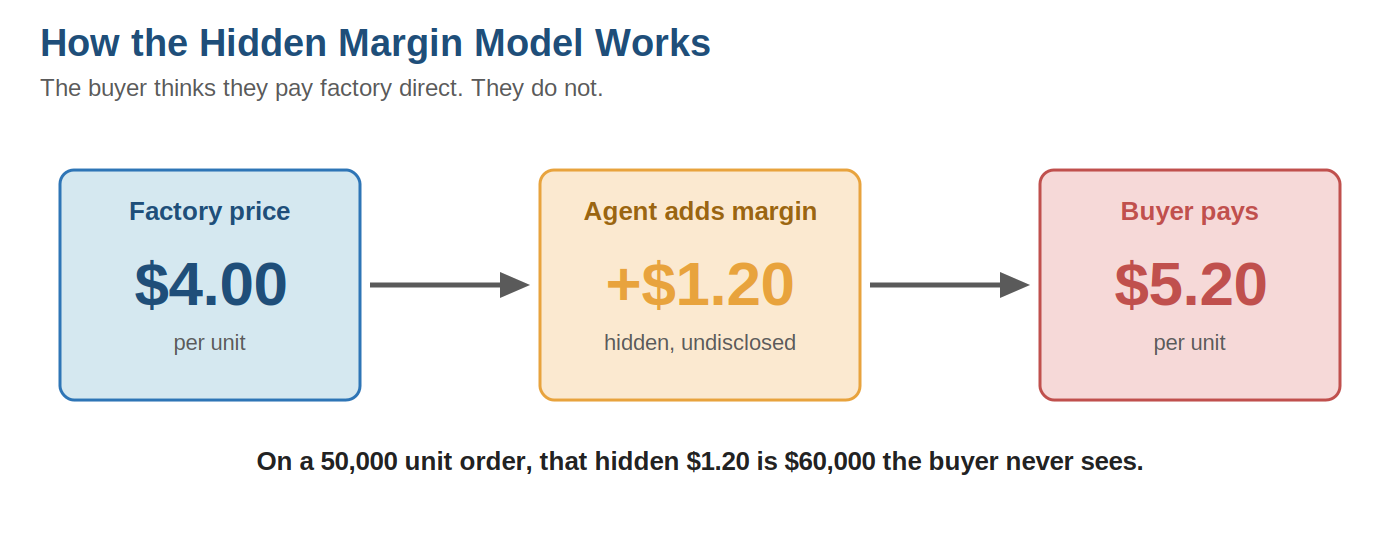
This model exists in many forms, sometimes transparently and sometimes without clear disclosure to the buyer. Instead of charging a visible fee, the agent quotes you a unit price that already includes a markup, then keeps the difference between what the factory charges and what you pay.The hidden margin model: the buyer believes they pay factory direct, but a markup is built into the unit price.The numbers add up fast. If the factory price is $4.00 per unit and the agent quotes you $5.20, that hidden $1.20 looks small until you multiply it by volume. On a 50,000 unit order, it is $60,000 you never see. Many importers believe they are buying at factory-direct pricing when they are not, and they have no way to check because the factory relationship is hidden from them. This is one of the strongest reasons to insist on transparency and direct supplier access.
3. The Fixed-Fee Sourcing Model
With a fixed fee, you pay a set amount for sourcing, supplier search, and project work, separate from the unit price you pay the factory. It tends to be the most transparent of the four models.The advantages are practical:
Cleaner incentives: the agent is paid for the work, not for a higher supplier price.
Visible pricing: you can see what the factory charges and analyze it properly.
Easier comparison: total cost is easier to model when the fee is fixed, and the unit price is open.
4. The Retainer Model
A retainer is a monthly fee for ongoing sourcing support. It suits buyers with steady, repeat needs who want a partner managing suppliers, quality, and reorders over time rather than project by project. The key, as with any model, is that supplier pricing stays visible and the incentives stay aligned with your cost.
Reliable product sourcing starts here
Work with experts who help you evaluate suppliers and reduce risk.
Why Country Choice Affects Cost More Than the Agent Fee
Buyers searching for a sourcing agent in China often assume China is the only option, then negotiate against a single country’s quotes. In reality, the country you source from often has a larger impact on landed cost than small differences in sourcing fees. Labor rates, tariffs, shipping lanes, and product specialization all vary widely between sourcing hubs.A few common comparisons buyers should run:
China: deep supplier base, mature logistics, strong for electronics, hardware, and complex goods.
Vietnam: competitive for apparel, footwear, and furniture, often with favorable trade access for some markets.
India: strong in textiles, leather, and certain metal and chemical categories.
Bangladesh: highly competitive labor cost for garments and basic apparel at volume.
The point is not that one country always wins. It is that comparing suppliers across regions gives you real negotiating leverage. When a factory knows you have credible alternatives in another country, your pricing, MOQ, and payment terms tend to improve. An agent who only ever shows you one country, or one factory, has quietly removed that leverage.
Reliable product sourcing starts here
Work with experts who help you evaluate suppliers and reduce risk.
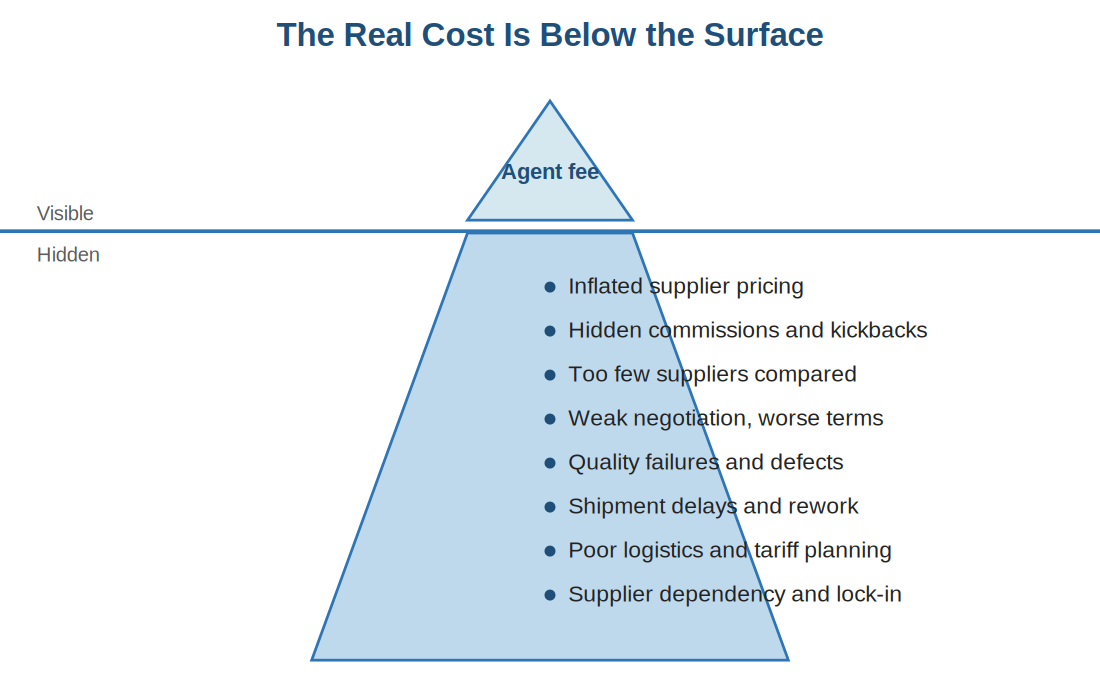
The agent fee is the tip of the iceberg. The costs that decide whether a sourcing project is profitable are mostly hidden from view at the moment you choose a partner.The visible agent fee is small. The hidden costs below it are where projects are won or lost.Here is a scenario that plays out constantly. A buyer chooses a slightly cheaper supplier to save $0.30 per unit. A few weeks later, they are dealing with an 8% defect rate, a delayed shipment, customer complaints, returns, and rework. The $0.30 saving is gone many times over, and the brand damage does not show up on any invoice.The cheapest sourcing agent is often not the cheapest sourcing solution. Bad sourcing creates defective inventory, delays, weak negotiations, logistics inefficiencies, quality problems, and supplier dependency. That is where real costs explode, and none of it is captured by comparing fees.
How Professional Sourcing Actually Works, Step by Step
Understanding the process makes it much easier to judge whether a fee is reasonable. Good sourcing is not just finding a factory. It is a structured process that protects your cost and your quality at every stage.
Define the product and the target cost: agree on specifications, tolerances, packaging, and a realistic landed cost target before contacting anyone.
Broad supplier search: cast a wide net across factories and, where it helps, across countries, rather than settling for the first few quotes.
Shortlist and request quotes: gather comparable quotes from a meaningful number of suppliers so you can see the real market range.
Verify and audit the factory: confirm the supplier is real, capable, and compliant through checks and, where needed, a factory audit.
Negotiate price and terms: use the comparison and any cross-country leverage to negotiate unit price, MOQ, payment terms, and production priority.
Quality control during and after production: inspect goods before they ship, not after they arrive, to catch defects while they can still be fixed.
Optimize logistics, tariffs, and documentation: plan shipping, duties, and paperwork so the final landed cost works in your favor.
Manage reorders and the supplier relationship: keep pricing honest over time and protect against quality drift on repeat orders.
Notice how much of this happens after the supplier is found. The fee buys the whole process, not a single introduction. A partner who skips verification, comparison, or quality control is cheap for a reason.
Reliable product sourcing starts here
Work with experts who help you evaluate suppliers and reduce risk.
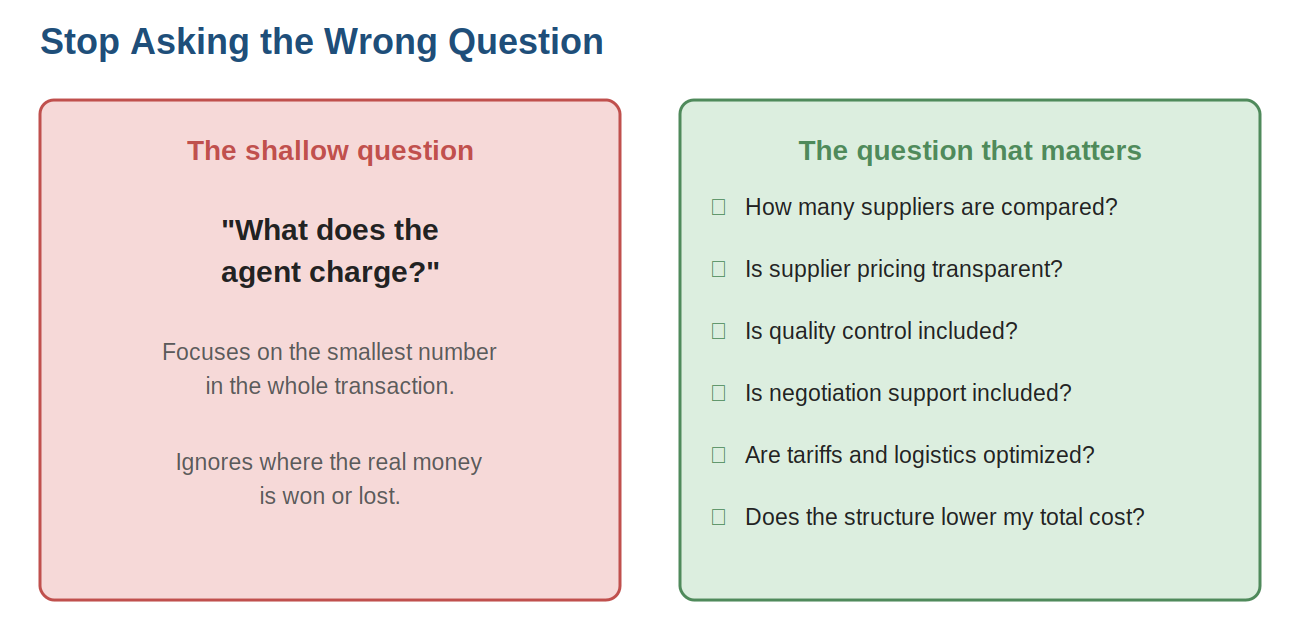
Instead of only asking what the agent charges, ask the questions that reveal whether the structure will lower your total cost.The shallow question focuses on the smallest number in the deal. The better question focuses on your total cost.A serious evaluation looks at all of this:
Supplier comparison: how many suppliers, and how many countries, are actually compared?
Transparency: are supplier relationships and factory pricing openly shared with you?
Quality control: are inspections and a clear QC process included?
Factory audits: is supplier verification part of the process?
Negotiation support: does the partner negotiate on price, MOQ, and terms?
Logistics and tariffs: are shipping, duties, and packaging optimized for landed cost?
The real value of sourcing is not finding a factory. It is reducing your total purchasing cost, improving your supplier leverage, avoiding expensive mistakes, and protecting your margins over the long term.
A Real Example: How Broad Supplier Search Saved an Apparel Brand Roughly $1 Million a Year
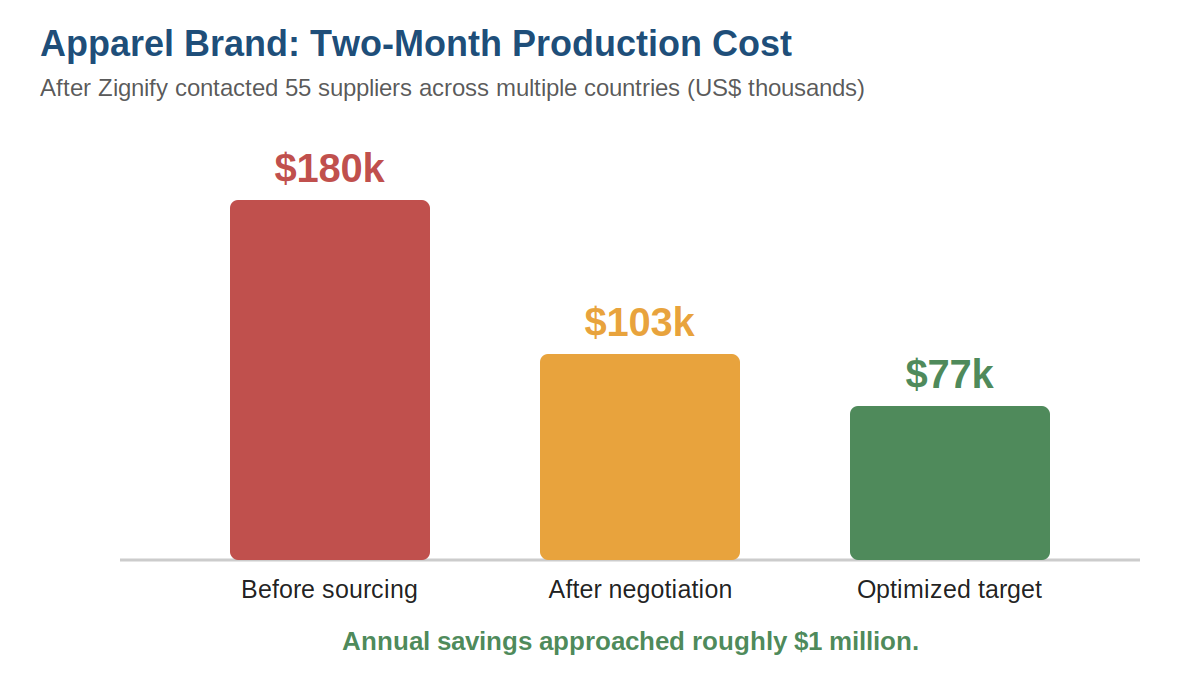
Numbers make the point better than theory. One apparel brand came to Zignify paying far more than it needed to because it had compared only a handful of suppliers.After contacting 55 suppliers across multiple countries, the projected two-month production cost fell from $180k toward $77k.Zignify contacted 55 suppliers across multiple countries. The client’s projected production cost dropped from $180,000 to $103,000 every two months, and eventually moved toward roughly $77,000. Annual savings approached around $1 million.The value here was not a cheap sourcing fee. It was a broader supplier comparison, strategic negotiation, and global sourcing leverage. A narrow search would have left most of that savings on the table, no matter how low the agent’s percentage was. This is the difference between a low fee and a low total cost.
Common Mistakes and Red Flags to Avoid
Most expensive sourcing decisions come from a small set of avoidable mistakes. Knowing them helps you spot a weak partner before you commit an order.
Comparing too few suppliers
The typical importer checks Alibaba, contacts five factories, compares prices, and decides quickly. Professional sourcing compares dozens of factories, looks across countries, analyzes total landed cost, and negotiates strategically. The gap between those two approaches is where most savings live.
Assuming you are paying factory direct
Without transparency and direct supplier access, you cannot verify the real factory price. Foreign buyers in particular are often quoted inflated pricing, higher MOQs, and worse payment terms when they have no leverage and no visibility.
Warning signs of a bad sourcing agent
Watch for these red flags. Any one of them is a reason to slow down and ask questions:
Refuses to disclose factory details or names.
Pushes only one supplier and discourages comparison.
Avoids transparent communication with the factory.
Has an unclear or evasive pricing structure.
Offers a vague quality control process, or none at all.
Provides no inspection support and no factory verification.
Zignify is not a traditional middleman sourcing company. The model is built around the buyer’s side of the table, which changes the economics in your favor.In practice, that means:
Direct factory payment: clients pay factories directly, so there is no hidden layer between you and the supplier.
Transparent supplier pricing: you see what the factory charges, not a marked-up quote.
Open supplier access: suppliers are shared openly, not kept as a black box.
No factory commissions or kickbacks: Zignify does not earn from higher factory pricing, so the incentive is to lower your cost.
Long-term cost optimization: the focus is on reducing total purchasing cost over time, not closing one order.
Alongside supplier search, Zignify supports quality control, compliance, contract support, production management, and logistics optimization, the parts of the process where total cost is really protected. The aim is simple: help you make better sourcing decisions, not sell you a product. You can read more about the full approach on the Zignify blog.For independent context on why supplier verification and trade compliance matter, buyers often reference resources from the International Trade Administration, the World Customs Organization, and quality standards bodies such as ISO.
Reliable product sourcing starts here
Work with experts who help you evaluate suppliers and reduce risk.
Sourcing is getting more complex, not less. Tariffs shift, supplier reliability varies, and the difference between a good and a bad supplier decision compounds over every reorder. The buyers who win are the ones who stop optimizing for the cheapest fee and start optimizing for the lowest total purchasing cost with the least risk.A transparent, buyer-side partner gives you the supplier comparison, negotiation leverage, quality protection, and logistics planning that actually move that number. The fee is small next to what a strong sourcing structure protects.
What Most Guides Get Wrong, Here’s What Our Expert Knows
Most sourcing cost guides stop at listing fee percentages. They miss the structural issues that actually decide whether your sourcing is cheap or expensive. Here is what experience teaches.
A low agent fee can hide a high supplier price.
Buyers fixate on the percentage because it is easy to compare, but the percentage is the smallest lever in the deal. A partner charging a slightly higher fee while comparing dozens of suppliers and negotiating hard will almost always beat a cheap agent working from one quote. Judge the structure by the total cost it produces, not by the line item that is easiest to read. The fee is the part you can see, which is exactly why it distracts you.
Factory direct is a claim, not a guarantee, until you can verify it.
Many importers believe they are buying at factory price when a hidden margin is built into every unit. The only way to know is direct supplier access and open pricing. If you cannot see the factory quote and communicate with the factory, assume there may be a markup you are not being shown. Insist on transparency before the first order, not after a margin problem appears.
Quality control pays for itself by preventing the costs that never appear on an invoice.
Returns, rework, delayed launches, and lost customers do not show up when you compare fees, but they are where sourcing projects bleed money. Inspecting goods before they ship is far cheaper than discovering a defect rate after the container lands. Treat QC as part of the cost of sourcing, not an optional add-on, and the math almost always favors doing it properly.Want to see what your real sourcing cost should be? Book a free sourcing call →
Frequently Asked Questions
How much does a sourcing agent cost?
It depends on the model. Commission-based agents typically charge 3% to 15% of order value, while others use a fixed project fee or a monthly retainer. The more important number is your total purchasing cost, including the supplier price and quality outcomes, not the fee alone.
Is a commission-based sourcing agent a bad idea?
Not necessarily, but the structure can create mixed incentives because a higher supplier price can mean a higher fee. The risk is manageable if pricing is transparent and you can see what the factory actually charges. Ask how supplier selection and negotiation work before you commit.
What is the hidden margin model?
It is when an agent quotes you a unit price that already includes an undisclosed markup, then keeps the difference between the factory price and your price. You feel like you are buying factory direct when you are not. Direct supplier access and open pricing are the only reliable defenses.
Are cheap sourcing agents worth it?
Often not. A cheap agent who compares a few suppliers, skips quality control, and negotiates weakly can cost far more in defects, delays, and inflated supplier pricing than you saved on the fee. Cheap fee and low total cost are not the same thing.
How do I evaluate a sourcing company?
Look past the fee. Ask how many suppliers they compare, whether factory pricing and relationships are transparent, whether quality control and audits are included, and whether they optimize logistics and tariffs. The answers tell you whether the structure lowers your total cost.
Does Zignify take commissions from factories?
No. Clients pay factories directly, supplier pricing is transparent, and Zignify does not take factory commissions or kickbacks. That keeps the incentive aligned with lowering your purchasing cost rather than raising the factory price.