If your business still buys most of its products from a single country, you are carrying more risk than your margins show. Tariffs can move overnight. A port can close. One factory shutdown can stall an entire product line. The China Plus One strategy exists to reduce that exposure, and the smartest buyers are applying it without abandoning the suppliers that helped build their business.This guide explains what the China Plus One strategy really means, why it became a priority for serious importers, and how to apply it step by step without breaking the supply chain you already depend on. We will cover which countries fit which products, where companies go wrong, and what a resilient sourcing setup looks like in practice.
Need help with your product sourcing?
Get practical advice tailored to your product, suppliers, and market form Zignify experts
This is the most important point in the entire conversation, and most companies get it wrong. China Plus One does not mean abandoning China. It means reducing dependency on China without giving up its advantages.That difference matters. Most successful brands still source heavily from China. What they do differently is add secondary supplier countries, spread their risk, and build pricing leverage. The goal is resilience, not exit.
Reduce dependency: lower the share of total volume tied to one country.
Add a second source: qualify suppliers elsewhere so production never sits in one place.
Create leverage: a credible alternative improves your negotiating position on price and terms.
Protect continuity: if one country or factory stops, the others keep your products moving.
Why the China Plus One Strategy Became a Priority
China Plus One did not appear out of nowhere. A series of pressures stacked up over a few years and turned single-country sourcing from a cost advantage into a business liability. The chart below summarizes what changed.The pandemic was the turning point for many companies. It exposed how dangerous it is to have every product tied to one country, one region, or one factory. When that single point of supply went dark, businesses had no backup and no leverage. That lesson has reshaped how many procurement teams approach sourcing strategy.
Reliable product sourcing starts here
Work with experts who help you evaluate suppliers and reduce risk.
It is fashionable to say China is finished as a manufacturing base. That is simply not true, and treating it that way leads to bad decisions. In many categories, no country fully replaces China yet.China still leads in areas that are hard to copy quickly:
Supplier ecosystems: dense clusters where components, tooling, and assembly sit close together.
Manufacturing speed: fast turnaround from sample to mass production.
OEM and engineering support: strong capability for complex and custom products.
Tooling and prototyping: quick, affordable mold and prototype development.
Scalability: the capacity to ramp volume without breaking quality.
This is why the real skill is not finding one country to replace China. It is finding the right product and country combination, then keeping China for what it does best while diversifying the rest.
Reliable product sourcing starts here
Work with experts who help you evaluate suppliers and reduce risk.
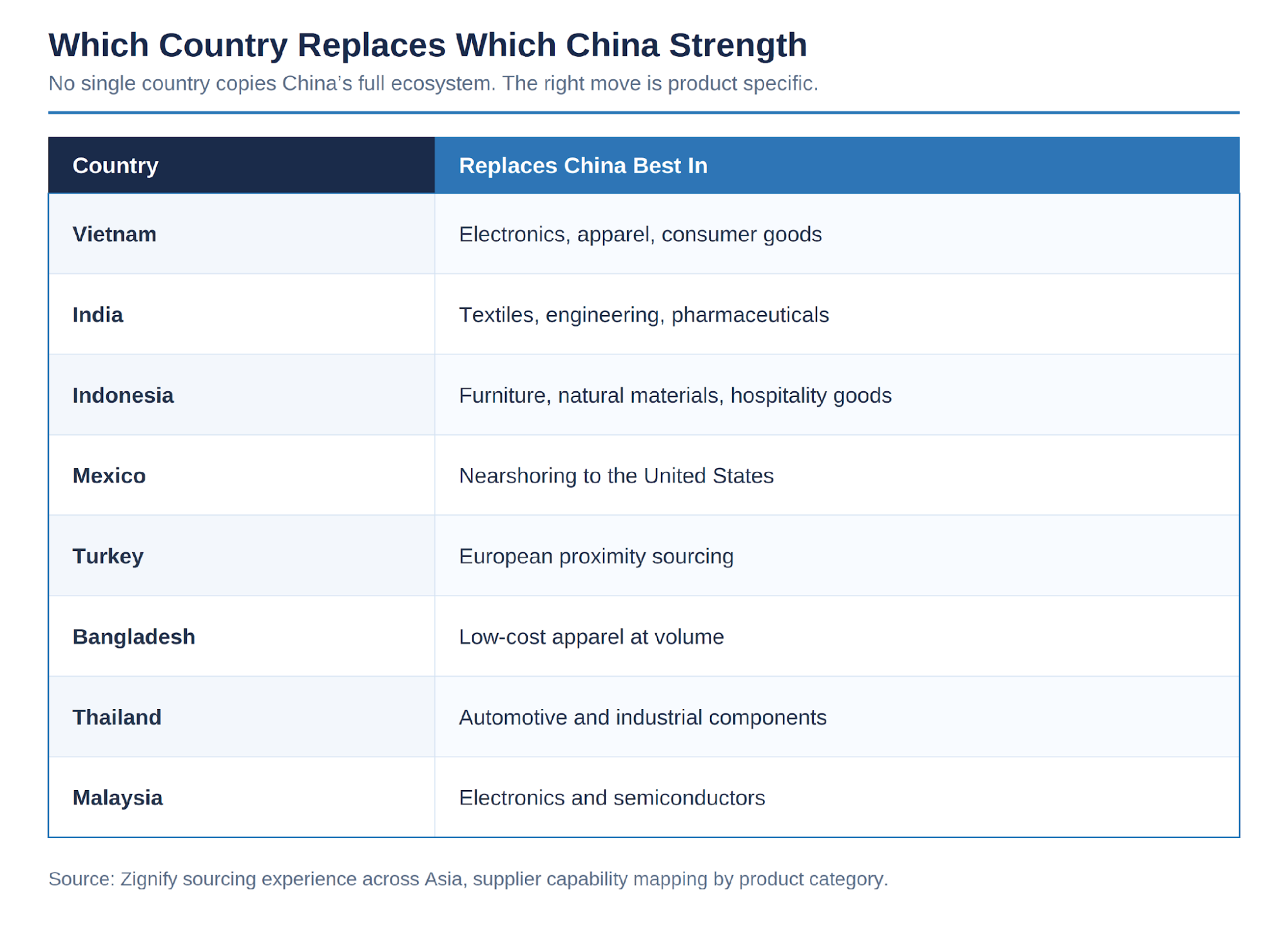
Different countries are good at different things. No single one copies China’s full ecosystem, so diversified sourcing usually means matching each product to the country that handles it best. Use the mapping below as a starting framework, not a fixed rule.Figure 2. Common alternative sourcing countries by product strength.Notice that the answer is always product-specific. Vietnam may be right for electronics and apparel, while India fits textiles and engineering, and Indonesia suits furniture and natural materials. The product decides the country, not a headline about which country is trending.
Reliable product sourcing starts here
Work with experts who help you evaluate suppliers and reduce risk.
Many companies assume that diversifying automatically means cheaper sourcing. It does not always work that way. Sometimes Vietnam is more expensive, Mexican labor costs more, and Indian logistics are more complex.Companies still diversify because the value is broader than the unit price:
Resilience: a second source keeps production running through disruption.
Supply continuity: fewer inventory gaps and missed sales windows.
Tariff exposure: less margin tied to one trade relationship.
Investor and customer confidence: a supply chain that does not depend on a single point of failure.
When you measure China Plus One only on the price of one unit, you miss most of the return. The full picture is total landed cost plus the cost of the disruptions you avoid.
How to Execute China Plus One Without Disrupting Your Supply Chain
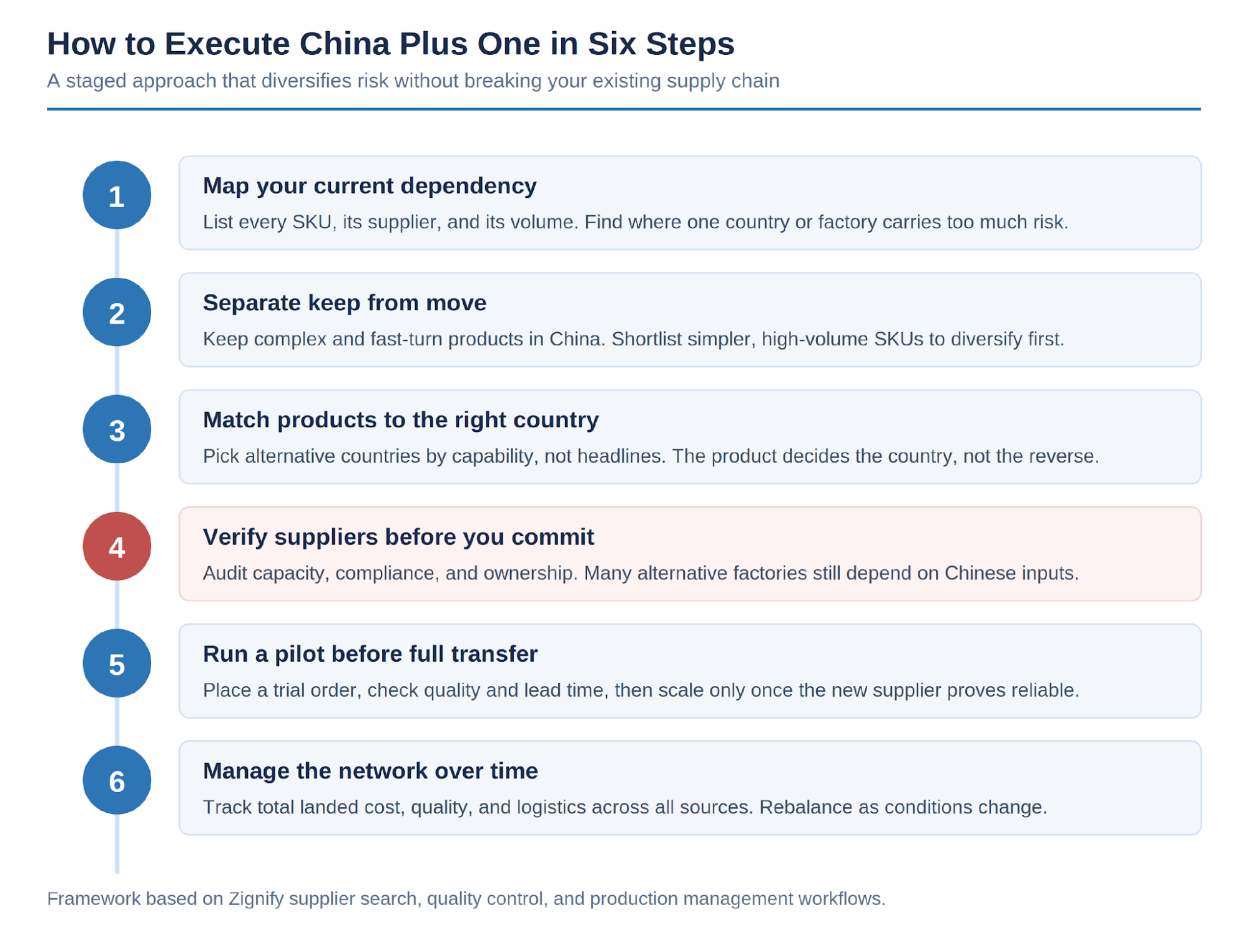
The fear that stops most companies is simple: they worry that moving production will break what already works. Done in stages, it does not have to. The process below diversifies risk while your current supply chain keeps running.Figure 3. A staged China Plus One execution framework.
Step 1: Map your current dependency
Start with facts, not assumptions. List every SKU, its supplier, and its annual volume. Identify where one country or one factory carries a dangerous share of your business. You cannot fix exposure you have not measured.
Step 2: Separate keep from move
Do not move everything. Keep complex, custom, and fast-turn products with the suppliers and manufacturing ecosystems that already support them well, often in China. Shortlist the simpler, high-volume products that are easier to produce elsewhere. These are your first diversification candidates.
Step 3: Match products to the right country
For each candidate, choose an alternative country based on supplier capability, not on tariffs or news cycles alone. This is where the country mapping above turns into a real shortlist of places that can actually meet your product standards.
Step 4: Verify suppliers before you commit
This is where careful buyers separate from hopeful ones. Audit capacity, compliance, and quality systems before placing real volume. Check ownership and upstream dependencies too, because many factories outside China still rely heavily on Chinese inputs, tooling, or management structures.
Step 5: Run a pilot before full transfer
Never switch a product over in one move. Place a trial order, inspect quality, and measure real lead times. Scale only after the new supplier proves it can hold the standard and schedule. The pilot protects your existing supply chain while the new source earns trust.
Step 6: Manage the network over time
Diversification is not a one-time project. Track total landed cost, quality, and logistics performance across all your sources, and rebalance as tariffs, freight, and capacity change. A China Plus One setup is a living system, not a single decision.
Reliable product sourcing starts here
Work with experts who help you evaluate suppliers and reduce risk.
The Hidden Trap: Your New Supplier May Still Depend on China
Here is something that surprises many buyers. A large share of factories marketed as Vietnamese, Indonesian, or otherwise non-Chinese are Chinese-owned, Chinese-managed, or built on Chinese raw materials and components. China still indirectly powers much of Asian manufacturing.This matters because it changes the resilience math. If your alternative supplier sources its inputs from the same region you were trying to diversify away from, you have moved the label, not the risk. Real diversification evaluates the entire upstream supply chain, not just the country where final assembly takes place.
The Biggest Mistakes Companies Make
Most failed diversification efforts share the same root cause: country shopping instead of strategy building. Buyers jump between countries based on headlines, tariff news, or a single low quote, without checking whether the supplier base can actually deliver.
Chasing headlines: moving because a country is trending, not because it fits your product.
Ignoring capability: assuming any factory can make your product to standard.
Skipping verification: committing volume before auditing quality and capacity.
Underrating logistics: forgetting that infrastructure and shipping differ sharply by country.
Treating it as one-and-done: diversifying once, then never managing the network.
These shortcuts create hidden costs, production delays, and inconsistent quality. The result is often worse than the single-country setup the company was trying to improve.
Reliable product sourcing starts here
Work with experts who help you evaluate suppliers and reduce risk.
A Real Example: Beauty Accessories Moved to Vietnam
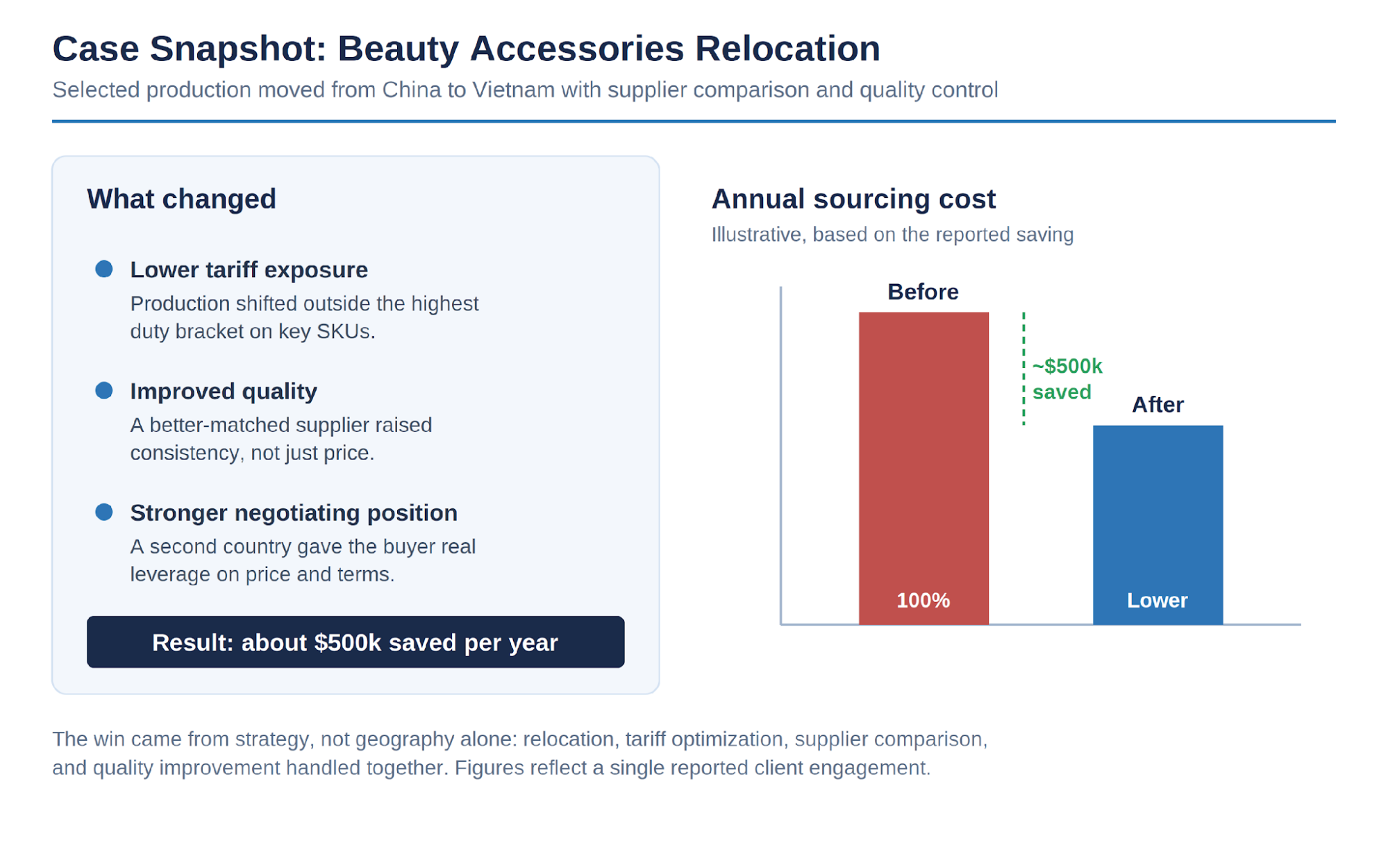
Consider a company that shifted selected production out of China to Vietnam. The headline result was approximately $500,000 in estimated annual savings, but the savings were not simply because Vietnam was cheaper.Figure 4. Outcomes from a strategic relocation, not a price-only move.The real win came from handling several things at once: strategic supplier relocation, tariff optimization, careful supplier comparison, and quality improvement. Lower tariff exposure protected margins, a better-matched supplier raised quality, and a second country gave the buyer genuine negotiating leverage. That combination is what a well-run China Plus One project actually delivers.
China Plus One Is Becoming China Plus Many
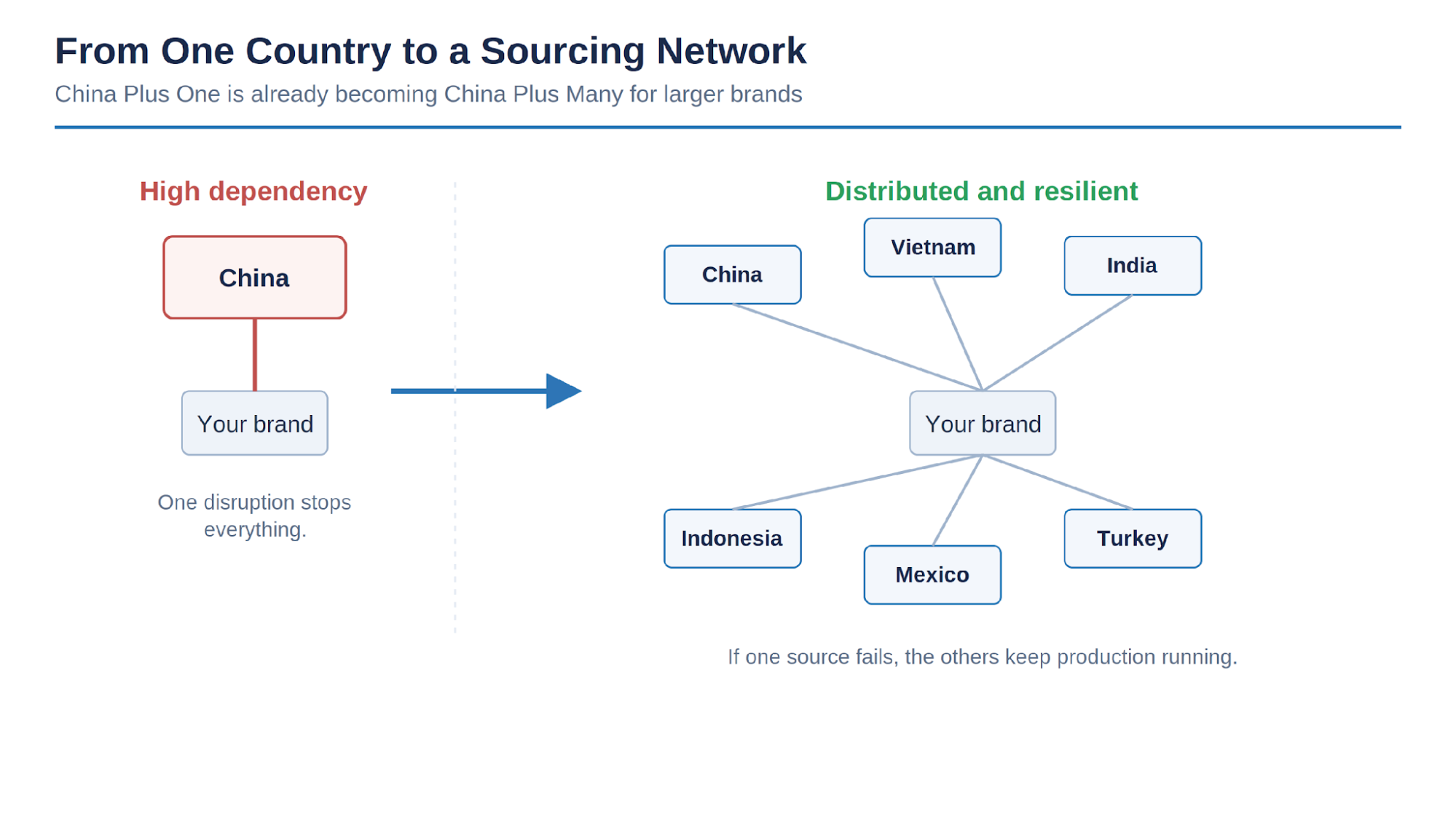
The leading edge of this trend has already moved past a single backup country. Larger brands increasingly source across China, Vietnam, India, Indonesia, Mexico, and Turkey at the same time. Many large sourcing organizations are moving toward distributed manufacturing networks rather than dependency on a single country.Figure 5. The shift from single-country dependency to a resilient sourcing network.You do not need to reach that scale immediately. The point is direction. Each qualified supplier you add in a new country makes your supply chain harder to disrupt and easier to negotiate with. Start with one well-chosen plus, then expand as it proves out.
Best Product Categories for China Plus One
Some categories diversify more easily than others because mature supplier bases already exist outside China. If your products fall into the groups below, you have strong alternatives to work with.
Product Category
Strong Alternatives
Apparel
Vietnam, India, Bangladesh
Furniture
Indonesia, Vietnam
Supplements
India, United States
Electronics
Vietnam, Malaysia
Packaging
India, Vietnam
Hospitality Products
Indonesia
Industrial Components
India, Thailand
How Zignify Supports Your China Plus One Strategy
The hardest part of China Plus One is not the idea. It is execution: comparing countries honestly, finding suppliers who can actually deliver, verifying them before you commit, and managing several sources without losing control of cost or quality. That is the work Zignify is built for.Zignify works on the buyer side, which shapes everything about how we operate:
Broad supplier search: we search widely to find and shortlist suppliers that match your product and country needs.
Country and supplier comparison: we evaluate options on capability, cost, and risk, not just on the lowest quote.
Quality control and compliance: we audit and inspect so problems surface before shipment, not after.
Purchasing cost optimization: we focus on total landed cost, including tariffs and logistics.
Production and logistics support: we help manage production and optimize freight across multiple sources.
Transparency and direct access: you get direct supplier relationships, with no factory commissions and no hidden markups.
The smartest sourcing teams have stopped asking which country is cheapest. They ask a better question: what sourcing structure gives us the best long-term resilience, margins, and scalability? That is the real China Plus One conversation, and it favors companies that plan now rather than react later.Tariffs, freight, and policy will keep shifting. A diversified, well-managed supplier network turns that uncertainty from a threat into something you can absorb. The transition becomes far more manageable when it is staged correctly and supported by experienced sourcing and supply chain teams.
Frequently Asked Questions
What is the China Plus One strategy?
China Plus One is a sourcing approach where a company keeps producing in China but adds at least one additional supplier country to reduce dependency. The goal is to lower risk, protect margins from tariffs, and keep production running if one source is disrupted.
Does China Plus One mean leaving China completely?
No. It means reducing reliance on China, not abandoning it. Most companies keep China for complex, fast-turn, or high-engineering products and diversify simpler, high-volume items to other countries.
Which countries are best for a China Plus One strategy?
It depends on the product. Vietnam suits electronics and apparel, India fits textiles and engineering, Indonesia works for furniture, and Mexico is strong for nearshoring to the United States. The right country is always matched to the specific product.
Is China Plus One always cheaper than sourcing only from China?
Not always. Some alternative countries have higher labor or logistics costs. Companies still diversify because the value is in resilience, continuity, and reduced tariff exposure, measured as total landed cost rather than unit price alone.
How do I move production without disrupting my current supply chain?
Move in stages. Keep your existing suppliers running, shortlist a few products to diversify, verify new suppliers with audits, run a pilot order, and scale only once quality and lead time are proven. Nothing switches over in a single step.
What is the biggest mistake companies make with China Plus One?
Country shopping instead of building a strategy. Jumping to a country based on headlines or one low quote, without checking supplier capability, compliance, and logistics, usually creates hidden costs and quality problems.


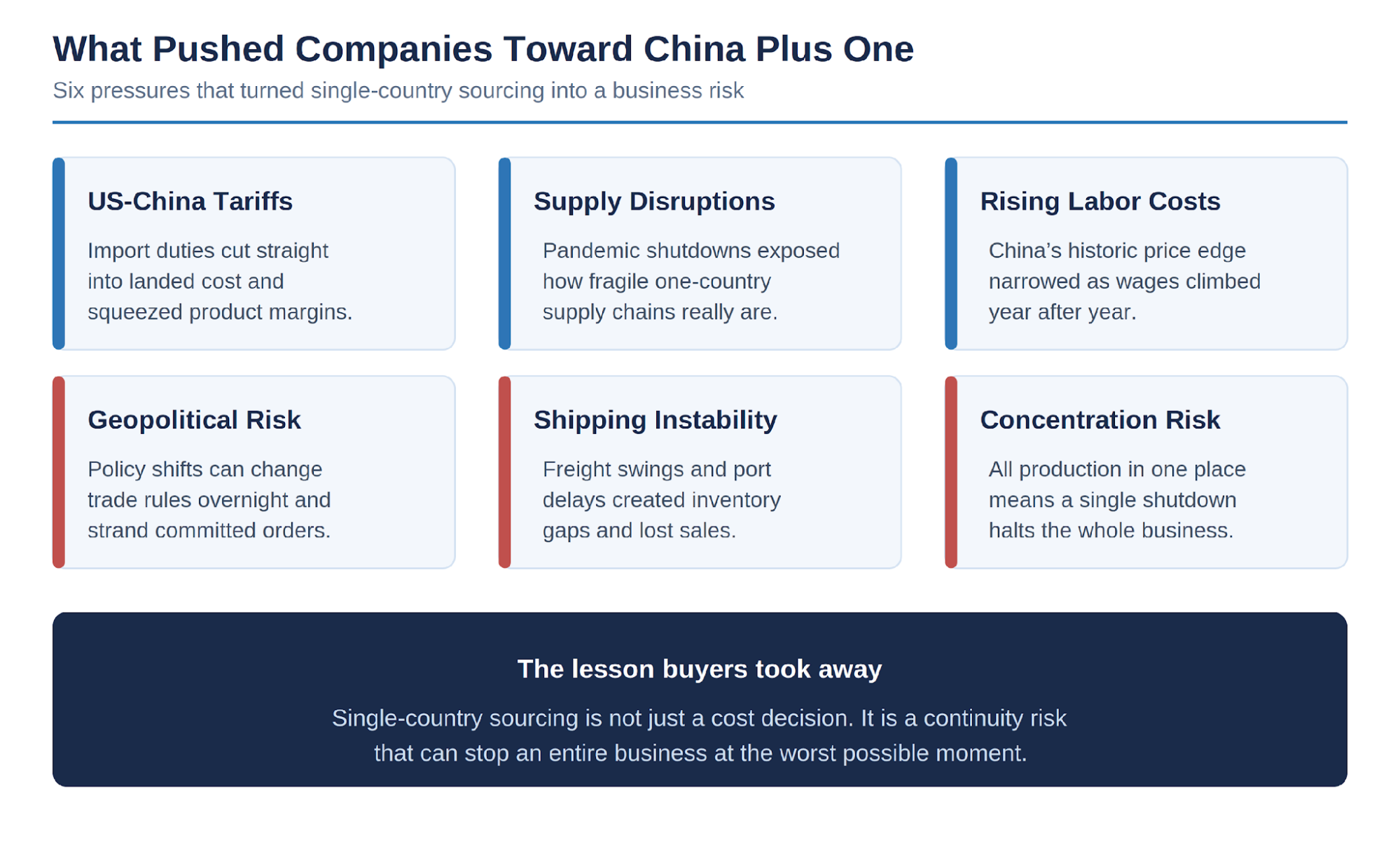 The pandemic was the turning point for many companies. It exposed how dangerous it is to have every product tied to one country, one region, or one factory. When that single point of supply went dark, businesses had no backup and no leverage. That lesson has reshaped how many procurement teams approach sourcing strategy.