

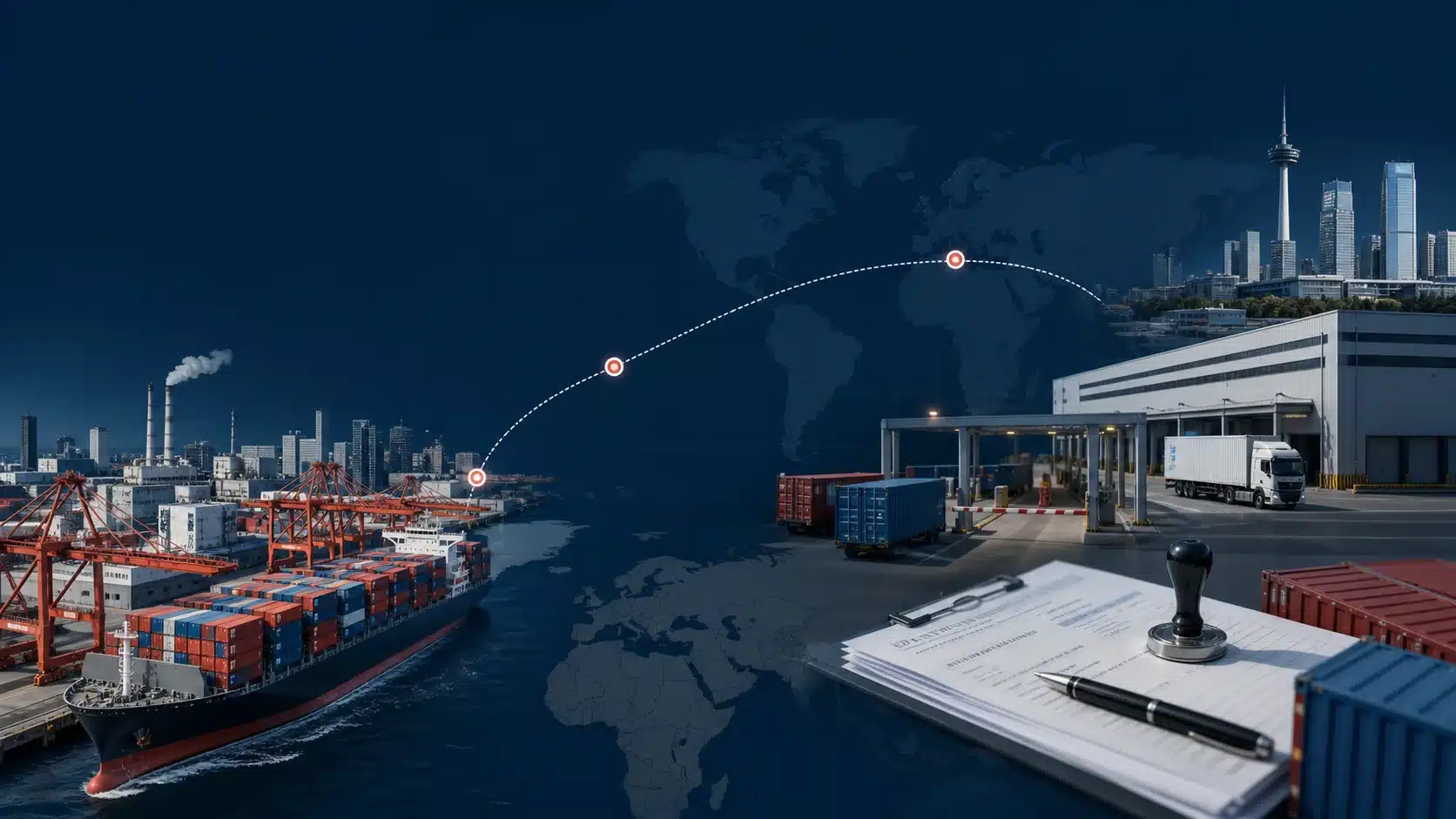
Executive summary: Importing goods from China into Germany is not simply a purchasing and freight exercise. The German or EU buyer must establish the correct importer structure, obtain an EORI number, classify the goods, calculate customs value and import VAT, verify product-specific compliance, prepare traceability and safety information, arrange transport and customs clearance, and meet German packaging and other extended-producer-responsibility obligations before sale. The safest sequence is to resolve customs and compliance requirements before issuing the final purchase order—not after the shipment reaches Europe.
Quick answer: To import commercially from China to Germany, a business normally needs an EORI number, the correct commodity code, a documented customs value, an import declaration, commercial and transport documents, payment of applicable customs duty and import VAT, and evidence that the product meets all relevant EU and German rules. CE marking is required only for product categories covered by legislation that mandates it. Consumer products may also fall under the General Product Safety Regulation, while packaging placed on the German market can trigger LUCID registration and system-participation duties.
Scope: This is a practical B2B planning guide, not legal, tax or customs advice. Product rules, tariff measures and documentation depend on the exact product, origin, transaction and intended use. Verify the current requirements before every commercial shipment.
Use this guide as a working import plan
Do not try to complete every task in one sitting. Bookmark this page, finish one control point, record the result in your import file and return for the next step. The official links below lead to the responsible government or EU source; the Zignify links offer optional execution support for commercial buyers.
If you do not yet have a German business, begin with the German Federal Ministry's official business start-up portal. It explains the principal legal forms and the route to registering a commercial activity with the local Trade Office. This guide assumes that the commercial importer is—or will be—a properly established economic operator. Obtain legal and tax advice for the structure you select.
The China-to-Germany import process at a glance
- Define the product and commercial requirement.
- Determine the importer and economic-operator roles.
- Obtain or validate the EORI number.
- Classify the goods and check TARIC measures.
- Map product compliance, labeling and documentation.
- Qualify and verify the manufacturer.
- Issue a normalized RFQ and compare total landed cost.
- Approve samples, testing and quality criteria.
- Agree the Incoterm, payment and shipping documents.
- Complete export, transport and EU customs clearance.
- Meet German packaging and other market-entry obligations.
- Inspect, release and retain traceability records.
Skipping steps usually does not remove the obligation. It merely moves the discovery to a more expensive point—often after tooling, production or freight has already been paid.

Step 1: Define the product before searching for suppliers
A supplier cannot quote consistently when the buyer has not defined what is being purchased. Start with a complete sourcing brief that covers:
- Product purpose and intended users
- Drawings, dimensions, materials and tolerances
- Required functions and performance tests
- Order quantities and expected annual demand
- Retail and transport packaging
- Destination market and sales channels
- Required language, warnings and labeling
- Target timeline and required delivery location
- Acceptable quality limits and inspection plan
- Target landed cost—not only a target factory price
This document becomes the basis for supplier discovery, quotation comparison, compliance assessment and the eventual purchase agreement.
Step 2: Identify who is legally importing and placing the product on the market
An importer is generally an EU-established person or business that places a product from a non-EU country on the EU market. That role carries obligations beyond paying the shipment.
For consumer products, the importer may need to verify that the manufacturer completed the applicable conformity work, that technical documentation exists, that required markings and traceability information are present, and that instructions and safety information are understandable in the destination market.
If goods are manufactured and sold under the buyer’s own name or trademark, the buyer may assume manufacturer responsibilities under applicable product legislation. Private-label sourcing therefore requires more—not less—control over technical files, test evidence, labeling and change management.
Before placing the order, document:
- Importer of record
- EU manufacturer, importer, authorised representative or other responsible economic operator where required
- Brand owner
- Person responsible for technical documentation
- Customs representative and whether representation is direct or indirect
- Product-safety and recall contacts
Do this now: Write the legal name of the importer of record, registered address, VAT or tax identifiers, responsible person and customs representative into a one-page responsibility matrix. If the business has not been established, use the official German business start-up portal before moving to customs registrations.
Step 3: Obtain an EORI number
The Economic Operators Registration and Identification number is mandatory for EU customs-clearance operations, including import, export and transit. A business should apply early and confirm that the legal name and address used in customs declarations match the registered data.
Do not wait until the container is approaching port. Delays caused by missing master data are avoidable and may produce storage, demurrage or rebooking costs.
Apply or verify: German economic operators can apply through the official German Customs Portal under the EORI service. Read the German Customs EORI application guidance first. An EU-established operator applies in the Member State where it is established; do not apply in Germany merely because the goods will arrive there.
Step 4: Classify the product correctly
Every imported product needs a defensible commodity classification. The code affects:
- Customs-duty rate
- Possible anti-dumping or countervailing measures
- Import restrictions or licences
- Required certificates and controls
- Trade-policy measures
- Customs-declaration data
The EU’s TARIC database consolidates tariff and trade-policy measures and is updated frequently. Classification should be based on the product’s objective characteristics—not on the code a supplier happens to place on an invoice.
Ask for enough technical information to support the decision: material composition, function, construction, power rating, ingredients, processing method, dimensions and photographs. For material or recurring imports, consider obtaining professional customs advice or a binding tariff-information decision.
Check the code and measures: Use the European Commission's live TARIC database and Access2Markets to investigate classification, third-country duty, trade-defence measures, restrictions and product requirements. When classification has material consequences, discuss Binding Tariff Information with a customs specialist rather than relying on an informal supplier code.
Step 5: Calculate customs value, duty and import VAT
The supplier’s unit price is not automatically the customs value or the landed cost.
The transaction-value method is the primary EU customs-valuation method and starts with the total price paid or payable, subject to required additions and deductions. Depending on the transaction, relevant additions can include items such as packing, assists, royalties and transport or insurance to the EU border.
Import VAT uses a broader taxable base. EU guidance explains that it starts with the customs value and can include customs duties, taxes and incidental costs such as packing, transport and insurance to the first destination in the EU when not already included.
A practical landed-cost model
Build the commercial model before selecting a supplier:
Product cost + tooling and engineering allocation + packaging and labeling + testing, certification and inspection + inland transport in China + export handling + international freight and insurance + customs duty and trade measures + broker, terminal and clearance fees + delivery to the German warehouse + financing and working-capital cost + expected defects, rework and warranty + storage and fulfilment = commercial landed cost
Import VAT affects cash flow and tax accounting even where recoverable as input VAT. Confirm the treatment with a qualified tax adviser.
Calculate before ordering: Build a landed-cost worksheet using the intended commodity code, Incoterm, freight, insurance, duty and import-VAT assumptions. Zignify's Logistics Optimization and Import Assistance can help commercial buyers compare logistics options and review the import-cost structure. Confirm the tax treatment with the buyer's tax adviser.
Step 6: Map product compliance before production
“EU compliant” is not a certificate and CE is not a universal import label.
CE marking is not universal. It is mandatory only where harmonised EU legislation specifically requires it. Products outside those categories must not carry CE merely because a supplier believes European buyers expect it.
Where CE legislation applies, the responsible manufacturer must identify the applicable rules, carry out the conformity-assessment procedure, compile technical documentation, issue an EU Declaration of Conformity and affix the marking correctly. Depending on the category, a notified body may be required.
Products can also fall under several regimes at once. Examples include rules covering electrical safety, electromagnetic compatibility, radio equipment, chemicals, batteries, toys, machinery, food contact, cosmetics, medical devices or personal protective equipment.
For consumer non-food products, the General Product Safety Regulation adds horizontal safety, risk-analysis, traceability, incident and recall obligations. Distance-sale offers must show specified manufacturer/responsible-person, product-identification and warning information clearly and visibly.
Create a compliance matrix containing:
- Applicable EU and German legislation
- Economic-operator roles
- Required conformity assessment
- Required standards and test methods
- Technical-file contents
- Declaration or certificate requirements
- Product, packaging and online-listing information
- Instructions and warning languages
- Traceability fields and batch/serial structure
- Record-retention and corrective-action owners
Identify the rules: Start with the EU's official product-requirements finder, general importer obligations and CE-marking guidance. Save the applicable legislation, standards, evidence and owner in the product file. For a commercial project, submit a structured request to Zignify so evidence can be built into supplier qualification rather than requested after production.
Step 7: Verify the manufacturer, not only the salesperson
A polished marketplace page does not prove manufacturing capability.
Supplier verification should consider:
- Legal entity, business scope and ownership
- Factory address and production-line evidence
- Critical machinery and subcontracted processes
- Quality-management system and inspection controls
- Capacity, lead times and peak-season constraints
- Export history for the relevant product and market
- Certificates verified with their issuers
- Test reports matched to the exact product/model
- References, sample quality and communication discipline
- Financial and operational continuity risks
Zignify typically searches beyond the first visible platform results because the best-fit manufacturer may not be the supplier with the strongest English listing or advertising budget.
Need broader supplier coverage? Zignify performs the search, communication, comparison and verification work while the buyer and purchasing team retain the selection decision. Start with a structured commercial sourcing request.
Step 8: Normalize quotations and negotiate the complete commercial package
Require suppliers to quote the same specification and commercial scope, including quantity tiers, packaging, testing requirements, Incoterm and timeline. Separate:
- Product price
- Tooling
- Packaging
- Testing and certification
- Samples
- Export packing
- Logistics
Next action: Select the products with the highest annual spend or greatest import risk, standardize the specification and request comparable quotations. Do not treat three unverified quotes as the market. Record the comparison method and decision in the sourcing file.
- Optional features
Then compare capability and risk alongside price. A quotation that excludes testing, uses a weaker material or assumes a different Incoterm is not a cheaper version of the same offer.
Do not reveal the maximum viable buying price in the first RFQ. Collect evidence first, build a should-cost and landed-cost model, then negotiate from credible alternatives.
Step 9: Approve samples, testing and the quality agreement
A good sample is evidence, not a guarantee of mass-production consistency.
Before approving production:
- Freeze the specification and approved reference sample.
- Complete required testing on the correct construction and materials.
- Define critical, major and minor defects.
- Specify inspection methods and acceptance criteria.
- Control changes to components, suppliers, tooling and processes.
- Define corrective action, rework and replacement responsibilities.
- Link final payment to agreed release evidence where commercially possible.
The purchase agreement should identify the legal supplier, specifications, quality criteria, delivery terms, tooling ownership, confidentiality/IP provisions, delay consequences and dispute framework appropriate to the transaction.
Book an inspection: Review Zignify's mass-production quality-control service and practical quality-inspection guides. Agree inspection criteria before production; an inspector cannot reconstruct an undefined specification at the end.
Step 10: Select the Incoterm and logistics plan deliberately
Incoterms allocate delivery tasks, costs and risks; they do not replace the sales contract or determine product compliance.
The correct choice depends on buyer capability, freight control, supplier location and the desired visibility over origin charges. Obtain comparable freight quotations and clarify:
- Exact named place and Incoterms version
- Export-clearance responsibility
- Origin handling and documentation
- Main transport mode and route
- Cargo insurance
- Destination terminal and clearance charges
- Customs representation
- Final delivery and unloading
- Free-time, demurrage and detention exposure
Treat “DDP Germany” cautiously when the arrangement obscures the importer, declared value, duty payment or compliance responsibility. Cheap door-to-door freight does not justify inaccurate declarations or an unclear legal chain.
Plan the shipment: Compare the actual responsibilities, charges and risks—not only the freight headline. Obtain written confirmation of the customs representative, importer of record, route, insurance and destination charges.
Step 11: Prepare the customs and shipment documents
The exact document set depends on the product and transport mode. A commercial shipment commonly involves:
- Commercial invoice
- Packing list
- Bill of lading, sea waybill or air waybill
- Customs declaration data
- EORI and importer details
- Commodity code and origin information
- Freight and insurance values
- Preference or origin documents where applicable
- Licences, certificates or permits for controlled goods
- Compliance and transport documents required by the product
Check document consistency before departure. Differences in company names, quantities, weights, values, Incoterms or product descriptions create avoidable questions at clearance.
Document checkpoint: Send the draft commercial invoice, packing list, transport data and commodity-code rationale to the appointed customs representative before departure. Resolve inconsistencies before the goods leave the factory.
Step 12: Complete German market-entry obligations
Customs release does not mean the product is ready for sale.
Packaging filled with goods and placed on the German market can trigger obligations under German packaging law. Registration in the LUCID Packaging Register must be completed before relevant packaging is first placed on the market; system-participation and data-reporting obligations may also apply. Importers that initiate the German supply chain can carry producer responsibilities.
Depending on the product, additional German or EU obligations can involve electrical/electronic equipment, batteries, single-use plastics, chemicals, food, cosmetics, textiles or other regulated categories.
Before launch, verify:
- Product and packaging labels
- German-language instructions and warnings where required
- Online-listing safety and traceability information
- LUCID and relevant EPR registrations
- System-participation contracts and reporting
- Responsible economic-operator information
- Complaint, incident, recall and traceability processes
Register or verify: Use the official LUCID registration guidance and public producer register. LUCID registration is free, but registration alone may not satisfy system-participation and data-reporting duties. Check separately whether electrical equipment, batteries, single-use plastics or other categories trigger additional registers.
Common China-to-Germany import mistakes
Ordering before compliance is mapped
Testing the wrong sample or discovering missing documentation after production can require relabeling, retesting, rework or destruction.
Trusting the supplier’s commodity code
The importer remains responsible for accurate declaration data. Supplier codes are inputs, not final decisions.
Comparing FOB with DDP as if they were equivalent
The offers may allocate different costs, taxes, risks and customs responsibilities.
Treating a certificate as product evidence
A certificate can be expired, outside scope, issued to another entity or unrelated to the model being shipped.
Optimizing unit price instead of landed margin
A lower price can create higher freight, defects, inventory, compliance or delay costs.
Letting the supplier control every part of the chain
When the supplier controls freight, declarations, testing and inspection, the buyer may lose independent evidence and negotiation leverage.
China-to-Germany import checklist
Before paying a production deposit, confirm:
- [ ] Importer and economic-operator roles are assigned
- [ ] EORI is active and master data is correct
- [ ] Commodity classification and current TARIC measures are checked
- [ ] Customs-value and import-VAT assumptions are documented
- [ ] Product compliance matrix is approved
- [ ] Manufacturer and critical subcontractors are verified
- [ ] RFQ and quotations use comparable assumptions
- [ ] Samples and required testing are complete
- [ ] Technical documentation, declarations and labels are reviewed
- [ ] Quality agreement and inspection plan are accepted
- [ ] Incoterm, freight, insurance and customs representation are clear
- [ ] Commercial invoice and packing-list fields are agreed
- [ ] LUCID/EPR and German market-entry duties are addressed
- [ ] Product traceability and recall process are operational
Frequently asked questions
Do German companies need an EORI number to import from China?
Economic operators involved in commercial EU customs operations generally need an EORI number. Apply before the shipment and ensure the declaration uses matching legal master data.
How much customs duty applies to goods from China?
There is no single “China import duty.” The rate depends on the commodity classification, origin and current tariff or trade-policy measures. Check TARIC for the exact product and import date.
Is import VAT calculated only on the factory invoice?
No. The import-VAT taxable amount starts from customs value and can include duties and incidental expenses such as packing, transport and insurance according to the applicable rules.
Does every product imported from China need CE marking?
No. CE marking applies only to products covered by EU legislation that specifically requires it. Applying CE to products outside those categories is not appropriate.
Can the Chinese supplier be the importer of record in Germany?
The commercial and customs structure must be reviewed carefully. The EU importer and responsible economic operator must be identifiable and capable of fulfilling the applicable obligations. A vague DDP arrangement should not be allowed to obscure these roles.
What should be checked before paying a deposit?
At minimum: supplier identity, specification, compliance route, quotation scope, samples, testing plan, landed-cost assumptions, Incoterm, quality agreement, documents and German market-entry obligations.
Build the import plan before the purchase order
The strongest China-to-Germany imports are designed backwards from the German market. Customs, compliance, packaging, quality and margin requirements shape the product specification and supplier choice before production begins.
Zignify supports commercial buyers with supplier discovery, verification, quotation benchmarking, compliance coordination, quality control and import execution. The objective is not merely to move a shipment. It is to create a supply chain that can withstand customs review, market-surveillance questions and commercial scaling.
Request a Germany/EU import-readiness review: submit a structured product-sourcing request. Bring the product specification, expected quantity or annual spend, target selling price, destination, current supplier status and required launch date so the discussion can focus on a real commercial decision.
Scope statement: Zignify provides paid professional sourcing and procurement support for commercial buyers. It is not a retailer, does not hold products in stock and does not provide free sourcing for personal or very-small-quantity purchases.
Official sources