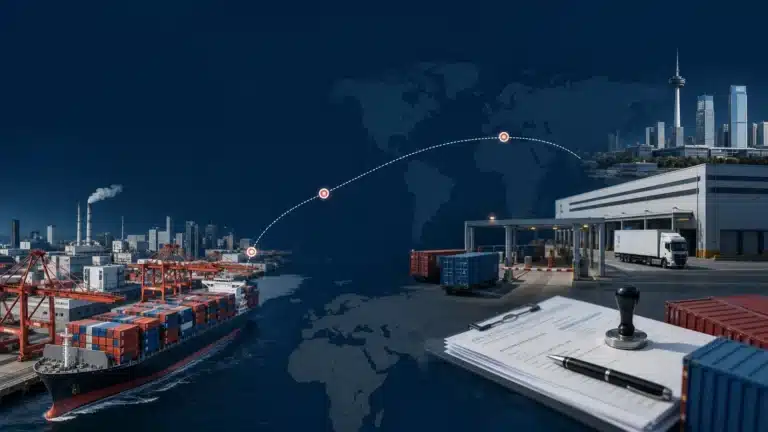


Executive summary: A commercial import from China to the United Kingdom requires the buyer to define the destination—Great Britain or Northern Ireland—identify the importer, obtain the correct EORI number, classify and value the goods, check live tariff and trade-remedy measures, map licences and product-safety obligations, prepare labels and technical evidence, appoint the customs and logistics parties, declare the goods, manage duty and import VAT, and retain the entry records. Resolve these controls before production, because the customs agent does not replace the importer’s responsibility.
Quick answer: To import commercially from China to England, Wales or Scotland, a business normally needs a GB EORI number, a commodity code, customs value, current tariff and trade-remedy checks, product-specific licences or certificates, compliant product markings and labels, a customs declaration, payment or accounting for duty and import VAT, and retained invoices and customs records. Northern Ireland can require different treatment, including an XI EORI in some movements.
Scope: This is a practical B2B guide, not legal, customs or tax advice. The correct process depends on the product, destination within the UK, importer structure, origin and shipment date. Verify current rules before ordering and before shipment.
Use this page as a working import plan
Bookmark the guide, complete one control point and return for the next. Official links lead to GOV.UK and HMRC guidance. Zignify supports established companies and commercial bulk buyers through paid sourcing and procurement projects; it is not a retailer, free product-finding service or source for individual items.
First decide: Great Britain or Northern Ireland?
“Importing into the UK” is not always one operational route. Great Britain means England, Wales and Scotland. Northern Ireland can involve different customs and product-regulatory arrangements depending on the movement and goods.
Write the final destination, importer, sales territory and storage location into the sourcing brief. Then use the official GOV.UK import step-by-step service to follow the route applicable to the actual movement.
The China-to-UK process at a glance
- Define the product and destination.
- Identify the importer and obtain the correct EORI.
- Appoint the customs agent and logistics parties.
- Determine the commodity code.
- Establish the customs value.
- Check live tariffs and trade-remedy measures.
- Identify licences, controls and responsible agencies.
- Map product safety, conformity and labelling.
- Verify the supplier and compliance evidence.
- Normalize quotations and calculate landed cost.
- Approve samples, quality controls and documents.
- Declare, clear, review and retain records.

Step 1: Define the product and commercial requirement
Create one controlled specification containing:
- Intended use and user group
- Drawings, dimensions, materials and composition
- Electrical, radio, chemical, food-contact or safety characteristics
- Order quantity and expected annual volume
- Retail and transport packaging
- Destination and sales channels
- Required instructions, warnings and language
- Testing, documentation and inspection requirements
- Target landed cost and delivery date
Use the same specification for every supplier. Otherwise, the quotation comparison rewards omissions.
Step 2: Identify the importer and EORI number
GOV.UK states that a business importing into England, Wales or Scotland needs an EORI number beginning with GB. Movements involving Northern Ireland may require an XI EORI.
The importer is responsible for accurate declarations and compliance even when an intermediary acts on its behalf. Document the legal name, address, VAT status, EORI, customs representative and responsible compliance contacts.
Do this now: Read the official EORI eligibility and application guidance. Confirm establishment and destination requirements rather than assuming an EU EORI can be reused for Great Britain.
Step 3: Decide who will declare and transport the goods
Most businesses use a customs agent or freight forwarder. Agree in writing:
- Direct or indirect representation
- Classification and valuation responsibilities
- Required declaration instructions
- Duty and VAT payment mechanism
- Evidence and pre-alert deadlines
- Freight, insurance and destination charges
- Escalation for customs queries or examinations
The agent needs accurate product and transaction data. “As per supplier invoice” is not a sufficient internal control.
Step 4: Determine the commodity code
The commodity code drives customs duty, restrictions, licences, VAT information and trade measures. Classify from the product’s objective characteristics, not from a code copied from the supplier.
Gather material composition, function, construction, ingredients, technical diagrams and photographs. Use the UK Online Trade Tariff and retain the dated reasoning. For a material or recurring uncertainty, investigate HMRC’s tariff-classification and advance-ruling routes.
Step 5: Establish the customs value
The customs value helps determine duty and import VAT. It is not always identical to the invoice total. Depending on the transaction and valuation method, adjustments may be needed for freight, insurance, packing, assists, royalties or related-party considerations.
Follow HMRC’s customs valuation guidance and provide the customs agent with the purchase order, invoice, Incoterm, freight and insurance split, tooling or assists, and any relevant royalty or relationship information.
Step 6: Check the live tariff and trade remedies
There is no single China-to-UK duty rate. Treatment depends on the commodity code, origin, current UK Global Tariff, reliefs or suspensions, quotas and possible trade-remedy measures.
Time-sensitive tariff control — last reviewed 1 September 2026: Check the UK Trade Tariff and UK tariff guidance before the commercial decision and again before shipment. The basic tariff lookup does not replace a product-specific check for antidumping, countervailing or safeguard measures.
Step 7: Identify licences and controlled-goods requirements
The GOV.UK import service routes buyers to controls for products such as food, plants, animals, medicines, chemicals, waste, weapons and other regulated categories. One product can involve several authorities.
Map the controls before issuing the purchase order:
- Import licence, notification or certificate
- Border-control post or inspection requirement
- Registration or authorisation of the importer
- Supplier or establishment approval
- Laboratory, sanitary or phytosanitary evidence
- Packaging, transport and storage conditions
Do not ask the supplier only whether the product is “UK compliant.” Give it a defined evidence request.
Step 8: Map product safety, conformity and labelling
Businesses that make, import, distribute or sell consumer products in the UK are responsible for safety and applicable labelling. The importer needs evidence of compliance before the product is placed on the market and remains responsible for corrective action and recall where required.
Depending on the product and destination, controls can include:
- Product-specific safety legislation
- Conformity assessment and technical documentation
- Applicable UKCA, CE or UKNI marking route
- Manufacturer and importer identification
- Product, model, batch or serial traceability
- Warnings and user instructions
- Ongoing incident monitoring and corrective action
Marking arrangements have changed over time and differ by product. Use the current GOV.UK marking and labelling collection and OPSS importer guidance. Do not rely on an old “CE versus UKCA” article.
Step 9: Verify the supplier and evidence
Confirm:
- Chinese legal identity and manufacturing site
- Manufacturer, trader or group-company structure
- Product-specific processes and capacity
- Subcontractors and change controls
- Certificate entity, site, scope and status
- Test-report model, materials and standard version
- Traceability from approved sample to production batch
- UK export history and corrective-action capability
Use Zignify’s factory-or-trading-company verification guide, certificate-verification guide and supplier evaluation scorecard.
Step 10: Calculate the complete landed cost
Compare:
Product cost + tooling and packaging + compliance and inspection + China inland and export charges + freight and insurance + customs duty and trade-remedy exposure + brokerage and destination charges + import VAT cash requirement + defects, contingency and finance = commercial landed cost
Import VAT can be recoverable for an eligible VAT-registered business with the necessary evidence, including the C79 where applicable, but it still affects cash flow. Confirm the structure with a UK tax adviser.
Submit a Qualified Product Sourcing Request
Step 11: Approve samples, quality controls and documents
Connect the approved sample, bill of materials, testing evidence, packaging artwork and inspection standard. Before production, agree:
- Critical-to-quality requirements
- Defect classifications and acceptance criteria
- Inspection stages and sample sizes
- Laboratory or production-test requirements
- Change-notification and approval rules
- Remedies for nonconforming goods
Prepare the commercial invoice, packing list, transport document, origin and valuation evidence, licences, agency documents, test reports and declaration instructions before dispatch.
Step 12: Declare, clear and review the entry
The customs agent submits the declaration using the importer’s instructions. After release, compare the declaration with the approved commodity code, value, origin, duties, VAT and licence data.
GOV.UK requires businesses to retain commercial invoices and customs paperwork, including the C79 import VAT certificate where relevant. Correct overpayments or underpayments promptly through the applicable HMRC process.
Common China-to-UK importing mistakes
- Treating Great Britain and Northern Ireland as one identical route
- Using the wrong EORI type
- Accepting the supplier’s commodity code without review
- Checking trade remedies after production
- Assuming a customs agent assumes all importer responsibility
- Using outdated CE/UKCA statements
- Treating a certificate as product-specific proof
- Ignoring importer identification and traceability
- Comparing FOB prices instead of total landed cost
- Failing to review the filed customs declaration
Frequently asked questions
Do I need a GB EORI to import from China?
A business importing goods into England, Wales or Scotland generally needs an EORI beginning with GB. Northern Ireland movements can require different treatment, including an XI EORI.
How much duty applies to imports from China?
There is no single rate. Check the exact commodity code, origin and live UK tariff and trade-remedy measures.
Can my freight forwarder handle everything?
It can manage logistics and may make declarations, but the importer must still provide correct instructions, exercise due diligence and meet applicable product obligations.
Do all products need UKCA marking?
No. Marking requirements are product- and destination-specific, and current arrangements can recognise different conformity routes. Check the current official guidance for the exact product.
Can Zignify import a single item for a private customer?
No. Zignify is a paid sourcing and procurement service for established businesses, brands and commercial bulk buyers. It does not hold retail stock or offer free individual-product searches.
Final buyer checklist
- Destination and importer structure documented
- Correct GB or XI EORI confirmed
- Customs representative appointed with written instructions
- Commodity code and customs value supported
- Live tariff and trade remedies checked
- Licences and controlled-goods requirements mapped
- Product safety, marking and labelling evidence approved
- Manufacturer and subcontractors verified
- Landed cost and VAT cash flow modelled
- Samples, inspection criteria and documents approved
- Filed declaration reviewed after release
- Records retained and responsible owner assigned