

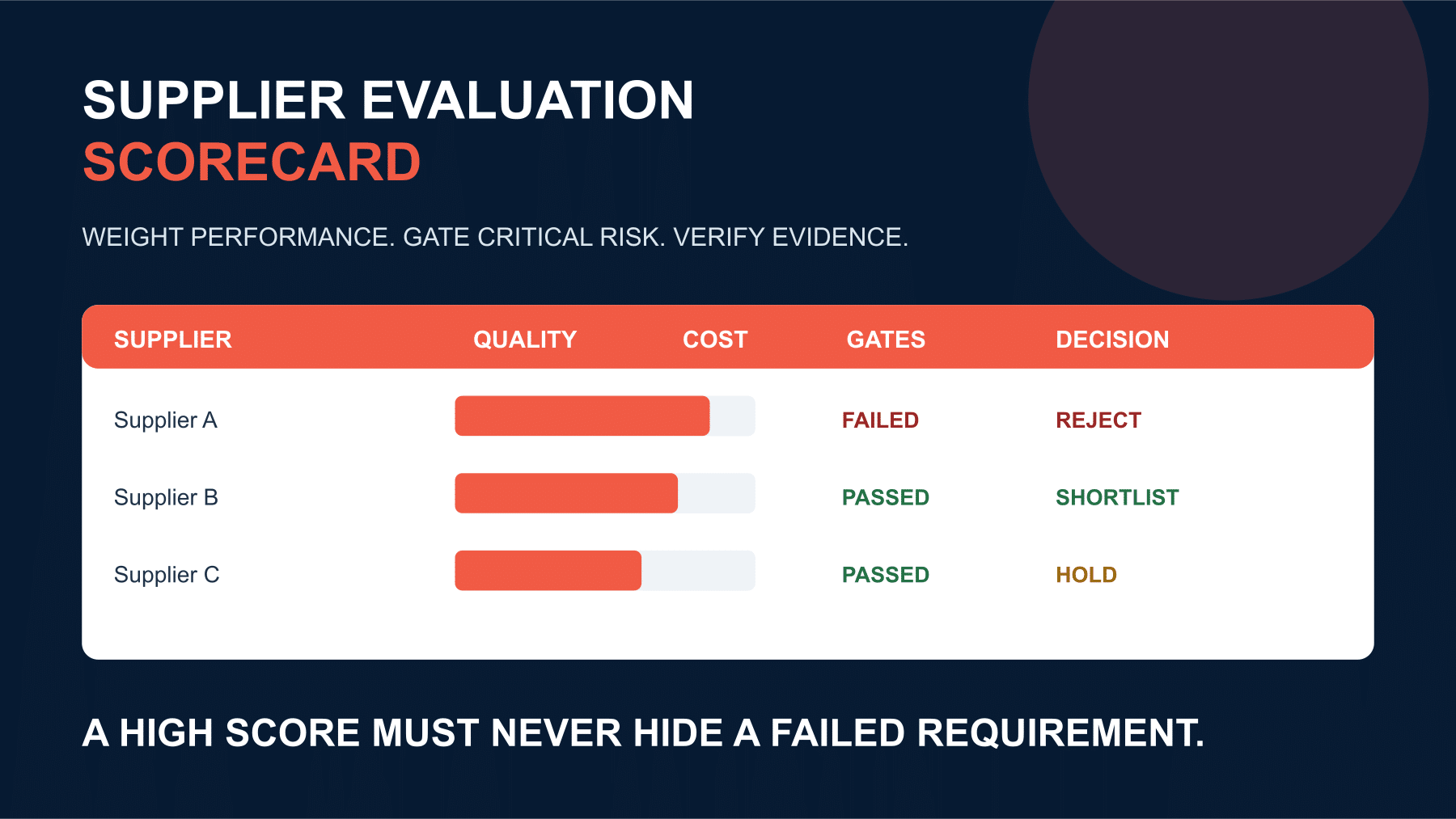
A supplier evaluation scorecard turns a collection of quotations, certificates and sales promises into a traceable purchasing decision. The strongest scorecards do two things at once: they weight the commercial factors that matter and enforce non-negotiable gates for quality, compliance, capacity and legal identity.
That distinction matters. A supplier with an attractive price and polished communication can still be unacceptable if it cannot prove who manufactures the product, meet the destination-market requirements or control critical production changes.
Quick answer: score suppliers only after the specification and quote basis are comparable. Use weighted criteria for trade-offs, mandatory gates for unacceptable risks, and an evidence log so every important score can be challenged and verified.
Why a simple supplier rating is dangerous
Many supplier scorecards create a false sense of precision. Procurement assigns numbers, Excel calculates a total, and the supplier with the highest percentage appears to win.
But a total score can conceal a fatal weakness. Imagine two suppliers:
- Supplier A scores 86/100 but cannot provide valid product-specific compliance evidence.
- Supplier B scores 78/100, meets every mandatory requirement and has a documented quality-control process.
If compliance is treated as just another weighted category, Supplier A may still rank first. That is mathematically tidy and commercially reckless.
The solution is to separate weighted performance from decision gates.
A high total score should never compensate for a failed requirement that could prevent legal sale, cause product failure or make reliable delivery impossible.
What the downloadable scorecard includes
The Zignify supplier evaluation workbook is designed for international commercial buyers. It contains five connected tabs:
- START: project settings, decision thresholds and instructions.
- Criteria & Weights: 12 editable criteria, weights, gates and evidence expectations.
- Supplier Scorecard: up to 20 suppliers with automatic weighted scores and recommendations.
- Evidence Log: document, source, date, reviewer and verification result.
- Decision Summary: shortlist view and a supplier-score comparison chart.
Download the Supplier Evaluation Scorecard

Step 1: Make quotations comparable first
A scorecard cannot repair inconsistent RFQs. If one supplier quoted EXW, another quoted FOB, and a third included packaging and testing, the prices do not represent the same commercial package.
Before scoring, align:
- the controlled product specification and drawing version;
- order quantity and price tiers;
- materials, performance and tolerances;
- packaging and branding requirements;
- required testing and destination market;
- Incoterm and exact named place;
- tooling, samples and other separate charges;
- expected production and delivery timing.
Use the manufacturer RFQ template to collect the same information from every candidate. If the offers are still not comparable, do not disguise the gaps with numbers. Resolve them.
Step 2: Choose criteria that reflect the actual buying risk
The downloadable workbook starts with 12 criteria across quality, compliance, cost, capacity, manufacturing, communication, risk, resilience and strategic fit.
The default weights are a useful starting point—not a universal answer. A regulated electrical product may place far more weight on compliance and technical capability. A simple promotional textile product may put more weight on delivery, workmanship and commercial terms.
Quality and technical capability
Assess whether the supplier can repeatedly manufacture the specified product, not whether it owns a generic quality certificate.
Useful evidence includes:
- samples and product-specific test results;
- process-control plans;
- inspection records;
- equipment and production-route evidence;
- defect handling and corrective-action examples;
- traceability and change-control procedures.
ISO explains that ISO 9001 provides a general quality-management framework, but it does not prescribe exactly how an organization must operate. A certificate can support a review; it does not replace product and process verification.
Compliance readiness
Compliance must be evaluated against the specific product, model, destination market and intended use. Confirm the issuer, scope, dates, referenced standards, model identifiers and whether the evidence applies to the item being purchased.
Never award a strong score simply because the supplier sends a folder named “certificates.” Use the supplier certificate verification guide and record what was actually checked.
Commercial position
Compare normalized total cost, not just quoted unit price. Depending on the project, this can include:
- tooling and development;
- samples and courier charges;
- packaging;
- testing and inspection;
- freight, duty and import taxes;
- defect, rework and replacement exposure;
- payment timing and working capital.
Three inconsistent quotes do not establish a market price. The scorecard works best after a broader, controlled search has produced credible alternatives.
Step 3: Set weights deliberately
Weights express trade-offs. They should total 100% and reflect the project rather than company politics or the latest supplier presentation.
Use three questions:
- What failure would create the greatest customer, legal or financial damage?
- Which differences between suppliers are commercially meaningful?
- Which criteria can the team support with current evidence?
Avoid double counting. For example, if “quality system,” “process control,” “inspection ability” and “defect rate” all measure almost the same capability, giving each a large weight can distort the result.
Step 4: Define mandatory gates
The workbook marks critical criteria as gates. A candidate fails the gate when its score falls below the defined minimum.
Typical gates include:
- verified legal identity and contracting entity;
- product-specific compliance readiness;
- critical manufacturing capability;
- acceptable sample or test performance;
- capacity and lead-time feasibility;
- traceability and controlled production changes.
Gates must be defined before the preferred supplier becomes emotionally obvious. Changing thresholds after seeing the result turns the scorecard into a justification exercise.
Step 5: Score evidence, not confidence
Use a consistent five-point scale:
- 1 — Unacceptable: clear failure or no credible response.
- 2 — Weak: material gaps or unverified claims.
- 3 — Acceptable: minimum requirement supported by reasonable evidence.
- 4 — Strong: documented capability above the minimum.
- 5 — Excellent: convincing, relevant evidence and demonstrably strong execution.
Missing information should not receive a neutral score by default. “Unknown” is itself a risk signal. Record the missing evidence, request it, and score only what the team can defend.
The workbook’s evidence log captures:
- supplier and criterion;
- document or observation;
- issuer or source;
- document and verification dates;
- reviewer;
- result and limitations.
This creates an audit trail when a decision is questioned months later.
Step 6: Keep risk separate from weighted performance
A supplier can perform well today and still present structural risk. The workbook therefore includes a separate risk score.
Consider:
- dependence on one production line or one critical raw material;
- undisclosed subcontracting;
- unstable ownership or legal identity;
- unrealistic capacity claims;
- weak change control;
- poor financial or geopolitical resilience;
- concentration risk in the buyer’s existing supplier base.
ISO 31000 frames risk management as identifying, analyzing, evaluating, treating, monitoring and communicating risk. For supplier selection, that means the scorecard should lead to explicit actions: verify, mitigate, dual-source, hold or reject.
Step 7: Use the result as a decision aid—not an automatic award
The workbook generates four practical outcomes:
- SHORTLIST: threshold met, gates passed and risk acceptable.
- HOLD — score: weighted performance needs improvement or clarification.
- HOLD — risk: performance may be acceptable but the risk needs treatment.
- REJECT — gate failed: a mandatory requirement is not met.
The purchasing team should then document the next action. That might be a factory audit, technical call, sample order, certificate validation, commercial negotiation or removal from consideration.
Common supplier-scorecard mistakes
Scoring before requirements are frozen
If suppliers are solving different problems, the ranking is not meaningful.
Treating every certificate as proof
Check the issuer, validity, scope, legal entity, site, model and applicable standard.
Letting price dominate every category
Low price can be the result of a real process advantage—or missing scope, different quality, incorrect assumptions or unsustainable terms.
Rewarding presentation quality instead of manufacturing capability
A fast English-speaking salesperson is helpful. It is not evidence that the factory can control production.
Hiding uncertainty inside an average
Record missing evidence and unresolved risks explicitly. Do not average them away.
Using one scorecard for every category
Keep the method consistent but adapt the criteria, gates and weights to the product and market.
How Zignify uses supplier evaluation differently
Zignify does not begin with a preferred supplier and build a spreadsheet around it. The team can support established brands and B2B buyers with a wider manufacturer search, controlled RFQs, multilingual follow-up, evidence collection, supplier verification, quotation normalization and negotiation.
The buyer keeps the final decision. The purpose is to create better alternatives and better evidence, not to outsource accountability to a formula.
Zignify is a paid professional service for commercial buyers. It is not a retailer, does not hold products in stock and is not intended for private or very small-quantity purchases.
Download the supplier evaluation scorecard
Download the editable Supplier Evaluation Scorecard and adapt the weights, gates and evidence requirements before scoring candidates.
If you need help finding, verifying and comparing a broader supplier market, submit a qualified product sourcing request.
Frequently asked questions
What is a supplier evaluation scorecard?
It is a structured decision tool that compares suppliers against defined criteria such as quality, cost, compliance, capacity and risk. A professional scorecard also records evidence and applies mandatory gates.
How many supplier criteria should we use?
Use enough criteria to capture the material decision factors without measuring the same capability several times. The downloadable workbook begins with 12 editable criteria.
Should the supplier with the highest score always win?
No. A failed mandatory gate, unacceptable risk or missing critical evidence can override the weighted result.
How should missing supplier information be scored?
Treat missing evidence as an unresolved risk, request clarification and avoid awarding an average score merely to complete the spreadsheet.
Can we change the weights?
Yes. Adjust them before scoring to reflect the product, destination market, category risk and commercial priorities. Keep the total at 100%.
Is ISO 9001 certification enough to approve a supplier?
No. ISO 9001 can support a quality-system assessment, but buyers still need to verify the certificate and evaluate the specific product, process, facility and evidence relevant to the order.