
South Korea is showing up more often in sourcing conversations because buyers are shifting from “cheapest possible” to “best value for the brand.” As competition increases, product quality, finishing, and consistency matter more for reviews, repeat purchases, and return rates.
Compared to ultra low-cost sourcing models that prioritize price above all else, South Korea typically offers stronger quality control, tighter specification adherence, and more premium packaging standards, often at a higher unit cost but with fewer defects and lower return rates. For brands positioning themselves in the mid-to-premium segment, that trade-off can make financial sense over the long term.
What many people overlook is that South Korea is not only about K-beauty and not only for big brands. Beyond cosmetics, Korea is a strong option for product categories where details make or break the customer experience, such as skincare and personal care, beauty packaging, consumer electronics accessories, select textiles, and premium lifestyle goods. If your product needs reliability, clean branding, and export-ready manufacturing standards, sourcing from South Korea can be a better match than most buyers expect.
Read more Comprehensive Guide to Sourcing Products from Japan
Why source a product from South Korea?
South Korea is gaining more attention in product sourcing not only because of cultural influence, but also due to operational strengths. While global interest driven by K-dramas, K-pop, and Korean lifestyle trends increases consumer demand for Korean snacks, skincare, beauty, fashion, and lifestyle products, sourcing decisions are ultimately grounded in business fundamentals.
Buyers are attracted by consistent quality standards, advanced manufacturing capabilities (especially in cosmetics and food processing), strong regulatory compliance, reliable lead times, and suppliers that can execute detailed specifications. Cultural demand may open the door — but operational reliability is what sustains long-term sourcing relationships.
- Premium-grade manufacturing and finishing (materials, tolerances, packaging, design execution)
- Strong R&D and innovation cycles, particularly in skincare/beauty and tech supply chains
- Brand / perceived value in categories where “Made in Korea” matters
- More stable quality consistency, which helps reduce returns and bad reviews
- Korean products often feel more premium because of better finishing and packaging
- Strong OEM and ODM ecosystem, especially for skincare, cosmetics, and personal care
- Structured documentation, batch traceability, and compliance processes Korean suppliers are typically well-organized when it comes to paperwork, certifications, and production records
You’ll still need to manage lead times, MOQs, and compliance, just like any international sourcing project, and in many cases, MOQs can be higher than in some Southeast Asian markets, particularly for custom or OEM production. However, the upside is often a stronger “quality-to-brand-positioning” fit compared to purely cost-driven sourcing regions.

What types of products are best for product sourcing South Korea?
South Korea is a strong sourcing option when you want products that feel premium the moment customers touch them. Buyers are increasingly looking to Korea because many Korean-made items are known for consistent quality, modern design, and export-ready manufacturing, which helps brands sell with more confidence and fewer complaints.
Here are the product categories that are typically the best fit for product sourcing South Korea:
- White-label skincare and cosmetics (OEM/ODM), especially where formula and texture matter
- Personal care and beauty tools such as skincare devices, accessories, and applicators
- Beauty packaging including premium bottles, pumps, tubes, and secondary packaging
- Consumer electronics accessories like chargers, cables, and premium tech add-ons
- Lifestyle and premium home goods where finishing, materials, and presentation drive value
- Select textiles and fashion items that require clean stitching, fabric quality, and branding detail
If your priority is to build a brand around quality, presentation, and consistency, these categories are where sourcing from South Korea usually performs best.
Read more Understanding Total Landed Cost: Definition, Formula, and How to Calculate
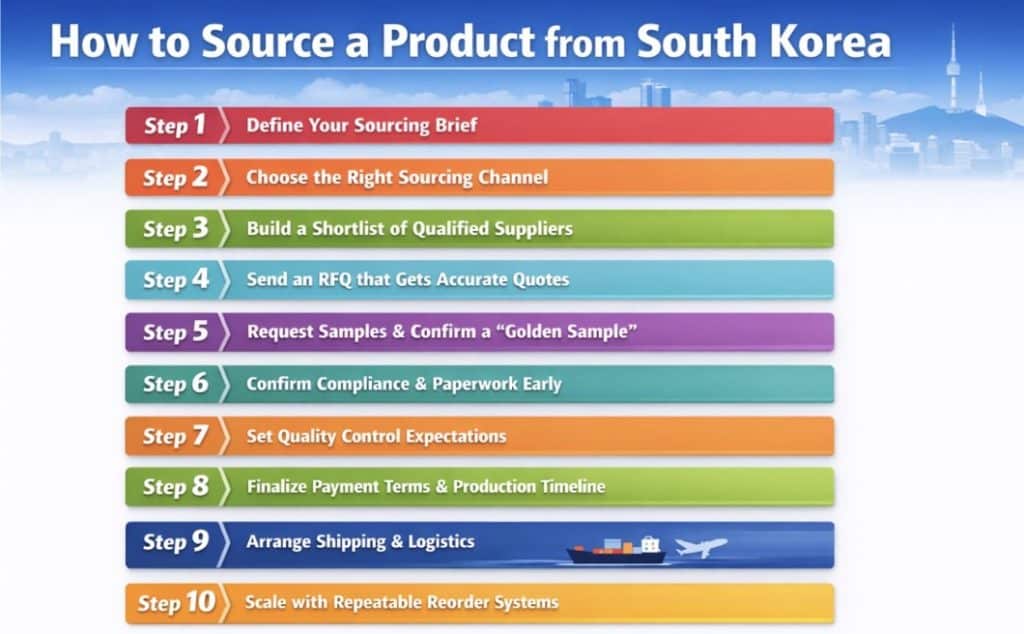
How to Source a Product from South Korea (Step-by-Step)
Step 1: Define your sourcing brief
Clarify your product specs, target price, order volume, packaging needs, and compliance requirements before contacting suppliers.
Step 2: Choose the right sourcing channel
Use B2B platforms, trade shows, official directories, or a sourcing partner depending on your category, budget, and risk tolerance.
For example, trade fairs like Cosmobeauty Seoul and Korea International Beauty Expo are popular for cosmetics and personal care sourcing, while directories supported by KOTRA can help identify verified Korean manufacturers across multiple industries.
Step 3: Build a shortlist of qualified suppliers
Shortlist 5–10 suppliers, then filter based on capability, communication, documentation readiness, and export experience.
Step 4: Send an RFQ that gets accurate quotes
Share clear specs, quantity tiers, packaging details, and requested incoterms (EXW/FOB/CIF/DDP) to compare suppliers properly.
Step 5: Request samples and confirm a “golden sample”
Review reference samples carefully, then approve a final golden sample in writing — this becomes the official benchmark for mass production. Without written approval and clear documentation (spec sheets, tolerances, packaging details), you risk “close enough” interpretations that lead to quality disputes later.
Step 6: Confirm compliance and paperwork early
Align on labeling, testing documents, product certifications (if needed), and import requirements for your destination market.
Step 7: Set quality control expectations
Define defect tolerance, inspection checkpoints (during production and pre-shipment), and what happens if products fail QC.
Step 8: Finalize payment terms and production timeline
Lock deposit/balance terms, production lead time, and delivery milestones so your launch plan stays realistic. In many cases, standard payment terms are 30% deposit and 70% balance before shipment, though highly customized orders may require 50/50 or milestone-based payments. Clarifying this upfront helps avoid cash flow surprises and production delays.
Step 9: Arrange shipping and logistics
Choose air or sea freight based on urgency and cost, confirm carton specifications and labeling requirements, and ensure all shipping documents are accurate before dispatch. Don’t overlook HS codes, even small classification errors can trigger customs delays, additional duties, inspections, or shipment holds that disrupt your timeline and cash flow.
Step 10: Scale with repeatable reorder systems
Track supplier performance, tighten specs over time, and build a reliable reorder rhythm based on sales forecasts.
Common Pitfalls When You Source a Product from South Korea
Sourcing from South Korea can be a strong advantage, but many buyers run into avoidable problems because they apply assumptions from other sourcing markets or move too quickly. Most issues don’t come from bad suppliers, but from unclear expectations, weak preparation, or skipping key validation steps. Here are the most common pitfalls to watch out for:
- Chasing the lowest price instead of aligning with Korea’s strength in quality, consistency, and premium execution
- Skipping proper sampling stages, relying on one sample instead of approving a true golden sample
- Underestimating compliance requirements, especially for cosmetics, electronics, or regulated products
- Not defining QC standards in writing, which makes it hard to enforce quality expectations
- Assuming all suppliers offer the same flexibility, when MOQs and customization limits can vary widely
- Overlooking packaging complexity, which often impacts cost, lead time, and minimum order quantities
Avoiding these mistakes early makes product sourcing in South Korea far smoother and more predictable. With clear specs, realistic expectations, and proper validation, Korea can be one of the most reliable sourcing markets for long-term brand growth.
Want to avoid these sourcing pitfalls? Book a free consultation with Zignify and get expert guidance on sourcing from South Korea
How Zignify Supports Your Product Sourcing from South Korea
Here’s how Zignify can help you source a product from South Korea and beyond with confidence and efficiency. Zignify combines global expertise, a trusted supplier network, and proven systems to give you an end-to-end sourcing solution, from supplier identification all the way through quality control and delivery, so you spend less time fixing problems and more time growing your business
- Zignify Global Product Sourcing: Global Expertise and Trusted Networks: 20+ years of experience and a multilingual team connected with vetted suppliers worldwide.
- End-to-End Integrated Solutions: everything from supplier research and negotiation to product customization, logistics, and compliance under one roof.
- Cost Savings and Price Optimization: competitive pricing through expert negotiation and supplier competition.
- Quality Assurance at Every Stage: rigorous inspection and monitoring to ensure products meet your standards.
- Scalability and Flexibility: support for both small pilot runs and high-volume orders as your business grows.
- Intellectual Property and Trademark Protection: strategies to safeguard your brand internationally.
- Ethical and Sustainable Sourcing: ESG-aligned supplier selection and transparent auditing processes.
- Quality Assurance Where It Matters: On-site factory audits before onboarding, production monitoring during manufacturing, and pre-shipment inspections before goods leave the facility, not just paperwork, but real verification on the ground.
Read more: Which Company is the Best Product Sourcing Company Worldwide?
The Opportunity Ahead: Product Sourcing South Korea
South Korea is creating real sourcing opportunities as global demand for Korean products continues to grow, driven by visibility from K-pop, K-dramas, and Korean lifestyle trends. Many brands are already benefiting from this demand, but many others have not explored Korea yet simply because they are unsure where to start or how to navigate suppliers, quality, and compliance.
With the right expert guidance, product sourcing form South Korea can be a strong competitive advantage, and Zignify can help you identify what to source, how to source it, and how to build a reliable supply chain from the ground up.
Frequently Asked Questions about Sourcing a Product in South Korea
1. Is private label cosmetics still a good business in 2026?
Yes, but only if you treat it as a brand and distribution business, not just a labeling exercise. Many brands fail due to weak differentiation, rising customer acquisition costs, and inconsistent quality. The winners focus on positioning, repeat purchase, and operational discipline.
2. How do I find Korean skincare manufacturers for private labels?
Start with OEM/ODM discovery channels, then narrow down aggressively. Focus on manufacturers that clearly explain their specialization, provide regulatory-ready documentation, and support proper sampling stages. Always compare multiple suppliers based on communication quality and process, not price alone.
3. What’s the difference between white label and OEM/ODM in South Korea?
White label usually means ready-made formulas with minimal customization. OEM/ODM allows deeper customization such as formula tweaks, textures, actives, and packaging. In South Korea, ODM is widely used and often preferred for brands that want differentiation at scale.
4. Do Korean cosmetics require MFDS approval?
Not all cosmetics go through the same regulatory pathway, but functional cosmetics may require evaluation or reporting under MFDS. If your product includes claims related to whitening, anti-wrinkle, UV protection, or treatment-like benefits, compliance should be addressed early.
5. What documents should I request from a Korean cosmetics manufacturer?
At minimum, ask for ingredient lists, product specifications, batch and lot traceability processes, testing documentation, and labeling support. If a supplier cannot provide these clearly, scaling internationally will be difficult.
6. What MOQs should I expect when sourcing private label skincare from Korea?
MOQs vary based on formula type, packaging complexity, and customization level. Stock formulas usually have lower MOQs, while custom ODM projects require higher commitments. Planning repeat orders and simpler packaging can help reduce initial barriers.
7. How long does it take to develop and produce a private label cosmetic in Korea?
Timelines depend on whether you use stock formulas or custom development. Key factors include sampling rounds, packaging approvals, and production queues. Even with white label products, expect multiple weeks rather than instant turnaround.
8. How can I avoid scams or low-quality manufacturers in South Korea?
Verify business registration, avoid relying on a single “perfect” sample, and always approve a golden sample with written QC criteria. Running a pre-shipment inspection on your first order is one of the most effective risk controls.
9. Are large Korean ODMs the only option for sourcing?
No. While large ODMs exist, many mid-sized and niche manufacturers offer more flexibility and attention, especially for early-stage brands. The key is matching your order volume and growth plan to the right supplier size.
10. What products besides cosmetics are good to source from South Korea?
South Korea is strong in personal care tools, beauty packaging, consumer electronics accessories, lifestyle goods, select textiles, and premium home products. These categories benefit from Korea’s strengths in finishing, materials, and export-ready manufacturing.
11. Is South Korea more expensive than China for product sourcing?
Unit prices can be higher, but total cost of ownership is often competitive due to better consistency, lower defect rates, and stronger quality control. For premium or brand-sensitive products, Korea can offer better long-term value. Read more Top 25 China Wholesale Websites Offering Better Prices and Quality
12. Can South Korean suppliers support international shipping and exports?
Yes. Many Korean manufacturers are experienced exporters and familiar with international documentation, labeling requirements, and logistics coordination. This makes Korea a good option for brands selling across multiple markets.
13. What are common mistakes when sourcing products from South Korea?
Common mistakes include chasing the lowest price, skipping proper sampling stages, underestimating compliance, and failing to define QC standards in writing. These issues often lead to delays, disputes, and rework.
14. Do I need a sourcing agent to source products from South Korea?
It’s not mandatory, but working with an experienced sourcing partner can significantly reduce risk, especially if you are new to Korea, dealing with regulated products, or managing multiple suppliers. The right guidance helps you move faster and avoid costly mistakes.