

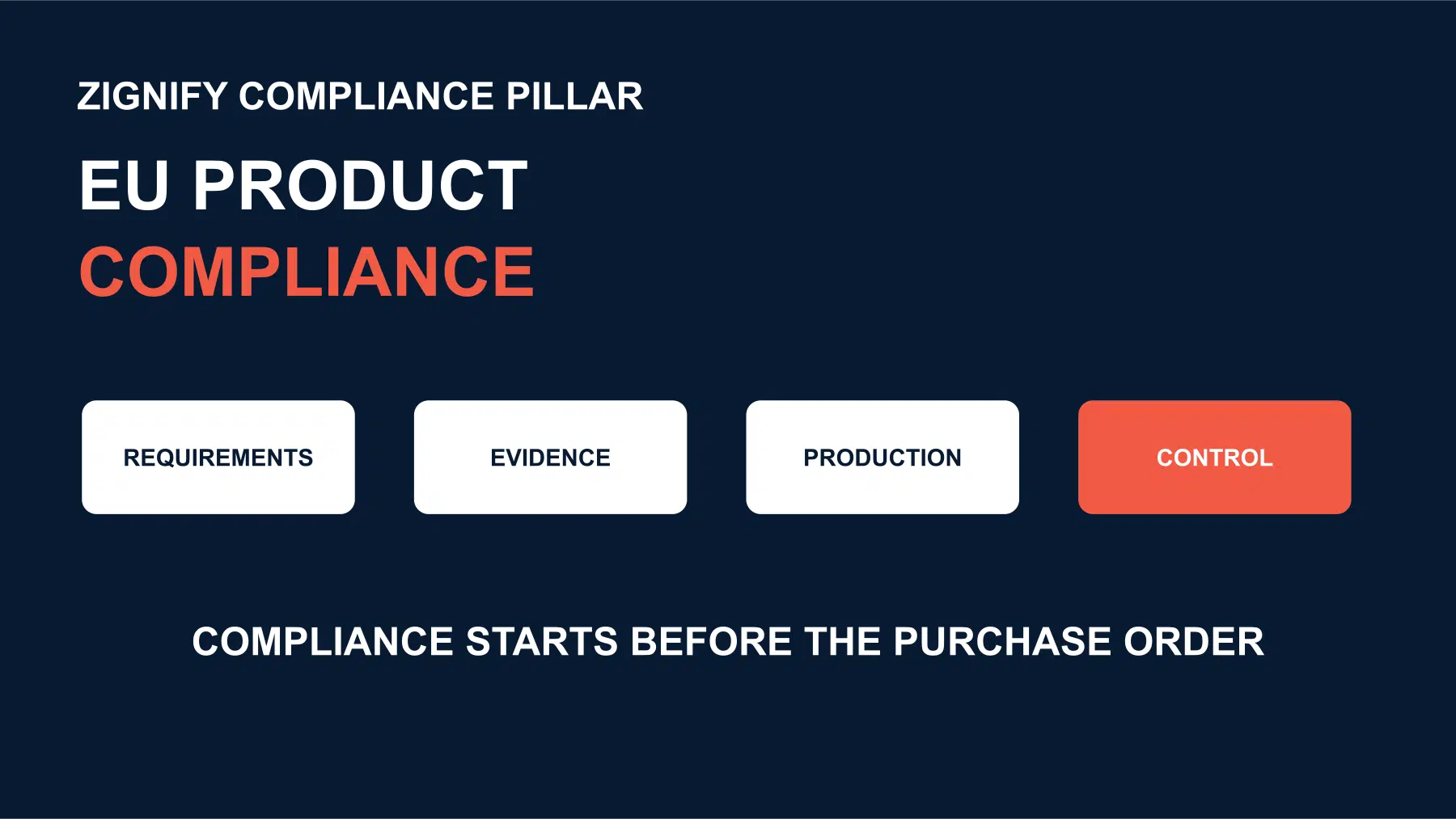
Executive summary: An EU importer must determine the rules applicable to the exact product, confirm the economic-operator roles, verify that the manufacturer completed the required conformity assessment and technical documentation, check labels, markings, traceability, instructions and safety information, preserve access to evidence, control production changes and take corrective action when a product is unsafe or noncompliant. CE marking is required only for products covered by legislation that mandates it; it is not an EU approval or a substitute for the technical file.
Quick answer: Before placing a non-EU product on the EU market, identify every applicable EU and national rule, determine whether the buyer is importer or manufacturer, verify the conformity-assessment route, obtain the technical documentation and declaration, confirm the correct product and economic-operator identification, approve warnings and instructions in the required languages, verify production matches the evidence, and establish traceability, incident, withdrawal and recall controls.
Scope: This is a commercial planning guide, not legal or regulatory advice. Product requirements vary by category, intended use, users, technology, chemicals, destination country and sales channel. Obtain competent product-specific advice before market placement.
Compliance begins before the supplier quotation
Many buyers request “CE certification” after selecting a factory. That reverses the correct sequence.
First determine:
- What the product is legally—not only commercially
- Who will use it and under what foreseeable conditions
- Which EU and national rules apply
- Which conformity-assessment route applies
- What evidence must exist before production approval
- Which labels, instructions and online information are required
Only then can the RFQ ask every supplier for comparable evidence and cost.
Step 1: Determine your legal role
An EU-established business that places a product from a non-EU country on the EU market is generally an importer. An importer must ensure the manufacturer fulfilled the applicable obligations.
If a business has a product designed or manufactured and sells it under its own name or trademark, it can be treated as the manufacturer. Private label therefore does not reduce responsibility; it can increase it.
Other roles can include authorised representative, distributor, fulfilment-service provider, online marketplace and the responsible person required under applicable rules. Document the legal entity performing each role before contracting.

Step 2: Identify every applicable requirement
Do not start with the question “Does it need CE?” Start with a product-requirements map.
Review:
- Product category and intended use
- Consumer, professional, child or vulnerable-user exposure
- Electrical, radio, machinery or pressure functions
- Chemical composition and restricted substances
- Food-contact, cosmetic, medical or protective claims
- Batteries, packaging, waste and environmental obligations
- Energy, labelling and ecodesign rules
- Destination-country language and registration duties
- Distance-sales and marketplace information
Use the European Commission’s product rules and compliance portal and product-specific legislation. One product can fall under several legal acts.
Step 3: Decide whether CE marking applies
CE marking is compulsory only for products covered by EU legislation that requires it. It is forbidden to affix CE marking to products outside that scope.
CE marking means the manufacturer declares conformity with the applicable CE-marking requirements. It does not mean:
- The EU approved the product
- Every product category is covered
- The product’s country of origin is Europe
- A certificate image replaces conformity assessment
- One component’s CE marking covers the complete finished product
Use the official CE marking guidance and identify all applicable legislation before selecting standards or laboratories.
Step 4: Choose the correct conformity-assessment route
The required route depends on the legislation and product. Some products allow manufacturer self-assessment; others require an EU notified body for defined tasks.
Confirm:
- Applicable modules or assessment procedure
- Whether a notified body is mandatory
- Exact notified-body scope
- Required testing, production-control and audit steps
- Applicable harmonised standards and versions
- Evidence needed for variants, components and software
Only notified bodies designated under EU law can perform notified-body work within their notified scope. A generic “compliance certificate” from a laboratory does not change the legal route.
Harmonised standards are generally voluntary, but when correctly applied they can provide a presumption of conformity for the requirements they cover. Alternative technical solutions require stronger documented justification.
Step 5: Build the technical documentation
Technical documentation must demonstrate how the product complies. Official EU guidance says it should be prepared before market placement and normally retained for ten years unless product legislation specifies otherwise.
A useful technical file can include:
- Product description and intended use
- Type, model and variant structure
- Design drawings and specifications
- Bill of materials and critical components
- Manufacturing sites and processes
- Applicable legislation and requirement matrix
- Risk assessment
- Standards and technical solutions used
- Calculations, test reports and certificates
- Notified-body documents where applicable
- Labels, packaging, instructions and warnings
- Quality, traceability and production-control evidence
- EU declaration of conformity where required
- Change history and approval records
No technical file, no controlled product. A folder containing unrelated PDFs is not a compliance system.
Step 6: Verify the EU declaration of conformity
Where required, the EU declaration of conformity is signed only after the applicable assessment and technical documentation are complete. The manufacturer takes responsibility for the product’s conformity.
Check:
- Manufacturer’s correct legal identity
- Unique product, model and type references
- Applicable EU legislation
- Standards or specifications used
- Notified-body details where relevant
- Name, title, signature and date
- Consistency with labels, reports and the technical file
For a private-label finished product, component declarations do not replace a declaration covering the complete product.
Step 7: Approve labels, traceability and instructions
Before production, approve controlled artwork and location rules for:
- Manufacturer identification and contact details
- Importer identification and contact details
- Responsible-person information where applicable
- Type, batch, model or serial identifier
- CE or other mandatory markings where applicable
- Ratings, ingredients, warnings or disposal symbols
- Country-specific language requirements
- Instructions and safety information
The importer’s name, registered trade name or trademark and contact address must be presented as required by the applicable rules. Under the General Product Safety Regulation, consumer-product information can also include postal and electronic addresses and visible information for distance sales.
Step 8: Apply the GPSR where relevant
Regulation (EU) 2023/988, the General Product Safety Regulation, applies from 13 December 2024 and provides the general safety framework for consumer products within its scope, including distance sales.
Key operational controls include:
- Risk assessment and safe-product requirement
- Product identification
- Manufacturer and importer contact information
- EU responsible-person information when required
- Clear instructions and safety information
- Information displayed in online product offers
- Traceability and complaint/incident controls
- Cooperation with market-surveillance authorities
- Corrective action, withdrawal and recall
Use the official GPSR text and the European Commission’s Safety Gate business resources. Product-specific harmonisation legislation can impose additional or more specific obligations.
Step 9: Verify the supplier and production match the evidence
The technical file is valid only for the product and production it describes. Verify:
- Manufacturer legal entity and production site
- Exact model and variant tested
- Bill of materials and critical-component match
- Tooling and process controls
- Test-report applicant, sample and photographs
- Certificate entity, site, scope and status
- Subcontractors and outsourced processes
- Production inspection and batch traceability
- Change-notification and revalidation rules
Use Zignify’s factory-or-trading-company guide and certificate-verification guide.
Step 10: Control changes after approval
Compliance can be lost when a factory substitutes a material, battery, radio module, adhesive, coating, power supply, component supplier, software version or production site.
The purchase contract and quality agreement should define:
- Changes requiring prior written approval
- Evidence required before approval
- Retesting or risk-assessment triggers
- Golden-sample and bill-of-material control
- Batch and supplier traceability
- Consequences of undisclosed changes
Production inspections should verify controlled characteristics—not only colour and appearance.
Submit a Qualified Product Sourcing Request
Step 11: Prepare market-surveillance and incident response
Before launch, assign owners for:
- Technical-document retrieval
- Authority communications
- Complaints and incident assessment
- Safety Gate notification where required
- Distributor and customer traceability
- Stop-sale, withdrawal and recall decisions
- Corrective-action verification
- Insurance and legal escalation
An importer that cannot retrieve the technical documentation promptly does not have an operational compliance system.
Step 12: Keep the compliance file current
Review the file when:
- Legislation or standards change
- A supplier, site, material or component changes
- A new country or sales channel is added
- Complaints reveal a new foreseeable use or hazard
- The product design or software changes
- A certificate or report expires or is withdrawn
Record the decision, evidence and approver. “No change required” should still be a documented conclusion.
Common importer compliance mistakes
- Asking for “CE certification” without mapping legislation
- Believing CE marking is an EU product approval
- Using component evidence for the finished product
- Accepting reports for a different model or material
- Omitting importer and responsible-person information
- Treating translated instructions as an end-of-project task
- Ignoring online-offer information under GPSR
- Allowing substitutions without revalidation
- Assuming an inspection replaces regulatory testing
- Storing documents without a retrieval and recall process
Frequently asked questions
Does every imported product need CE marking?
No. CE marking applies only to products covered by legislation requiring it, and it must not be affixed outside that scope.
Is a CE certificate sufficient?
No. The required evidence depends on the legal route. Compliance normally involves applicable legislation, assessment, technical documentation, declaration, marking, labels and production control.
Who is responsible for a private-label product?
A business that has a product made and places it on the market under its own name or trademark can assume manufacturer responsibilities.
How long should technical documentation be retained?
Official EU guidance states that ten years is common, unless the applicable product legislation specifies another period.
Can Zignify certify a product?
No. Zignify can help structure sourcing, supplier evidence, testing coordination and quality controls, but legal decisions and conformity-assessment activities remain with the responsible economic operators and competent bodies.
Final pre-order checklist
- Exact product, use, users and markets defined
- Importer/manufacturer/responsible-person roles documented
- Applicable EU and national rules mapped
- CE applicability and assessment route confirmed
- Harmonised standards and versions identified
- Technical-file structure agreed
- Testing and notified-body requirements budgeted
- Declaration, labels, instructions and online information designed
- Supplier, site, materials and reports matched
- Change-control and batch-traceability rules contracted
- Incident, withdrawal and recall owners assigned
- Evidence-retention and review dates recorded