

Executive summary: Product cost is the amount charged for the goods under the agreed commercial term. Landed cost is the broader economic cost of making sellable units available at the buyer’s destination. It can include tooling, testing, freight, insurance, customs duty, trade remedies, brokerage, delivery, financing, defects and other costs. Import VAT often affects cash requirement but may be recoverable, so it should be shown separately rather than silently mixed into margin.
Quick answer: Compare suppliers using cost per sellable unit, not the headline factory price. First normalize specification, quantity, Incoterm and named place. Then add pre-shipment costs, logistics, customs value and duty, destination charges, compliance, quality, expected defects and working-capital cost. Show recoverable import VAT as cash flow and non-recoverable VAT as economic cost.

A cheaper factory quote can produce a higher-cost product
Supplier A quotes €8.40 per unit. Supplier B quotes €9.10. The spreadsheet highlights Supplier A in green.
But Supplier A requires new tooling, uses inefficient export cartons, has a higher defect rate, demands an earlier deposit and quoted EXW from an inland factory. Supplier B quoted FOB at a convenient port, included compliant packaging and has better process control.
The €0.70 unit-price advantage may disappear before the goods reach the warehouse. If only sellable units generate revenue, it may reverse entirely.
That is the difference between buying price and business cost.
Product cost, import cash and landed cost are different numbers
Product cost
Product cost is the amount charged for the goods on the agreed quotation basis. It may include or exclude packaging, tooling, inland transport, export clearance and other items depending on the Incoterm and supplier assumptions.
Import cash requirement
Import cash requirement is the money that must be funded through production and import. It can include deposits, balance payments, freight, duty, import VAT and destination charges.
Economic landed cost
Economic landed cost is the cost attributable to making sellable units available at the chosen destination. Recoverable import VAT is normally excluded from economic cost but still matters for cash flow. Non-recoverable tax belongs in economic cost.
Keeping these views separate prevents finance, procurement and commercial teams from debating numbers that answer different questions.
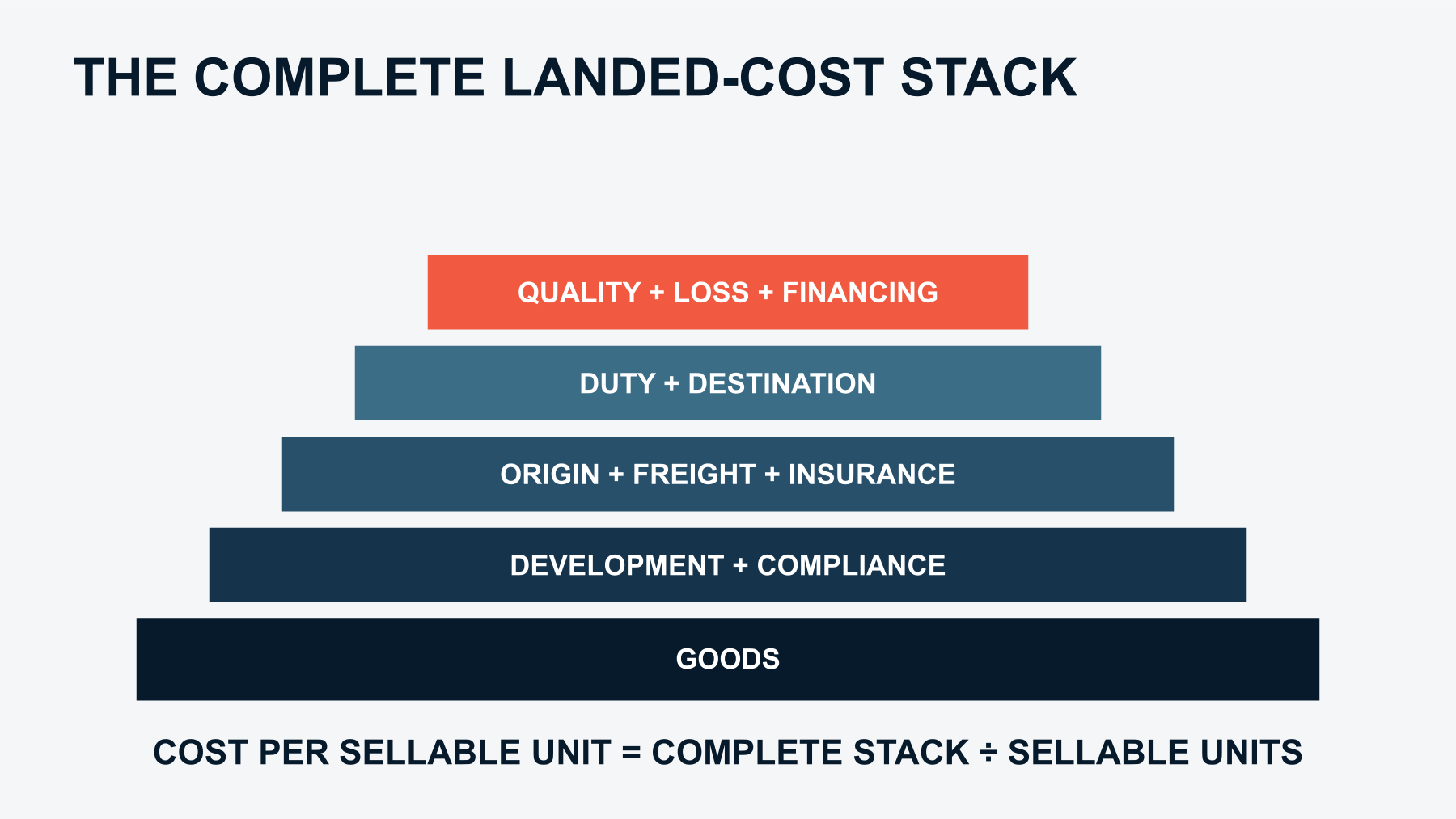
The complete landed-cost formula
A practical model is:
Economic landed cost = goods + development + compliance + origin logistics + international freight + insurance + duty and trade measures + destination charges + quality and loss + financing + overhead directly attributable to the shipment − recoverable credits
Then:
Cost per sellable unit = economic landed cost ÷ expected sellable units
Expected sellable units—not ordered units—is the denominator that exposes the cost of defects, damage and unusable inventory.
1. Normalize the quotation basis
Before adding costs, make the supplier offers comparable. Align:
- exact product specification and material grade;
- packaging and labeling;
- order quantity and volume tiers;
- included tooling, samples and development;
- test and documentation requirements;
- Incoterm and exact named place;
- currency, validity and payment schedule;
- production and delivery timing.
“FOB China” is not a complete term. The port matters. “DDP Germany” is not automatically transparent if the importer of record, customs value, duty and VAT treatment are unclear.
2. Add tooling and development costs
Tooling, moulds, dies, print plates, engineering, samples and pilot production can materially change the first-order economics.
Decide whether to:
- charge the full amount to the first order;
- amortize it across a defensible volume;
- separate reusable assets from order-specific expense;
- assign ownership, storage, maintenance and replacement responsibility.
Do not amortize across optimistic lifetime volume simply to make the project appear profitable.
3. Add compliance, testing and documentation
Depending on the product and destination, costs may include laboratory testing, technical documentation, conformity work, label review, registrations, inspection certificates and specialist advice.
Supplier claims are not a substitute for evidence. If a low quote excludes required testing or uses an irrelevant report, it is not a comparable compliant offer.
4. Calculate origin logistics
The commercial term determines where cost and risk transfer, but the model must capture the entire route. Origin costs can include:
- factory pickup;
- consolidation;
- export packing;
- inland haulage;
- terminal and handling charges;
- export clearance and documents;
- storage or demurrage caused by readiness problems.
An inland supplier can be competitive on factory price and expensive at port.
5. Estimate freight and insurance realistically
Use chargeable weight or container utilization, not only product weight. Capture:
- base freight;
- peak-season and fuel surcharges;
- insurance;
- security and documentation fees;
- route-specific handling;
- expected price volatility or a contingency.
Packaging design affects freight. A slightly higher unit price with better cube efficiency can reduce delivered cost.
6. Establish customs value, classification and duty
Customs duty cannot be calculated reliably without the correct commodity code, origin, customs value and import date.
For EU imports, the European Commission explains that customs valuation normally begins with transaction value, subject to required additions and deductions. TARIC and Access2Markets help identify tariff and trade-policy measures. National VAT rates are not included in TARIC.
Check:
- commodity classification;
- non-preferential and preferential origin;
- customs value additions such as assists or certain royalties;
- duty rate;
- anti-dumping, countervailing or safeguard measures;
- quotas, licences and restrictions.
Never copy the duty rate from a different product or an old shipment.
7. Separate import VAT from margin
In the EU, the import VAT taxable amount can include customs value, duties, taxes and relevant incidental expenses. Treatment depends on the transaction and Member State.
Show import VAT in two ways:
- Cash view: when and how much must be funded?
- Economic view: is it recoverable, partly recoverable or non-recoverable?
Calling recoverable VAT a permanent product cost understates margin; ignoring its financing requirement understates cash need.
8. Add destination and delivery charges
Include costs between arrival and the selected landed-cost point:
- customs broker;
- port, terminal or airport fees;
- examination and storage risk;
- container or pallet handling;
- last-mile delivery;
- unloading and receiving;
- warehouse intake and relabeling.
Define the endpoint. “Landed port,” “delivered warehouse” and “available for sale” are not the same cost boundary.
9. Model quality, defects and loss
A quality risk allowance should be evidence-based rather than a generic percentage. Consider:
- historical defect and return rates;
- inspection failure and rework;
- damage in transport;
- missing or unusable units;
- warranty, complaint and replacement cost;
- delay or stockout exposure.
If 1,000 units cost €18,000 to land but only 960 are sellable, the denominator is 960. The apparent €18 cost becomes €18.75 before considering rework or customer returns.
10. Add working-capital and currency effects
Two suppliers with the same delivered price can create different cash burdens.
Model:
- deposit timing;
- days until shipment and arrival;
- balance-payment timing;
- inventory holding period;
- borrowing or opportunity cost;
- currency conversion and hedging;
- payment fees.
Long lead times and aggressive deposits can consume more cash than a modest unit-price difference.
11. Allocate overhead carefully
Include costs directly attributable to the sourcing option: engineering work, travel, audits, inspections, project management, special warehousing or vendor onboarding.
Avoid loading arbitrary corporate overhead into one supplier comparison. The purpose is decision clarity, not accounting theatre.
A worked illustrative example
Assume a shipment of 1,000 units with:
- goods and packaging: €14,000;
- tooling allocation: €600;
- testing and inspection: €750;
- origin, freight and insurance: €2,200;
- customs duty and destination charges: €1,459.41;
- expected defect and financing allowance: €1,000;
- expected sellable units: 970.
Illustrative pre-VAT landed cost is €20,009.41, or €20.63 per sellable unit. If the import-VAT cash requirement brings total cash to €23,257.13, cash per sellable unit is €23.98—but recoverable VAT should not automatically be treated as permanent margin cost.
These figures reconcile to the included Zignify China-to-EU landed-cost workbook and are examples, not quotations. Replace every input with live product, tariff, tax, logistics and quality data.
How to compare supplier scenarios
Build one row or scenario for each supplier and test:
- base case;
- higher freight;
- lower sellable yield;
- delayed shipment;
- alternative Incoterm;
- different order volume;
- changed duty or trade measure;
- improved payment terms.
The best supplier is not always the lowest base-case result. Decision-makers should see sensitivity, evidence quality and operational risk.
Common landed-cost mistakes
- Comparing EXW with FOB or DDP without normalization.
- Dividing by ordered units rather than sellable units.
- Ignoring tooling, testing and inspection.
- Using an outdated duty rate.
- Treating all import VAT as either permanent cost or irrelevant.
- Omitting trade remedies and origin rules.
- Accepting unexplained DDP pricing.
- Ignoring payment timing and currency.
- Modeling freight from weight but not volume.
- Hiding assumptions instead of documenting them.
Frequently asked questions
Is landed cost the same as cost of goods sold?
Not necessarily. Landed cost is a decision model up to a defined location or state. Accounting treatment for inventory and cost of goods sold follows the company’s policies and applicable standards.
Should import VAT be included?
Show it in cash requirements. Include it in economic cost only to the extent it is non-recoverable or otherwise a real cost, subject to qualified tax advice.
Which Incoterm gives the lowest landed cost?
No Incoterm is universally cheapest. The right answer depends on supplier capability, freight buying power, importer responsibilities, visibility and risk.
How accurate should the model be before an RFQ?
Use estimates to screen options, then replace them with confirmed quotations and live official tariff/tax inputs before committing.
Can Zignify calculate customs duty or provide tax advice?
Zignify can support the sourcing comparison and organize inputs. Final customs classification, tax and regulatory determinations should be confirmed with the relevant authorities and qualified advisers.
Make the commercial decision on the complete number
Unit price is a visible number. Landed cost is a management system.
When buyers normalize offers, calculate cost per sellable unit and expose cash, risk and assumptions, supplier negotiations become more credible. They can improve packaging, payment terms, quality controls, Incoterms and specifications—not merely demand an arbitrary discount.
Last fact review: September 1, 2026. Refresh tariff, VAT, freight, currency and regulatory inputs before use or publication.